

Using Open Account Terms When Buying From Bangladesh: Bank Rules and Tips
Open account when buying from Bangladesh: the seller ships and sends documents direct, and the buyer pays later. How it works, what it costs, the Bangladesh Bank insurance-backed route, and the checks to make before signing.
Short answer
Open account is a sale on credit: the seller ships the goods and sends the documents directly to the buyer, who pays on a future date, typically in 30, 60 or 90 days. No bank holds the documents and no bank promises to pay, so the seller carries payment risk until the money arrives. It suits parties with a track record, used with a risk control such as credit insurance, factoring, a standby letter, or a staged term.
On this page
Key takeaways
Open account is a sale on credit: goods and documents go directly to the buyer, who pays on an agreed future date, with no bank holding the documents and no bank promise to pay.
It is the highest buyer-trust, highest seller-risk end of the payment-terms scale: unlike D/P, payment does not come first, and unlike D/A, no signed time draft stands behind the due date.
Risk controls must be agreed before shipment: credit insurance, factoring, a standby letter of credit, a staged term, or a combination, each with its cost and payer confirmed.
In Bangladesh, confirm the AD bank route and any insurance or undertaking before signing: since October 2025, Bangladesh Bank has permitted banks to arrange local-insurer payment undertakings or risk coverage for open account exports.
Open account is the payment term at the far end of the trust scale. The seller ships the goods and sends the documents straight to the buyer, and the buyer pays later, on the date agreed. No bank holds the documents until payment, and no bank promises to pay. The buyer gains cash-flow room. The seller carries the payment risk until the money arrives.1
That fact shapes this guide. Open account is not a cheaper letter of credit, nor a documentary collection with the bank step left out. It is a sale on credit, where the only payment promise is the buyer's own. Between parties with a track record, it keeps trade moving with little paperwork. On a first order with an untested buyer, it leaves the seller with goods delivered and no bank, held document, or accepted draft to fall back on.
Why this matters for buyers and sellers
For a buyer, open account is the most favourable standard payment term. Goods are shipped and delivered before payment is due, typically in 30, 60 or 90 days, according to the International Trade Administration (ITA) Trade Finance Guide.1 The buyer can receive, check, and in many cases resell the goods before the invoice falls due. That is why buyers in competitive markets press sellers for open terms.
For a seller, the same feature is the risk. The ITA guide calls open account a risky option for an exporter, recommended for low-risk trading relationships or markets, and for competitive markets where it is used with one or more trade finance techniques.1 The seller has paid for production and shipment, given up both goods and documents, and holds only an invoice. If the buyer does not pay, the seller faces a cross-border collection problem, not a document problem: nothing is held back to release, return, or resell through a bank.
Risk controls must be built before shipment, not after the due date. The ITA guide names four techniques sellers use with open account: export working capital financing, export credit insurance, export factoring, and standby letters of credit.1 Export credit insurance protects an exporter against non-payment by a foreign buyer, covering commercial risks such as insolvency, bankruptcy, or protracted default, and certain political risks such as war or currency inconvertibility.2 Coverage is usually below 100 percent, so the seller still carries the uncovered share, and claims can be denied where policy requirements were not met.2 None of these tools turns a buyer's promise into a bank promise. They spread, insure, or finance the risk.
A buyer also has something to lose from a careless deal: a seller who is not protected will shorten the term next time. Each clean payment earns the next, longer one.
Step-by-step: how it works
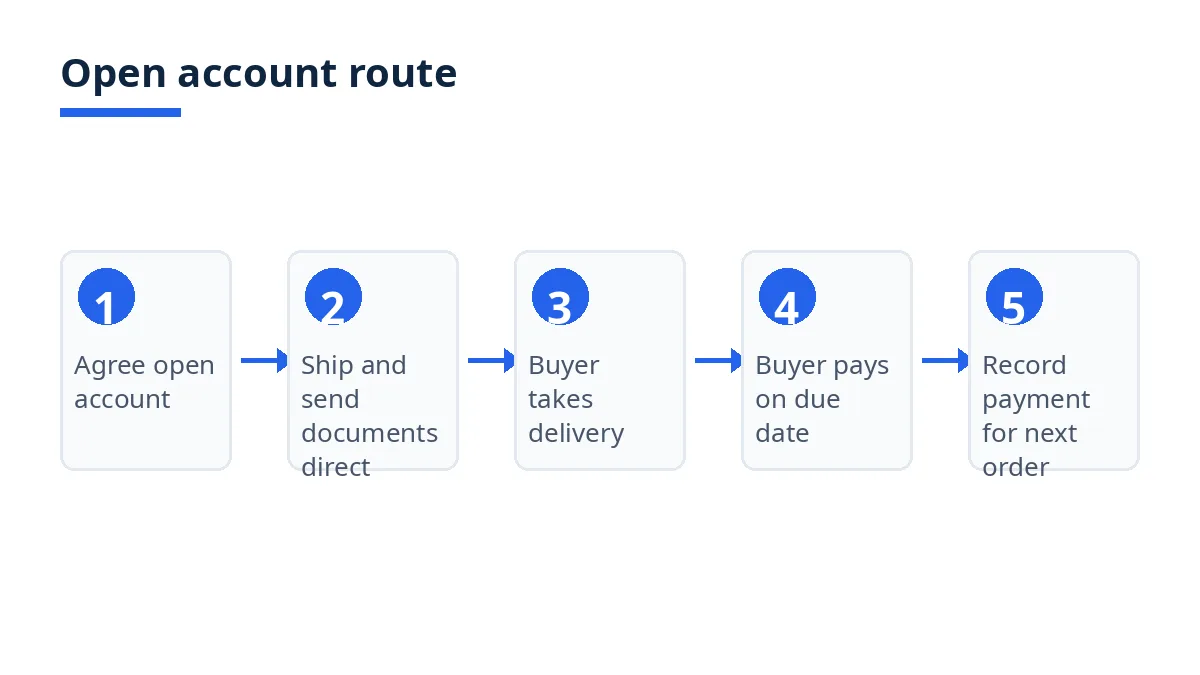
Agree open account in the sales contract. State the goods, price, currency, shipment terms, the words open account, the credit period, and the date from which it runs.
Set the payment trigger in words. State whether the period runs from the invoice date, shipment date, or bill of lading date, and the exact due date or how to work it out.
Agree the risk controls before shipment. Name any credit insurance, factoring, standby letter, or staged structure, and who arranges and pays for each.
Agree the document set and delivery route. State which documents the buyer receives, how they are sent, and who bears each cost.
The seller ships and sends the documents directly to the buyer. Unlike a documentary collection, they do not pass through a bank for release against payment or acceptance. The goods, along with the necessary documents, are shipped directly to the importer.1
The buyer takes delivery and checks the goods and documents. Any quality dispute should be raised under the contract route from step 1, not by simply holding payment.
The buyer pays by the due date, normally by bank transfer, on the agreed date and in the agreed currency.
Both sides reconcile and record the payment. That record becomes the track record for the next order.
Worked example
Figures below are illustrative only, not a bank offer. A buyer in Spain agrees open account terms with a producer near Narayanganj for terry towels priced at USD 18,400, payable Net 60 from the invoice date. The seller ships by ocean and sends the invoice, packing list, and bill of lading directly to the buyer. The buyer takes delivery, checks the towels, and pays USD 18,400 on day 60.
In a staged version, the first two orders run on Net 30, and only after both are paid in full on time does the term move to Net 60. It limits first exposure to one order at a time, and a late second payment can hold the Net 60 step until the record is clean again.
Open account compared with D/P, D/A, and a letter of credit
Feature | Open account | D/P | D/A | Letter of credit |
|---|---|---|---|---|
Bank holds documents | No, sent direct | Until sight payment | Until acceptance | Under the credit |
Buyer holds goods | Before paying | After paying | On acceptance | After release under the credit |
Seller holds | An invoice | Documents | An accepted draft | A bank undertaking |
Bank promise to pay | None | None | None | Yes |
Payment trigger | Agreed date | Sight payment | Draft maturity | Complying presentation |
A buyer who needs goods before paying, and a seller who trusts that buyer to pay on the agreed date, may choose open account. A seller who needs payment before giving up document control should look at documents against payment instead. A seller who needs a bank behind payment should look at a letter of credit, explained in Exportain's letter of credit guide.3
Costs, timelines and documents
There is no universal open account fee, timeline, or approval condition. Open account itself has no bank collection charge, because no bank collection takes place, but that does not make it free. The costs sit elsewhere, and each must be confirmed in writing before shipment: any insurance premium, factoring discount, standby letter fee, working capital finance cost, and transfer charge. The ITA guide notes that short-term export credit insurance for multi-buyer policies often costs less than 1 percent of insured sales, while single-buyer policies vary widely.2 Treat that as an ITA range for United States exporters, not as a Bangladesh price. Your own insurer or bank must quote your cost.
Timelines are set by the contract, not by a banking rule. The ITA guide gives 30, 60, or 90 days as the typical periods, with goods shipped before payment is due.1 Your contract must state your own period and starting point, because days from the invoice date, shipment, and bill of lading date give three different due dates. State the due-date method in words, agree how weekends and bank holidays are treated, and agree the late-payment route: reminder timing, interest if any, and when the seller stops further shipments.
The document set is set by the contract, not by a single standard list. A typical set includes a commercial invoice, a packing list, and the transport document, usually an ocean bill of lading, plus any named certificate. Because the documents go directly to the buyer, errors are found by the buyer, not by a bank. Keep parties, amounts, currency, goods description, and document list identical across contract, invoice, and packing list.
Item | Confirm before shipment |
|---|---|
Contract term | Open account in words, goods, price, currency, shipment terms |
Credit period | Length, starting point, due-date method |
Risk control | Insurance, factoring, standby letter, staged structure, payer |
Document set | Invoice, packing list, transport document, certificates |
Delivery route | How documents reach the buyer, payer of each cost |
Payment route | Bank details, currency, transfer charges, payer |
Dispute route | How quality disputes are raised, whether they pause payment |
Stop rule | When further shipments stop if late |
Bangladesh-specific rules and tips
Exports from Bangladesh run through authorised dealer, or AD, banks, and the foreign exchange paperwork must be confirmed with the seller's AD bank at contract stage. Do not copy a term from another market into a Bangladesh export without that check. The AD bank route, repatriation of proceeds, and the bank's record documents must all be settled before signing.
In October 2025, Bangladesh Bank permitted banks to arrange payment undertakings or payment risk coverage from Bangladeshi insurers for exports on open account credit terms.4 Before that change, open account exports were allowed only against payment undertakings from designated institutions abroad.4 Under the 2025 circular, banks can facilitate such exports through foreign currency-denominated policies issued by local insurers, and where proceeds are not received, claims must be settled in foreign currency.4 The same reporting notes that banks were authorised to offer post-shipment finance against covered exports.5
That framework does not automatically cover every Bangladesh open account shipment. The insurance must be arranged, the policy must be in foreign currency, and the seller's AD bank must be satisfied with the arrangement. Confirm before signing that it will handle your shipment on the agreed route, what insurance or undertaking it requires, and what proof of repatriation it needs when payment arrives. Record the reference in the contract so both sides can check it.
A further tip: a seller who has already financed production may need the receivable to be insurable or financeable before agreeing to a long credit period. Ask early, not after shipment, whether the period you want is one its bank and insurer will support. A term the seller cannot finance is a term the seller cannot sustain.
Mistakes and red flags
Treating open account as free credit. The seller finances the period between shipment and payment, and that financing has a cost.
Granting the longest term on the first order. Start short, and lengthen it only on a clean payment record.
Leaving the credit period starting point vague. Days from invoice, shipment, and bill of lading dates give different due dates.
Assuming a bank will chase payment. No bank holds the documents or promises to pay, so collection is the seller's problem unless insurance or a standby letter has been arranged.1
Assuming insurance covers the whole invoice. Export credit insurance coverage is usually below 100 percent, and the seller carries the uncovered share.2
Letting a quality dispute become a payment dispute. Agree inspection, evidence, and the dispute route in the contract.
Skipping the AD bank check in Bangladesh. Confirm the route, insurance or undertaking, and repatriation paperwork before signing.4
Shipping the next order while the last one is overdue. A stop rule agreed in advance is easier to enforce than one imposed in anger.
Confusing open account with D/A or D/P. In D/A, the buyer signs a time draft first. In D/P, the buyer pays at sight first. In open account, neither step applies.
Checklist
[ ] The contract states open account in words, with goods, price, currency, and shipment terms.
[ ] The credit period, starting point, and due-date method are stated in words.
[ ] Any insurance, factoring, standby letter, or staged structure is named, with arranger and payer.
[ ] The document set and delivery route are stated, and documents match the contract.
[ ] The payment route, currency, charges, payer, late-payment route, interest if any, and stop rule are confirmed.
[ ] The dispute route is agreed, separate from payment unless the contract says otherwise.
[ ] The seller's AD bank has confirmed the route, insurance or undertaking, and paperwork.
[ ] Due dates are recorded by both sides, with a reminder before each one, and the payment record kept for the next term decision.
How Exportain helps
Exportain helps buyers and sellers agree open account terms in writing before either side approaches a bank. A buyer can post a request for quotation stating the goods, shipment terms, and the payment term open account, including the credit period and starting point. The recorded quotation trail keeps the request, every quotation version, every counter-offer, and the accepted terms in one place.6
Exportain's payment terms are separate from bank charges on any trade payment: they cover payments to Exportain and memberships, not money paid directly between buyer and seller outside the platform.7 A buyer who needs a bank promise instead can compare routes first: Exportain's letter of credit guide explains the bank-undertaking route that open account deliberately does not use.3 Agree the term, risk control, and AD bank route first, and only then commit the first shipment.
FAQs
What should I know first about open account?
Open account means the seller ships the goods and sends the documents directly to the buyer, and the buyer pays later, typically in 30, 60 or 90 days.1 No bank holds the documents and no bank promises to pay. It suits parties with a track record, used with a risk control such as credit insurance or factoring.
What are the typical costs and timelines?
There is no universal open account cost or timeline. The typical periods in the ITA guide are 30, 60, or 90 days, but your own period and starting point must be stated in the contract.1 Costs depend on the risk control used, and each must be confirmed before shipment.
Which documents are needed?
The documents are those named in the contract: typically a commercial invoice, packing list, and transport document, usually an ocean bill of lading, plus any named certificate. Because they go directly to the buyer, keep parties, amounts, currency, and goods description identical across contract, invoice, and packing list.
What are the most common mistakes?
The most common mistakes are granting the longest term first, leaving the starting point vague, assuming a bank will chase payment, assuming insurance covers the whole invoice, letting a quality dispute become a payment dispute, skipping the AD bank check, and shipping the next order while the last is overdue. Avoid them by writing the term, risk control, due-date method, and stop rule clearly before shipment.
Next steps on Exportain
Start with the deal terms, not the shipment. Post a free RFQ on Exportain at https://exportain.com/rfqs, stating the goods, quantity, shipment terms, and the payment term open account, including the credit period, starting point, and any risk control proposed. Read the letter of credit guide at https://exportain.com/blog/lc-letter-of-credit, platform payments at https://exportain.com/payment-terms, and buyer protection at https://exportain.com/buyer-protection. Once terms are agreed, confirm the AD bank route and any insurance or undertaking, and only then commit the first shipment to open account.
Sources
- The Trade Finance Guide: A Quick Reference for U.S. Exporters - 2022 Edition. International Trade Administration (accessed )
- Export Credit Insurance. International Trade Administration (accessed )
- LC Meaning (Letter of Credit). Exportain (accessed )
- BB allows exporters to use local insurance for open account exports. The Business Standard, (accessed )
- BB allows exporters to use local ins for open account shipments. The Financial Express, (accessed )
- Buyer protection: What Exportain does to protect buyers. Exportain (accessed )
- Payment and Membership Terms. Exportain (accessed )
About the author
Sourcing from Bangladesh?
Post a request for quotation and suppliers on Exportain can send you their quotes directly.
Post an RFQ


