Using Net 30 Payment Terms When Buying From Bangladesh: Bank Rules and Tips
Net 30 when buying from Bangladesh: how the trigger date sets the due date, what a discount option adds, what late payment means, and the checks to make before shipping.
Short answer
Net 30 means the full invoice amount is due 30 days after the trigger event named in the contract, usually the invoice date, counted in calendar days unless the contract says otherwise. It carries no discount, bank undertaking, or document hold on its own. Name the trigger, the counting rule, any discount option, and the late-payment and stop rules in writing, and confirm with the seller bank in Bangladesh before shipping.
On this page
Key takeaways
Net 30 is a time term: the full invoice amount is due 30 days after the trigger event named in the contract, usually the invoice date, counted in calendar days unless the contract says otherwise.
The same shipment gives different due dates under invoice-date, shipment-date, and delivery-date triggers, so a contract that names no trigger cannot settle a due-date dispute.
A discount option such as 2/10 Net 30 and any late-payment consequence exist only where the contract agreed them; plain Net 30 carries no discount rate, late fee, or interest rate.
No Bangladesh-specific Net 30 rule, fee, or timeline was found in the material opened for this guide: confirm with the seller bank whether it will handle the shipment on Net 30, and note that Exportain payment and buyer-protection pages describe funds holds, not Net 30 processing.
Net 30 is a clock, not a payment method. It states that the full invoice amount is due 30 days after a trigger event named in the contract. In the usual form, that trigger is the invoice date: Net 30 means full payment is due within 30 calendar days from a specified date, usually the invoice date.1 The word net means the full amount, with no deduction, unless a separate discount option has been agreed.
That definition hides the question that causes most Net 30 disputes: 30 days from what. A contract that says only Net 30 leaves the invoice date, the shipment date, and the delivery date all open as possible starting points. On an international shipment, those dates can be weeks apart, so the same shipment produces three different due dates. This guide covers naming the trigger, counting the days, and setting controls.
Net 30 is often used inside an open account sale, where the buyer pays after shipment. The two ideas are not the same. Open account describes the structure, goods and documents moving before payment. Net 30 describes only the time allowed for payment once the trigger happens.
Why this matters for buyers and sellers
For a buyer, Net 30 gives a defined window to receive goods, check them, run the invoice through accounts payable, and pay from cash flow.
For a seller, Net 30 is 30 days of credit on every invoice, with production and shipment already paid for. Manage that wait before shipment with a credit limit for each buyer, exposure monitoring across open invoices, and credit insurance as a separate product. Export credit insurance protects an exporter against non-payment by a foreign buyer, covering commercial risks such as insolvency or protracted default and certain political risks.2 Coverage is usually below 100 percent, claims can be denied where policy requirements were not met, and commercial insurers can usually offer flexible and discretionary credit limits.2
Step-by-step: how it works
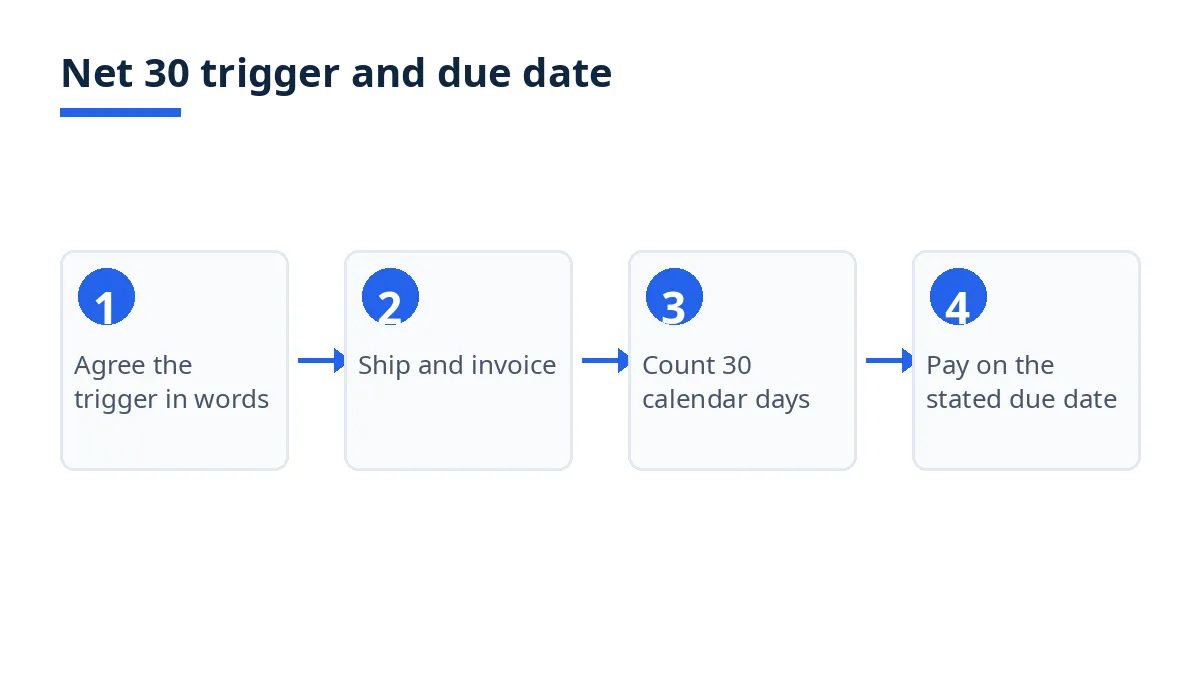
Name the term in full. Write Net 30 from a named trigger, with the due date, for example Net 30 from the invoice date, due 3 April.
Name the trigger event. Choose one: invoice date, shipment date, or delivery date. Repeat it on the invoice.
Name the counting rule. State that the 30 days are calendar days unless the contract says otherwise, since Net 30 usually counts calendar days and weekends and holidays are included unless the terms state otherwise.1 Then answer in words: weekend or bank holiday due dates, sent or received as paid, and month-end triggers.
Name any discount option separately, or state that there is none. A discount is never part of plain Net 30.
Name the payment route and the payer of each charge. State bank details, currency, charges, and payment evidence.
Ship, invoice, and diary the due date. Record the same due date on both sides.
Pay on the due date and reconcile. Match payment to invoice and keep the record.
How the same shipment gives three due dates
Trigger named in the contract | Count starts | Due date, 30 calendar days later |
|---|---|---|
Invoice date, 4 March | 4 March | 3 April |
Shipment date, 9 March | 9 March | 8 April |
Delivery date, 20 March | 20 March | 19 April |
Worked example: a due-date dispute caused by trigger wording
Figures below are illustrative only, not a bank offer. A buyer in Canada orders handloom cotton scarves from a producer in Bangladesh for USD 12,750 on Net 30 terms. The contract states Net 30 but names no trigger event. The seller invoices on 4 March, ships on 9 March, and the goods are delivered on 20 March.
The seller counts from the invoice date and expects payment on 3 April. The buyer counts from delivery and plans to pay on 19 April. On 3 April the seller treats the invoice as overdue and holds the next shipment. The buyer treats the hold as a breach, having believed payment was not due for another sixteen days.
The fix is made before the next order. The amended contract states Net 30 from the invoice date, due 3 April on the same example dates, with a reminder three days before the due date and a stop rule pausing further shipments if an invoice is unpaid seven days after its due date.
Net 30 beside other payment routes
Each route below is stated in one line. Choosing one instead changes what the seller holds or when the buyer pays.
Route | One-line contrast with Net 30 |
|---|---|
Letter of credit (LC) | A bank undertaking to pay on a complying presentation, rather than the buyer promise alone.3 |
Telegraphic transfer, TT, with MT103 | A payment instruction sent through banks, where an MT103 is the record that a payment was sent, not proof that it was received.4 |
Documents against payment, D/P | A collection in which the collecting bank releases documents to the importer only on payment for the goods.5 |
Documents against acceptance, D/A | A collection in which documents are released on signed acceptance of a time draft, with payment at the draft maturity date.5 |
Cash against documents, CAD | A collection term for payment at sight against documents, described in the same collection rules as D/P.5 |
Factoring | A finance arrangement in which a business sells an invoice to a factor, which advances a percentage upfront, collects from the buyer, and releases the balance less its fee.6 |
Escrow | An arrangement in which a neutral third party holds money or documents until the agreed conditions in the escrow agreement are satisfied.7 |
Proforma invoice | A preliminary document sent before shipment that outlines expected cost and terms, and is not a demand for payment.8 |
Costs, timelines and documents
There is no universal Net 30 fee, interest rate, discount rate, or approval condition. Costs around it are whatever the parties agreed, confirmed in writing before shipment: transfer charges, any insurance premium, any factoring fee, and any discount cost.
An early-payment discount is a contract option, not a feature of Net 30. The notation 2/10 Net 30 means a 2 percent discount is available for payment within 10 days, with the full amount due within 30 days.9 On the worked example, a 2/10 Net 30 option, if agreed, would work as follows, using example figures only: 2 percent of USD 12,750 is USD 255, so payment within 10 days would be USD 12,495 and payment after the discount window would be the full USD 12,750 by day 30. The 2 percent figure is an example of a discount term, not a standard rate.
Late payment has no universal fee or interest rate either. What happens past the due date is decided by the contract: reminder timing, any agreed interest or charge, whether further shipments pause, and the dispute route. If the contract says nothing, the parties must resolve the position under the contract and governing law route they chose.
Bank processing time is separate from the 30-day count, which runs from the named trigger in calendar days unless the contract says otherwise.1 A buyer who sends payment on the due date may see it credited days later, so the contract should state whether paid means sent or credited.
The document set is set by the contract, not by a single standard list: the contract or accepted quotation stating the term, the commercial invoice stating the term, the trigger, and the due date, a packing list, the transport document, and any named certificate. Keep parties, amounts, currency, goods description, and document list identical across contract, invoice, and packing list.
Bangladesh-specific rules and tips
No Bangladesh-specific Net 30 rule, fee, or timeline was found in the material opened for this guide. Net 30 in a Bangladesh export therefore takes its meaning from the contract, within whatever open account framework the seller bank will support. Do not quote a Bangladesh Net 30 rate or deadline from a general guide as if it were a local rule.
What the opened material does show is an open account framework that Net 30 sits inside. In October 2025, Bangladesh Bank permitted banks to arrange payment undertakings or payment risk coverage from Bangladeshi insurers for exports on open account credit terms, where previously open account exports were allowed only against payment undertakings from designated institutions abroad.10 Under that circular, banks can facilitate such exports through foreign currency-denominated policies issued by local insurers, and where proceeds are not received, claims must be settled in foreign currency.10 The same reporting notes that banks were authorized to offer post-shipment finance against covered exports.10
That framework is about open account credit terms generally. It does not name Net 30, set a Net 30 period, or guarantee that any particular Net 30 shipment will be covered. Before signing, confirm with the seller bank whether it will handle the shipment on Net 30, what undertaking or insurance it requires, and what repatriation proof it needs.
Mistakes and red flags
Writing bare Net 30 with no trigger. Invoice, shipment, and delivery dates give different due dates.
Assuming the trigger is the invoice date. It usually is, but a contract that says delivery, or says nothing, can displace that assumption.
Counting business days when the contract counts calendar days, or the reverse. State the counting rule in words.
Assuming a discount exists. Plain Net 30 carries no discount. A 2/10 Net 30 option exists only where it was written into the contract.
Claiming a discount after the discount window. The discount deadline is separate from the 30-day due date.
Treating an MT103 as proof of credit. An MT103 records that a payment was sent. Only a bank credit advice or statement shows that it arrived.4
Assuming a standard late fee or interest rate. Late consequences are only those the contract agreed.
Using a proforma invoice as the clock. A proforma invoice is not a demand for payment, so it cannot start a Net 30 count on its own.8
Shipping the next order while a Net 30 invoice is overdue. A stop rule agreed in advance is easier to enforce than one imposed after the event.
Skipping the seller bank check in Bangladesh. Confirm whether the bank will handle the shipment on Net 30 before signing.10
Confusing Net 30 with a bank route. Net 30 alone gives no bank undertaking, no document hold, and no third-party hold on the money.
Checklist
[ ] The contract states Net 30 from a named trigger, with the due date or the counting rule in words.
[ ] The trigger is repeated on the commercial invoice, and the invoice due date matches the contract count.
[ ] Calendar days, weekend and bank holiday treatment, and sent or credited as paid are all stated.
[ ] Any discount option is stated separately, with its percentage and discount window, or the contract states that no discount is offered.
[ ] The late-payment route, any agreed interest or charge, and the stop rule are confirmed.
[ ] The credit limit, total exposure across open invoices, and any credit insurance are confirmed before shipment.
[ ] The document set and payment route are stated, with charges, payer, and payment evidence named.
[ ] The seller bank has confirmed it will handle the shipment on the agreed Net 30 trigger.
How Exportain helps
Exportain helps buyers and sellers put the Net 30 wording in writing before shipment. A buyer can post a request for quotation stating the goods, shipment terms, and Net 30 from a named trigger, including the counting rule and any discount option. The recorded quotation trail keeps the request, every quotation version, every counter-offer, and the accepted terms in one place, with both parties seeing the same payment terms.11
Payment for goods on Exportain is settled directly between buyer and supplier on the terms in the accepted quotation, unless both sides agree to a funds hold.11 Where a funds hold is agreed, Exportain keeps the paid hold until the supplier has filed an export clearance document and the buyer has confirmed the trade complete.11 Exportain payment terms apply to payments made to Exportain and to memberships, and they do not cover money paid directly between two companies outside the platform.12
That distinction should be stated plainly. Exportain payment-terms and buyer-protection pages describe funds holds, not Net 30 processing. They do not set a Net 30 due date, discount rate, or late fee, and they do not turn a buyer promise into a bank promise.
FAQs
What should I know first about net 30 payment terms?
Net 30 means the full invoice amount is due 30 days after the trigger event named in the contract, usually the invoice date, in calendar days unless the contract says otherwise.1 The term itself gives no discount, no bank undertaking, and no document hold.
What are the typical costs and timelines?
The timeline is 30 calendar days from the named trigger, with the exact due date set by the contract.1 There is no universal Net 30 cost, discount rate, or late fee. Costs are the transfer charges, insurance premium, factoring fee, or discount cost the parties agreed, each confirmed before shipment. A discount option such as 2/10 Net 30 is an example of a contract option, not a standard rate.9
Which documents are needed?
The contract or accepted quotation stating the term in full, the commercial invoice stating the term, the trigger, and the due date, a packing list, the transport document, and any named certificate. When payment is made, match the transfer confirmation to the invoice number.
What are the most common mistakes?
The most common mistakes are writing bare Net 30 with no trigger, assuming the invoice date when the contract says otherwise, counting business days against a calendar-day contract, assuming a discount or a late fee that was never agreed, treating an MT103 as proof of credit, using a proforma invoice as the clock, shipping the next order while a Net 30 invoice is overdue, and skipping the seller bank check in Bangladesh.
Next steps on Exportain
Start with the wording, not the shipment. Read the letter of credit guide at https://exportain.com/blog/lc-letter-of-credit to compare a bank undertaking with a buyer promise, the platform payment terms at https://exportain.com/payment-terms to see what funds holds do and do not cover, and buyer protection at https://exportain.com/buyer-protection to see how the recorded quotation trail works. Confirm the seller bank route before committing the first shipment to Net 30.
Sources
- Net 30 Payment Terms: Meaning, Examples & 2/10 Net 30. Upflow (accessed )
- Export Credit Insurance. International Trade Administration (accessed )
- LC Meaning (Letter of Credit). Exportain (accessed )
- What Is SWIFT MT103? Meaning, Format, Fields and How to Get One. Xflowpay (accessed )
- Documentary Collections. International Trade Administration (accessed )
- Proforma invoice - Explanation of terms. Corporate Factoring (accessed )
- escrow | Wex | US Law | LII / Legal Information Institute. Cornell Law Institute (accessed )
- How to Make a Proforma Invoice for International Trade. LegalClarity (accessed )
- What does 2/10 mean in accounting?. AccountingCoach (accessed )
- BB allows exporters to use local insurance for open account exports. The Business Standard, (accessed )
- Buyer protection: What Exportain does to protect buyers. Exportain (accessed )
- Payment and Membership Terms. Exportain (accessed )
About the author
Sourcing from Bangladesh?
Post a request for quotation and suppliers on Exportain can send you their quotes directly.
Post an RFQ