Mobile Phones Lead Time From Bangladesh: Production and Shipping Timeline
Phone lead times from Bangladesh run on chipset and display supply, market approval and battery shipping rules, not just assembly days. This guide maps each stage, with planning ranges and a document checklist.
Short answer
Mobile phone lead time from Bangladesh is set by chipset and display allocation, sample approval, the destination market's radio approval file and the battery shipping file, not by assembly days alone. A repeat order of an already-approved model with stocked components can plan around 6–12 weeks, while a new or customized model with an unconfirmed allocation and a fresh approval file should plan around 12–24 weeks. Get dated gates per stage from the supplier.

On this page
Key takeaways
Phone lead time is set by chipset and display allocation, sample approval, the destination-market approval file and the battery shipping file, not by assembly days alone.
A repeat order of an approved model with stocked components can plan around 6–12 weeks; a new or customized model with an unconfirmed allocation and a fresh approval file should plan around 12–24 weeks.
One approval file does not cover the USA, UK, EU and UAE: each market has its own radio equipment route, and the file must name the exact model and variant.
A phone ships as lithium-ion batteries contained in equipment, UN3481, and the UN38.3 test summary must cover the exact battery model.
Compare quotations only on the same specification and Incoterm, with dated gates per stage, and keep one model identity across every document.
For a phone order, the assembly line is usually the shortest part of the story. The weeks that decide your delivery date sit before it and after it: chipset and display allocation, testing and approval for the market where the phones will be sold, and the battery shipping file that must match the battery model exactly. This guide maps the mobile phones lead time bangladesh buyers should plan around, so a date promised to a customer in the USA, UK, EU or UAE rests on dated gates, not an assembly estimate alone.
A feature phone and a 5G smartphone share a factory roof but not a supply chain. A supplier who can assemble a repeat model quickly may still wait weeks for a chipset allocation or a new model's approval file.
Local assembly in Bangladesh is growing. HONOR inaugurated a smartphone facility at the Hi-Tech Park in Kaliakair, Gazipur, with devices assembled there carrying a "Made in Bangladesh" label; the plant started with one line with a daily capacity of 1,500 units of the Honor X6c, with plans to reach four lines within 2026.1 Confirm which parts are stocked, which are ordered in, and which sets the earliest start.
Why this matters for buyers and sellers
For the buyer, phone lead time is launch timing and cash. Phones are often ordered against a retail season or a corporate rollout date, and a model that arrives after that window loses its slot. A phone that arrives early but without the destination market's approval file cannot be sold legally in that market.
For the seller, a realistic timeline protects the order itself. Chipsets, displays and memory are allocated in batches, a production line is booked in blocks, and a battery test summary belongs to one battery model. A seller who shows the gates — component confirmation, sample approval, approval file, battery file, export clearance — gives the buyer something to plan against.
Two controls keep the timeline honest. The first is one delivery term for every quotation: the Incoterms 2020 rules set out 11 rules with a clear allocation of cost, risk and obligations.2 Compare timelines only on the same term. The second is a model-level document file, where the model code matches across the quotation, approval file, battery summary, invoice and retail box.
Step-by-step: how it works
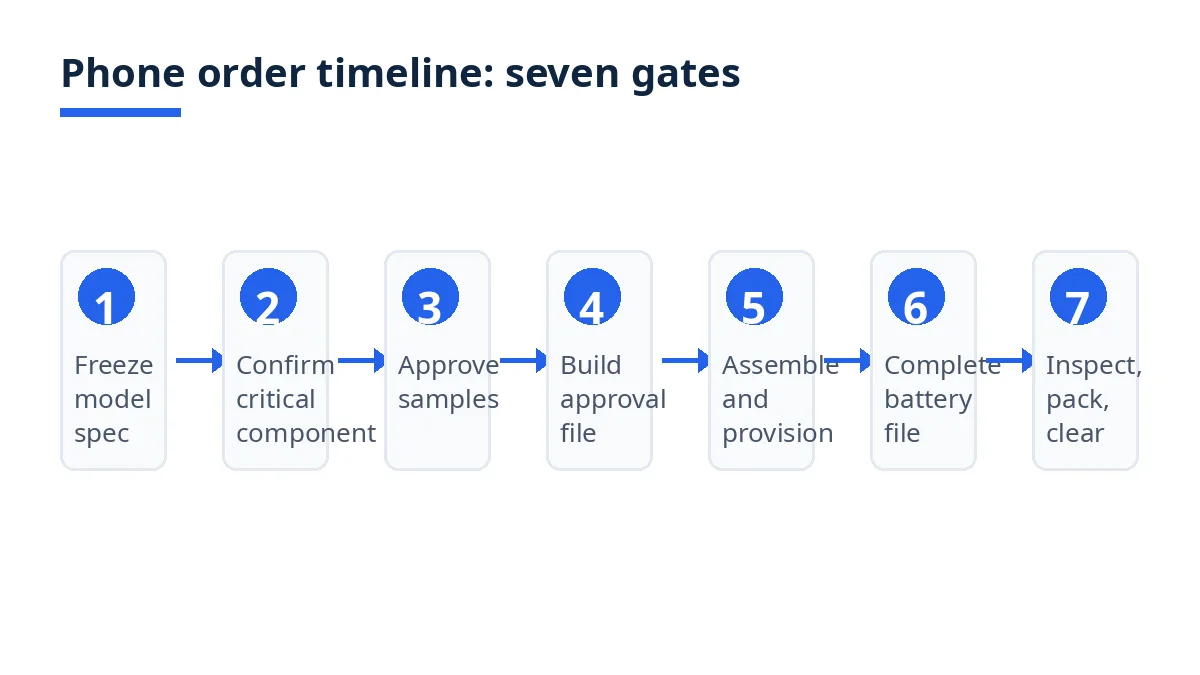
Freeze the model specification in writing. State the model and variant, chipset, display, memory and storage, battery model, radio bands, software version, language packs, charger and box contents. A specification that still says "or equivalent" on the chipset or display has no timeline yet, because the supplier cannot confirm allocation for an unnamed part.
Confirm the critical component path. Ask which component sets the earliest start: chipset allocation, display supply, memory, camera module or battery. Ask whether each is stocked, ordered to a confirmed date, or still subject to allocation, and record the confirmation date per component.
Approve samples in stages. Order a working sample, then a pre-production sample in the final specification, software build, packaging and labels. Test it on the networks and chargers of the destination market, and approve or list corrections in writing. Production should not start on an unapproved software build, because a software change after assembly is a rework.
Build the destination-market approval file in parallel. For the EU, mobile phones fall under the Radio Equipment Directive 2014/53/EU, which sets requirements to avoid interference and to protect user health and safety, and a CE marking indicates the manufacturer has tested the device and complies with the applicable requirements.3 The SAR limit under that framework is 2 W/kg averaged over 10 grams of tissue, and most phones sit between 0.2 and 1.6 W/kg.3 For the USA, confirm the FCC route for the exact model; for the UK and UAE, confirm each authority's type approval route. One file does not cover all four markets. Ask who holds the technical documentation and whether it names your exact model and variant.
Assemble, load software and provision IMEIs. Assembly, software loading, functional testing and IMEI provisioning run as one production block, but it starts only when components, the approved sample and the approval file are all ready. Ask for the production start date, daily output and final-unit date as three separate lines.
Complete the battery shipping file before booking freight. A phone ships as lithium-ion batteries contained in equipment, UN3481, not as standalone batteries, UN3480, and the two entries are declared and priced differently.4 The battery design type must have passed the UN38.3 tests, and the test summary must cover your exact battery model: a similar model's report does not satisfy the carrier.4 Ask for the summary, the safety data sheet and the dangerous goods declaration early, because a missing or mismatched battery file stops a booking at space confirmation.
Inspect, pack and clear for export. Agree the inspection plan before production: sample size, acceptance criteria, functional tests, IMEI and label checks, and carton checks. Pack by model and variant, and confirm the vessel or flight only after the battery file and export declaration are both accepted.
Costs, timelines and documents (mobile phones lead time bangladesh)
Planning ranges, not promises
The table below gives planning ranges to build a schedule around. They are typical ranges for planning, not guaranteed delivery figures: your model, component allocation, approval route and freight mode move the actual dates. Get dated gates from the supplier for your order, and treat any single-week promise covering the whole journey as unconfirmed.
Stage | Typical planning range | What moves it |
|---|---|---|
Specification freeze and sample approval | 2–5 weeks | Sample rounds, software corrections |
Critical component confirmation | 4–10 weeks | Chipset and display allocation |
Production block (assembly, software, testing) | 2–4 weeks | Order size, line capacity, rework |
Destination-market approval file | 2–6 weeks | New vs. approved model, lab slots |
Battery file, packing and export clearance | 1–2 weeks | UN38.3 match, goods acceptance |
Transit, air | 1–2 weeks door to door | Flight and goods acceptance |
Transit, sea | 4–7 weeks port to port | Route, transshipment, congestion |
Read the total two ways. A repeat order of an already-approved model with stocked components can plan around 6–12 weeks from confirmed order to delivered goods. A new or customized model with an unconfirmed chipset allocation and a fresh approval file should plan around 12–24 weeks.
What drives cost
No guide can state a typical phone cost: the chipset, display, memory, battery, approval testing and freight mode set the price per model. The cost lines to compare are: components per model and variant; assembly and software loading; approval testing per destination market; inspection; packing and dangerous goods handling; freight on the same Incoterm; and destination duties and taxes, which the importer confirms against the destination tariff. The Incoterms 2020 rules allocate cost, risk and obligations for each rule,2 so compare quotations only on the same rule and named place. Air freight shortens transit but raises the freight line sharply, and dangerous goods acceptance can restrict which flights accept the shipment.
Which documents are needed?
For export clearance in Bangladesh, goods may not be loaded unless an export declaration, the Bill of Export or Shipping Bill, is submitted to Customs and approved.5 Enclosed documents include the export contract or purchase order where there is no export letter of credit, the commercial invoice, the packing list, the EXP form certified by an authorized dealer, and a certificate of origin issued by the EPB or a Chamber of Commerce and Industry.5 For a phone order, add the model-level set: the specification sheet and sample approval record; the destination-market approval file for the exact model; the UN38.3 test summary for the exact battery model; the safety data sheet; the dangerous goods declaration showing UN3481 for phones with batteries installed;4 the IMEI list per carton; and the inspection report. Check that the model code, battery model and IMEI range match across every document before the cartons are sealed.
Bangladesh-specific rules and tips
Separate the domestic market from the export market. In Bangladesh, the National Equipment Identity Register (NEIR) verifies mobile phone IMEI numbers, and users are encouraged to check whether a phone is registered in NEIR by sending its 15-digit IMEI to 16002.6 That system governs phones connecting to Bangladeshi networks; an export order is governed by the destination market's approval rules, so confirm which applies and do not assume one substitutes for the other.
Classify the phone and its accessories separately. Smartphones generally fall under heading 8517, which covers telephone sets including smartphones for cellular networks, and the code for mobile phones is often cited as 8517.13.7 Accessories such as chargers or cases fall under different codes, and using the phone code for accessories is a common cause of customs rejection.7 List accessories as separate lines with their own codes.
Ask what is stocked and what is ordered in. A phone's critical parts are commonly sourced internationally. Ask for the stocked list per component and the fallback if an allocation slips: a substitute component restarts sample approval and may restart the approval file, so a substitution is a new timeline, not a shortcut.
Mistakes and red flags
Counting only assembly days. The most common phone timeline mistake is adding assembly days and calling the sum a lead time. Chipset allocation, sample rounds, the approval file and the battery file each add weeks, and none of them runs inside the assembly block.
Assuming one approval covers every market. A CE-marked phone is not automatically cleared for the USA, and a US-authorized phone is not automatically cleared for the EU or UAE. Each market has its own radio equipment route, and the approval file must name the exact model and variant sold there.
Accepting a battery file for a different battery model. The UN38.3 test summary must cover your exact battery model, and the dangerous goods declaration must show UN3481 for phones with batteries installed.4 A summary for a similar battery, or a declaration showing UN3480 for a phone shipment, is a booking rejection or a port hold.
Approving the sample but not the software build. A phone approved on an early software build and shipped on a later one is a different product for testing and support purposes. Approve the final build, record its version, and require written notice of any change after approval.
Comparing timelines on different delivery terms. A 10-week date ex works and a 12-week date delivered to your port can be the same journey. The Incoterms 2020 rules allocate cost, risk and obligations differently per rule,2 so compare only quotations that state the same rule and named place.
Treating a profile or a badge as approval. A supplier profile is a starting point for enquiries. It does not test whether a factory can build your model, and a badge is not a guarantee of capacity, quality or delivery.
Checklist
Before you confirm, every line should be answered in writing.
Model and variant frozen: chipset, display, memory, storage, battery model, radio bands, software version, charger, box contents.
Critical component named, with its confirmation date.
Sample approved in writing: final specification, software build, packaging and labels.
Approval file per destination market, naming the exact model and variant and the documentation holder.
Battery file complete: UN38.3 summary for the exact battery model, safety data sheet, declaration showing UN3481.4
Inspection plan agreed: functional, display, camera, charger, IMEI and label checks, with acceptance criteria.
Quotations compared on the same specification and Incoterm.2
Export set agreed: invoice, packing list, EXP form, certificate of origin, Bill of Export.5
IMEI list per carton matched to the invoice and packing list.
Freight mode confirmed: dangerous goods acceptance confirmed with the forwarder before departure is promised.
Dated gates recorded: component confirmation, production dates, inspection, clearance and departure dates.
How Exportain helps
On Exportain, browse suppliers and post a request for quotation (RFQ) on the RFQ board with your model specification, target markets and delivery term, so suppliers quote against the same model and the same term. Ask each reply for its critical component, its approval file per market and its battery file, and compare replies on dated gates rather than on a single promised week. Read the Incoterms guide for shipments from Bangladesh before you choose a delivery term.
Read the badges for what they record. Exportain Verified means Exportain has checked identity, phone, email and business registration, and Export Verified means it has checked the Export Registration Certificate (ERC).8 Verification is a document review by staff, free, and never granted by membership plans.9 It is not a factory inspection,8 9 so sample approval and inspection stay with you.
FAQs
What should I know first about mobile phones?
Know the model before you ask for a date. The timeline is set by the chipset and display allocation, the destination-market approval file and the battery shipping file, not by assembly days alone. Smartphones generally sit under HS heading 8517, often cited as 8517.13,7 and each destination market has its own approval route.
What are the typical costs and timelines?
There are no typical figures a buyer can rely on, because the chipset, display, memory, battery, approval testing and freight mode set the price and the dates per model. For planning, a repeat order of an approved model with stocked components can plan around 6–12 weeks, while a new model with an unconfirmed allocation and a fresh approval file should plan around 12–24 weeks. Those are planning ranges, not guaranteed figures.
Which documents are needed?
The order documents are the frozen specification, quotation and purchase order, sample approval record, destination-market approval file, UN38.3 summary for the exact battery model, safety data sheet and dangerous goods declaration showing UN3481.4 The export set is the Bill of Export, commercial invoice, packing list, EXP form certified by an authorized dealer, and certificate of origin issued by the EPB or a Chamber of Commerce and Industry.5
What are the most common mistakes?
The most common mistakes are counting only assembly days, assuming one approval covers every market, accepting a battery file for a different battery model,4 approving a sample on one software build and shipping another, and comparing timelines on different delivery terms.2 Each looks like a shorter timeline until the approval, battery or customs gate stops the shipment.
Next steps on Exportain
Post a free RFQ on Exportain and get quotes from suppliers for your model: state the frozen specification, your target markets and your delivery term on the RFQ board, then compare replies on dated gates. Before you confirm, browse suppliers and read the Incoterms guide for shipments from Bangladesh so every quotation uses the same term and named place.
Sources
- Honor begins local smartphone production with Bangladesh factory. The Daily Star (accessed )
- Incoterms® 2020. International Chamber of Commerce (ICC) (accessed )
- Mobile phones: regulations and standards. FPS Public Health, Belgium (accessed )
- Lithium Battery Shipping 2026: UN3480/UN3481 & UN3556-3558. Eastern Cargo (accessed )
- Customs Clearance Procedures for Export. Bangladesh Customs, National Board of Revenue (accessed )
- A guide to ensuring your mobile handset stays legal under Bangladesh's new NEIR system. The Financial Express (accessed )
- Smartphone HS Code Guide 2026 | Duty & Compliance. FreightAmigo (accessed )
- Trust & Safety Center. Exportain (accessed )
- Supplier verification: Earn trust badges buyers can see. Exportain (accessed )
- Incoterms
- export documents
- supplier verification
- quality control
- buyer guide
- Bangladesh sourcing
- Electrical products
About the author
Sourcing from Bangladesh?
Post a request for quotation and suppliers on Exportain can send you their quotes directly.
Post an RFQ