

Typical MOQ for Medical Scrubs in Bangladesh (and How to Negotiate It Down)
No single medical scrubs MOQ in Bangladesh: how fabric rolls, department colors, size runs and embroidery set the minimum per color and size, and how to negotiate or structure a smaller order.
Short answer
There is no single typical MOQ for medical scrubs from Bangladesh. For a first-time buyer, each factory sets its minimum per fabric roll, per color and per size run for your specification, driven by woven roll lengths, dye lots per department color, cutting markers across the size range, and embroidery set-up. Run one department as a pilot, ask for each minimum line by line in writing, and lock the repeat price and minimum before you confirm.

On this page
Key takeaways
There is no single typical MOQ for medical scrubs from Bangladesh, because each factory sets its minimum per fabric roll, per color and per size run for your specification.
A first-time buyer should run one department as a pilot: one color, one size curve, and one matched top-and-pant set, so the pilot proves wash performance, fit and color before any rollout.
Ask for every minimum line by line in writing, with the split per color, per size and per piece, and with set-up costs itemized apart from the unit price.
Negotiate the pilot structure first: one department, one fabric shared across top and pant, stocked fabric and trims, and set-up paid as a separate line.
Lock the rollout at first order: repeat price, repeat minimum, color standard and paid set-ups in writing, so the pilot is not renegotiated from zero.
Buy your first scrub order as a test, not as a program. A first-time buyer usually outfits one department first: one team, one color, one size curve, with the rest of the hospital watching the result. If that pilot washes well, fits its wearers, and arrives in the approved color, the rollout that follows is straightforward. If it fails on any of those three points, every later department inherits the same problem at larger scale.
There is no single typical MOQ for medical scrubs in Bangladesh, and a first-time buyer feels that absence more than a repeat buyer does. Each factory sets its minimums for your specification, and the binding one is usually the fabric roll, the color lot, the size run, or the embroidery set-up rather than the order total. Poly-cotton blends in ratios such as 65/35 or 55/45 are the industry standard for scrubs, with cotton adding breathability and polyester adding wrinkle resistance and shape retention, while stretch blends add spandex or rayon for range of motion during long shifts.1 A blend chosen for comfort still has to survive high-heat commercial laundering, so a first order must prove wash performance before it proves anything else.
Bangladesh gives a first-time buyer many factories to ask, but no shared minimum. Ready-made garment exports grew 6.1 percent year on year to $10.58 billion in the first quarter of fiscal 2026-27, July to September, with woven garments up 5.11 percent to $4.61 billion, according to Export Promotion Bureau data.2 In the Harmonized System, heading 6211 covers track suits, swimwear and other garments not knitted or crocheted, including other garments of cotton and of man-made fibers, which is the heading buyers most often check first for woven scrub sets.3
The sections below follow the order in which the minimums bite on a first order: fabric roll, color lot, size run, then embroidery and trims.
Why this matters for buyers and sellers
For a first-time buyer, the minimum decides what the pilot can prove. A pilot that covers only the most common sizes proves nothing about petite and tall staff, and a pilot in a substitute color proves nothing about the department color that will actually be worn. Hospitals commonly assign scrub colors by department or role so staff can be identified at a glance, which means a first-time buyer cannot merge colors to reach a minimum and still run a valid pilot.1 A navy set for nurses and a ceil blue set for surgical staff are separate color lots even when the fabric and pattern are identical, and each lot carries its own floor.
For a seller, a first order carries set-up cost that no earlier order has absorbed. Fabric dyed to a new hospital color, drawcords matched to it, and a digitized logo have no second buyer, and a short pilot still uses the dye lot and the line change. Cost per piece therefore runs higher on a pilot than on a repeat, and the buyer's real leverage is not volume today but a written repeat: the same specification, the same color standard, and the same set-ups carried into the rollout.
Two controls keep a first order honest. The first is an inspection plan agreed before production: ISO 2859-1 defines a system of acceptance sampling plans for inspection by attributes, indexed by acceptance quality limit (AQL) for lot-by-lot inspection, and AQL is the maximum average percentage of defective items considered acceptable during random sampling.4 The second is one delivery term on every quotation: the Incoterms 2020 rules set out 11 rules with a clear allocation of cost, risk and obligations.5 Agree both before you compare minimums.
Example figures: a first-time buyer plans a 240-set pilot for one department in one color, across the full size range. That pilot can clear a per-color floor that the same 240 sets split across three departments in three colors cannot, because each of the three colors would fall below its own dye minimum. The example shows structure only, not a typical MOQ, price or lead time.
Step-by-step: how it works
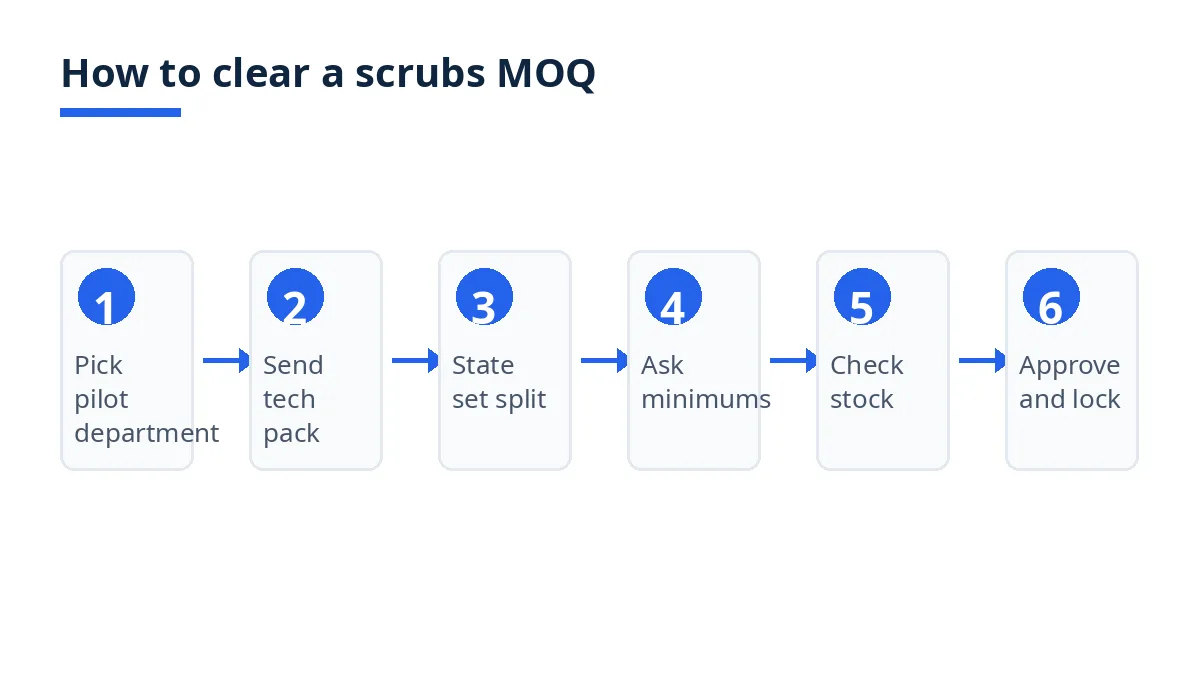
Pick the pilot department first. Choose one department, one color and one size curve for the first order, and say in the enquiry that later departments will follow on the same specification. A factory prices a pilot differently when the rollout is stated rather than implied.
Send one tech pack to every candidate. State the top and pant pattern, fabric blend and weight, pilot color, pocket layout, waist type, size chart including petite and tall, embroidery artwork and placement, labels, and packing per set.
State the split, not only the total. Give the quantity per color, per size and per garment piece. A total without a split cannot be answered with a usable minimum, because the fabric roll, the color lot and the size run are priced separately.
Ask for each minimum line by line. Ask for the fabric roll minimum, the minimum per color, the minimum per size run, and any separate embroidery, trim, label, tag and carton minimums, and ask which line binds for your pilot split.
Ask what is stocked. Record whether each fabric color is stocked or dyed to order, and whether drawcords, elastic, thread and labels are stock items. Stocked inputs are where a lower pilot minimum is most often possible.
Approve samples in writing, then lock the repeat. Order a proto sample, then a pre-production sample in your actual fabric, color, pocket layout, embroidery and labels. Wash it close to your laundry routine, measure it, then approve or list corrections in writing, and put the repeat price and minimum for the same specification in the same purchase order.
Negotiation levers that change the structure
Negotiation works when you change the line that creates the minimum, not when you ask for an exception to it. Get the result in writing.
Start with one department, not the whole hospital. A pilot in one color concentrates the whole order into one dye lot and one size run. Dropping two planned colors from the first order raises the quantity per remaining color at the same total, and it is the fastest way to clear a color-lot floor.
Share one fabric across the top and the pant. A top and a pant cut from the same fabric and color share one roll and one dye lot. Ask whether the fabric minimum can be met across both pieces combined, in writing, and keep the full size range inside that combined lot.
Use stocked fabric and stock trims for the pilot. A standard color in a stocked poly-cotton, with stock drawcords and elastic, removes the dye lot and part of the set-up. Ask for the stock list before you finalise the pilot color, and let the stock list narrow the choice.
Pay embroidery digitizing as a separate line and own the repeat. Where the floor comes from logo digitizing or a label run, ask for those costs apart from the unit price. The pilot can then be shorter, and the same digitized design serves the rollout. Record that paid set-ups carry into repeat orders, so they are not charged again.
Costs, timelines and documents
What are the typical costs and timelines?
There are no typical costs or timelines a guide can state as fact, for the same reason there is no typical MOQ. Each factory prices your blend, weight, pocket construction, embroidery, trim, label and carton runs, finishing and packing, and the delivery term you choose.5 On a first order the set-up share is heavier, because digitizing, dye lots and label runs are paid once and spread over a pilot rather than a program. Wash durability also enters the price: hospital-grade scrubs are laundered industrially at high temperatures, so ask for wash-cycle test data and a shrinkage tolerance.1
For timelines, sampling depends on fabric availability and correction rounds, and bulk production on dyeing, finishing, trim delivery and line capacity. Ask for sampling, fabric ready, production and inspection dates as separate lines, not a single delivery week.
Which documents are needed?
The order documents are the tech pack, the itemized quotation and the purchase order, with the minimum per fabric roll, per color and per size run written on both the quotation and the order, plus the repeat price and minimum for the rollout. For the export paperwork itself, follow the current Bangladesh Customs export clearance guidance for the shipment rather than working from a fixed list, since the required enclosures depend on the consignment.6
Bangladesh-specific rules and tips
Check the wash claim against your laundry, not the swatch. A fabric that looks right dry can shrink, fade or pill under industrial washing. Ask for shrinkage and colorfastness results after repeated washing, and run the pre-production sample through your own laundry cycle before approving it. The procurement guide for nurse scrubs puts shrinkage tolerance under 3 to 5 percent and wash-cycle test data at 50 or more cycles among the checks to verify.1
Keep fiber labeling exact for the EU. If you sell into the European Union, Regulation (EU) No 1007/2011 states that a textile product shall be labelled or marked with the name and percentage by weight of all constituent fibers in descending order.7 State the blend on the tech pack exactly as it will appear on the label, so the factory does not substitute a near-equivalent blend that changes the label.
Mistakes and red flags
What are the most common mistakes?
Ordering every department at once. A first order spread across departments splits into small color lots that each fall below their floor. A pilot in one department is cheaper to fix than a hospital-wide order in the wrong color or size curve.
Asking for a total MOQ only. The binding minimum is usually the fabric roll, the color lot or the size run. An order can clear the total and still fall below the minimum for one department color, which then carries a surcharge or removal.
Merging department colors to reach a quantity. Color coding exists so staff can be identified by role.1 A merged color that breaks a hospital policy will be rejected on arrival even if the factory accepts it, so settle colors with the end user before you negotiate them with the factory.
Comparing minimums on different specifications. A lower minimum on a lighter fabric, a stock color, a simpler pocket layout or a different delivery term is a different offer. Compare only replies to the same tech pack on the same Incoterm.5
Accepting verbal repeat terms. A pilot is only useful if the rollout follows on the same terms. Record the repeat price, repeat minimum, color standard and paid set-ups on the purchase order.
Paying embroidery set-up twice. Keep the paid digitizing lines from the first purchase order and attach them to the repeat enquiry.
Treating a profile or a badge as capacity proof. A profile is a starting point for enquiries. Read what each badge records on the supplier verification page before treating it as evidence of capacity, quality or delivery.8 A badge is not a guarantee of production capacity, product quality or delivery.9
Skipping the wash test to save time. Sampling under ISO 2859-1 checks a lot against an agreed AQL,4 and a washed pre-production sample is the last control before the goods become your uniform stock.
Checklist
Before you confirm a first order, every line should be answered in writing.
Pilot department, color and size curve chosen; later departments named as rollout.
Tech pack sent: pattern, blend and weight, pilot color, pockets, waist, embroidery, labels, sizes, packing.
Split stated per color, size and piece, with one size ratio per color.
Minimums confirmed per fabric roll, per color and per size run; binding line named.
Fabric status per color recorded: stocked or dyed to order.
Embroidery, trim, label, tag and carton minimums confirmed apart from the garment minimum.
Set-up costs itemized apart from the unit price; paid set-ups recorded as carried into repeats.
Repeat price, repeat minimum and color standard written into the purchase order.
Pre-production sample washed, measured and approved in writing.
Inspection level and AQL values in the purchase order.4
Quotations compared on the same specification and Incoterm.5
Export paperwork confirmed against the current Bangladesh Customs export clearance guidance.6
How Exportain helps
On Exportain, browse suppliers and post a request for quotation (RFQ) on the RFQ board with your tech pack summary, pilot split per color and size, and delivery term, so suppliers quote against the same specification. Ask each reply for its fabric roll, per-color and per-size-run minimums, and for its repeat price and minimum on the same specification. When you accept a quotation, Exportain creates one order and issues one proforma invoice from the accepted terms.9 Read how supplier verification works on Exportain before you weigh any badge, and keep sample approval and inspection with you.
FAQs
What should I know first about medical scrubs?
Know that a scrub order is a matched set, and that the minimum is set per fabric roll, per color and per size run rather than as one total. Poly-cotton blends in ratios such as 65/35 or 55/45 are the industry standard, with stretch blends adding spandex or rayon for mobility.1 Woven scrub sets sit first under HS heading 6211, which covers track suits, swimwear and other garments not knitted or crocheted, including other garments of cotton and of man-made fibers.3
What are the typical costs and timelines?
There are no typical figures a buyer can rely on, because each factory sets its price, minimum and lead time for your specification. Blend, weight, pocket construction, embroidery, the color and size split, and the delivery term drive the price,5 and sampling, dyeing, finishing, trim delivery and line capacity drive the timeline. On a first order, set-up costs weigh more heavily across a pilot.
Which documents are needed?
The order documents are the tech pack, itemized quotation and purchase order, with the minimum per fabric roll, per color and per size run on both, plus the repeat price and minimum for the rollout. For the export paperwork, follow the current Bangladesh Customs export clearance guidance for the shipment.6
What are the most common mistakes?
The most common mistakes are ordering every department at once, asking only for a total minimum, merging department colors to reach a quantity, comparing minimums on different specifications or terms,5 accepting repeat terms verbally, and reading a badge as a guarantee. A badge is not a guarantee of production capacity, product quality or delivery.9
Next steps on Exportain
Browse suppliers, then post your pilot tech pack summary, split per color and size, and delivery term on the RFQ board so suppliers state their fabric roll, per-color and per-size-run minimums and their repeat terms. Before you confirm, read the MOQ definition guide.
Sources
- Nurse Scrub Uniform Requirements: A Procurement Guide. Xingye Textile, (accessed )
- RMG exports grow 6.1% in Q1. The Business Standard, (accessed )
- Classification Detail — HS Code 6211. United Nations Statistics Division (accessed )
- ISO 2859-1:2026 - Sampling procedures for inspection by attributes — Part 1: Sampling schemes indexed by acceptance quality limit (AQL) for lot-by-lot inspection. ISO (accessed )
- Incoterms® 2020. International Chamber of Commerce (ICC) (accessed )
- Customs Clearance Procedures for Export. Bangladesh Customs, National Board of Revenue (accessed )
- Regulation (EU) No 1007/2011 on textile fibre names and related labelling and marking of the fibre composition of textile products. European Union, (accessed )
- Supplier verification: Earn trust badges buyers can see. Exportain (accessed )
- Trust & Safety Center. Exportain (accessed )
- MOQ
- supplier verification
- buyer guide
- woven garments
- Bangladesh sourcing
- bangladesh garments
- Medical scrubs
About the author
Sourcing from Bangladesh?
Post a request for quotation and suppliers on Exportain can send you their quotes directly.
Post an RFQ


