Leggings Exporters in Bangladesh: Verified Supplier Checklist
Work through this numbered checklist before you place a leggings order in Bangladesh: legal documents, who actually makes the goods, samples, compliance certificates, references and contract terms, with a pass, conditional or stop decision at the end.
Short answer
Before you order leggings from Bangladesh, check the exporter in decision order: legal documents and export registration, who actually makes the goods, bulk-fabric samples, compliance certificate scope, buyer references and written contract terms. Record each item as pass, conditional or stop, and pause the order on any stop item until new evidence resolves it.
On this page
Key takeaways
Work the checklist in decision order, and record every item as pass, conditional or stop instead of relying on a single overall impression of the exporter.
Check legal identity first: one legal name across the trade licence, tax and VAT papers, export registration, quotation and bank account, with current association membership.
Confirm who actually makes the leggings, including any subcontracted stage, and require a production sample in the bulk fabric before bulk cutting is approved.
Check every certificate for scope, product coverage and validity, and agree the sampling plan, stage checks and failure procedure in writing before production starts.
Before you pay a deposit or sign a purchase order, work through this checklist on the leggings exporter itself: its legal documents, who actually makes the goods, its leggings capability, its compliance certificates, its references and its contract terms. Record each item as pass, conditional or stop. This checklist checks the exporter, not the garments; use the leggings quality control checklist separately for the goods.
Leggings are knitted garments, so the supplier pool sits inside the knitwear sector. The Bangladesh Knitwear Manufacturers and Exporters Association (BKMEA) states that it represents approximately 2,540 knitwear member factories.1 A pool that large makes document, factory-control and reference checks the work that separates a workable supplier from a sales page.
Why this checklist matters
Most exporter problems are visible before production if you ask for the right papers in the right order. A legal name that differs between the quotation and the bank account, production subcontracted to a factory you never checked, a certificate whose scope does not cover your product, or a label pack agreed after bulk labels are printed each become expensive once goods are made.
Use three decisions only. Pass means the evidence was seen and matches. Conditional means the item is documented, dated and owned by a named person, with closure before shipment. Stop means the item blocks the order: a name mismatch, an expired export registration, undisclosed subcontracting, or a certificate that does not cover your product. Resolve a stop item with new evidence, not reassurance.
Before you start
Gather four things before you contact suppliers: your tech pack and size chart, your fabric description, your target markets, and your payment and inspection plan. Decide who completes the checks and makes the stop decision before quotations arrive.
Ask every shortlisted exporter for the same document set at the same time: trade licence, Taxpayer Identification Number (TIN), VAT registration, Export Registration Certificate (ERC) and association membership certificate. The ERC is issued by the Office of the Chief Controller of Imports and Exports under the Ministry of Commerce.2 Requesting the same set from every candidate shows quickly who cannot produce a current paper.
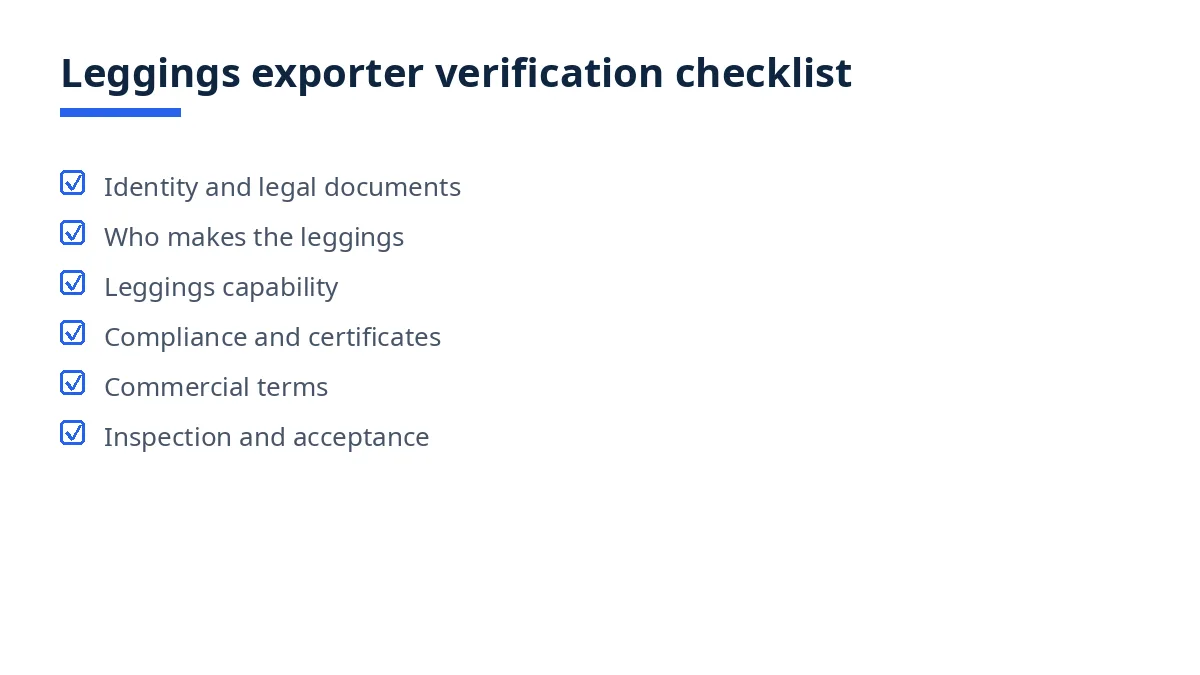
The full checklist (numbered, printable)
A. Identity and legal documents
Check that the legal name is identical on the trade licence, TIN certificate, VAT registration, ERC, quotation and bank account. Any difference is a stop item until the papers are aligned.
Check that the ERC is current. The ERC is issued by the Office of the Chief Controller of Imports and Exports.2 Record the expiry or renewal date.
Check that the trade licence, TIN certificate and VAT registration are current and in the same legal name. The prerequisite set for an ERC application includes a valid trade licence, TIN and VAT registration number, a bank solvency certificate and a membership certificate from a recognised chamber or trade association.2
Check the association membership certificate and its currency, usually BGMEA or BKMEA membership for knitwear. BKMEA states that it represents approximately 2,540 knitwear member factories.1 Membership shows an active knitwear business, not proof of capacity, quality or compliance.
Ask for the company registration papers and check that directors, registered address and business activity match the other documents.
Check the bank details against the legal name and ask for a bank solvency certificate.2 Never pay an account held in a different name from the contract name.
B. Who actually makes the leggings
Get a written statement of which stages are in-house and which are subcontracted: knitting, dyeing and finishing, cutting, sewing and packing, naming any subcontractor used for your order.
Check the factory by a visit or live video walkthrough: lines, stretch sewing machines, cutting tables and packing areas.
Check capacity against your dates: lines available, current order load, and cover for rising volume.
Take two or three buyer references in your market and contact them. Ask what went wrong on their orders and how it was fixed.
C. Leggings capability
Require a production sample made from the bulk fabric, not a salesman sample: waistband, flatlock seams, gusset finishing, stretch and recovery, and fit against your size chart.
Check the fabric route: who supplies the stretch fabric, where dyeing and finishing happen, and how shade is controlled across lots.
Check size grading with a graded set across your full size range, measured against your chart, before bulk cutting.
Agree the label pack for each target market before bulk labels are printed. For the European Union, Regulation (EU) No 1007/2011 requires a textile product to be labelled with the name and percentage by weight of all constituent fibres in descending order.3
D. Compliance and certificates
Check factory licence and fire safety documents for currency and scope, recording dates rather than accepting that a document exists.
Check social and environmental compliance reports for scope, date and corrective actions still open.
Check any OEKO-TEX STANDARD 100 claim against the certificate scope. The label is awarded only if all components of an item meet the criteria, including fabric, threads and finishes.4 Confirm the certificate covers your product and is within its validity period.
Treat every other claim the same way: certificate scope, product coverage and transaction documents, never a logo on a sales page alone.
E. Commercial terms
Get a written quotation naming fabric, trims, packing, delivery term, payment terms and price validity.
Confirm the payment route with your bank before you agree terms, including the export documentation the bank requires. For export, approval of the EXP form from banks is part of the process.2
Agree minimum order quantity per style and colour, the cost of splitting an order, and how long the price holds. Read the typical MOQ for leggings in Bangladesh guide first.
Agree change control in writing: no change of fabric, factory, trim or label without your written approval, and state who owns the tech pack and grading files.
F. Inspection and acceptance
Agree the sampling and acceptance plan before production starts. ISO 2859-1 specifies an acceptance sampling system for inspection by attributes, indexed in terms of the acceptance quality limit (AQL), for lot-by-lot inspection.5 Set your own acceptance numbers in the purchase order; this checklist states no sample size or defect limit.
Agree stage checks in writing: pre-production sample approval, an in-production check while correction is still possible, and a final inspection before shipment.
Decide who inspects: you, a local agent or an independent inspector. Share the approved references, tolerances and acceptance levels before production, not at final inspection.
Agree the failure procedure before goods ship: sorting or rework, documented partial acceptance, or rejection, and who pays for re-inspection.
If every item passes, proceed to the purchase order. If items are conditional, attach dated closure actions to the order. If any stop item remains, pause until new evidence resolves it.
Common failures and how to fix them
The most common failure is a name mismatch: the quotation, the contract, the label pack and the bank account carry different versions of the exporter's name. Stop and align every paper on one legal name before agreeing payment terms. A second failure is the salesman sample: a sample made from different fabric or on a different line from bulk. Fix it by requiring the production sample in bulk fabric and holding bulk cutting until approval.
A third failure is treating membership or a certificate as a quality guarantee. Membership shows an active knitwear business,1 and a certificate covers only its stated scope and period.4 Fix it by checking currency, scope and coverage for every claim. A fourth failure is undisclosed subcontracting, found when delivery slips or quality changes mid-order. Fix it by naming subcontractors in writing at item 7.
The last common failure is a label pack agreed late, when fibre or care wording no longer matches the bulk goods. For the European Union, fibre names and percentages must appear in descending order.3 Fix it by signing the label pack at tech-pack stage.
Downloadable template / summary table
Copy the checklist into your supplier file, add one row per exporter, and record the evidence and decision for each block.
Block | Checks | Evidence to file |
|---|---|---|
Identity and legal documents | Items 1 to 6 | Licence, TIN, VAT, ERC, membership, bank details |
Who makes the leggings | Items 7 to 10 | Subcontracting statement, walkthrough notes, references |
Leggings capability | Items 11 to 14 | Bulk-fabric sample, fabric route, graded set, label pack |
Compliance and certificates | Items 15 to 18 | Licence and safety papers, reports, certificate scopes |
Commercial terms | Items 19 to 22 | Written quotation, payment route, change control |
Inspection and acceptance | Items 23 to 26 | Sampling plan, stage checks, failure procedure |
How Exportain helps
Exportain is a B2B marketplace connecting buyers with Bangladeshi suppliers, so the document checks in this list can start at the enquiry stage rather than after a quotation. Browse suppliers and read how supplier verification works on Exportain before you shortlist. Supplier verification on Exportain is a document and photo review: staff review every submission, and approved checks earn trust badges shown on the company page, listings and quotations.6 It is not a factory inspection.6 Exportain is not a party to the goods contract and does not inspect goods, so the checks in block F remain your own controls.
FAQs
When should this checklist be used?
Use it before you place an order, when you shortlist exporters and before you renew terms with an existing supplier. Re-run the document and certificate items whenever a paper expires or the factory changes.
Who should complete it?
The buyer, a local agent or an independent inspector can complete it, using the same document set, sample references and decision rule for every candidate.
What are the most common failures?
Name mismatches across documents, salesman samples that differ from bulk fabric, certificates whose scope does not cover the product, undisclosed subcontracting and late label packs are the failures buyers find most often.
Can a third party do it?
Yes, if you share the approved references, the document set, the acceptance levels and the stop rules first, and if the third party reports evidence per item.
Next steps on Exportain
Start with the leggings manufacturers in Bangladesh guide to shortlist by factory type, read how supplier verification works on Exportain to see which document and photo checks sit behind a profile, then post a free RFQ via RFQs and run this checklist on every quoting exporter.
Sources
- BKMEA at a Glance. BKMEA (accessed )
- Export Import License in Bangladesh: Procedure, Requirements, and Legal Framework. Law Firm in Bangladesh, (accessed )
- Regulation (EU) No 1007/2011 on textile fibre names and related labelling and marking of the fibre composition of textile products. European Union, (accessed )
- OEKO-TEX STANDARD 100 for textiles tested for harmful substances. Hohenstein (accessed )
- ISO 2859-1:1999 - Sampling procedures for inspection by attributes — Part 1: Sampling schemes indexed by acceptance quality limit (AQL) for lot-by-lot inspection. International Organization for Standardization (accessed )
- Supplier verification: Earn trust badges buyers can see. Exportain (accessed )
About the author
Sourcing from Bangladesh?
Post a request for quotation and suppliers on Exportain can send you their quotes directly.
Post an RFQ