Checklist for Leather Shoes Exporters in Bangladesh
Eighteen passes in three rounds for leather shoes exporters in Bangladesh: paper, pair and order checks on identity, last and fit, upper material, sole adhesion, size curve, minimum, delivery terms and the shipment file, each with the evidence to file before a deposit.
Short answer
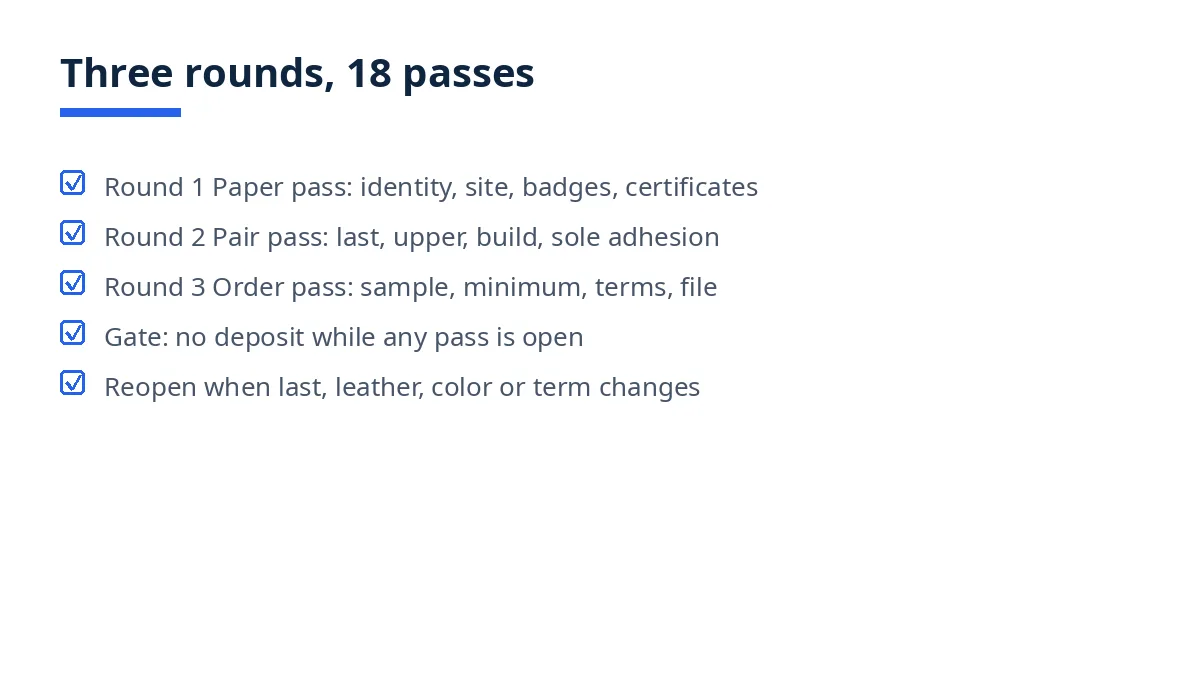
Run an 18-pass check in three rounds before ordering leather shoes from Bangladesh: a paper pass on identity, site, badges and certificates; a pair pass on the last, upper material, build, sole adhesion, size curve and labelling; and an order pass on the sealed sample, minimum, quotation fields, payment and shipment file. Hold any deposit until every pass is filed, and reopen the file when the last, leather, color or delivery term changes.
On this page
Key takeaways
Work three rounds in order: paper pass, pair pass, then order pass, and hold the deposit until all 18 passes are filed.
Read each badge for the checks its name records: verification is a document and photo review, not a factory inspection or a guarantee.
Example figures: a minimum of 600 pairs per color, per last, across 3 colors and 2 lasts means a smallest order of 3,600 pairs, not 600.
A contradiction between any two documents stops the file; the supplier supplies evidence and the sample pair but does not close its own file.
A shoe that looks right in a photograph can still fail on the foot, in the first week of wear. A pinching last, a toe seam that opens, or a color that drifts between the sample pair and the bulk lot can each turn a style unsellable before it reaches a shop floor. Buyers comparing leather shoes exporters in Bangladesh need a check that covers three things in sequence: the exporter behind the pair, the pair itself, and the terms the order will be paid against. This guide runs that check as eighteen passes in three rounds, and stops the file while any pass stays open. No company is named here and no exporter is ranked. Figures that show a calculation are labeled "Example figures" throughout.
What this pass settles before you order
A sound sample pair does not prove that the company answering the enquiry will make the bulk lot, at the site named, on the terms written. The pair pass answers whether the shoe fits, holds together, and matches its written description. The paper pass and the order pass answer whether the answering company can be tied to that pair, and whether the quotation, the payment terms, and the shipment file all describe one order. Take the rounds in sequence and pay no deposit until every pass is filed. A badge cuts desk work, but it leaves the sample pair, the adhesion result, and the payment terms for the buyer to settle, because verification on Exportain is a staff review of documents and photographs. It is no visit to a factory, and it promises nothing about capacity, quality, or delivery dates.1
Set up one file per exporter before you ask for prices
Give all exporters one identical requirement pack, so quotations arrive in comparable form: specification sheet reference and version, last reference, quantity and unit for each color and size set, delivery term with the named place, and destination. From each exporter, request the same set of quotation fields: price per pair, lead time, validity dates, delivery term, payment terms, and minimum with its counting basis.2 File one record per exporter, keeping entries in identical order, each marked with its date and sender, and keep the earlier version whenever an answer is revised. Open the record again whenever the last, the leather, the finish, a color, the size curve, or the delivery term is altered.
The shoe check for leather shoes exporters: 18 passes in three rounds
Take the rounds in sequence: paper first, pair second, order last. The paper round shapes the shortlist, the pair round decides whether the shoe merits an order, and the order round decides whether the terms are safe to pay against.
Round 1: the paper pass
Company name and address match on every document. Request the trade licence and the ERC direct from the exporter, then match the company name and address on those documents to the quotation and the invoice.1 Any mismatch in spelling, address, or company form stops the file until the documents agree.
Every badge is read strictly by the checks named for it. Exportain Verified covers identity, phone, email, and business registration checks. Export Verified covers the ERC check. Factory Verified covers reviewed factory photographs, Trading Company Verified covers reviewed office or warehouse photographs, and Trusted Trader covers completed orders on Exportain with no disputes.1 No badge on a profile records only that no check of that kind has been approved yet. It does not record a failed check.1
The maker is named for every stage of the pair. Record who cut, closed, lasted, and sole-attached the sample pair, where each stage took place, and which stages came from outside suppliers. Where a trading company answers, record the factory behind the pair before any deposit is paid, and write that factory into the order terms.
Association membership is stated, then checked with the body named. Ask whether the exporter belongs to a trade body for leather goods and footwear in Bangladesh, and put the answer to that body. LFMEAB presents itself as the trade body for Bangladesh makers and exporters of leather goods, footwear, and allied products.3 Membership is a single line in the record, not evidence about a particular pair.
Each certificate is confirmed with the body that issued it. Where a certificate bears on the order, confirm it with the issuing body, and record its scope, the site it covers, and the date it runs to.1 LWG audits rate tanneries on how they measure, control, and report manufacturing impact: Gold needs 85 percent, Silver 75 percent, and Bronze 65 percent in every section, and a manufacturing-site certificate runs for 24 months.4 Certification is no promise that a finished product will pass every restricted-substance test.4
The payment account line is read, and bank details are frozen early. A supplier profile carries a payment account line showing whether the business bank account was checked against the company name, and buyers are shown no bank details.1 Settle the payment account before accepting a quotation. If bank details change late, stop the file until the change is confirmed in writing through the same channel as the quotation.
Round 2: the pair pass
Last, width, and fit target are fixed before sampling. Record the last reference, the width fitting, and the wearer the fit target serves, and insist the sample pair is made on that last. A different last, a changed width, or a sample from another last sends the fit evidence back to the start.
Upper material is named part by part, and the heading follows the material. The chapter notes treat the upper material as the constituent material covering the greatest outside area of the upper, setting aside add-ons put on for strength or decoration, such as tabs, buckles, edging, ankle patches, eyelet stays, and ornamentation; the outer sole material is the one with the greatest area touching the ground.5 UK guidance puts leather-upper shoes under 6403 and textile-upper shoes under 6404, decided by the material covering most of the upper's outside.6 Heading 6403 is the leather-upper heading, for shoes whose outer soles are rubber, plastics, leather, or composition leather.5 Treat the heading as indicative, and let a customs broker confirm the full national code for the exact shoe and destination.
Build is named, and a decorative stitch is never treated as a welt. Record whether the sole is cemented, stitched through a welt, Blake stitched, moulded, or vulcanised, and name the outsole material on its own. ISO 17708:2018 gives a method for upper-sole adhesion covering cementing, vulcanisation, and injection moulding, and says the test is not needed where the bond was made with nails or screws, or with stitching.7 A welt seam that is drawn on or purely decorative goes in the record as decoration, not as construction.
Sole adhesion evidence names the method and the load agreed. ISO 17708:2018 sets out how to measure how hard it is to pull the upper away from the outsole, to split outsole layers, or to tear the upper or the sole.7 A SATRA sole adhesion tester presses the sole away from the upper with rising force, or holds a set pass load to confirm the sole stays fixed to the upper assembly.8 Put the method, the pass load, and the pairs tested in writing before bulk, and assume no universal pass mark, since the sources used here state none.
The size curve is written out, size by size, with quantities. A curve is not a size range. Record each size, the pairs for that size, and the total, and check the arithmetic before quotations are compared. Example figures: a six-size curve in the ratio 1-2-3-3-2-1 across sizes 39 to 44 totals 12 parts, so a 1,200-pair order on that curve means 100, 200, 300, 300, 200, and 100 pairs per size.
Labelling and shade are checked against the market, not against a photograph. For the EU, a material is labeled only when it covers at least 80 percent of the upper, lining and sock surfaces, or 80 percent of the outer sole volume; below that, the two main materials are shown. The label covers the upper, the lining and sock, and the outer sole, and whoever first puts imported footwear on the EU market answers for the label.9 Record label content market by market, and judge shade under the light source named in the specification.
Round 3: the order pass
One sealed sample pair is approved for each color and last, and kept. Approve one sealed pair for each color and last, showing the upper, shade, finish, stitching, and sole build, and store it apart from other colors. Judge every bulk lot against that sealed pair, never against a photograph of it.
A trial lot is judged on the same record as the bulk lot. Ask what lot size is normally produced in a single run, and whether the order will run in one lot or several; every run needs its own sample approval. Where the specification calls for laboratory work, insist the report names the product, the pair tested, and the method used. A change of tannery, last, or sole material sends the sample and laboratory evidence back to the start.
The minimum is counted on one stated basis, and the total is worked out. Ask whether the count runs per pair, per style, per color, per last, per size set, or by order value, and whether two minimums apply together. The count may run per order, per style, or per color, and a value floor may sit beside a quantity floor.2 Example figures: a minimum of 600 pairs per color, per last, across 3 colors and 2 lasts, means a smallest order of 3,600 pairs, not 600.
Every quotation field is present, and the delivery term fits the shipment. A quotation must state the price, the minimum and how it is counted, the lead time, the delivery term and named place, the payment terms, and the dates it stays valid.2 Only four Incoterms 2020 rules are for sea and inland waterway transport only: FAS, FOB, CFR, and CIF. CPT is an any-mode rule, DPU is an any-mode rule, and DDP is an any-mode rule under which the seller clears the goods for import and pays duty.10 For containerized shoes handed over at a terminal, the any-mode rules match the physical handover better than a sea-only rule, since containers may wait at a terminal for days before loading.10 Compare totals, not unit prices alone. Example figures: 950 pairs at 16.00 dollars a pair totals 15,200 dollars, while 1,000 pairs at 14.50 dollars a pair totals 14,500 dollars, so ordering 50 more pairs costs 700 dollars less in total.
Payment and inspection terms are settled before money moves. Record the payment schedule, the documents that trigger payment, and the inspection condition. Advance cash leaves the buyer carrying the risk if goods never ship; under a letter of credit, payment turns on documents showing the goods shipped as agreed.1 Exportain itself stays outside the sale contract, and money is held for a goods order only where both parties agree to a funds hold.1 Put the inspection basis in writing, naming who inspects and which sealed pair governs, before shipment.
The shipment file is listed before loading, and the whole record is re-read. Before loading, list for the shipment file the specification sheet version, the confirmed code for the exact shoe, any binding rulings, and the origin proof, and invoice each shoe style separately. Cross-check every name, site, code, unit, quantity, and date across the licence, the quotation, the specification sheet, the sample record, and the shipment file; anything unexplained stops the deposit. Suspected fraud or misrepresentation goes to the Trust Center as a report.1
Failures that close a file, and repairs that reopen it
A repair supplies the missing or corrected evidence, and the pass is then checked again from the start. A second correction that contradicts the first closes the file.
Failure | Pass | Repair, or close when |
|---|---|---|
Last altered after the sample pair was approved | 7 | Sample pair remade on the new last; close if bulk cutting began on the old last |
Leather given by a trade name, with no part-by-part material record | 8 | Material named for each part; close if only the trade name arrives |
Sole bond claimed, with no method or load named | 10 | Method, load, and pairs tested put in writing; close if the claim rests on a photograph |
Curve quantities moved between sizes after pricing | 11 | Curve re-issued and totals checked again; close if cartons were packed to the old curve |
Sea-only term applied to a container handover at a terminal | 16 | Term restated to match the handover; close if the seller refuses to restate it |
Certificate past its run-to date put forward as current evidence | 5 | Current certificate confirmed with the issuing body; close if confirmation never arrives |
Bank details altered late, with no written confirmation | 6 | Confirmed in writing through the quotation channel; close if confirmation never arrives |
One-page record: the file you keep for each exporter
Each row is one exporter and one decision. The table records decisions; it ranks nobody.
File | Rounds filed | Open passes | Decision |
|---|---|---|---|
File 1 | Paper, pair, order | None | Proceed to order terms |
File 2 | Paper, pair | 15: counting basis unstated; 16: named place missing | Repair or walk away |
File 3 | Paper | 7: last unnamed; 13: no sealed pair | Walk away |
Where two records are both complete, weigh identical quotation fields, the sealed pair, and the sole adhesion record, not how many badges sit on a profile. A badge cuts desk work. It still leaves the pair, the inspection, and the payment terms for the buyer to settle.1
When does a buyer run this shoe checklist?
Use it when the shortlist is drawn, when the sample pair is signed off, and again before any deposit is paid. One pass at the very end leaves no room to alter the shortlist, and one pass at the very start cannot test the lot. Open the record again whenever the last, the leather, the finish, a color, the size curve, or the delivery term is altered.
Who runs the pass, and who checks the checker?
The buyer holds the record and takes the decision. Classification passes can go to a customs broker, sample and inspection passes to an inspector, and test-method passes to a laboratory, each working to the buyer specification. The supplier hands over documents, names sites and stages, and makes the sample pair. It never closes its own record. Assign one named person to each round before the first quotation is compared.
Which failures turn up most often on shoe files?
A last left unnamed while the price is settled; a trade name put forward instead of a part-by-part material record; a sole bond claimed with no method or load; one sealed pair stretched across several colors or lasts; a minimum weighed with no counting basis; and a sea-only term applied to a container handover. In each case the paperwork failed first; the goods only showed it later.
Can a third party run the pass for you?
For parts of it, yes. An independent inspector can run the sample, in-production, and before-shipment checks, working to the buyer specification and the sealed pair. A broker can settle classification, and a laboratory can report on named methods. Insist on a written report for each part, setting out the lot, the pairs checked, the measurements taken, and the packing seen. The decision remains the buyer's: no third party closes a pass on evidence it never saw, and none turns a badge into an inspection.
Next steps on Exportain
Open the supplier directory on Exportain and read the trust and verification checklist on each profile before shortlisting, then read how Exportain records badge checks and what a minimum counts against. Once the specification sheet, the last, the quantity for each color and size set, and the delivery term are settled, put all four in full in your request, and weigh quotations on identical fields. Exportain connects buyers with Bangladeshi suppliers for requests for quotation and quotations. It takes no part in the sale contract for the goods, and it offers no goods inspection, freight booking, or customs clearance.1
Post a free RFQ on Exportain and get quotes from verified Bangladeshi suppliers →
Sources
- How Supplier Verification Works on Exportain. Exportain, (accessed )
- MOQ Meaning (Minimum Order Quantity). Exportain (accessed )
- President's Message - LFMEAB. Leathergoods and Footwear Manufacturers and Exporters Association of Bangladesh (LFMEAB) (accessed )
- Certification - Leather Working Group. Leather Working Group (accessed )
- HS Nomenclature 2007, Chapter 64: Footwear, gaiters and the like; parts of such articles. World Customs Organization (accessed )
- Classifying footwear for import and export. GOV.UK (accessed )
- ISO 17708:2018 - Footwear - Test methods for whole shoe - Upper sole adhesion. International Organization for Standardization (accessed )
- The SATRA STD 185 sole adhesion tester. SATRA (accessed )
- Footwear labelling. European Commission, EUR-Lex (accessed )
- FOB & FAS Incoterms® 2020 explained: Key differences. ICC Academy (accessed )
About the author
Sourcing from Bangladesh?
Post a request for quotation and suppliers on Exportain can send you their quotes directly.
Post an RFQ