Knitted Underwear Lead Time From Bangladesh: Production and Shipping Timeline
How to read a knitted underwear lead time from Bangladesh: fabric and elastic supply, size-curve and waistband approval, shade and elastic-recovery checks, wash re-check, inspection and transit as dated stages, with a stage table, document checks and red flags to check before ordering.
Short answer
A knitted underwear lead time from Bangladesh is a chain of dated stages: sampling and size-curve approval, fabric and elastic supply, dyeing and shade approval, cut-and-sew, wash and measurement re-check, labeling and packing specification, inspection, and transit. No single figure fits every order. Ask each supplier for dated stages, named approvals for waistband, size set, shade, and elastic recovery, a correction route, and a forwarder estimate, then work backward from your selling date with a buffer after inspection.
On this page
Key takeaways
A knitted underwear lead time is a chain of dated stages, not a single number, with extra gates for fabric and elastic supply, size-curve approval, shade approval across fabric, elastic, and lining, and elastic-recovery approval.
Bulk cutting should wait for written size-set approval across the range and a waistband specification recorded at relaxed and extended measurements, not a base-size sample or a relaxed measurement alone.
Shade must be approved on elastic and gusset lining as well as body fabric, and elastic recovery must be approved as a buyer specification with a stated method, sample, and pass result before bulk cutting.
Wash and measurement re-checks, skin-contact specification, and labeling and packing specification are stages in their own right: each needs a dated check and a correction route before inspection and loading.
Transit must be read from a dated forwarder estimate for the exact route and port pair, never as a fixed number of days, and supplier replies should be compared on the same stage table, priced to the same delivery term.
A knitted underwear order rarely slips for one large reason. It slips at a small gate left open: an elastic roll never ordered in the right width, a waistband measured relaxed only, a size at the end of the range never tried on, or a shade that matches on fabric but not on elastic. A buyer who reads only the total weeks in a quote cannot see which gate is holding the order. This guide gives a method for reading a knitted underwear lead time from Bangladesh as dated stages.
Why this matters for buyers and sellers
For a buyer, lead time decides whether underwear reaches its selling window. Work backward from the date the garments must be in hand and cleared.
For a seller, a dated stage table is a stronger offer than a short total. Naming each stage, its approver, and its dates lets the buyer plan, and it matters here because underwear fit is judged on the body.
Step-by-step: how it works
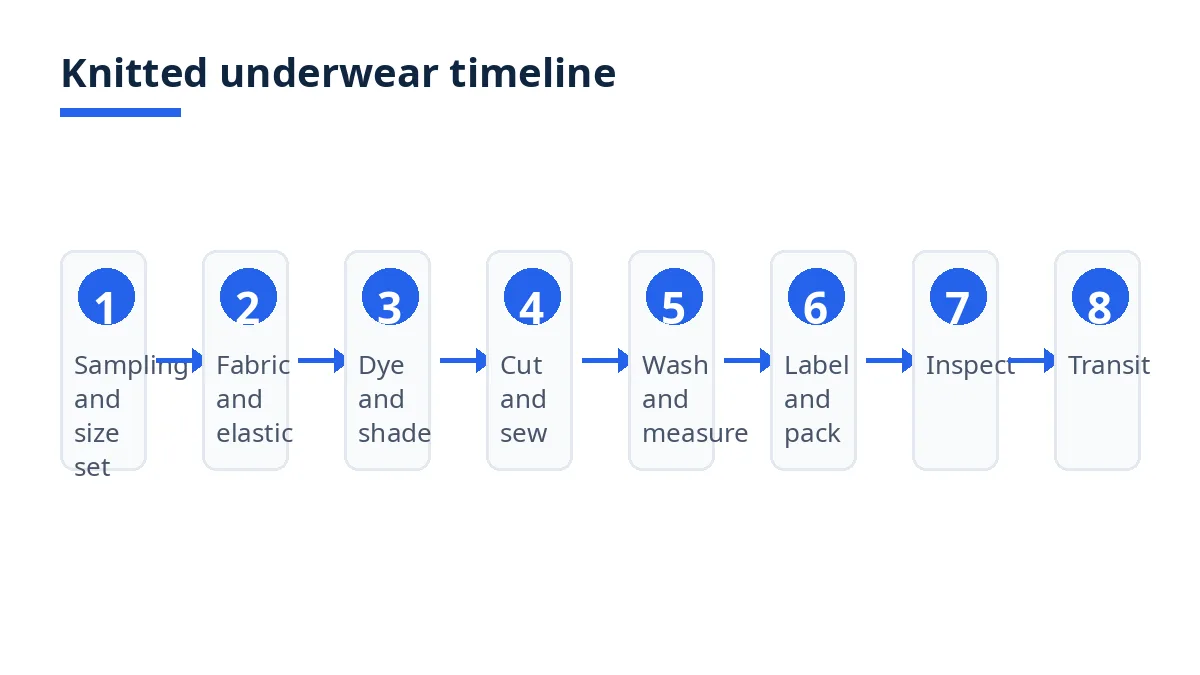
Read any supplier timeline against eight stages: sampling and size-curve approval, fabric and elastic supply, dyeing and shade approval, cut-and-sew, wash re-check, labeling and packing, inspection, and transit.
Stage 1: Sampling and size-curve approval
Sampling turns a tech pack into a physical pair the buyer can approve. Fit samples are measured against the fit requirement, pre-production samples are checked for actual trims and for whether earlier comments were incorporated, and size set samples are made in each size before bulk cutting is approved.1 For knitted underwear, the sample must also settle the size curve. One grading account explains that each point of measurement, including waist, hip, rise, and leg opening, should have its own grade increment, and that key sizes should be reviewed through size-set samples before bulk production.2
Stage 2: Knit fabric and elastic supply
Knit fabric and elastic are two supplies, not one, and either can gate the order. One underwear production account describes incoming inspection of fabric and elastic on arrival, covering GSM, stretch, and shade.3 Ask the quote to name both supplies separately: fabric source, fiber content, and GSM range, and elastic source, width, type, and route. A fabric approval does not approve the elastic, and an approval on one width does not approve every width.
Stage 3: Dyeing, shade, and elastic-recovery approval
Dyeing sets color, and shade approval gates cutting. Lap dips are checked and approved for dyed fabrics, and bulk fabric is checked against the approved sample and for shade variation across lots, with out-of-shade lots rejected before bulk cutting.1 For underwear, add two approvals a flat fabric check misses. First, approve shade on elastic and gusset lining as well as body fabric, because the same dye reads differently on each. Second, approve elastic recovery as a buyer specification: state in the tech pack how it will be checked, on what sample, and what counts as a pass, and ask the supplier to confirm the method and date in writing. Record relaxed and extended waistband measurements. One underwear production account logs the waistband at both widths and specs it against front and back rise, treating a single relaxed measurement as the roll-down risk.3
Stage 4: Cut-and-sew: waistband and gusset
Cut-and-sew joins body panels, waistband, leg openings, and gusset into a finished pair. Ask for the sewing sequence: how the waistband is set, how elastic tension is kept consistent across sizes, and how the gusset is lined and seamed. One account describes cutting to the marker with elastic and gusset aligned to the same specification.3 Ask for a weekly update of pieces cut, sewn, and packed against target, split by size.
Stage 5: Wash, shrinkage, and measurement re-check
Underwear is washed before it is worn, so a measurement off the machine is not the final measurement. Agree whether garments will be measured before washing, after washing, or both, and what shrinkage allowance applies. One underwear production account measures shrinkage after laundering so that a size still fits as that size after the first wash.3 Put the re-check date in the stage table, with a correction route if washed measurements fall outside tolerance.
Stage 6: Skin-contact specification, labeling, and packing
Underwear sits against skin, so the buyer specification must cover more than fabric and color. Treat skin-contact requirements as buyer-specification items: list every component that will touch skin, state what evidence you require, and state which label and packing details must match. One account lists shell, thread, elastic, gusset lining, and label as the components that touch skin, each needing its own record.3 If you require a test, name the test, the component, and the pass result, and ask for the dated result before bulk shipment. On labeling and packing, confirm label content and position, fold, poly bag, and carton assortment before inspection. A buying-house account notes that the top-of-production sample represents final packed pieces, including hang tags, folding, and poly bag size and quality.1
Stage 7: Inspection
Inspection is a stage in its own right, not a formality at the end. During-production checks catch a systematic fault, such as waistband roll or shade drift between fabric and elastic, while remaining units can still be corrected. AQL sampling, defined in ISO 2859-1, sets how many garments are inspected from a lot and how many defects of each type are allowed before rejection, with commonly used thresholds of zero for critical, 2.5 for major, and 4.0 for minor defects.4 Agree in writing which faults count as major for underwear: a rolling waistband, a twisted leg opening, an open gusset seam, a missing label, a measurement outside tolerance, and a shade mismatch between fabric and elastic. One guide notes that during-production inspection at around 20 to 30 percent completion catches systemic defects early.4
Stage 8: Transit
Transit starts when packed, inspected goods are handed to the carrier and ends when they reach the buyer warehouse, cleared for import. Its variables are sailing schedule, transhipment, port congestion, documentation readiness, and destination clearance. No transit leg should be read as a fixed number of days. Ask the forwarder for a dated estimate for the exact route and port pair, and what happens if the booked sailing is missed. For containers handed over at a terminal in Bangladesh, FCA, CPT, or CIP usually describe the handover more accurately than FOB, CFR, or CIF.5
Costs, timelines and documents
How to read a supplier timeline
Ask for a table with five columns: stage, start date, finish date, approval closing the stage, and what happens if it slips. Use the table below only as a planning example, not a promise about any order. Replace every cell with the dated figures in the written quote and forwarder estimate before planning a selling date around it.
Stage | Illustrative planning example | Confirm in writing |
|---|---|---|
Sampling and size-curve approval | 2 to 4 weeks across rounds | Size-set approval date |
Knit fabric and elastic supply | 2 to 3 weeks after approval | Fabric and elastic routes |
Dyeing, shade, and elastic-recovery approval | 1 to 2 weeks, lot by lot | Lab-dip date, shade and recovery checks |
Cut-and-sew, waistband and gusset | 2 to 5 weeks after fabric is in hand | Weekly reporting by size |
Wash, shrinkage, and measurement re-check | 3 to 7 days after sewing, plus rework | Wash route and correction route |
Labeling and packing specification | Within the packing stage, as agreed | Label, fold, bag, assortment |
Inspection and correction | 2 to 7 days, plus re-inspection | AQL levels and correction window |
Transit and import clearance | Dated forwarder estimate only | Sailing, transhipment, clearance |
What moves the cost
Speed costs money: air freight, an expedited dye lot, line overtime, or a re-booked inspection all carry a price, and the quote should say whether it is included or extra. Changes cost time and money: a design change after pre-production approval restarts sampling, a color change after dyeing restarts materials, and an elastic change after waistband approval restarts waistband and size-set checks. Fabric weight and elastane share move cost through yarn, dyeing, and carton weight, so a GSM or blend change should be re-priced. A wider size range moves cost through grading and size-set samples, and a second color moves cost through a second dye lot and shade approval. Payment terms change the start date: a factory waiting for a deposit or letter of credit before ordering fabric and elastic starts later.
Documents that gate the timeline
Documents gate each next stage: the tech pack gates sampling, the approved pre-production sample gates bulk cutting, the wash re-check gates packing, the inspection report gates loading, and the export documents gate clearance. For export clearance from Bangladesh, the standard export set includes an export contract or purchase order, commercial invoice, packing list, EXP form certified by an authorized dealer bank, certificate of origin, and a bill of export submitted and approved through ASYCUDA World before goods are loaded or stuffed into containers.6 For the buyer, the invoice, packing list, bill of lading or air waybill, and certificate of origin are what customs and the carrier ask for first, and any mismatch can trigger examination or a hold.6
Bangladesh-specific rules and tips
Confirm three things in every order: fabric and elastic sources and routes before approving the sample, because a stock-elastic sample shade and stretch do not prove bulk lots will match; who handles export clearance and which C and F agent is used, because the bill of export and EXP form must be approved before loading;6 and the port and handover point in the delivery term, since containers are commonly handed to the carrier at a yard, depot, or terminal, so FCA often describes the real operation better than a sea-only term.5
Mistakes and red flags
The most common mistake is treating a single total as a plan: a reply giving only weeks, with no stage dates or correction route, cannot be managed. A second mistake is approving bulk from a base size only: an end size can fail while middle sizes fit, and the failure is found at packing. A third mistake is approving a waistband from a relaxed measurement only: a band right relaxed can still roll or grip once stretched. A fourth mistake, specific to knitted underwear, is approving color on body fabric while leaving elastic and gusset shade open: the pair is not color-approved until fabric, elastic, and lining match. A fifth mistake is approving bulk from a photo: a photo cannot show waistband recovery or washed measurements. Red flags deserve a direct question: stages all starting the same day usually means they were not sequenced; inspection on the same day as loading leaves no correction window; and transit as a single fixed number of days is a guess, not a plan.
Checklist
Use this checklist before confirming an order.
Tech pack: fabric, GSM, fiber content, waistband relaxed and extended, rise, leg opening, gusset, seam type, measurements, colors, elastic route, labels, packing
Sample plan: sample types, ship dates, comment turnaround, base-size and size-set approvals
Fabric and elastic: sources, GSM, elastic width, type, and route, shade approval on fabric, elastic, and lining, recovery method and pass result, rejected-lot route
Dyeing: lab-dip date, shade tolerance, lot-by-lot approval, replacement route for a rejected lot
Production: line allocation, weekly reporting by size, waistband and gusset slots
Wash and measurement: wash route, measurement point, shrinkage allowance, correction route after washing
Labeling and packing: label content and position, fold, poly bag, carton assortment, top-of-production approval
Skin-contact specification: components listed, evidence required, dated results before shipment
Inspection: stages, AQL levels, underwear major faults, inspector booking, correction window
Documents: draft invoice and packing list checked against the inspection report, C and F agent named
Delivery term: rule, named place and edition, for example FCA Chattogram, Incoterms 2020
Transit: dated forwarder estimate for the route and port pair, missed-sailing route stated
Selling date: buffers after inspection and before the selling window, holidays included
Change route: what restarts sampling, dyeing, waistband and size-set approval, and who pays after pre-production approval
How Exportain helps
Exportain helps buyers turn a supplier timeline into a comparable plan: post a requirement with the tech pack, waistband and size-curve specification, quantity, dates, and delivery term, and compare replies on the same stage table rather than on a single total. Ask each reply to fill every row, including the elastic route, size-set date, and recovery check, before comparing.
FAQs
What should I know first about knitted underwear?
Lead time is a chain of stages, not a single figure, and for knitted underwear the chain has extra gates: fabric and elastic supply, size-curve approval, shade approval across fabric, elastic, and lining, elastic-recovery approval, waistband and gusset work, wash re-check, and labeling and packing. Sampling approves the garment and size curve, dyeing approves color across materials, inspection approves the packed shipment, and transit moves it under a dated forwarder estimate.
What are the typical costs and timelines?
No single figure fits every knitted underwear order, so treat any single number with caution and ask for the order-specific version. Costs move with fabric weight, elastane share, color count, elastic route, size range breadth, labeling and packing, inspection, freight, and the delivery term, and the timetable moves with sample revisions, fabric and elastic supply, dye lots, waistband and size-set approvals, wash re-checks, inspection results, and the forwarder estimate. Use the illustrative table only to structure the questions, then replace every cell with the written quote.
Which documents are needed?
The documents gating the order are the tech pack and size chart, the approved pre-production sample, the wash re-check, the inspection report, and the export set. For export clearance from Bangladesh, that set commonly includes the contract or purchase order, commercial invoice, packing list, EXP form, certificate of origin, and bill of export, approved through ASYCUDA World before loading.6 Keep the invoice, packing list, bill of lading or air waybill, and certificate of origin consistent with the inspection report, because a mismatch can hold a shipment at the port.6
What are the most common mistakes?
The most common mistakes are accepting a single total with no stage dates, approving bulk from a base size only, approving a waistband from a relaxed measurement only, approving color on body fabric while leaving elastic and gusset shade open, approving bulk from a photo, and treating transit as fixed days. Put a dated check at each point.
Next steps on Exportain
Write the tech pack, waistband and size-curve specification, quantity, target date, and delivery term into one requirement, then ask each supplier for the stage table. Start from the supplier directory, check the delivery term in the Incoterms guide, and post the requirement through RFQs.
Sources
- Preproduction Inspection Stages Followed by Buying House. Online Clothing Study (accessed )
- Activewear Manufacturing FAQs & Support. Call The STYLE (accessed )
- Custom Underwear Manufacturers. Leeline Apparel (accessed )
- AQL Inspection in Apparel: A Practical Guide (2026). Wave PLM (accessed )
- Incoterms for Shipments From Bangladesh. Exportain (accessed )
- Custom Clearance in Bangladesh: Port Procedures and C and F Agent Guide. Bizmend (accessed )
- Incoterms
- export documents
- knitwear
- quality control
- buyer guide
- Bangladesh sourcing
- aql inspection
- bangladesh garments
About the author
Sourcing from Bangladesh?
Post a request for quotation and suppliers on Exportain can send you their quotes directly.
Post an RFQ