Knit Dresses Price in Bangladesh: FOB Cost Breakdown for Buyers
No standard knit dresses FOB price exists in Bangladesh. This guide breaks down how drape-knit fabric, silhouette and length, print and embellishment, and the size curve move a quote, and how to compare supplier quotes on the same terms.
Short answer
There is no standard FOB price for knit dresses from Bangladesh. Each supplier prices your drape-knit fabric and weight, silhouette and length, print and embellishment, size curve, packing and named FOB port. Ask for an itemized FOB build-up on one tech pack, compare quotes only on the same dress, term and port, and approve a pre-production sample at more than one size before you confirm.
On this page
Key takeaways
There is no standard FOB price for knit dresses from Bangladesh: each supplier prices your drape-knit fabric, silhouette and length, print and embellishment, size curve, packing and named FOB port.
Silhouette and length drive cloth use: a flared or longer dress consumes more fabric and printed cloth than a straight, shorter dress in the same fabric.
Print is priced by method and coverage, and embellishment by item and placement, so price each apart from fabric and never add them after the unit price is set.
The size curve changes average cloth use: ask how the supplier prices it, and sample a larger size as well as a middle size before you confirm.
Exportain verification is a document and photo review, not a factory inspection, and a badge is not a guarantee.
Ask a supplier how many metres of cloth one dress consumes before you discuss the unit price. A knit dress quotation is, at its core, a consumption figure multiplied by a cloth rate, with print, embellishment, sewing, finishing, packing and delivery to the vessel added around it. When two quotes for the same dress name differ, the metre figure is usually where the difference starts.
Two honest quotes can still land far apart: one resting on a straight knee-length dress in a middle size, the other on a tiered maxi dress across a larger-weighted range. Each suits the dress it was measured on, but only one describes the dress you intend to buy. This guide makes the dress behind every quote visible, so comparisons happen on identical measurements, print coverage and size ratios.
Why this matters for buyers and sellers
A dress order is priced on an average no single sample shows: consumption across the size range, weighted by how many pieces fall in each size. That weighted figure decides the cloth bill for the whole order. A buyer who approves a middle-size figure and then orders mostly larger sizes has agreed a price for an order that will not be cut, while the seller cutting that range absorbs unpriced cloth. Writing the weighted consumption beside the size ratio settles the point before cutting begins.
Print adds a second hidden variable. A repeat that runs cleanly down a straight skirt can waste cloth on a tiered or flared skirt, where each tier must match the pattern at its seams. The waste appears as extra metres rather than a separate print charge, so name the repeat length, the match requirement and the matching-waste allowance as a priced line.
The third variable is the delivery boundary: name the port on every quote and keep the term identical across candidates. FOB under the Incoterms 2020 rules places delivery on board the vessel at the port you name.1 See the FOB guide.
What should I know first about knit dresses?
Take the four inputs below in the order each one changes the metre figure.
The size curve, weighted. A dress pattern grows in bust, waist and hip together, so each step up the range adds cloth across the full body, not at one point. Example figures: with consumption of 1.70 metres in small, 1.85 in medium, 2.00 in large and 2.20 in extra large, and a size ratio of 1:2:2:1, the weighted average is 1.93 metres per dress (1.70 + 3.70 + 4.00 + 2.20 = 11.60, divided by 6 pieces = 1.93). State the range, the ratio and the quantity in each size, and ask whether the supplier charges one average across the range or a different figure per size band.
Print repeat and matching waste. An all-over print is governed by its repeat, the length over which the pattern completes and starts again. A straight dress lays the repeat with little waste, while a tiered dress must line the pattern up at every tier boundary, and the marker must leave room for that alignment. A placement print works differently: positioned on one part of the dress, such as the bodice or the lower skirt, its cost follows the number of print colours and the size of the placed area rather than dress length. State the repeat length, the match requirement and the print colours, and ask how matching waste is allowed for in the metre figure.
Silhouette, sleeve and finished length. The shape of the dress decides the width of the cutting marker. A straight column dress cuts from narrow panels, a wrap dress adds an overlap panel that consumes cloth without adding length, and a tiered dress adds a full panel at each tier. Sleeves follow the same logic: a flutter sleeve is a small shaped piece, while a long bishop sleeve adds a full-length panel plus a gathered cuff. Length then multiplies the shape you chose, so the same tiered dress in knee and maxi length carries two different metre figures. State the silhouette, the sleeve shape and the finished length at each size, with a measurement chart and tolerances.
Drape cloth, fibre and weight. The cloth is judged by how it falls on the body, and that fall is set by the knit family, the fibre mix and the weight together. A viscose-blend jersey falls in soft folds and suits a fluid tiered dress, a cotton-modal jersey gives a smoother drape, a slub jersey adds surface texture that can break up a print, and a ribbed knit with elastane holds its shape at necklines, cuffs and waistbands. A heavier cloth costs more per dress, while a very light cloth may need a lining or a facing to keep its shape, which adds a second cloth. State the knit family, the fibre percentages, the construction, the weight, and whether each colour is held in stock or dyed to order.
Step-by-step: how it works
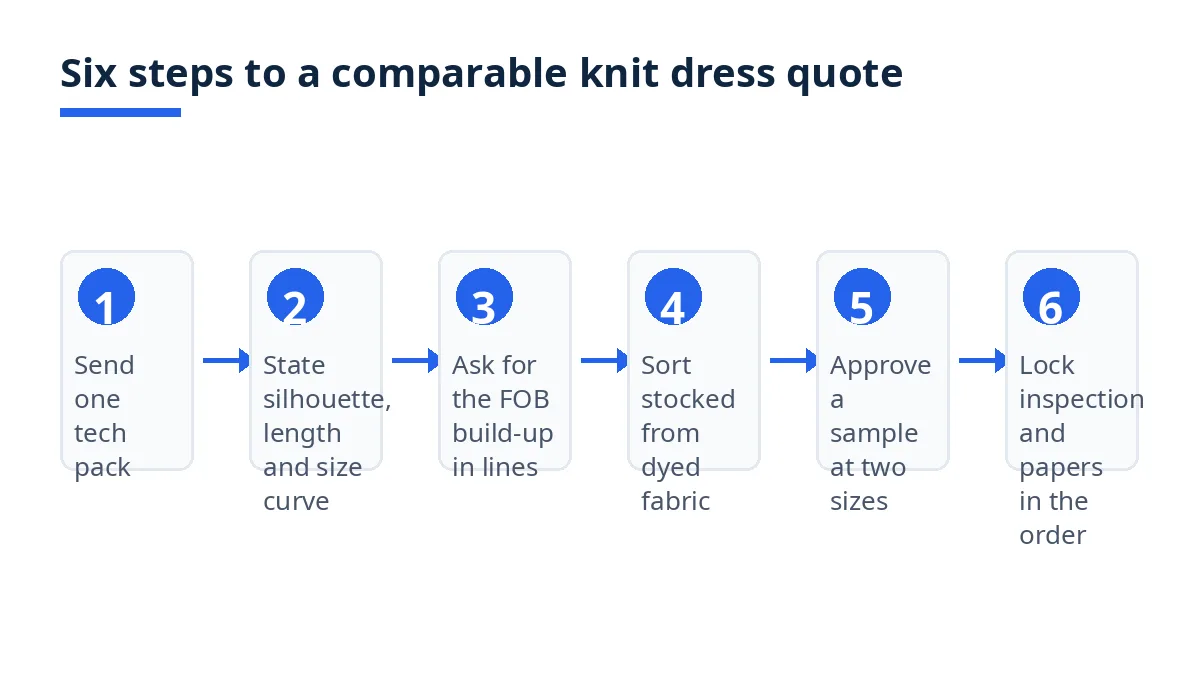
Fix finished measurements and marker width first. Send the silhouette, sleeve shape, finished length at each size and the measurement chart with tolerances, so every candidate measures consumption from the same dress.
Lock the print repeat and every embellishment position. State the repeat length, the match requirement, the print colours, and each embellishment with its exact position, such as a lace edge at the hem or bead work on the bodice.
Fix the size ratio and the weighted average. Send quantities per style, colour and size, and require the weighted average metres per dress to appear on the quote.
Require a line-by-line quote. Break the quote into cloth, print and embellishment, cut and sew, finishing and testing, packing, and inland transport and export handling, with FOB port and Incoterm stated.
Separate stocked cloth from cloth dyed to order. Record the status of each colour, and of lace, beads and labels, since a dyed-to-order colour or a special trim can set its own minimum and lead time.
Sample at two sizes, then write everything into the purchase order. Approve a pre-production sample in the actual cloth, colour, print and embellishment at a middle size and a larger size, then put the inspection plan, document set and FOB port and term on the purchase order.
Costs, timelines and documents
What are the typical costs and timelines?
No guide can state typical costs as fact, because each factory prices your cloth, silhouette and length, print and embellishment, size curve, packing and delivery term.1 Read any supplier quote against this structure.
Line in the quote | What it pays for | Dress input that shifts it |
|---|---|---|
Drape cloth | Cloth, dyeing, lining, facing | Knit family, fibre mix, weight, stocked or dyed |
Print and embellishment | Repeat printing, placement printing, lace, bead work | Repeat length, match waste, print colours, item count |
Cut and sew | Cutting, sewing, grading, hems, sleeves | Marker width, tiers, sleeve shape, size range |
Finishing and testing | Pressing, checking, drape and wash checks | Quality standard, test list |
Packing | Folding or hanging, polybags, hang tags, cartons | Hanging or folded packing, carton print |
Inland transport and export handling | Factory to port, port handling, loading | Distance to port, carton count |
Example figures: a per-dress build-up of 4.20 for drape cloth, 1.15 for print and embellishment, 1.75 for cut and sew, 0.40 for finishing and testing, 0.25 for packing, and 0.55 for inland transport and export handling, in US dollars. The example figures add to 8.30 per dress (4.20 + 1.15 + 1.75 + 0.40 + 0.25 + 0.55 = 8.30). For an order of 2,500 dresses, the example figures give an order value of 20,750 dollars (2,500 x 8.30 = 20,750). These example figures demonstrate build-up arithmetic only, not a market price or a price any supplier will offer.
Test a competing quote with the same arithmetic, and watch for the dress behind the difference. Example figures throughout: a second quote at 7.60 per dress looks 0.70 cheaper than the 8.30 example, but it prices a straight knee-length dress with a placement print, while the first prices a tiered maxi dress with an all-over print. Align length, silhouette and print coverage first; the gap may narrow or reverse. If no dress input moved and the price is far lower, ask what was left out, in writing.
For timelines, get a date for each stage on its own: sampling, cloth readiness, print approval, production and inspection. A single delivery date hides which stage slipped when the order runs late.
Which documents are needed?
Settle the papers before cutting, and use one legal name for buyer and seller on all of them. Start with the order set: tech pack, itemised quotation and purchase order, with silhouette, length, size curve, FOB port and Incoterm on the purchase order. Then confirm the shipping set required by the export clearance procedure: the export declaration goes with the commercial invoice, packing list, EXP form and certificate of origin.2 For European Union sales, see the label rules in the Bangladesh-specific section below.3
Bangladesh-specific rules and tips
Association membership, checked directly. If a supplier claims membership of the Bangladesh Knitwear Manufacturers and Exporters Association (BKMEA), confirm it with the association itself. BKMEA, established in 1996, is the apex trade body for the knitwear sector and represents approximately 2,540 knitwear member factories.4 Membership signals an active knitwear business, not a price or a suitability judgement for your silhouette and size curve.
Fibre first, then the classification line. Knitted dresses fall under heading 6104, and its dress subheadings split by fibre into wool or fine animal hair (610441), cotton (610442), synthetic fibres (610443), artificial fibres (610444) and other textile materials (610449).5 A viscose-blend dress and a cotton dress therefore sit on different lines even when the silhouette is identical, so confirm the subheading with your customs broker for your blend.
EU labels, agreed before production. For European Union sales, sort the label wording while the tech pack is still open. Regulation (EU) No 1007/2011 requires every constituent fibre to appear by name with its weight percentage, ordered from the largest share downward.3 Fixing a label after the dresses are made means a relabelling run; fixing it at tech-pack stage adds nothing.
Mistakes and red flags
What are the most common mistakes?
Comparing quotes built on different consumption figures. A lower price on a shorter dress, a straighter silhouette or a simpler sleeve is a different offer, as is a lower price on a middle-size average. Rank only replies measured on the same lengths, silhouette, sleeve shape, print coverage and size ratio, on the same Incoterm and FOB port.1
Pricing embellishment after the unit price is set. Lace, beads and sequins settled after the unit price is agreed tend to arrive as extras, or get thinned out to fit the price. Name every embellishment and its position in the tech pack, and price each on its own line.
Taking one total instead of the lines behind it. One number cannot show whether a later price move came from cloth, print or sewing, or which dress input changed. Insist on the line-by-line build-up, attached to the purchase order so later changes are measured against it.
Leaving an agreed change off the paper. A price, a shared dye lot or a revised size split that lives only in conversation is not part of the order yet. Put each agreed change on the quotation and the purchase order, noting the split it covers, so the factory cuts to the document the buyer approved.
Sampling one size only. The pre-production sample is where drape, print match at seams and hem behaviour are proven, and a middle size cannot prove them for a larger size. Sample a larger size as well as a middle size, in the actual cloth, colour, print and embellishment.
Checklist
Finished lengths, silhouette and sleeve shape at every size, with tolerances, in every tech pack sent.
Repeat length, matching allowance, print colours and each embellishment position written into the tech pack.
Quantities per style, per colour and per size sent, with the weighted metres per dress stated on the quote.
Separate lines for cloth, print and embellishment, sewing, finishing, packing and port delivery, with the port named.1
Stocked versus dyed-to-order status noted for each colour, plus minimums for trims, labels and cartons.
Two-size sample approval: middle and larger, measured and washed, signed off before production.
Inspection method, label wording and commercial terms agreed before any cutting starts.
How Exportain helps
Shortlist candidates in the supplier directory, then send the tech-pack summary, silhouette, length and size ratio out as an RFQ on the RFQ board. Ask each reply to state its weighted consumption figure and to break the FOB figure into lines. Badge checks cover documents and photos, not factory inspection, so sample approval and inspection remain your responsibility.6 7
FAQs
What should I know first about knit dresses?
Begin with the dress inputs that set the metre figure: weighted average consumption across your size ratio, print repeat with matching waste, silhouette, sleeve shape and finished length, and drape cloth family, fibre mix and weight. The fibre mix also decides the subheading under heading 6104.5
What are the typical costs and timelines?
No published figure can stand in for your quote, since price and lead time both follow your specification. Cloth consumption, silhouette and length, print coverage with matching waste, the size curve and the delivery term move the price,1 while sampling, dyeing, printing and line capacity move the timeline. Request the FOB figure in lines, with a date for each stage.
Which documents are needed?
Two paper sets matter. Before production, the tech pack, itemised quotation and purchase order fix the dress, the price lines and the port. With the goods, the export declaration travels alongside the commercial invoice, packing list, EXP form and certificate of origin.2 Labels follow the rules of the destination market, including Regulation (EU) No 1007/2011 in the European Union.3
What are the most common mistakes?
The recurring mistakes are ranking quotes measured on different consumption figures, omitting print matching waste from the metre figure, settling embellishment after the unit price, taking one total instead of the lines behind it, leaving an agreed change off the paper, and sampling a single size. Rank only replies measured on identical dress inputs, with the same Incoterm and the same FOB port.1
Next steps on Exportain
Start in the supplier directory, then send your tech-pack summary, silhouette, length and size ratio out as an RFQ on the RFQ board, asking for itemised FOB quotes built on a stated consumption figure. Before confirming, read how to import knit dresses from Bangladesh and the knit dresses quality checklist.
Sources
- Incoterms® 2020. International Chamber of Commerce (ICC) (accessed )
- Customs Clearance Procedures for Export. Bangladesh Customs, National Board of Revenue (accessed )
- Regulation (EU) No 1007/2011 on textile fibre names and related labelling and marking of the fibre composition of textile products. European Union, (accessed )
- BKMEA at a Glance. BKMEA (accessed )
- Classification Detail — HS Code 6104. United Nations Statistics Division (accessed )
- Trust & Safety Center. Exportain (accessed )
- Supplier verification: Earn trust badges buyers can see. Exportain (accessed )
About the author
Sourcing from Bangladesh?
Post a request for quotation and suppliers on Exportain can send you their quotes directly.
Post an RFQ