

Knit Dresses Lead Time From Bangladesh: Production and Shipping Timeline
Knit dresses lead time from Bangladesh: gated stages for pattern, neckline, hem, drape, print placement and size curve, plus a planning table and checklist for buyers.
Short answer
A knit dresses lead time from Bangladesh is a chain of gated approvals, not a single figure. Dress pattern and grading, neckline and armhole finishing, hem length, drape and hand-feel, print placement on a dress panel, and size-curve approval must close in writing before bulk sewing, and labelling, inspection, export clearance, and transit close after it. Every duration is a planning example or a dated quotation figure.
On this page
Key takeaways
A knit dresses lead time is a chain of gated approvals, not a single figure: dress pattern and grading, neckline and armhole finishing, hem length, drape and hand-feel, print placement on a dress panel, and size-curve approval close in writing before bulk sewing.
The knit-dress-specific gates are dress pattern and grading approval, neckline and armhole finishing on the garment itself, hem finishing and length consistency on a hung dress, drape and hand-feel approval on a washed finished dress, print or embroidery placement on a dress panel, and size-curve approval across dress sizes.
Wash-care labelling is a buyer-specification item inside bulk sewing: the label must match the approved composition and care instructions, and market-specific documents for the destination market must be confirmed in writing before bulk labelling.
Inspection, export clearance, and transit close last, with transit read only from a dated forwarder estimate for the exact route and port pair, and a buffer after inspection written into the plan.
A knit dress is judged as one continuous line, from neckline to hem. A neckline that pulls, an armhole that binds, a hem that rises at one side, or a print higher on one colour than on another will be seen at once. A dress fitting one size and colour proves nothing about the rest. Replace every planning figure here with the dated figures in the written quotation and forwarder estimate for the actual order.
Knit dresses add gates where timetables slip most often: dress pattern and grading, neckline and armhole finishing, hem finishing and length consistency, drape and hand-feel, print or embroidery placement on a dress panel, size-curve approval across dress sizes, and wash-care labelling as a buyer-specification item. A skipped gate reappears later, when correction means re-sewing finished dresses.
Why this matters for buyers and sellers
For a buyer, the timetable decides whether a complete range reaches the shelf with every neckline, hem, print, and length in the same place across colours and sizes. A range arriving with one colour still in drape approval or hems at different lengths is not a complete delivery, even if most cartons have arrived. Working backward from the on-sale date, with a buffer after inspection, leaves room for one correction cycle per gate.
For a seller, the same gates protect the production plan: written approval at each gate, naming the size, colour, and panel covered, prevents late disputes. The Bangladesh Knitwear Manufacturers and Exporters Association (BKMEA), established in 1996, is the apex trade body for the knitwear sector, representing approximately 2,540 knitwear member factories.1
Step-by-step: how it works
Read any supplier timeline against seven dress gates, followed by inspection, clearance, and transit. If a reply skips a gate, ask where that approval sits. A gate closes only by written approval naming the sizes and colours covered.
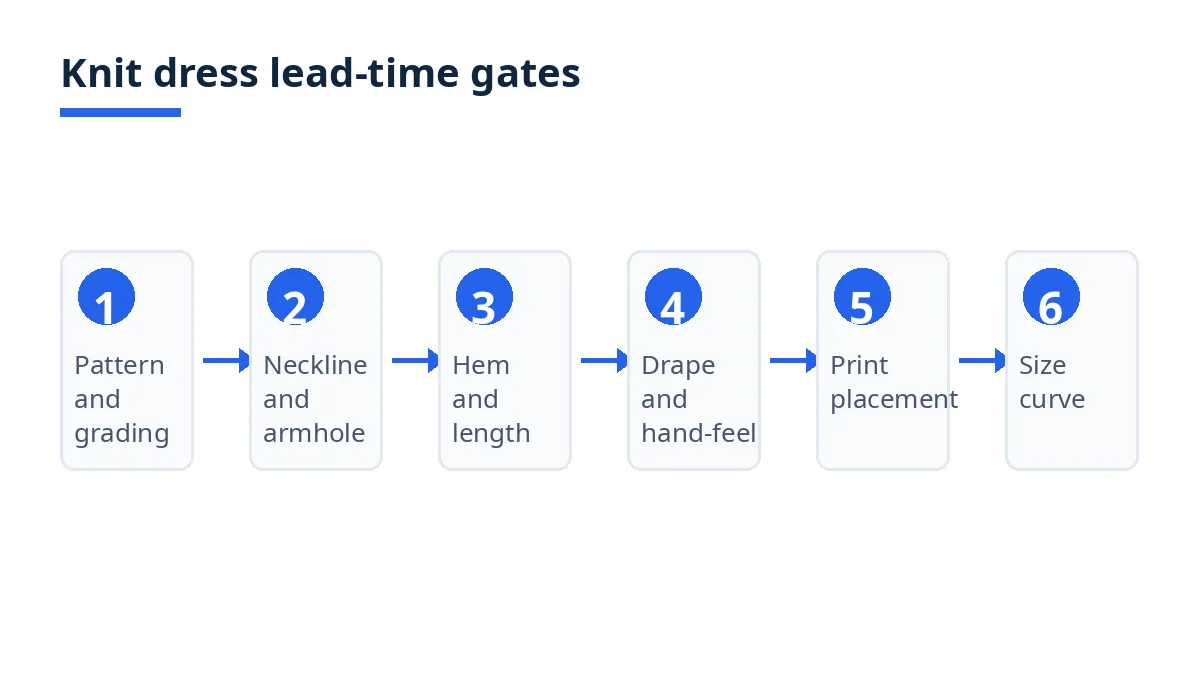
Close the pattern gate: dress pattern and grading approval. State silhouette, length, neckline shape, sleeve length, waist and hip placement, and the finished measurement for each size in the tech pack. Approve the pattern on a sewn sample, then the grading, which is how each measurement changes from one size to the next. Approval on one sample size does not prove the smallest and largest sizes.
Close the neckline and armhole gate: finishing on the garment itself. Approve the finishing method, finished width, joining method, and how the edge should lie after the agreed wash check. Approve it on a finished dress, worn or on a form, after that wash check. Finishing checked only laid flat does not prove it will lie flat in wear.
Close the hem gate: hem finishing and length consistency. Approve the hem method, hem depth, finished length measured from a stated point, and the tolerance accepted between sizes and colours. Approve the hem on a finished dress hung, not only laid flat.
Close the drape gate: drape and hand-feel approval. Approve fabric construction, fabric weight as a buyer specification, the colour reference for each colour, and the washed state in which the sample is judged. Approve drape and hand-feel on a finished dress on a form, after the agreed wash check. A fabric swatch alone does not prove how a skirt falls.
Close the print gate: print or embroidery placement on a dress panel. Approve the artwork, the placement point measured from stated reference points, the print or embroidery size, and the colour reference for each print colour. Approve placement on a finished panel in each colour, and on the smallest and largest sizes, since the same artwork occupies a different share of a small panel than of a large one.
Close the size-curve gate: approval across dress sizes. Approve the full size range, the finished measurement for each size, and the measurement points for bust, waist, hip, length, neckline, and armhole. Approve the curve on finished samples covering the smallest, middle, and largest sizes, not only the sample size.
Close bulk sewing with labelling, then inspection, clearance, and transit. Bulk sewing starts only after the six dress gates above are closed in writing for the sizes and colours in the order. Wash-care labelling is a buyer-specification item here: the label must match the approved composition and care instructions, and its position and size must match the approved sample. Inspection checks finished dresses against the approved samples, using the sampling approach agreed in writing. Transit is read only from a dated forwarder estimate for the exact route and port pair.
Stage | Gate that must close | Illustrative planning example, not a promise |
|---|---|---|
Pattern and grading | Pattern and grading approved in writing | Example: 4 days for pattern correction |
Knit and colour | Fabric, colour, drape, hand-feel approved on washed samples | Example: 7 days for knit approval |
Neckline and armhole | Finishing approved on a finished dress after the wash check | Example: 3 days for finishing correction |
Hem and length | Hem method and length approved on a hung dress | Example: 2 days for hem rework |
Print or embroidery | Placement approved on a finished panel in each colour | Example: 4 days for placement |
Size curve | Smallest, middle, largest sizes approved in writing | Example: 5 days for size curve |
Bulk sewing and labelling | Bulk sewing, labelling, packing approved against samples | Example: 12 days for bulk sewing |
Inspection, clearance, transit | Inspection passed, clearance approved, transit from a forwarder estimate | Example: 2 days for inspection and clearance |
Do not add the example blocks into a single promised date.
Worked example: a midi knit dress in three colours
Illustrative planning example only: a midi knit dress in three colours, sizes XS to XL, with a boat neckline, short sleeves, a hemmed skirt, and a print on the front panel. In week one, pattern and grading close for the full size range, and knit, colour, drape, and hand-feel close on washed samples in all three colours. In week two, neckline and armhole finishing and the hem close on finished dresses, with length measured from the same stated point on every size. In week three, print placement and the size curve close, and bulk sewing follows only after those approvals. Inspection, clearance, and transit close last, with transit from a dated forwarder estimate.
If print placement had been approved only on a flat panel, a stretched panel could have shifted the artwork.
Costs, timelines and documents
Costs move with the same gates that move time: fabric construction and weight, colour count, print coverage, size range, finishing method, labelling, inspection scope, delivery term, and transit route. A quotation bundling those items into one figure cannot be compared with one that splits them, so ask for the same cost split from every supplier.
Example figures only, for a planning sheet: fabric USD 3.80, trims and labels USD 0.65, cutting and sewing USD 2.40, print USD 0.90, inspection and packing USD 0.55, and inland and export handling USD 0.70, giving an example subtotal of USD 9.00. Those figures show how a sheet is structured, not a price for any dress. Destination freight, insurance, duty, and onward delivery sit outside that subtotal until the delivery term and forwarder estimate place them. If a supplier quotation differs, the quotation governs.
A quotation timeline should name each gate, the written approval that closes it, and the buffer after inspection. A quotation with one date, no gates, and no buffer leaves no room for a rejected neckline or a corrected hem. Ask for the buffer in writing.
Documents fall into three sets: the order set (tech pack, gate approvals, purchase order or contract, commercial invoice and packing list); the product set (approved composition and care information for labelling, plus market-specific documents confirmed in writing); and the shipment set (export declaration and transport document under the agreed delivery term). Bangladesh Customs requires that goods are not loaded for export unless a Bill of Export is submitted and approved, and the enclosed set includes the commercial invoice, packing list, EXP form, and certificate of origin, among other items.2
Bangladesh-specific rules and tips
Classification comes first in the document set. Heading 6104 covers suits, ensembles, jackets, dresses, skirts, and related garments for women or girls, knitted or crocheted, and subheadings 610441 to 610449 divide dresses by fibre, including wool or fine animal hair, cotton, synthetic fibres, artificial fibres, and other textile materials.3 Confirm the subheading for the actual fibre composition in writing with your forwarder or customs broker, because it follows the fibre, not the style name.
Labelling is a market-specific item to confirm in writing for each destination market, not a single rule applied everywhere. Regulation (EU) No 1007/2011 covers textile fibre names and related labelling and marking of fibre composition in the European Union.4 For a European destination, confirm in writing which fibre names, composition statements, and label items your market requires, and match the wash-care label to the approved composition and care instructions. For another market, confirm the equivalent items before bulk labelling.
Delivery terms are agreed in writing as part of the quotation, not assumed from a price. Incoterms 2020 provides 11 rules allocating cost, risk, and obligations, used in trade contracts since 1936 and updated in 2020.5 Name the rule, the named place, and the edition together in the contract, so the delivery point and risk point are not left to interpretation. If inspection is agreed in writing, state the sampling approach in writing as well. ISO 2859-1:2026 defines acceptance sampling plans indexed by acceptance quality limit for lot-by-lot inspection.6 Agreeing that approach in writing, with sample size and acceptance basis stated, prevents a dispute about whether inspection covered the size curve, hem lengths, and print placements.
Three tips save time: approve the washed state early, approve the hem hung and the neckline on a form, and keep one approval file per order, so inspection can be checked against the same approvals bulk sewing followed.
Mistakes and red flags
Approving the pattern on one size only, approving the hem laid flat, and approving print placement on one colour only are the three most common dress-gate failures. Each shares one cause: an approval that named too little, covering one size, colour, or state, when bulk sewing needed all of them.
Other red flags in a supplier reply: one date and no gates, wash-care labelling treated as an afterthought, transit promised without a dated forwarder estimate, and a delivery term left unnamed. A quotation mixing cost bases is another: a price including destination freight compared against a price stopping at the port is not a comparison. Re-price every quotation to the same point, using the same delivery term and forwarder estimate, before judging which is cheaper.
Checklist
Use this checklist before bulk sewing starts.
Tech pack states silhouette, length, neckline, sleeve length, waist and hip placement, and finished measurements for every size.
Pattern and grading approved in writing for the full size range, including the smallest and largest sizes.
Neckline and armhole finishing approved on a finished dress after the agreed wash check.
Hem method, depth, and finished length approved on a hung dress, measured from the same stated point on every size and colour.
Drape and hand-feel approved on a washed finished dress, for every colour.
Print or embroidery placement approved on a finished panel in each colour and on the smallest and largest sizes.
Size curve approved on finished samples covering the smallest, middle, and largest sizes.
Wash-care labelling matches the approved composition and care instructions, with label position and size matching the sample.
Inspection scope, sampling approach, and acceptance basis agreed in writing, covering hem lengths, print placements, and size curve.
Delivery term, named place, and edition stated in full in the contract, with transit from a dated forwarder estimate.
Export declaration set prepared, including the commercial invoice, packing list, EXP form, and certificate of origin, with market-specific documents confirmed in writing.
Buffer after inspection written into the plan, with the on-sale date protected by working backward.
How Exportain helps
Exportain gives buyers a place to compare knit dress suppliers on the same gate table, the same tech pack, and the same delivery term, rather than on headline dates alone. A buyer can set out the seven dress gates in the request, ask each supplier to name the written approval for each gate, and compare replies gate by gate.
FAQs
What should I know first about knit dresses?
Know the seven dress gates before you judge any timetable: pattern and grading, neckline and armhole finishing, hem and length, drape and hand-feel, print or embroidery placement, size curve, and bulk sewing with labelling, followed by inspection, clearance, and transit. A gate approved on one size, colour, or state does not settle bulk sewing.
What are the typical costs and timelines?
Costs and timelines here are planning examples and quotation items, not promises. Costs move with fabric, colour count, print coverage, size range, finishing, labelling, inspection scope, delivery term, and transit route, and the example cost sheet shows how to structure a comparison, with destination freight, insurance, duty, and onward delivery placed by the delivery term and forwarder estimate. Timelines move with the same gates: each gate needs a written approval and a buffer after inspection.
Which documents are needed?
The order set is the tech pack, the written gate approvals, the purchase order or contract, and the commercial invoice and packing list. The product set is the approved composition and care information for labelling, plus market-specific documents confirmed in writing. The shipment set is the Bill of Export, with the commercial invoice, packing list, EXP form, and certificate of origin, and the transport document under the agreed delivery term.2 Confirm the HS subheading for the actual fibre composition in writing, since heading 6104 divides dresses by fibre.3
What are the most common mistakes?
The most common mistakes are approving the pattern on one size only, approving the hem laid flat instead of hung, approving print placement on one colour only, and treating a fabric swatch as drape approval for a full skirt. Others are accepting one headline date with no gates, leaving the delivery term unnamed, accepting transit without a dated forwarder estimate, and comparing quotations priced to different points. Avoid each one the same way: name the gate and the sizes and colours it covers.
Next steps on Exportain
Compare knit dress suppliers on the same gate table by browsing supplier listings, read how each delivery term divides cost and risk in the Incoterms guide for shipments from Bangladesh, and post a request setting out the seven dress gates on the RFQ board. Ask each reply to name the written approval for pattern, hem, drape, print, and size curve.
Sources
- BKMEA at a Glance. BKMEA (accessed )
- Customs Clearance Procedures for Export. Bangladesh Customs, National Board of Revenue (accessed )
- Classification Detail — HS Code 6104. United Nations Statistics Division (accessed )
- Regulation (EU) No 1007/2011 on textile fibre names and related labelling and marking of the fibre composition of textile products. European Union, (accessed )
- Incoterms® 2020. International Chamber of Commerce (ICC) (accessed )
- ISO 2859-1:2026 - Sampling procedures for inspection by attributes — Part 1: Sampling schemes indexed by acceptance quality limit (AQL) for lot-by-lot inspection. ISO (accessed )
About the author
Sourcing from Bangladesh?
Post a request for quotation and suppliers on Exportain can send you their quotes directly.
Post an RFQ


