Kitchen Towels Price in Bangladesh: FOB Cost Breakdown for Buyers
Kitchen towels FOB price in Bangladesh, broken down component by component: terry yarn and fabric, dyeing and printing, cutting and hemming, trims, packing, inspection and port delivery, with example figures showing how each driver moves the total.
Short answer
A kitchen-towel FOB price from Bangladesh is the seller's price for towels delivered loaded on board the vessel at the named port of shipment. It adds up terry yarn and fabric, dyeing or printing, cutting and hemming, trims and packing, inspection, export documents and port delivery. The buyer pays ocean freight, insurance and import costs after loading. There is no single market price: every quotation depends on the towel specification, the order split and the named port.
On this page
Key takeaways
A kitchen-towel FOB price is the seller's price up to loading on board at the named port; ocean freight, insurance and import costs after that point sit with the buyer.
Fabric is the largest block, followed by dyeing or printing, cutting and sewing, and trims and packing; inspection, export documents and port delivery close the build-up.
Colour count, cloth weight, towel size, size mix and pack format are the drivers that move the total; a second colour or a heavier cloth moves its own block.
Compare quotations only on the same towel, the same split per colour and size, the same itemised blocks and the same named port.
Example figures show structure only; your quotation replaces them with the factory's figures for your towel.
A kitchen-towel FOB price from Bangladesh is the seller's price for towels delivered loaded on board the vessel at the named port of shipment. It is not a single market rate. It is a build-up: yarn and fabric, dyeing or printing, cutting and hemming, trims and packing, inspection, export documents and port delivery, added together up to loading. The buyer pays ocean freight, insurance and import costs after that point. Every number here is an example figure showing structure only, not a market price. No two quotations match unless the towel specification, the order split and the named port match.
What an FOB kitchen-towel price covers
Under the Incoterms 2020 FOB rule, the seller delivers the goods loaded on board the vessel nominated by the buyer at the port of shipment, and risk transfers to the buyer at that point.1 The seller carries the goods to the port, loads them on board and completes export formalities, while the buyer contracts the carrier, pays freight and handles import formalities.1 The Incoterms 2020 rules allocate cost, risk and obligations clearly, so a quotation naming only "FOB" without a port is incomplete.2
Three boundaries decide what sits inside the price. The named port matters, because inland transport and port handling differ by route. The loading point matters, because FOB covers loading on board; where containerised goods are delivered to a terminal instead, the FCA rule is the more appropriate Incoterms rule.1 And the basket matters: the FOB price covers the finished, packed towel with labels and cartons, but not ocean freight, insurance, destination charges, import duty or onward delivery. Comparing FOB with CIF compares different baskets, because CIF adds freight and insurance to the seller's side.
The FOB build-up, block by block
A kitchen-towel FOB price has seven blocks, in factory order, shown below with what moves each one. The sections that follow take each block in turn.
Block | What sits inside it | What moves it |
|---|---|---|
Yarn and fabric | Yarn, weaving, weight, width | Weight, yarn fineness, size |
Dyeing and printing | Dye or print, matching, drying | Colour count, depth, print method |
Cutting and sewing | Cutting, hems, stitching, borders | Size mix, hem type, border detail |
Trims and packing | Labels, tags, inner packs, cartons | Label count, pack format, carton spec |
Inspection | Pre-shipment checking, agreed plan | Inspection level, re-checks |
Export documents | Invoice, packing list, EXP form, origin certificate | Destination document set |
Port delivery | Inland transport, handling, loading | Distance to port, port charges |
The diagram below shows the build-up in factory order.
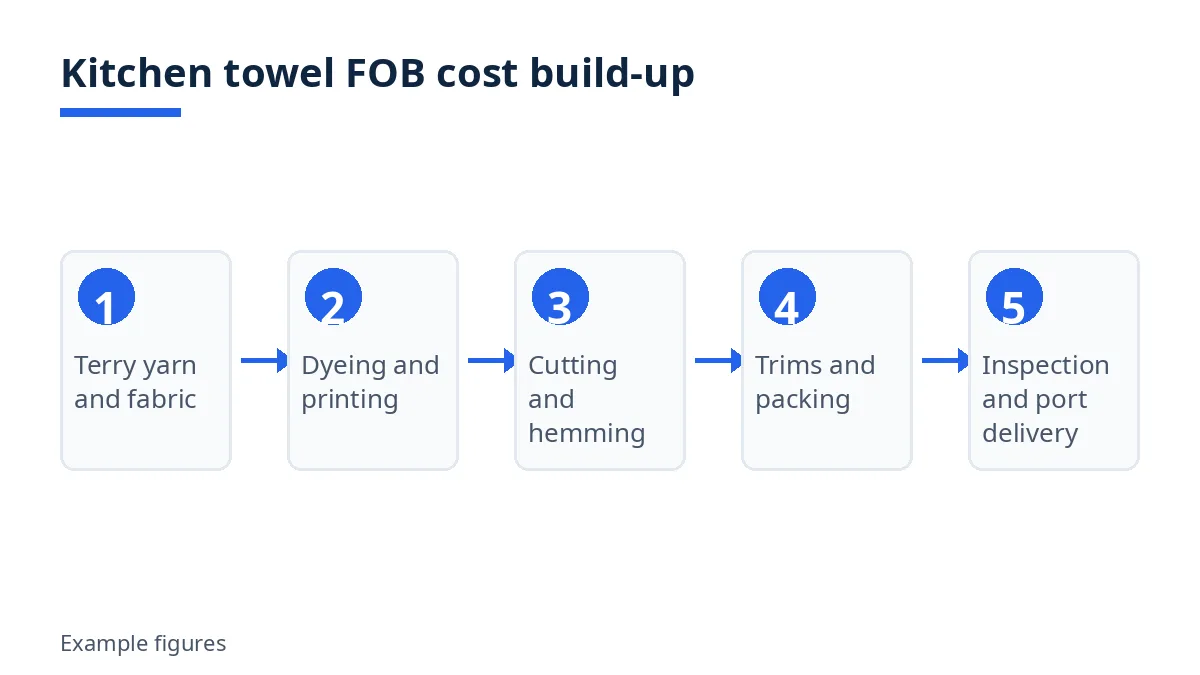
Terry yarn and fabric
Fabric is usually the largest block, because the towel is mostly yarn. A terry towel has looped pile for absorbency, while a flat-weave tea towel has no pile and is used for drying and polishing. The two consume yarn differently, so they price differently at the same size.
Heading 6302 covers bed, table, toilet and kitchen linen; within it, 6302.60 covers kitchen and toilet linen of terry towelling or similar terry fabrics, of cotton, while 6302.91 covers toilet and kitchen linen of cotton excluding terry fabrics.3 Man-made fibre kitchen linen sits at 6302.93 and other materials at 6302.99.3 State construction and fibre on the enquiry: a terry quotation cannot be compared with a flat-weave quotation.
Three choices move this block most: heavier cloth uses more yarn per towel, finer yarn costs more per kilogram than coarser yarn, and a larger towel consumes more fabric per piece, including cutting waste. Change any one and the FOB total moves even when every other block stays fixed.
Dyeing, printing and finishing
Dyeing and printing turn grey fabric into the finished colour or design. A dyed towel is coloured in a dye lot, so the lot minimum can set the smallest run for that colour. A printed towel carries artwork instead of, or in addition to, a ground colour, and each print colour adds a screen and a pass.
Colour count is the main driver. One plain colour needs one dye lot; three colours need three lots, three matches and three set-ups, and a small quantity split across three colours can fall below the lot minimum for one colour. Dark colours generally need more dye and longer processing than pale colours. Ask whether each colour is dyed to order or stocked, because a stocked colour removes the lot minimum from that line.
Cutting, hemming and sewing
Cutting turns finished cloth into towel blanks, and hemming and sewing finish the edges. A kitchen towel is normally hemmed so it does not fray in use and washing. A dobby border, a woven stripe or a hanging loop each add a step, and each step adds labour and machine time.
Size mix moves this block. Several sizes need separate cutting markers, and small sizes leave different waste than large sizes from the same cloth width. A single size in a long run cuts efficiently, while a mixed range wastes more cloth per piece in its smallest size. State the size range and ratio on the enquiry.
Trims, labels and packing
Trims, labels and packing are small lines buyers often overlook, and they move a price twice: through their own cost and their own minimums. A woven label, a printed care label, a hang tag and a barcode label are each ordered in their own run, and a small order can fall below the label run even when the towel quantity clears the fabric minimum.
Packing follows the same logic. Towels may be packed singly, in sets or in bulk, and the pack format decides the polybag, insert and carton count. A set pack needs collation, so labour rises with pieces per set, and a printed carton carries its own print run. State the pack format, pieces per pack and carton marking, and ask whether labels and cartons sit inside the towel price or are charged apart.
Labels also carry a legal duty. For sales into the European Union, Regulation (EU) No 1007/2011 lays down harmonised provisions on textile fibre names and labelling of fibre composition, and fibre labelling is compulsory so correct, uniform information reaches consumers.4 A fibre change after quotation can therefore change both the label and the price.
Inspection, export documents and port delivery
The last three blocks take the packed towel from the factory floor to the vessel. Inspection checks the shipment against an agreed plan before it leaves. ISO 2859-1 defines a system of acceptance sampling plans for inspection by attributes, indexed by acceptance quality limit (AQL) for lot-by-lot inspection, and AQL is the maximum average percentage of defective items considered acceptable during random sampling, used to set sample sizes and acceptance or rejection thresholds.5 Agree the level and AQL values in writing before production.
Export documents are the paper that lets the goods leave Bangladesh. Goods may not be loaded for export unless an export declaration, the Bill of Export or Shipping Bill, is submitted to Customs and approved, with the export contract or purchase order where there is no export letter of credit, the commercial invoice, the packing list, the EXP form certified by an authorized dealer and a certificate of origin issued by the EPB or a Chamber of Commerce and Industry.6 A destination requiring an extra certificate adds a document line.
Port delivery is inland transport, terminal handling and loading on board, driven mainly by distance: a factory far from the named port carries higher inland transport than one near it. Two quotations at different ports are therefore never directly comparable.
Worked example: one dozen, priced block by block
Example figures: the table prices one dozen plain terry kitchen towels, FOB Chittagong, as structure only, not market prices.
Block | Example figure per dozen (USD) |
|---|---|
Terry yarn and fabric | 5.40 |
Dyeing and finishing | 1.80 |
Cutting, hemming and sewing | 1.60 |
Trims, labels and packing | 0.95 |
Inspection | 0.35 |
Export documents | 0.25 |
Port delivery | 0.60 |
FOB total per dozen | 10.95 |
The arithmetic is the point, not the numbers: fabric is the largest block at 5.40, the three factory blocks after it add 4.35, and the three closing blocks add 1.20. A buyer who asks for the blocks can see at once which block moved when the price changes.
How each driver moves the price
Heavier cloth. More yarn per towel raises the fabric block directly, and a heavier towel also takes longer to dye and dry, so the dyeing block rises with it.
An extra colour. A second colour adds a dye lot, a colour match and a set-up, and splits the order so each colour carries less. If one colour falls below its lot minimum, it carries a surcharge or is dropped. In the worked example, adding a second dyed colour at an example 0.40 per dozen would lift the FOB total from 10.95 to 11.35 per dozen.
Printing instead of dyeing. A printed design replaces part of the dyeing block with a print block: screens, print colours and registration. One print colour on a plain ground is a small addition; a multi-colour print is larger.
A larger towel or a mixed size range. A larger towel consumes more fabric and dye per piece, and a mixed range adds cutting markers and waste in the small sizes. The smallest-quantity size carries the highest cost per piece.
Reading a quotation line by line
Ask for five things on every quotation.
The towel, in full. Construction, fibre, weight, size, hem, border, colours, pack format. Without these, the price is for an unknown towel.
The named port and term. FOB plus the port of shipment, in the form FOB Chittagong, Incoterms 2020. "FOB" alone leaves port delivery undefined.
The blocks, itemised. Fabric, dyeing or printing, cutting and sewing, trims and packing, inspection, documents, port delivery, each on its own line.
The split, per colour and per size. Quantity per colour and per size, with the size ratio. A total without a split hides the per-colour lot minimum.
The dates, as separate lines. Sampling, fabric ready, production, inspection and loading dates. A single delivery week hides the step that is late.
Compare only quotations matching on all five: a lower total on a lighter cloth, a fewer-colour design, a bulk pack or a nearer port is a different towel or delivery, not a better price.
What should I know first about kitchen towels?
Start with construction: a terry kitchen towel is a looped-pile cotton towel at 6302.60, while a flat-weave cotton tea towel sits at 6302.91, with man-made fibre kitchen linen at 6302.93 and other materials at 6302.99.3 A terry towel must absorb; a flat-weave towel must dry and polish without linting, and the checks for each differ.
Fix the specification before asking for prices: construction, fibre, weight, size, hem, colours and pack format are the inputs to every block in this guide, and a price asked without them is a guess. Remember the boundary: the FOB price ends when the towels are loaded on board at the named port.1 Freight, insurance and import costs after that point are yours, so budget them separately.
What are the typical costs and timelines?
There are no typical costs or timelines a guide can state as fact for kitchen towels, because each factory prices your construction, weight, colours, size range, pack format and named port. The blocks above are the structure of the price; your quotation replaces the example figures with the factory's figures.
Timelines follow the same logic: sampling depends on fabric availability and correction rounds, bulk production on dyeing, finishing, trim delivery and line capacity, and inspection and loading on the agreed plan and vessel schedule. Ask for those dates as separate lines, and treat a quotation giving only a single delivery week as incomplete.
Which documents are needed?
The order documents are the tech pack or specification sheet, the itemised quotation and the purchase order, with the blocks, the split per colour and size and the named port on all three. The export set is the Bill of Export, the commercial invoice, the packing list, the EXP form certified by an authorized dealer and a certificate of origin issued by the EPB or a Chamber of Commerce and Industry, with the export contract or purchase order enclosed where there is no export letter of credit.6 For sales into the European Union, the fibre label must follow Regulation (EU) No 1007/2011.4 Confirm any destination-specific certificate before confirming the order: a late certificate can hold the shipment.
What are the most common mistakes?
Comparing FOB with CIF, or FOB at different ports. The baskets differ. Compare FOB with FOB at the same named port, for the same towel.
Asking for a total only. The binding constraint is usually inside a block: a per-colour dye lot, a label run or a carton run. An order can clear the total and still fail on one colour.
Ignoring the per-colour split. A total split across many colours multiplies dye lots and set-ups. State the quantity per colour and check each against its lot minimum.
Treating a profile or a badge as a price or quality promise. A badge records checks made; it is not a guarantee of capacity, quality or delivery.
Skipping the inspection plan. Sampling under ISO 2859-1 checks a lot against an agreed AQL before the goods become your stock.5
Accepting an unnamed port or an unitemised total. Get the port, the blocks and the split in writing on the quotation and the purchase order.
How Exportain helps
On Exportain, browse suppliers and post a request for quotation on the RFQ board with your towel specification, split per colour and size and named port, so suppliers quote against the same towel and delivery point. Ask each reply for its itemised blocks, not only a total. When you accept a quotation, Exportain creates one order and issues one proforma invoice from the accepted terms.
Read the badges for what they record. Verification is a document review by Exportain staff, not a factory inspection and not a check against a government database, and a badge is not a guarantee of production capacity, product quality or delivery.7 Exportain Verified means Exportain has checked identity, phone, email and business registration, and Export Verified means it has checked the Export Registration Certificate.7
Next steps on Exportain
Browse suppliers, then post your towel specification, split and named port on the RFQ board so suppliers itemise their FOB blocks. Before you confirm, read how to import kitchen towels from Bangladesh, the kitchen towels quality control checklist and the HS code for kitchen towels guide.
Sources
- FOB & FAS Incoterms® 2020 explained: Key differences. ICC Academy (accessed )
- Incoterms® 2020. International Chamber of Commerce (ICC) (accessed )
- HS 2017 - Code 6302: Bed linen, table linen, toilet linen and kitchen linen. United Nations Statistics Division (accessed )
- Regulation (EU) No 1007/2011 on textile fibre names and related labelling and marking of the fibre composition of textile products. European Union, (accessed )
- ISO 2859-1:2026 - Sampling procedures for inspection by attributes — Part 1: Sampling schemes indexed by acceptance quality limit (AQL) for lot-by-lot inspection. ISO (accessed )
- Customs Clearance Procedures for Export. Bangladesh Customs, National Board of Revenue (accessed )
- Trust & Safety Center. Exportain (accessed )
About the author
Sourcing from Bangladesh?
Post a request for quotation and suppliers on Exportain can send you their quotes directly.
Post an RFQ