Kitchen Towels Lead Time From Bangladesh: Production and Shipping Timeline
Plan a kitchen towels lead time from Bangladesh by wash-durability gates: job and GSM, weave and hem, washed absorbency, linting and shrinkage checks, kitchen-use labelling, then bulk pressing, folding, packing, inspection, documents, and loading.
Short answer
A kitchen towel lead time from Bangladesh runs on wash-durability gates, not a single production run: kitchen job and GSM, weave and hem, a washed sample for absorbency, linting and shrinkage, kitchen-use labelling, bulk pressing, folding and packing, then inspection, documents and loading. Every duration is an illustrative planning example only. Replace it with the dated figures in the written quote and the dated forwarder estimate before setting a selling date.
On this page
Key takeaways
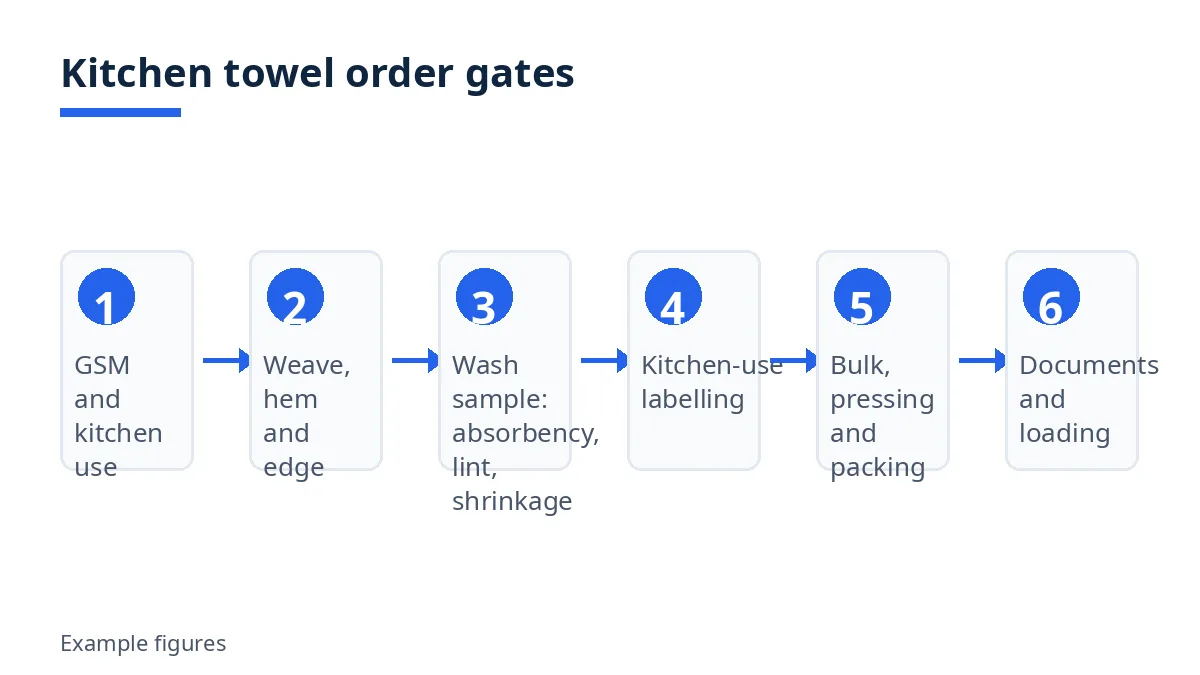
A kitchen towel order runs on wash-durability gates in a fixed order: kitchen job and GSM before weave and hem approval, weave and hem before the washed sample, the washed sample before labelling approval, labelling before bulk pressing, folding and packing, and packing before inspection, documents and loading approval.
State the kitchen job and GSM range in writing first: lightweight towels near 350 gsm suit high-use kitchen work because they wash and dry quickly, and a daily-washed towel must dry between uses and keep its size and edges after many cycles, not merely feel soft when new.
Approve hems and edges only on a washed sample: tea towels and linens are listed at 12 to 14 stitches per inch to prevent edge unravelling after industrial washing, and the sample must be checked after washing for curling, fraying and loose threads at the corners.
Close the washed sample on three results from the same sample with the wash count stated: absorbency with a drop absorbed within 5 seconds under the stated test method, a glassware lint check, and shrinkage within plus or minus 3.0 percent under its stated method, with softener effects checked because softeners can repel water.
A kitchen towel order from Bangladesh is decided at the wash, at the hem, at the glass, and at the fold. A towel that looks right on a first sample can still fail when it leaves lint on glassware, when its hem curls after washing, or when it shrinks out of size. A kitchen towel is washed far more often than a display towel, so the order must be read through wash-durability gates in a fixed order. Every duration here is an illustrative planning example only, or an item to confirm in the written quote and dated forwarder estimate.
Why this matters for buyers and sellers
A kitchen towel is judged wet, after washing, and in daily use, not dry on a table and not once. The buyer states the kitchen job first: drying dishes and glassware without lint, drying hands through a working day, or wiping surfaces between washes. Each job points to a different towel, and a sample approved for one job has not been approved for the other.
The seller needs the same job stated in writing before cutting. Weight, weave, hem, wash test, and label all follow from the job, and a change to any one of them reopens the gates after it. When the job is vague, sample, bulk, and inspection measure different things.
Step-by-step: how it works
Read a kitchen towel order against six gates, in this order.
Gate 0: Kitchen use and GSM decision
Gate 0 fixes the job and the weight before any fabric is cut. Grams per square metre, or gsm, is the standard unit of weight used to measure towels, and the higher the gsm, the more absorbent the towel will be.1 Every towel is made up of a pile and a base weave, and loop size, yarn thickness, and loop tightness all affect absorbency.1
Lightweight towels near 350 gsm are described as perfect for high use areas in the home, such as the kitchen, because tea towels in that range are quick to wash and dry and tend to have a high turnover rate.1 That lightness is a wash-durability question: a daily-washed towel must dry between uses and keep its size and edges. Gate 0 closes when the job, the gsm range, the finished size after washing, and the wash count the towel must survive are all written. A planning example is 2 to 4 days for that decision.
Gate 1: Weave, hem, and edge construction
Gate 1 approves the cloth and its edges as a working towel, not as a swatch. For kitchen linens, stitch density must be balanced to prevent needle cutting or seam slippage, and inspectors audit stitches per inch across at least five areas.2 Tea towels and linens are listed at 12 to 14 stitches per inch, to prevent edge unravelling after industrial washing.2
The hem is where a kitchen towel most often fails in use. A narrow, loosely stitched hem frays at the corners first, and a corner that frays in the sample wash will fray faster in bulk. Gate 1 therefore closes on a washed edge sample: hem depth, hem method, corner treatment, stitch count, and edge finish are written, and the sample is checked after washing for curling, fraying, and loose threads. A planning example is 3 to 6 days for that sample.
Gate 2: Wash-durability sample: absorbency, linting, and shrinkage
Gate 2 separates a kitchen towel from every other towel in the lead-time family. A bath towel is judged on first feel; a kitchen towel is judged on its tenth, thirtieth, and fiftieth wash. Three checks close this gate, all run on washed samples.
First, absorbency: kitchen towels must be tested for absorbency rate, and a drop of water should be absorbed within 5 seconds under the stated test method.2 Second, linting: the washed towel is wiped across clean glassware and dark surfaces, and any lint left behind is a failure for a glass-drying job, even if the towel absorbs well. Third, shrinkage: dimensional stability on washing is measured under its stated method, with shrinkage not to exceed plus or minus 3.0 percent in the cited pass criterion.2 A towel that passes absorbency but shrinks out of size, or dries glass well but leaves lint, has not passed Gate 2.
One finishing trap belongs here: many tea towels feel soft because of chemical softeners applied during finishing, yet those chemicals often repel water, so an absorbency test must confirm that the towel actually dries surfaces.2 Gate 2 closes only when all three results are written for the same washed sample, with the wash count stated. A planning example is 5 to 8 days for that sample set.
Gate 3: Kitchen-use labelling
Gate 3 fixes the label wording, position, and care method as a buyer-spec item, before bulk labels are printed. Under the cited United States guidance, all textile products must clearly state the generic fiber names and their percentages in descending order, and for kitchen products the country of origin must be permanently attached.2 The cited durability check rubs the label repeatedly with water and with an ethanol solution to confirm that ink does not smear and the label does not detach.2
For export from Bangladesh, products are labelled with required information such as size, material composition, care instructions, and country of origin.3 For a kitchen towel, the care method must be safe for the towel as sold, including any blend: a care claim tested on one fiber mix cannot simply be carried to another mix. Gate 3 closes when label wording, fiber content by percentage, size marking, origin marking, and care symbols are approved in writing and checked on a washed towel. A planning example is 2 to 4 days for approval.
Gate 4: Bulk production, pressing, folding, and packing
Gate 4 runs bulk production only after Gates 0 to 3 have closed, and it ends with pressing, folding, inspection, and packing treated as one stage. Bulk cloth must match the approved washed sample on gsm, weave, hem, and stitch count, not merely on colour. A pre-production meeting on the golden sample, and an in-line inspection at 20 percent completion, are cited as ways to catch stitch tension or label printing issues early.2
Pressing sets flatness, folding sets the crease pattern, and packing sets carton volume and the freight basis. The buyer states the fold method, towels per polybag and per carton, assortment per carton, and carton marking, and checks a packed carton against that standard. Final inspection measures packed towels against the approved washed samples, and towels that fail stay out of the packed cartons. A planning example is 6 to 10 days for bulk pressing, folding, inspection, and packing.
Gate 5: Inspection sign-off, documents, and loading
Gate 5 closes the order at the carton, not at the factory gate. Defects found at final inspection are classed by severity: broken needles found in a metal detection scan are a critical defect with zero acceptance, missing warning labels and stitch density below 8 are major defects, and long untrimmed thread ends are a minor defect.2 State before inspection which class stops the shipment and which allows rework.
The export document set starts with the commercial invoice, packing list, bill of lading or air waybill, export declaration form, and certificate of origin.3 For customs clearance in Bangladesh, goods must not be loaded or stuffed in containers for export unless an export declaration, known as a Bill of Export or Shipping Bill, is submitted to Customs in the prescribed format and approved by the Customs authority.4 The enclosed set for all export consignments includes the export letter of credit or approved contract, purchase order, or guarantee, the commercial invoice, the packing list, the EXP form certified by authorized dealers, the certificate of origin, the VAT registration certificate, and the taxpayer identification number.4 Give each document one owner and one gate date.
Costs, transit time and documents
The table below is a stage framework only. Every figure is an illustrative planning example, not a promised date or price. Replace each figure with the dated figure in the written quote and dated forwarder estimate before setting a selling date.
Stage | Illustrative planning example only | Gate that closes the stage |
|---|---|---|
Kitchen use and GSM decision | 2 to 4 days | Gate 0 |
Washed edge and hem sample | 3 to 6 days | Gate 1 |
Washed sample: absorbency, linting, shrinkage | 5 to 8 days | Gate 2 |
Kitchen-use label approval | 2 to 4 days | Gate 3 |
Bulk pressing, folding, inspection, and packing | 6 to 10 days | Gate 4 |
Inspection sign-off, documents, and loading approval | Confirm in the dated forwarder estimate | Gate 5 and document set below |
Cost moves with the same gates that move time. Fabric cost moves with gsm and weave, because a heavier towel uses more material per square metre.1 Edge cost moves with hem depth and stitch count, because a wider hem and a higher stitch count use more thread and machine time. Wash-test cost moves with the sample set, because absorbency, linting, and shrinkage must be measured on washed samples, not unwashed cloth. Packing cost moves with fold method and carton volume, because freight follows the packed carton.
The delivery term moves cost and risk together and must be written with its named place and edition. For container cargo handed over at a terminal in Bangladesh, the any-mode terms often match the real handover better than the sea-only terms.5 Confirm packed carton dimensions at Gate 4, because the forwarder prices the packed carton.
Bangladesh-specific rules and tips
Three Bangladesh rules shape a kitchen towel order more than any other single factor. First, the loading rule: approval of the Bill of Export comes before loading, not after, so document preparation must run in parallel with Gate 4, not after it.4 Second, the labelling rule: size, material composition, care instructions, and country of origin must be correct on the label and on the waybill information.3 Third, the delivery-term rule: for container cargo handed over at a terminal in Bangladesh, the any-mode terms often match the real handover better than the sea-only terms.5
Ask for the washed sample, not the showroom sample, at every gate after Gate 0: unwashed cloth hides linting, shrinkage, and softener effects.2 Ask for the label check on a washed towel, because a label that survives printing but not washing will fail in the buyer's home.2
Mistakes and red flags
The most common mistakes are approving a gsm without a kitchen job, a hem without a washed edge check, absorbency without a lint check, shrinkage without a stated wash count, a label from one fiber mix carried to another, and packing without a packed carton check. Each mistake reopens its gate.
A gsm without a job, a hem shown unwashed, absorbency without a glassware lint check, shrinkage without a wash count, a label approved on artwork alone, and packing without a packed carton check are each not an approval.
A supplier who cannot state the stitch count, the wash count behind a shrinkage result, or the care method for the exact fiber mix is not ready for bulk.
Checklist
Use this checklist at the end of each gate.
Gate 0: kitchen job, gsm range, finished size after washing, and wash count are written.
Gate 1: hem depth, method, corners, stitch count, and edge finish are written, and a washed edge sample is checked for curling and fraying.
Gate 2: absorbency, linting, and shrinkage results are written for the same washed sample, with the wash count stated.
Gate 3: label wording, fiber content, size, origin, and care symbols are written, and a label is checked on a washed towel.
Gate 4: fold method, towels per polybag and carton, assortment, and marking are written, and a packed carton is checked.
Gate 5: inspection classes, stop-or-rework rules, and document owners are written, and loading waits for Bill of Export approval.4
Documents: invoice, packing list, EXP form, certificate of origin, and Bill of Export each have an owner and a gate date, and loading waits for approval.4
How Exportain helps
Exportain helps a kitchen towel buyer hold the gate order in one place. A buyer can list the six gates as written requirements, ask each seller to reply gate by gate, and compare replies on gsm, hem, wash results, labelling, and packing, rather than on a single headline date.
FAQs
What should I know first about kitchen towels?
Know the job first, the weight second, and the wash third. The job fixes whether lint-free glass drying or thick hand drying matters most. The weight, stated as gsm, fixes absorbency and drying speed. The wash fixes whether the towel still dries glass, holds its size, and keeps its edges after repeated laundering.
What are the typical costs and timelines?
Costs move with gsm and weave, hem depth and stitch count, the washed sample set, and packed carton volume, as set out in the table above, and no figure there is a quoted price. The schedule moves gate by gate, with the document and loading stage confirmed only in the dated forwarder estimate. Replace every example range with the dated figure in the written quote and the dated forwarder estimate before setting a selling date.
Which documents are needed?
The core set is the commercial invoice, packing list, bill of lading or air waybill, export declaration form, and certificate of origin.3 For Bangladesh customs clearance, add the Bill of Export or Shipping Bill with the enclosed set listed in the costs section, with loading only after Customs approval.4 Confirm each document owner and gate date early, and the delivery term with its named place and edition in the same quote.5
What are the most common mistakes?
The most common mistakes are approving a gsm without a kitchen job, a hem without a washed edge check, absorbency without a lint check, shrinkage without a wash count, a label from one fiber mix for another, and packing without a packed carton check. Each mistake reopens its gate. Return to the gate and close it on the washed sample or packed carton it requires.
Next steps on Exportain
Browse the Exportain suppliers page and compare replies gate by gate.
Read the Incoterms guide for shipments from Bangladesh before agreeing a delivery term.
Post the gate table as a requirement on the Exportain RFQs page and ask each seller to reply against each gate in writing.
Sources
- Towel Buying Guide. Baksana (accessed )
- Kitchen Textiles Quality Control: Stitch Density Standards and Label Compliance Guide. TradeAider (accessed )
- How to export garments overseas from Bangladesh. DHL (accessed )
- Customs Clearance Procedures for Export. Bangladesh Customs, National Board of Revenue (accessed )
- Incoterms for Shipments From Bangladesh. Exportain (accessed )
About the author
Sourcing from Bangladesh?
Post a request for quotation and suppliers on Exportain can send you their quotes directly.
Post an RFQ