

How to Find ISO 45001 Certified Factories in Bangladesh
How to find ISO 45001 certified organizations in Bangladesh: check the certificate scope, accreditation, worker participation and expiry before ordering.
Short answer
Finding an organization certified to ISO 45001 in Bangladesh starts with one distinction: the certificate covers an occupational health and safety management system, not a product, a factory building, or a shipment. Ask for the certificate itself, read its scope and expiry date, and check the certification body and the accreditation behind it before treating any claim as evidence. A logo on a website proves nothing on its own.[^1]
On this page
Key takeaways
ISO 45001 certifies an organization's occupational health and safety management system, not a product, a factory building, or a shipment.
Read the certificate scope, sites, legal name, edition, and expiry date before treating any claim as evidence.
Check the certification body and its accreditation, then confirm the certificate through IAF CertSearch or directly with the certification body.
Keep the DIFE inspection track separate: it answers a legal question that ISO 45001 does not.
Finding an organization certified to ISO 45001 in Bangladesh starts with one distinction: the certificate covers an occupational health and safety management system, not a product, a factory building, or a shipment. Ask for the certificate itself, read its scope and expiry date, and check the certification body and the accreditation behind it before treating any claim as evidence. A logo on a website proves nothing on its own.1
Why this matters for buyers and sellers
ISO 45001 is the international standard that specifies requirements for an occupational health and safety (OH&S) management system: a framework to manage risks and improve OH&S performance, covering policy, objectives, planning, implementation, operation, auditing, and review.1 Its elements include leadership commitment, worker participation, hazard identification and risk assessment, legal compliance, emergency planning, incident investigation, and continual improvement.1 That list is why this guide differs from a product or building check: the question is whether the organization has a working system for finding hazards before someone is hurt, involving workers, and acting on what it learns.
The distinction from ISO 14001 is one line: ISO 14001 covers an environmental management system, while ISO 45001 covers worker health and safety. A certificate for one says nothing about the other.
For a buyer, the practical value sits in the hazards behind a specific order. In a garment factory, those hazards may include cutting tools, machine guarding, dust, heat, boiler and electrical work, chemical handling, blocked exits, and contractor work. The test is the same in other sectors: does the certified scope cover the site and activities behind the order, and does the system show worker participation, incident investigation, and corrective action, rather than only a policy on a wall.
For a seller, the value is also practical. BSI describes ISO 45001 as a way to provide safe and healthy workplaces by reducing work-related injury risk and continually improving OH&S performance, with benefits including trust, lower absences, and stronger legal compliance.2 None of that is a promise about product quality, delivery dates, or prices.
Two cautions belong at the start. First, certification is a choice: ISO notes that some organizations implement ISO 45001 for its best practice while others also seek certification to reassure customers.1 A statement such as "we follow ISO 45001" is therefore not a certification claim. Second, ISO 45001 is not proof of labour-law compliance and not a social audit pass; labour inspection and OH&S certification are separate tracks, kept separate below.
Step-by-step: how it works
Finding a certified organization is a verification task, not a directory search. No source used for this guide publishes a list of Bangladeshi organizations certified to ISO 45001, and this guide names none, because no organization has been named as certified in an opened source for this article. The steps below therefore work from a claim made by a supplier, or from a shortlist a buyer already holds.
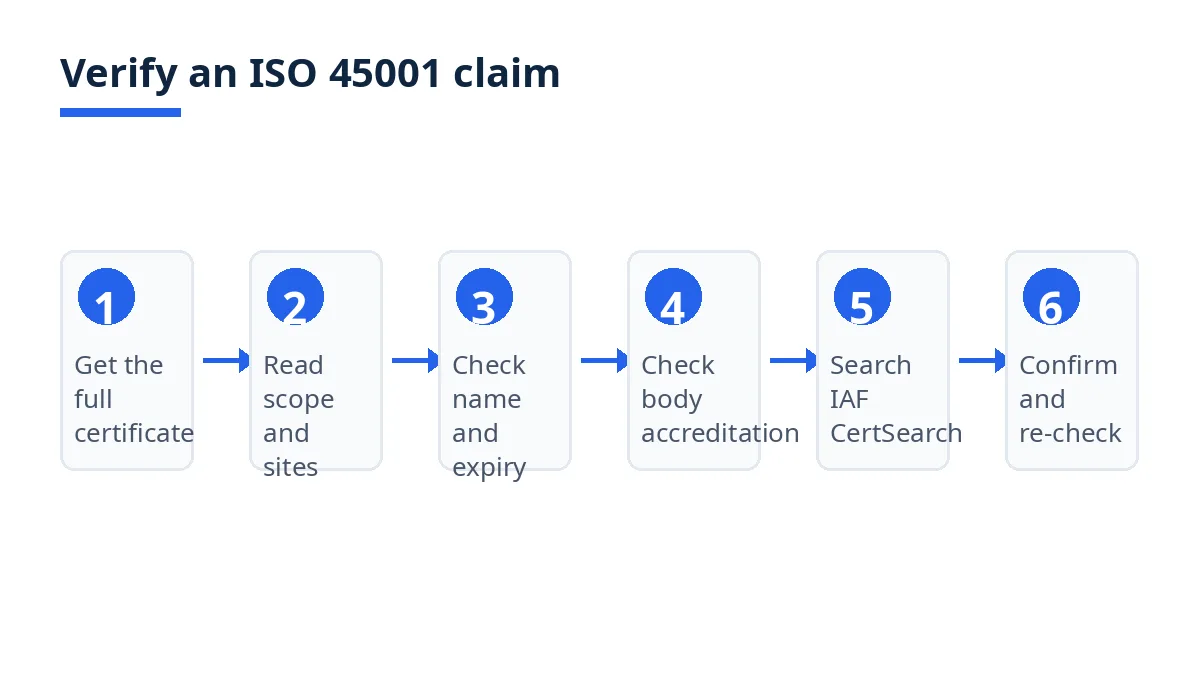
First, define what the system must cover. An OH&S scope may cover one site, several sites, or selected activities only, such as sewing but not washing, or a head office but not production. Write down the sites and activities your order will touch, including subcontracted steps, then compare that list with the scope on the certificate. A scope excluding the production site behind your order does not support that order.
Second, ask the supplier for a copy of the current certificate and read five items on it: the exact legal name of the certified organization, the scope of activities and sites covered, the certificate number, the edition, and the expiry date. Check that the legal name matches the company you are contracting with, not a parent, group, or trading name. If the supplier offers only a logo, a framed-certificate photograph, or a first page without the scope page, treat the evidence as incomplete.
Third, check the certification body and its accreditation. Certification is granted by a third-party certification body after an audit, and ISO notes that many certification bodies are accredited, meaning an accreditation body has independently confirmed their competence.1 Ask which accreditation body covers the certification body's ISO 45001 scheme, and check that body's directory. An unaccredited certificate may still reflect a real audit, but it lacks that independent check, and some buyers will not accept it.
Fourth, run the certificate through an independent check. IAF CertSearch is the database established and maintained by the International Accreditation Forum (IAF) where its members' accredited management system certifications can be validated.3 A search by company name or certificate number confirms that the certification is valid, that the certification body is accredited, and that the accreditation body is an IAF Multilateral Recognition Arrangement signatory.3 A matching result is meaningful evidence. No result is not, on its own, proof of a false claim, because not every accredited certificate appears in every database, so a missing result means asking the certification body directly.
Fifth, understand what the audit behind the certificate involved. A certification body describes the pattern as application review, an optional pre-assessment, a Stage 1 audit comparing documentation with the standard and checking readiness for Stage 2, a Stage 2 audit of compliance with all requirements and verification of implementation, followed by surveillance audits and recertification.4 For a buyer, the Stage 2 detail matters most: ask whether auditors visited the production site, spoke with workers, and reviewed incident and near-miss records, rather than only reviewing head-office documents.
Sixth, record what you checked and re-check before ordering. Certificates run on a three-year cycle with surveillance audits in between and a recertification audit at the end.4 A certificate valid during an initial enquiry may have lapsed, been suspended, or been withdrawn by the time an order is placed, so repeat the scope and expiry check before each significant order.
Costs, timelines and documents
There is no single published price for ISO 45001 certification in Bangladesh, and any figure quoted without naming the organization, sites, and scope behind it should be treated with caution. Certification bodies price from the audit work involved: one body states that Stage 2 audit duration is based on employee numbers, site numbers, and registrations required.4 A small single-site factory and a large multi-site group will therefore not pay the same fee, and a quote covering fewer sites or a narrower scope is not comparable with one covering the full operation.
Timelines follow the same logic and should be confirmed with the certification body. The time needed depends on how much of the system already exists, how quickly the organization can generate the operating records a Stage 2 audit needs, and how promptly nonconformities are closed. Useful records include hazard and risk records, consultation records, training records, incident and near-miss records, drill records, and management review minutes.
The documents a buyer should ask for are short: the current certificate with its scope page, confirmation of the certification body's accreditation for ISO 45001, and, where safety results are also claimed, the underlying records behind those figures, kept separate from the certificate. For a seller preparing for certification, the working documents are an OH&S policy, a hazard and risk register, a legal requirements register, objectives, operational and contractor controls, consultation and incident records, and a management review record.
Bangladesh-specific rules and tips
ISO 45001 certification does not replace Bangladeshi workplace-safety law, and it does not show whether a factory has passed a government inspection. Labour inspection in Bangladesh lies with the Department of Inspection for Factories and Establishments (DIFE), under the Ministry of Labour and Employment, which enforces the Bangladesh Labour Act 2006, as revised in 2013 and 2018, except for the chapters on trade unions and labour courts.5 DIFE approves factory machinery layout plans, issues and renews licences, inspects enterprises for working conditions, safety and health, and investigates complaints and accidents.5
Ask for both tracks of evidence and keep them apart. The DIFE track answers a legal and inspection question: whether the factory has been inspected under the Labour Act and what its licence and inspection position is. The ISO 45001 certificate answers a management-system question: whether an accredited body has audited the organization's OH&S system. A factory may hold one without the other. Where a supplier's licence or inspection position is unclear, confirm it from the supplier's own documents and, where needed, professional advice.
Sector context sharpens the questions to ask. In garment production, ask how the system covers the highest-risk steps behind your order: cutting and sewing machine safety, boiler and steam safety, electrical safety, fire exits and drills, chemical handling, and contract-worker safety. In any sector, ask how workers take part: ISO 45001 gives worker participation a central place, so a system with no consultation records or hazard-reporting channel is not showing the participation the standard requires.1
Mistakes and red flags
The most common mistake is reading a logo as a certificate. A logo can be copied, reused after expiry, or applied to products, shipments, and sites outside the certified scope. ISO notes that organizations should contact a certification body about certification options, timelines, accreditation, and the use of certification marks or logos, which is a reminder that logo use itself has rules and that the certificate, not the logo, is the evidence.1
The second mistake is accepting a certificate without reading its scope. A certificate for a trading office does not cover a factory, a certificate for one site does not cover another site, and a certificate whose scope covers only warehousing does not cover manufacturing. Read the scope against the sites and activities behind your order, and treat any mismatch as a gap to close before ordering.
The third mistake is ignoring expiry and status. Certificates run on a three-year cycle with surveillance audits in between, so a certificate can lapse, be suspended, or be withdrawn between orders.4 IAF CertSearch offers alerts when certificates are suspended, withdrawn, or expired, according to its own description of the service.3 Build a re-check date into your supplier file and act on it.
The fourth mistake is confusing ISO 45001 with other claims. Self-declared conformity is not the same as accredited third-party certification: ISO notes that some organizations implement the standard without seeking certification, while others seek certification to reassure customers.1 A statement such as "we follow ISO 45001" is therefore not a certification claim at all. Similarly, ISO 45001 is not a product quality mark, not a building rating, and not evidence of labour or social compliance.
The fifth mistake is trusting an unaccredited certificate at face value. An unaccredited certificate may still reflect a real audit, but it lacks the independent accreditation check buyers rely on, and some buyers will not accept it. Ask which accreditation body stands behind it, check that body's directory, and record the answer. A related safety check: if no worker can describe how to report a hazard, or no near miss has ever been recorded, the system is not operating as ISO 45001 describes it.
Checklist
Use this checklist for every supplier claim.
Full certificate copy received, including the scope page.
Legal name on the certificate matches the company being contracted.
Scope covers the sites and activities behind the order, including subcontracted steps.
Certificate number, edition, and expiry date recorded, edition stated in full, for example ISO 45001:2018.
Certification body named, and its ISO 45001 accreditation checked.
Independent check completed through IAF CertSearch or direct confirmation, with the date recorded.
Worker participation evidence seen: consultation records and a hazard-reporting channel.
DIFE licence and inspection position confirmed separately from the ISO 45001 certificate.
Surveillance and recertification dates noted, with a re-check date set before the next order.
How Exportain helps
Exportain's own verification system is separate from ISO 45001 certification, and the distinction matters for a buyer using both. Exportain's Trust Center states that its supplier verification is a document review by its team, not a factory inspection and not a check against any government database, and that a badge is not a guarantee of production capacity, product quality, or delivery.6 The seller verification page adds that verification is free, that each check is completed in the verification centre of the seller portal and reviewed by Exportain staff, and that approved checks earn trust badges shown on the company page, listings, and quotations.7
Use the two systems side by side. Start with the platform record: read the supplier's company page, note which trust badges are shown and what each badge means on the Trust Center page, and follow the seller verification page to understand which checks sit behind each badge.6 7 Then run the ISO 45001 verification route in this guide for the safety claim itself.
For trade services connected to certification, note one caveat: the certification services category page currently renders the message "No services published in this category yet", so no certification-body service can be booked through that category. Until providers publish services there, contact certification bodies directly.
FAQs
What should I know first about ISO 45001?
Know what it certifies and what it does not. ISO 45001 certifies an organization's occupational health and safety management system, not a product, a factory building, or a shipment, and not labour or social compliance.1 The current edition is ISO 45001:2018, reviewed and confirmed in 2024, with a revision planned as ISO 45001:2027.1 Before anything else, ask for the full certificate and check its scope, expiry, certification body, and accreditation.
What are the typical costs and timelines?
There is no typical price or timeline across Bangladeshi organizations, because audit duration depends on employee numbers, site numbers, and registrations required.4 A small single-site factory and a large multi-site group will be quoted differently, and the time to certification depends on how much of the system already exists and how quickly records can be produced. Compare quotations by scope, sites, and accreditation.
Which documents are needed?
From the supplier: the current certificate with its scope page and confirmation of accreditation, plus the records behind any safety results claimed. For a seller preparing: an OH&S policy, a hazard and risk register, a legal requirements register, objectives, operational and contractor controls, consultation and incident records, and a management review record.
What are the most common mistakes?
Reading a logo as a certificate, accepting a certificate without reading its scope, ignoring expiry and surveillance status, confusing self-declared conformity with accredited certification, trusting an unaccredited certificate, and accepting safety paperwork with no worker evidence. The fix for each is the same routine: full certificate, scope against the order, accreditation check, independent confirmation, and a re-check date.3
Next steps on Exportain
Start from the supplier record, then verify the safety claim. Read the Trust Center page to see what each trust badge does and does not mean, and the seller verification page to see which checks sit behind those badges. When you are ready to source, Post a free RFQ on Exportain and describe the sites and activities your order will touch, so suppliers can answer with the matching scope.
Sources
- ISO 45001:2018 - Occupational health and safety management systems. ISO (accessed )
- ISO 45001 - Occupational Health & Safety. BSI (accessed )
- What You Need to Know About IAF CertSearch. NSF (accessed )
- Certification Process. Munich Re (HSB) (accessed )
- Labour Inspection Governance in Bangladesh. ILO (accessed )
- Trust & Safety Center. Exportain (accessed )
- Supplier verification: Earn trust badges buyers can see. Exportain (accessed )
About the author
Sourcing from Bangladesh?
Post a request for quotation and suppliers on Exportain can send you their quotes directly.
Post an RFQ


