How to Find ISO 14001 Certified Factories in Bangladesh
How to find organisations certified to ISO 14001 in Bangladesh: read the certificate scope and expiry, check the certification body and its accreditation, and verify the claim before ordering.
Short answer
Finding an organisation certified to ISO 14001 in Bangladesh starts with one distinction: the certificate covers an environmental management system, not a product, a building, or a shipment. Ask for the certificate itself, read its scope and expiry date, and check the issuing body and the accreditation behind it before treating any claim as evidence. A logo on a website proves nothing on its own.[^1]
On this page
Key takeaways
ISO 14001 certifies an organisation's environmental management system, not a product, a building, or a shipment.
Read the certificate scope, sites, legal name, edition, and expiry date before treating any claim as evidence.
Check the certification body and its accreditation, then confirm the certificate through IAF CertSearch or directly with the certification body.
Keep the Bangladeshi Environmental Clearance Certificate separate: it answers a legal question that ISO 14001 does not.
Finding an organisation certified to ISO 14001 in Bangladesh starts with one distinction: the certificate covers an environmental management system, not a product, a building, or a shipment. Ask for the certificate itself, read its scope and expiry date, and check the issuing body and the accreditation behind it before treating any claim as evidence. A logo on a website proves nothing on its own.1
Why this matters for buyers and sellers
ISO 14001 is the internationally recognised standard for environmental management systems (EMS). It gives an organisation a framework to design and run an EMS, reduce its environmental footprint, meet its legal requirements, and improve its environmental performance over time.1 For a buyer, that framework is useful only when it is tied to the right organisation, the right sites, and the right activities, which is exactly what the certificate scope states.
This is where ISO 14001 differs from the neighbouring certification guides a buyer may already know. A LEED rating assesses a building. A social audit scheme assesses labour and workplace conditions. A product standard assesses a product or its content. ISO 14001 assesses none of those things directly. It assesses whether an organisation has a working system for identifying its environmental aspects, meeting its compliance obligations, setting environmental objectives, controlling its operations, and improving over time.1
For a seller, the value is practical rather than decorative. ISO states that organisations use the standard to improve environmental performance in a consistent and measurable way, reduce waste, use energy and resources better, comply more easily with environmental regulations, and strengthen credibility with stakeholders.1 A certification body describes the same benefits in commercial terms: winning tenders and contracts and increasing customer trust.2 Neither source presents certification as a guarantee of product quality or delivery.
The current edition also matters. ISO published ISO 14001:2026, the fourth edition, in April 2026, and advises organisations to use the full designation, for example "certified to ISO 14001:2026", rather than a bare reference to ISO 14001.1 A certificate issued under the earlier 2015 edition may still be valid during its transition period.
Step-by-step: how it works
Finding a certified organisation is a verification task, not a directory search. No source used for this guide publishes a list of Bangladeshi organisations certified to ISO 14001, and this guide names none, because no factory has been named as certified in an opened source for this article. The steps below therefore work from a claim made by a supplier, or from a shortlist a buyer already holds.
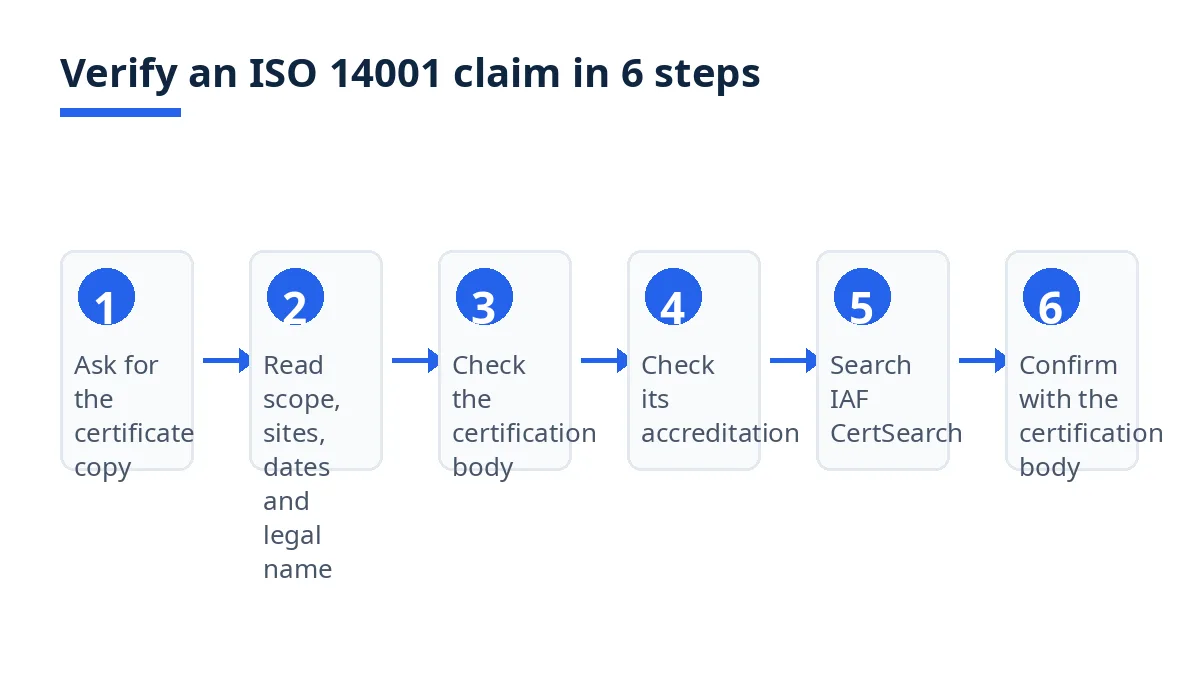
First, define what you need the system to cover. An EMS scope may cover one site, several sites, or selected activities only, such as dyeing but not printing, or head-office functions but not production. Write down the sites and activities your order will actually touch, then compare that list with the scope on the certificate. A scope that excludes the production site behind your order does not support that order.
Second, ask the supplier for a copy of the current certificate and read four items on it: the exact legal name of the certified organisation, the scope of activities and sites covered, the certificate number, and the expiry date. Check that the legal name matches the company you are contracting with, not a parent company, a group company, or a trading name.
Third, check the certification body and its accreditation. Certification is issued by an independent certification body after an audit, and ISO notes that organisations should contact a certification body for information on certification options, timelines, accreditation, and the use of certification marks or logos.1 One certification body explains that an ISO 14001 certificate is only as strong as the accreditation behind it, and advises buyers to ask which accreditation body covers the certification body's ISO 14001 scheme and to check that listing in the accreditation body's public directory.3
Fourth, run the certificate through an independent check. IAF CertSearch describes itself as the official global database for accredited certificates, where a company name or certificate details can be searched to confirm validity, and where the data cross-checks the certificate, the certification body, and the accreditation body behind it.4 A search result that matches the name, scope, and dates on the paper certificate is meaningful evidence. No result is not, on its own, proof of fraud, because not every accredited certificate appears in every database, so a missing result means going back to the certification body for direct confirmation.
Fifth, understand what the audit behind the certificate involved. Certification bodies describe a consistent pattern: the organisation develops and implements its EMS, applies to a certification body, undergoes a Stage 1 audit reviewing its documents and readiness, then a Stage 2 audit examining whether the system is implemented and working in practice, followed by a certification decision and annual surveillance audits.2 3
Sixth, record what you checked and re-check before ordering. Certificates expire, and ISO notes that certified organisations usually undergo surveillance audits annually, with a recertification audit every three years.1 A certificate valid during an initial enquiry may have lapsed by the time an order is placed, so repeat the scope and expiry check before each significant order.
Costs, timelines and documents
There is no single published price for ISO 14001 certification in Bangladesh, and any guide that quotes one without naming the organisation, sites, and scope behind it should be treated with caution. ISO itself directs organisations to contact a certification body for certification options and timelines, rather than publishing a fee schedule.1 Certification bodies price from the audit work involved: one body states that cost is driven by audit duration, set from employee count, number of sites, and the complexity of the environmental aspects.3 Another body states that its fees are calculated from the number of people in the organisation and the number of sites operated, and that it quotes for the whole three-year cycle.2
Timelines follow the same logic. One certification body reports that organisations with reasonably mature environmental practices typically reach certification in three to six months from application, driven mostly by how quickly the EMS operates long enough to generate the records the Stage 2 audit needs.3 That figure is a single body's published typical range, not a promise for any Bangladeshi organisation.
The documents a buyer should ask for are short and specific: the current certificate, the scope statement if issued separately, and confirmation of the certification body's accreditation for ISO 14001. If the supplier also claims environmental performance results, such as reduced water use, ask for the underlying monitoring records that support those figures, and keep them separate from the certificate. For a seller preparing for certification, the working documents are an environmental policy, an aspects and impacts register, a compliance obligations register, environmental objectives, operational controls, internal audit records, and a management review record.2 3
Two cost traps deserve attention. Consultancy and certification are separate services: a consultant may help build the system, but the certification body must audit it independently. Also, the cheapest audit quote may cover a narrower scope, fewer sites, or an unaccredited certificate, so compare quotes by scope, sites, accreditation, and the full three-year cycle, not by the first-year fee alone.
Bangladesh-specific rules and tips
ISO 14001 certification does not replace Bangladeshi environmental law. Under the Bangladesh Environment Conservation Act 1995, section 12 lays down the provision for obtaining an Environmental Clearance Certificate from the Director General of the Department of Environment (DoE) before establishing any industry or project.5 The Environment Conservation Rules 1997 classified industrial establishments into categories such as green, orange-A, orange-B, and red, with establishments in the higher categories first obtaining a location clearance certificate and then clearance after furnishing documents including a no objection certificate from local authorities.5
The practical tip is to ask for both tracks of evidence and keep them apart. The Environmental Clearance Certificate answers a legal question: whether the DoE has cleared this industrial unit or project. The ISO 14001 certificate answers a management-system question: whether an accredited body has audited the organisation's EMS. A factory may hold one without the other, and neither document substitutes for the other. Where a supplier's category, clearance status, or renewal position is unclear, confirm it from the supplier's own clearance documents and, where needed, with professional advice on the current rules.
Sector context sharpens the questions to ask. In textiles and dyeing, the significant environmental aspects will usually centre on water use, wastewater, chemical storage and handling, energy use, and waste, so ask how the EMS scope covers the wet-processing steps behind your order rather than only the head office or the sewing floor.
Mistakes and red flags
The most common mistake is reading a logo as a certificate. A logo can be copied, reused after expiry, or applied to products and shipments that fall outside the certified scope. ISO directs organisations to contact the certification body about the use of certification marks or logos, which is a reminder that logo use itself has rules and that the certificate, not the logo, is the evidence.1
The second mistake is accepting a certificate without reading its scope. A certificate for a trading office does not cover a factory, a certificate for one site does not cover another site, and a certificate whose scope covers only warehousing does not cover manufacturing. Read the scope against the sites and activities behind your order, and treat any mismatch as a gap to close before ordering.
The third mistake is ignoring expiry and status. Certificates run on a three-year cycle with annual surveillance audits, so a certificate can lapse, be suspended, or be withdrawn between orders.1 3 IAF CertSearch offers alerts when a certificate is suspended, withdrawn, or expired.4 Build a re-check date into your supplier file and act on it.
The fourth mistake is confusing ISO 14001 with other claims. Self-declared conformity is not the same as accredited third-party certification: ISO notes that some organisations implement the standard without seeking certification, while others seek certification to reassure customers.1 A statement such as "we follow ISO 14001" is therefore not a certification claim at all. Similarly, ISO 14001 is not a product quality mark, not a building rating, and not evidence of labour or social compliance.
The fifth mistake is trusting an unaccredited certificate at face value. An unaccredited certificate may still reflect a real audit, but it lacks the independent accreditation check that buyers rely on, and some buyers and procurement programmes will not accept it. Ask which accreditation body stands behind the certificate, check that body's directory, and record the answer.
Checklist
Use this checklist for every supplier claim, and keep the completed version with the supplier file.
Certificate copy received in full, including the scope page, not only a logo or a first page.
Legal name on the certificate matches the company being contracted.
Scope covers the sites and activities behind the order.
Certificate number, edition, and expiry date recorded, with the edition stated in full, for example ISO 14001:2026 where that is the certified edition.
Certification body named, and its ISO 14001 accreditation checked in the accreditation body's directory.
Independent check completed through IAF CertSearch or direct confirmation from the certification body, with the date recorded.
Environmental Clearance Certificate position confirmed separately from the ISO 14001 certificate.
Surveillance and recertification dates noted, with a re-check date set before the next significant order.
How Exportain helps
Exportain's own verification system is separate from ISO 14001 certification, and the distinction matters for a buyer using both. Exportain's Trust Center states that its supplier verification is a document review by its team, not a factory inspection and not a check against any government database, and that a badge is not a guarantee of production capacity, product quality, or delivery.6 The seller verification page adds that verification is free, that each check is completed in the verification centre of the seller portal and reviewed by Exportain staff, and that approved checks earn trust badges shown on the company page, product listings, and quotations.7
Use the two systems side by side. Start with the platform record: read the supplier's company page, note which trust badges are shown and what each badge means on the Trust Center page, and follow the seller verification page to understand which checks sit behind each badge.6 7 Then run the ISO 14001 verification route in this guide for the environmental claim itself: certificate, scope, accreditation, and independent check.
For trade services connected to certification, note one caveat exactly as it stands: the certification services category page currently renders the message "No services published in this category yet", so no certification-body service can be booked through that category at the time of writing. Until providers publish services there, a buyer should contact certification bodies directly for quotations and timelines.
FAQs
What should I know first about ISO 14001?
Know that ISO 14001 certifies an organisation's environmental management system, not a product, a building, or a shipment.1 Certification means an independent certification body has audited that system.1 Before anything else, read the certificate scope and expiry date, identify the certification body and its accreditation, and confirm the claim through an independent check.4
What are the typical costs and timelines?
There is no single published price, because certification bodies price from audit duration, which is set from employee count, number of sites, and the complexity of the environmental aspects.3 Fees are commonly quoted for the whole three-year cycle, with annual surveillance audits inside that cycle.2 One certification body reports that organisations with reasonably mature environmental practices typically reach certification in three to six months from application, but that is a single body's typical range, not a promise.3
Which documents are needed?
A buyer needs the current certificate with its scope page, the certificate number and expiry date, and confirmation of the certification body's ISO 14001 accreditation. A seller preparing for certification needs an environmental policy, an aspects and impacts register, a compliance obligations register, environmental objectives, operational controls, internal audit records, and a management review record.2 3 Keep the Bangladeshi Environmental Clearance Certificate as a separate document, since it answers a legal question that ISO 14001 does not.5
What are the most common mistakes?
Reading a logo as a certificate, accepting a certificate without reading its scope, ignoring expiry and surveillance status, confusing self-declared conformity with accredited certification, and trusting an unaccredited certificate without checking the accreditation behind it. Each mistake has the same remedy: return to the certificate itself, read the scope and dates, and confirm the claim through IAF CertSearch or directly with the certification body.1 4
Next steps on Exportain
Start from the platform record, then verify the environmental claim with the route in this guide. Read what each badge means on the Trust Center page, check how checks are reviewed on the seller verification page, and when you are ready to source, post a free RFQ on Exportain stating the certified scope, sites, and accreditation evidence you require.
Sources
- ISO 14001:2026 - Environmental management systems. International Organization for Standardization (accessed )
- ISO 14001 Certification. Centre for Assessment (accessed )
- ISO 14001 Certification in USA. IAS (accessed )
- IAF Certification Validation - IAF CertSearch. IAF (accessed )
- Legal framework in place to protect the environment. The Daily Star (accessed )
- Trust & Safety Center. Exportain (accessed )
- Supplier verification: Earn trust badges buyers can see. Exportain (accessed )
About the author
Sourcing from Bangladesh?
Post a request for quotation and suppliers on Exportain can send you their quotes directly.
Post an RFQ