Using Irrevocable LC When Buying From Bangladesh: Bank Rules and Tips
Irrevocable LC in Bangladesh: how UCP 600 makes every credit irrevocable, how amendments need the agreement of the issuing bank, any confirming bank, and the beneficiary, and what irrevocability does not protect.
Short answer
Under UCP 600, every documentary credit is irrevocable even if the credit does not say so, so the issuing bank cannot amend or cancel it without the agreement of the issuing bank, the confirming bank if any, and the beneficiary. Irrevocability protects the credit terms and the bank undertaking for a complying presentation, but it does not assure funding, document compliance, or goods quality.
On this page
Key takeaways
Under UCP 600 Article 3, a credit is irrevocable even if there is no indication to that effect: irrevocability is the default status, not an optional upgrade, and revocable credits no longer exist as the default form.
A credit can neither be amended nor cancelled without the agreement of the issuing bank, the confirming bank if any, and the beneficiary, under UCP 600 Article 10.
The original terms remain in force until the beneficiary accepts an amendment: partial acceptance is deemed rejection, an unless-rejected clause in an amendment is disregarded, and a presentation complying with a not yet accepted amendment is deemed acceptance of it.
Irrevocability does not assure the applicant's funds, document compliance, or shipment quality, and it does not set bank charges or timelines: confirm every charge, timeline, and AD bank file effect in writing with each bank before shipment.
An irrevocable letter of credit (LC) is a credit that the issuing bank cannot amend or cancel on its own after issuance. Under UCP 600, the Uniform Customs and Practice for Documentary Credits, a credit is irrevocable even if there is no indication to that effect, and Article 2 defines a credit as an arrangement that is irrevocable and thereby constitutes a definite undertaking of the issuing bank to honour a complying presentation.1 The word irrevocable does not add a special upgrade to a standard UCP 600 credit. It states the status that UCP 600 already gives the credit.
This guide covers the irrevocability angle only, for a buyer ordering from Bangladesh. It explains what that status protects, how an amendment works, what position the beneficiary holds when an amendment is offered, and what irrevocability does not protect. For the short definition of an LC, see the letter of credit (LC) guide. Confirmation, a second bank adding its own undertaking in addition to the issuing bank undertaking, is summarised in one line here only.
The central point is narrow. Irrevocability fixes who must agree before the terms change. It does not fix whether the applicant can fund the credit, whether the documents will comply, or whether the goods will match the order.
Why this matters for buyers and sellers
For the buyer, irrevocability cuts both ways. Once your bank issues the credit, you cannot instruct it to withdraw the credit because you found a cheaper supplier or changed a retail plan. A change to amount, shipment date, ports, documents, or expiry needs agreement through the amendment route below.
For the seller in Bangladesh, irrevocability is the reason a credit is worth producing against. The issuing bank is irrevocably bound to honour as of the time it issues the credit, provided the stipulated documents are presented to the nominated bank or the issuing bank and they constitute a complying presentation.1 Irrevocability protects the terms of the credit, not a presentation that fails them.
Irrevocability also separates the credit from the sale contract. A credit is a separate transaction from the sale or other contract on which it may be based, and banks are in no way concerned with or bound by that contract, even if a reference to it is included in the credit.1 A dispute about quality or delivery does not, by itself, change the bank undertaking.
What irrevocability protects | What it does not protect |
|---|---|
Credit terms against unilateral amendment or cancellation | The applicant having funds available when the bank must honour |
The beneficiary against a change imposed without its agreement | A presentation that is late, discrepant, or missing a document |
Original terms until the beneficiary accepts an amendment | Quality, quantity in the carton, or condition of the goods |
The bank undertaking once a complying presentation is made | A shipment outside the latest shipment date or after expiry |
Banks deal with documents and not with goods, services, or performance to which the documents may relate.1 An inspection certificate, where the buyer wants one, must therefore be named as a required document in the credit itself, with its issuer and content stated.
Step-by-step: how it works
Irrevocability operates from issuance to expiry, and the amendment route is the only route by which the terms change.
Agree the credit terms in the sale contract first. State that the credit will be subject to UCP 600, and write the amount, currency, latest shipment date, expiry date, ports, goods description, and document list in the same words that will appear in the credit.
The buyer, as applicant, asks the issuing bank to issue the credit on those terms. The issuing bank is irrevocably bound from the time it issues the credit.1 From this point, the applicant cannot cancel the credit by instruction alone.
The issuing bank asks an advising bank to advise the credit to the seller, as beneficiary. An advising bank that is not a confirming bank advises the credit without any undertaking to honour or negotiate.1
The seller checks every field of the advised credit against the contract before production or shipment. Any field the seller cannot meet should be raised as an amendment request before shipment, not after the goods are on the water.
If a change is needed, the buyer asks the issuing bank to issue an amendment. The issuing bank is irrevocably bound by an amendment as of the time it issues the amendment, but the amendment does not bind the beneficiary until the beneficiary accepts it.1 Until acceptance, the original terms remain in force.
The seller decides on the amendment as a whole, and should notify acceptance or rejection to the bank that advised the amendment. A presentation that complies with the credit and with a not yet accepted amendment is deemed to be notification of acceptance, and from that moment the credit is amended.1
The seller ships within the latest shipment date in the terms then in force, and presents the required documents at the place for presentation, within any presentation period stated in the credit, and before expiry. Where no period is stated, a presentation including original transport documents must be made not later than 21 calendar days after shipment, and in any event not later than expiry.1
The nominated bank, a confirming bank if any, and the issuing bank each have a maximum of five banking days following the day of presentation to determine if a presentation is complying.1 If it complies, the bank honours under the availability stated in the credit.
The diagram below shows the amendment route in sequence, from agreed terms to a presentation made under terms then in force.
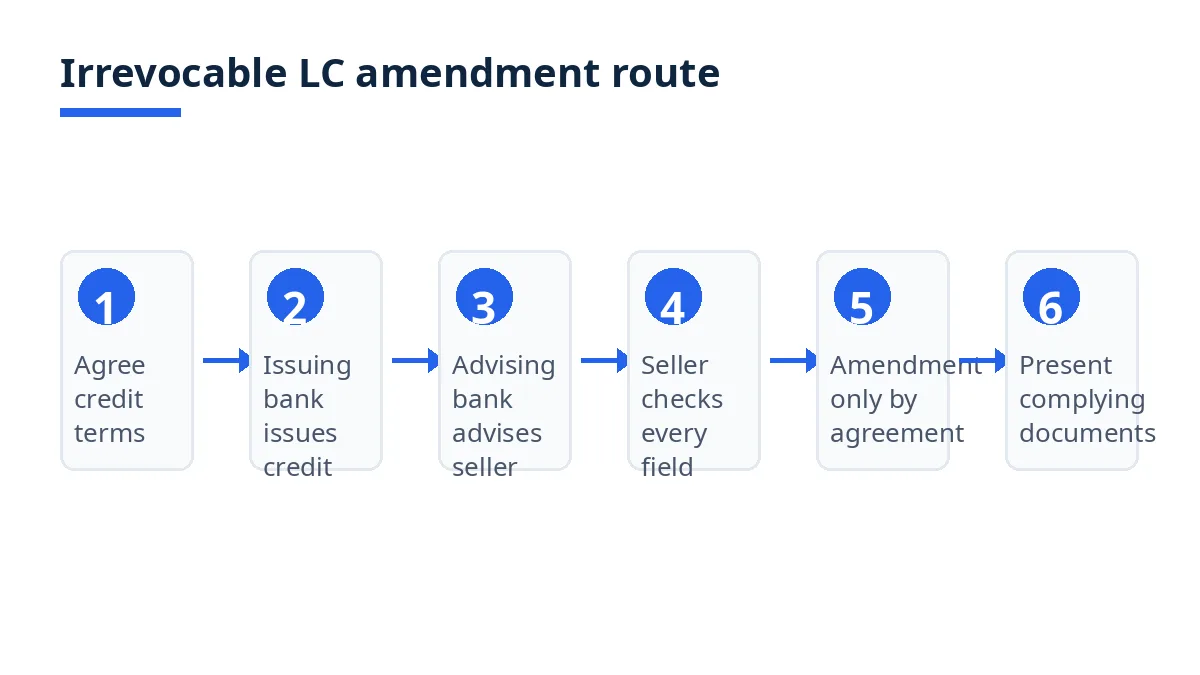
Example figures, for illustration only: a buyer orders handloom cotton scarves for USD 31,500 under an irrevocable LC, and the seller cannot meet the latest shipment date after a fabric delay. The buyer asks its bank to amend the shipment date only. The seller may accept or reject that change, but cannot accept the new date while rejecting a second change bundled into the same amendment, because partial acceptance is not allowed.
Costs, timelines and documents
No bank charge, margin, or approval condition in this section is universal. Confirm every item in writing with the issuing bank and the advising bank before the seller ships, and state in the contract and the credit application which charges fall on the applicant and which fall on the beneficiary.
Charges to confirm include the issuing charge, the advising charge, any amendment charge, any discrepancy charge, and any courier or transmission charge a bank applies. Under UCP 600, a bank instructing another bank to perform services is liable for charges incurred by that bank in connection with its instructions, and if a credit states that charges are for the account of the beneficiary and charges cannot be collected or deducted from proceeds, the issuing bank remains liable for payment of charges. It does not set the price of any charge.
UCP 600 fixes only the examination period above, at a maximum of five banking days, and the 21-calendar-day outer limit for a presentation including original transport documents where no period is stated.1 It does not fix issuance speed, amendment speed, or a seller response deadline.
Documents are governed by the credit itself. Present only the documents the credit requires, in the form the credit requires, with data that does not conflict across the set. The usual set for a Bangladesh shipment may include a commercial invoice, a transport document, a packing list, and, where the credit calls for them, a certificate of origin, an insurance document, or an inspection certificate.
Bangladesh-specific rules and tips
Irrevocability under UCP 600 sits alongside the Bangladesh export file, and the two clocks must be read together. The seller works through an authorised dealer (AD) bank in Bangladesh.
Under the Bangladesh Bank consolidated circular on foreign exchange regulations for export trade transactions, dated 30 July 2026, exporters submit a signed hard copy of the electronically submitted EXP Form together with the bill of export certified by the customs authority and relevant shipping documents to ADs within 14 days from the date of shipment.2 The prescribed period for repatriating export proceeds in the same circular is four months, subject to authorisation where the full proceeds are not received within that period.2 An amendment to an LC does not, by itself, rewrite those regulatory dates. A seller who accepts a later shipment date should therefore check the EXP Form submission date and the repatriation period that will apply to the new shipment date.
Mistakes and red flags
Assuming a credit must say the word irrevocable to be irrevocable. Under UCP 600 it is irrevocable even if there is no indication to that effect.1
Assuming revocable credits are still a standard alternative. The revocable form belonged to the earlier UCP 500 regime, and under UCP 600 revocable credits no longer exist as the default form.3
Treating irrevocability as a funds promise. It binds the issuing bank to honour a complying presentation. It does not prove that the applicant has funded the credit, and it does not remove the need to confirm issuance and availability with the banks.
Treating irrevocability as a quality promise. Banks examine documents, not goods.1
Accepting an amendment by silence, or accepting part of it. The beneficiary should notify acceptance or rejection, partial acceptance is not allowed and is deemed to be rejection, and a provision in an amendment that it will enter into force unless rejected within a stated time is disregarded.1
Shipping under requested terms before acceptance. If the seller ships to a new port or date that exists only in a requested amendment, and then rejects that amendment, the presentation may fail against the original terms.
Accepting a confirmed amendment without checking confirmation. Where the credit is confirmed, the confirming bank may extend its confirmation to an amendment, or may advise the amendment without extending confirmation, in which case it must inform the issuing bank without delay and inform the beneficiary in its advice.1
Ignoring a modification of UCP 600 in the credit text. UCP 600 applies when the credit expressly indicates that it is subject to those rules, and the rules are binding unless expressly modified or excluded by the credit.1
Checklist
Credit states it is subject to UCP 600, with no modification or exclusion that changes irrevocability, and the full text has been read.
Amount, currency, goods description, ports, latest shipment date, expiry date, presentation period, and document list match the sale contract where the credit requires correspondence.
Charge allocation is agreed in the contract and confirmed in writing with each bank, including the amendment charge and the discrepancy charge.
Seller has confirmed, before shipment, that every required document can be obtained in the form the credit requires.
Any amendment is answered as a whole, in writing to the advising bank, with acceptance or rejection, and shipment follows the terms then in force.
Where the credit is confirmed, the advice states whether confirmation extends to each amendment.
AD bank has confirmed how an amendment affecting shipment date, amount, or port affects the EXP Form file and the repatriation period.
Presentation is planned inside the presentation period and before expiry, with the 21-calendar-day outer limit in view where no period is stated.
How Exportain helps
Exportain connects buyers with Bangladeshi suppliers, and the RFQ stage is the place to settle LC terms before any bank is asked to issue a credit.
Post a free RFQ at https://exportain.com/rfqs and set out the LC terms in the RFQ itself. Keep the platform terms in their own place: Exportain payment and membership terms cover payments made to Exportain and memberships sold through it, and do not cover money paid directly between two companies outside the platform.4 Buyer protection on Exportain is a record of document checks reviewed, with trust badges described as a record of checks reviewed rather than a capacity, quality, or delivery promise.5
FAQs
What should I know first about irrevocable LC?
Know first that irrevocability is the default under UCP 600, not an optional upgrade. A credit is irrevocable even if there is no indication to that effect, and it can neither be amended nor cancelled without the agreement of the issuing bank, the confirming bank if any, and the beneficiary.
What are the typical costs and timelines?
There are no universal costs or timelines to quote for issuance, amendment, or approval. Confirm each charge, who bears it, and each bank timeline in writing with the issuing bank and the advising bank before shipment. The only UCP 600 periods stated in this guide are the maximum of five banking days for examination following presentation, and the 21-calendar-day outer limit for a presentation including original transport documents where no period is stated.1
Which documents are needed?
The credit itself states which documents are needed, and no general list replaces it. A Bangladesh shipment commonly requires a commercial invoice, a transport document, and a packing list, plus a certificate of origin, an insurance document, or an inspection certificate where the credit calls for them. Present exactly the required set, in the required form, with data that does not conflict, and present within the presentation period and before expiry.
What are the most common mistakes?
The most common mistakes are treating irrevocability as a funds or quality promise, accepting an amendment by silence or in part, shipping to requested terms before acceptance, and ignoring a modification of UCP 600 in the credit text.
Next steps on Exportain
Post a free RFQ at https://exportain.com/rfqs, read the letter of credit (LC) guide for the definition and document set, and check Buyer Protection for what the platform record covers and what it does not.
Sources
- Uniform Customs and Practice for Documentary Credits (UCP 600). LegalGuide (accessed )
- Consolidated circular on foreign exchange regulations — export trade transactions (FEPD-1 Circular No. 26, July 30, 2026). Bangladesh Bank (accessed )
- Irrevocability of the Letter of Credit. Learn Export Finance (accessed )
- Payment and Membership Terms. Exportain (accessed )
- Buyer protection: What Exportain does to protect buyers. Exportain (accessed )
About the author
Sourcing from Bangladesh?
Post a request for quotation and suppliers on Exportain can send you their quotes directly.
Post an RFQ