Industrial Lighting Price in Bangladesh: FOB Cost Breakdown for Buyers
Read an FOB quotation for industrial lighting line by line: the six lines inside the price, what sits outside it, and how FOB differs from EXW and CIF.
Short answer
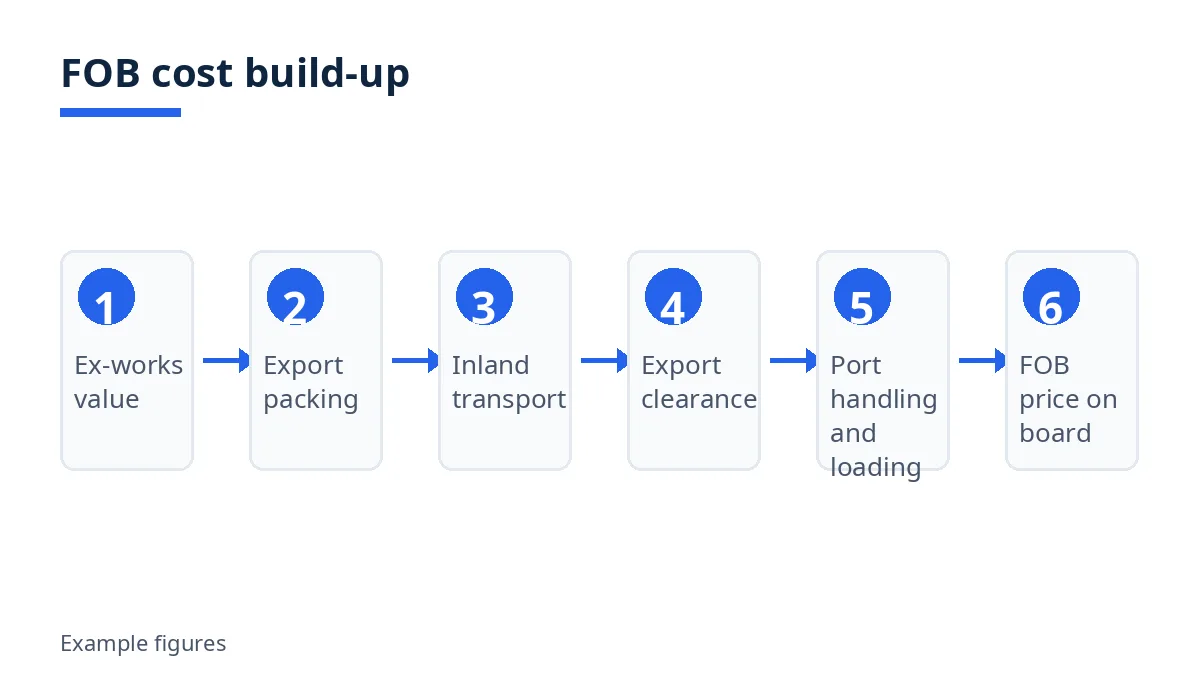
An FOB price for industrial lighting from Bangladesh is a six-line build-up: ex-works value, export packing, inland transport, export clearance, port handling, and loading on board. Compare completed build-ups on one term and one named port, arrange ocean insurance yourself, and confirm the vessel nomination and loading window in writing.
On this page
Key takeaways
An FOB price is a six-line build-up: ex-works value, export packing, inland transport, export clearance, port handling, and loading on board. A lump sum cannot be checked.
Under FOB, the seller delivers the goods loaded on board the vessel nominated by the buyer at the named port of shipment, and risk transfers at that on-board point.
Ocean freight, insurance, import clearance, duties, and destination transport sit outside FOB. CIF changes who pays freight and insurance, but risk still transfers on board.
Where containerized goods are delivered to a terminal rather than on board, FCA is the more appropriate rule. Match the term to the actual handover.
Compare completed build-ups on one term and one named port, and confirm the vessel nomination deadline, loading window, and insurance in writing.
An FOB quotation for industrial lighting is a build-up, not a single number. When a supplier in Bangladesh quotes "FOB Chittagong" for a run of high-bay fittings, the price is the sum of several lines: the finished fitting at the factory gate, export packing, transport to the port, export clearance, port handling, and loading on board. If any line is missing, bundled, or quoted on a different term, two quotations cannot be compared.
Under Incoterms 2020, FOB (Free On Board) means the seller delivers the goods loaded on board the vessel nominated by the buyer at the named port of shipment, and risk transfers to the buyer at that on-board point.1 The seller carries transport to the port, loading on board, and export formalities, while the buyer contracts the carrier, pays freight to destination, and handles import formalities.1 The Incoterms 2020 rules allocate cost, risk, and obligations across 11 rules, with each rule's costs gathered in its A9/B9 articles.2 This article reads an FOB quotation line by line: what sits inside the price, what sits outside it, how to test it for gaps, and how FOB differs from EXW and CIF in structure, not in price.
What should I know first about industrial lighting prices?
Start with the delivery term, not the unit price. A quotation that reads "FOB Chittagong, Incoterms 2020" and one that reads "EXW factory" describe different scopes of work, so their unit prices answer different questions. Ask every supplier for the same term, the same named port, and the same specification, then ask for the FOB price broken into its component lines. A lump sum hides the lines where errors usually sit: packing that does not survive an ocean voyage, a port charge left to the buyer, or an unpriced clearance step.
Fix the cargo type early, too. FOB applies only to sea and inland waterway transport, and where goods are containerized, the seller typically delivers them to a container terminal rather than on board the vessel, so FCA is the more appropriate rule.1 Confirm with your freight forwarder whether FOB or FCA matches how the cargo will actually be handed over.
Why this matters for buyers and sellers
For the buyer, the FOB build-up decides how much of the landed cost is visible before the order is placed. Ocean freight, insurance, import clearance, duties, and onward transport all sit outside FOB, so a low FOB price can still produce a high landed cost. The build-up also shows where you carry risk: once the goods are on board, loss or damage is yours, so the insurance decision belongs to you. The Incoterms 2020 rules place an insurance obligation only under CIP and CIF, not under FOB.1
For the seller, the build-up protects the margin line by line. A factory that quotes a lump sum absorbs every movement in inland transport, port charges, and clearance fees between quotation and shipment. A factory that quotes by line can show which line moved and re-quote that line without reopening the whole price.
Step-by-step: how it works
Fix the specification and the term together. Send one specification to every candidate: fitting type, wattage, luminous output, housing material, driver type, protection rating, controls, packing, and quantity. State "FOB Chittagong, Incoterms 2020" or the port you actually intend, and ask for the price broken into lines.
Ask for the ex-works value as line one. This is the finished fitting, tested and packed for the factory gate, before any export step. Ask what it includes: fitting, driver, mounting accessories, and standard packing, each stated separately. One published breakdown of LED lamp costs divides manufacturing cost into chips, driver, heat sink, housing, optics, assembly, and packaging, with a heavier weighting toward LEDs, driver, and heat sink for a high-bay fixture.3 If a quotation cannot say which driver or housing sits inside its ex-works value, the rest of the build-up rests on an unknown.
Ask for export packing as its own line. Export packing is not retail packing. Fittings need cartons or crates that protect housings, lenses, and drivers through handling, stacking, and a sea voyage, with markings that match the packing list.
Ask for inland transport as its own line. This is the move from the factory to the named port of shipment, including any terminal transfer. Ask whether the line is priced per shipment or per unit, and whether it covers a full truck or a shared load.
Ask for export clearance as its own line. In Bangladesh, goods may not be loaded or stuffed for export unless an export declaration, the Bill of Export or Shipping Bill, is submitted to Customs and approved.4 Ask which clearance steps the line covers, including the agent's work.
Ask for port handling and loading as separate lines. Port handling covers receiving, terminal handling, and moving the cargo to the vessel side. Loading covers placing the goods on board the vessel nominated by the buyer.1 A quotation that stops at port handling may leave loading to the buyer, which is not FOB at all.
Add the lines and test the total. The sum of the six lines is the FOB price. If the supplier's stated total does not match that sum, ask which line was adjusted or omitted. If a line is marked "included" without a figure, ask for the figure: an included line with no number cannot be checked when a charge moves.
Confirm the vessel nomination and the risk point in writing. The buyer must inform the seller in time of the vessel's name and the specific loading place and point within the port.1 If the buyer fails to do so and the goods cannot be loaded as a result, risk transfers to the buyer.1 Put the nomination deadline and loading window into the purchase order.
Costs, timelines and documents
What are the typical costs and timelines?
There are no typical FOB costs or timelines a guide can state as fact, because every line moves with the specification, quantity, factory location, port, and sailing schedule. What can be stated is the structure: six lines inside FOB, and everything from ocean freight onward outside it. Ask for production, packing, clearance, port arrival, and loading dates as separate lines, not a single delivery week.
The worked example below shows structure only. Example figures: an order of 200 high-bay fittings, quoted FOB Chittagong, Incoterms 2020.
FOB line | What it covers | Example figure per unit |
|---|---|---|
Ex-works value | Finished fitting, driver, mounting accessories, packing | $84.00 |
Export packing | Seaworthy cartons or crates, internal protection, marking | $2.50 |
Inland transport | Factory to the port of shipment | $3.00 |
Export clearance | Declaration, agent work, documents | $1.20 |
Port handling | Terminal receiving and handling to vessel side | $1.80 |
Loading on board | Goods placed on board the nominated vessel | $1.50 |
FOB price | Sum of the six lines | $94.00 |
Example figures: the figures above are illustrative only, to show how the lines add up. They are not a market price for high-bay fittings, and your quotation will differ on every line.
A second example shows why the breakdown beats the headline. Example figures: Supplier A quotes $94.00 FOB itemized. Supplier B quotes $92.00 FOB as a lump sum, port handling to be confirmed. If port handling lands at $3.00 per unit, Supplier B's completed FOB price is $95.00, above Supplier A. Compare completed build-ups only.
Which documents are needed?
The commercial documents are the specification, the itemized quotation with the FOB build-up, and the purchase order naming the term, the port, the vessel nomination process, and the loading window. The export set for Bangladesh is set out by Bangladesh Customs: the Bill of Export must be enclosed with the export letter of credit, or where there is no export letter of credit, the export contract, purchase order, or export guarantee approved by the negotiating bank; the commercial invoice with a detailed description of goods signed by the exporter; the packing list with quantity, weight, and packing information; the EXP form certified by an authorized dealer; the certificate of origin issued by the Export Promotion Bureau or a Chamber of Commerce and Industry; the VAT registration certificate; and the Taxpayer Identification Number.4 Product-specific certificates may also apply, so ask which additional documents your fitting type needs before the order is confirmed. Keep one legal name and one fitting description across quotation, invoice, packing list, and Bill of Export.4
Bangladesh-specific rules and tips
Confirm the clearance path before you confirm the price. Ask whether the supplier clears through its own team or a clearing and forwarding agent, and whether the clearance line covers the agent's fee as well as the declaration. Bangladesh Customs requires the export declaration to be submitted and approved before loading,4 so agree who chases approval, and what happens to the loading window if approval slips.
Match the term to the handover, not to habit. If your fittings move in containers handed to a terminal, ask your forwarder whether FCA fits better than FOB, since the ICC Academy guidance points to FCA where containerized goods are delivered to a terminal rather than on board.1
Price the insurance decision separately. FOB carries no insurance obligation for either party,1 so arrange cover for the voyage from the on-board point yourself, or confirm in writing who holds it.
Mistakes and red flags
What are the most common mistakes?
Comparing prices on different terms. An EXW price and an FOB price differ by packing, inland transport, clearance, port handling, and loading. Convert every quotation to the same term and the same named port before comparing unit prices.
Accepting a lump-sum FOB price. A lump sum cannot be checked, and it cannot be adjusted line by line when a charge moves. If a supplier will not itemize, treat the quotation as incomplete, not as competitive.
Reading FOB as a delivered price. FOB ends on board at the port of shipment. Ocean freight, insurance, import clearance, duties, and destination transport sit outside it. A buyer who budgets only the FOB price will understate the landed cost by the entire ocean leg.
Assuming CIF moves the risk point to destination. Under CIF, the seller pays freight and insurance to the destination port, with Institute Cargo Clauses (C) as the default cover level,2 but risk still transfers on board at the port of shipment, as with FOB. Compare the three terms by structure:
Term | Seller pays up to | Risk transfers | Buyer pays from |
|---|---|---|---|
EXW | Factory premises, goods at disposal | At the seller's premises | Everything after collection, including export clearance and loading |
FOB | On board the vessel at the named port of shipment | On board the vessel at the port of shipment | Ocean freight, insurance, import clearance, destination transport |
CIF | Freight and insurance to the named port of destination | On board the vessel at the port of shipment | Import clearance, duties, destination transport |
Missing the vessel nomination. The buyer must name the vessel and the loading point in time.1 A late nomination can leave cargo at the port while risk and storage costs pass to the buyer.1 Put the nomination deadline in the purchase order and share it with the forwarder on day one.
Treating a quotation as a contract. A quotation states a price structure. The contract states the term, port, specification, itemized lines, nomination process, loading window, and payment terms. Confirm all of them in writing before production starts.
Checklist
One specification sent to every supplier: fitting type, output, housing, driver, protection rating, controls, packing, quantity.
One delivery term and one named port on every quotation: FOB with the port, Incoterms 2020.
FOB price itemized into six lines: ex-works value, export packing, inland transport, export clearance, port handling, loading on board.
Each line checked: included, priced, per unit or per shipment.
Handover matched to the term: FOB for on-board loading, FCA considered where containers go to a terminal.1
Vessel nomination deadline and loading window in the purchase order, and insurance for the ocean leg arranged by the buyer, confirmed in writing.
Export document set confirmed: Bill of Export, commercial invoice, packing list, EXP form, certificate of origin, VAT registration, Taxpayer Identification Number.4
One legal name and one fitting description across quotation, invoice, packing list, and Bill of Export.
Completed FOB totals compared, never a completed price against an incomplete one.
How Exportain helps
Post a free RFQ at https://exportain.com/rfqs with the FOB build-up requested line by line. Browse suppliers at https://exportain.com/suppliers and read how supplier verification works on Exportain before confirming an order, so you know what a verification check covers and what it does not. For the quantity side of the same order, the MOQ guide explains how minimum order quantities are set. A verification badge is not a guarantee of capacity, quality, or delivery.
FAQs
What should I know first about industrial lighting prices?
Start with the delivery term, not the unit price. An FOB price is a six-line build-up: ex-works value, export packing, inland transport, export clearance, port handling, and loading on board. Under FOB, the seller delivers the goods loaded on board the vessel nominated by the buyer at the named port of shipment, and risk transfers at that point.1 Ask for the build-up itemized before comparing quotations.
What are the typical costs and timelines?
There are no typical FOB costs or timelines a guide can state as fact. Each line moves with the specification, quantity, factory location, port, and sailing schedule. The structure is fixed: six lines inside FOB, and ocean freight, insurance, import clearance, duties, and destination transport outside it.
Which documents are needed?
The order documents are the specification, the itemized FOB quotation, and the purchase order. The export set is the Bill of Export, commercial invoice, packing list, EXP form certified by an authorized dealer, certificate of origin issued by the Export Promotion Bureau or a Chamber of Commerce and Industry, VAT registration certificate, and Taxpayer Identification Number.4
What are the most common mistakes?
The most common mistakes are comparing prices on different terms, accepting a lump-sum FOB price, reading FOB as a delivered price, assuming CIF moves the risk point to destination, missing the vessel nomination deadline, and treating a quotation as a contract. Compare completed six-line build-ups on one term and one named port, and confirm the term, port, lines, and loading window in writing.
Next steps on Exportain
Browse suppliers, then post your specification and FOB line request on the RFQ board. Before you confirm, read how supplier verification works on Exportain so you know what a verification check covers.
Sources
- FOB & FAS Incoterms® 2020 explained: Key differences. ICC Academy (accessed )
- Incoterms® 2020. International Chamber of Commerce (ICC) (accessed )
- The Cost Structure of LED Lamps. Shenzhen Benwei Lighting Technology Co., Ltd. (accessed )
- Customs Clearance Procedures for Export. Bangladesh Customs, National Board of Revenue (accessed )
About the author
Sourcing from Bangladesh?
Post a request for quotation and suppliers on Exportain can send you their quotes directly.
Post an RFQ