

Industrial Lighting Exporters in Bangladesh: Verified Supplier Checklist
A 30-point verification checklist for industrial lighting exporters in Bangladesh: identity and export standing, capacity, safety and performance evidence, sampling and inspection, and commercial terms, with fixes for the failures buyers meet most often.
Short answer
Use this 30-point checklist to check an industrial lighting exporter in Bangladesh before ordering: confirm identity and export registration, capacity and component control, safety and performance evidence for the exact variant, ingress protection matched to each location, sample approval, agreed sampling and acceptance rules, and complete commercial and packing terms, and record evidence for every check.
On this page
An industrial lighting order fails in ways a catalogue page cannot show: a fitting that dims early in a hot hall, a housing that lets dust past its seals, or a supplier that cannot repeat the first sample in bulk. This checklist sets a fixed order of checks for an industrial lighting exporter in Bangladesh, from identity to delivery terms. IEC 60598-1 states that its tests are type tests, and that compliance of a type test sample does not ensure compliance of the whole production of a manufacturer.1
Why this checklist matters
Industrial lighting works where failure has a direct cost: a dark aisle, a stopped line, or a fitting replaced at height. Identity checks confirm the company exists and can export. Capacity checks confirm it can make the quantity on time. Product checks confirm the fitting suits the hall, voltage and cleaning regime.
A checklist also guards against selective evidence. One polished sample, one test report for a different model, or one photograph of a clean corner of a plant is not a pass. Each item asks for a named document, value, or test.
Before you start
Write the specification in one document first: fitting type and mounting, rated voltage and frequency, ingress protection rating for each location, colour temperature and colour rendering index, luminous flux and efficacy, and ambient temperature range. IEC 62722-2-1 lists the product information a buyer should expect for an LED luminaire, including rated input power, luminous flux, efficacy, colour temperature, colour rendering index, lumen maintenance and ambient temperature.2
Gather the reference set: registration documents, the export registration certificate, data sheets and test reports, the sample approval record, and the draft purchase order with inspection and acceptance terms. A food-processing hall washed down daily, a textile dyeing hall with high humidity, and a logistics dock canopy exposed to rain each need a different rating, so record the rating per location.
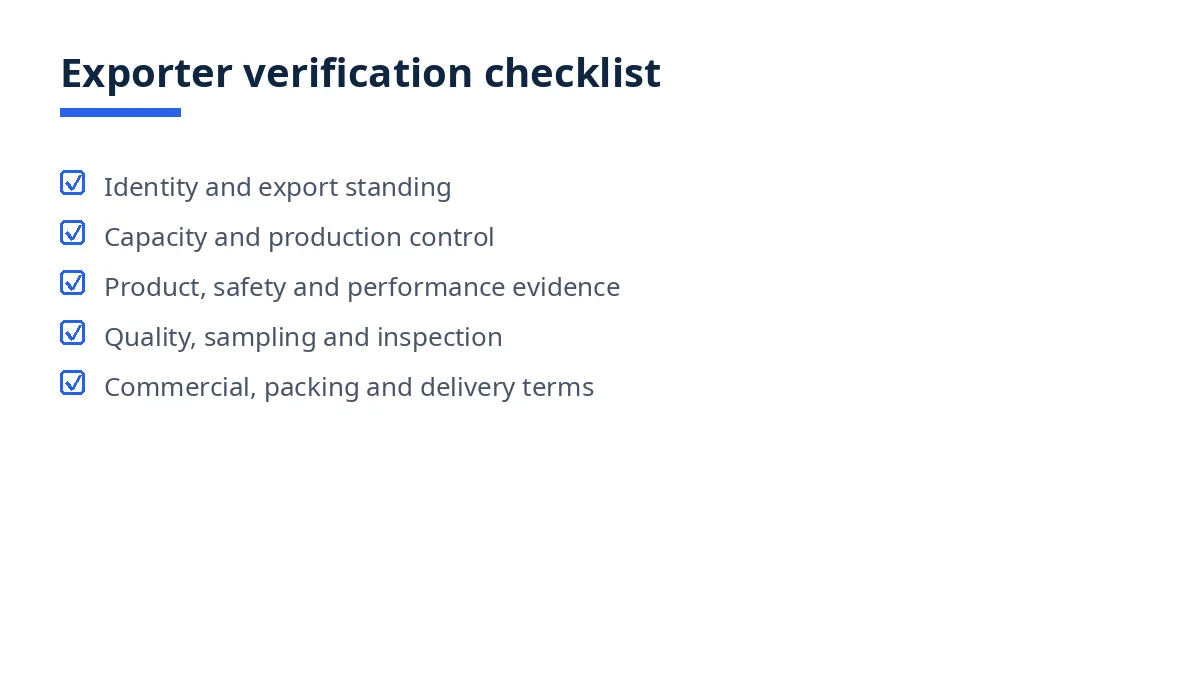
The full checklist (numbered, printable)
Record the evidence for each check.
Identity and export standing
Confirm the legal name, registered address and contact details on the quotation match the business registration documents.
Confirm the supplier holds an Export Registration Certificate (ERC) for export from Bangladesh, with the same company name as the quotation.
Confirm whether the supplier makes the fittings itself or trades them, and if it trades, ask for the maker name and location.
Check the supplier profile on Exportain for the trust and verification checklist, and read what each badge covers first.
Ask for two recent export references in the same product family, and contact at least one reference.
Record any refusal to share a registration document, certificate, or maker name as a failed check.
Capacity and production control
Ask for monthly capacity for the exact fitting type and variant, the current order book position, and lead time from sample to shipment.
Ask which components are made in-house and which are bought in, naming the driver, LED module, housing and optic suppliers.
Ask how variant changes are controlled: a change of driver, optic, colour temperature or housing must be approved as a new variant.
Ask for the production plan: batch size, sequence by variant, and the point at which inspection can take place.
Check spares and after-sales support in writing: parts supplied with the order and how replacements are ordered.
Confirm the supplier can repeat the approved sample in bulk, including incoming component checks and in-line testing.
Product, safety and performance evidence
Check the safety evidence for the exact model: standard tested against, laboratory, report number and date, and whether it covers the quoted variant.
Check that the fitting is designed and constructed to function safely in normal use under IEC 60598-1, and ask for its marking and installation instructions.1
Check the ingress protection rating per location: under IEC 60529 the first digit covers solids and dust, the second covers water, with 6 meaning dust-tight and 5 meaning protected against water jets.3 Ask for the test evidence, not a printed rating alone.
Check the data sheet against IEC 62722-2-1 product information: input power, luminous flux, efficacy, colour temperature, colour rendering index, lumen maintenance and ambient temperature.2 Reject a sheet giving only wattage and a lumen figure.
Check photometric evidence: light distribution, beam angle and peak intensity.
Check destination-market compliance: for the European Union, confirm whether the fitting falls under the RoHS Directive 2011/65/EU, which lists lighting equipment among the categories it covers, and excludes large-scale stationary industrial tools and large-scale fixed installations.4
Quality, sampling and inspection
Approve a sample of the exact variant before bulk production, including housing, driver, optic, colour temperature and finish, in writing.
Agree a pre-production sample for a first order or new variant, with bulk production starting only after written approval.
Agree sampling and acceptance rules before shipment: ISO 2859-1 defines the acceptance quality limit as the quality level that is the worst tolerable process average when a continuing series of lots is submitted for acceptance sampling.5 Name the inspection level, defect classes, and accept and reject numbers in the purchase order.
Inspect the bulk against the approved sample and data sheet: finish, lens and optic condition, hardware, driver labelling, marking and packing.
Test a sample of the bulk where the order justifies it: input power, light output, colour temperature and, for washdown locations, seal condition.
Record inspection results by variant and batch, with the remedy agreed in advance.
Commercial, packing and delivery terms
Check the quotation line by line: variant, quantity per variant, unit price, currency, Incoterm, lead time, payment terms, validity and exclusions.
Confirm how the minimum order quantity is counted: per order, per fitting type, per variant, or per colour temperature. Read the MOQ meaning guide before agreeing a figure.
Agree payment terms matching the risk: set the schedule against sample approval, inspection and shipment milestones, not advance payment alone.
Agree packing and marking in writing: export packing, protection for lenses and optics, carton marking by variant, and a matching packing list.
Agree delivery and delay terms: named port or place, shipment window, partial shipment rules, and the remedy for late delivery.
File the complete order record before payment: specification, data sheets, test reports, sample approval, sampling rules, inspection report, quotation, purchase order and packing list.
Common failures and how to fix them
The most common failure is a test report for the wrong model. A report for a lower-wattage fitting in the same housing, or for a different optic, does not prove the quoted variant. Ask for the report naming the quoted model and variant, and check the laboratory, report number and date. If the supplier cannot produce it, treat the safety check as failed.
The next failure is an ingress protection rating that does not match the location. A fitting rated for indoor use is sometimes quoted for a washdown hall or an exposed canopy. Re-check the rating per location against IEC 60529, ask for the test evidence, and change the fitting or the specification before production.3
A third failure is a bulk batch that differs from the sample: a different driver, colour temperature, or finish, usually from an unrecorded variant change. Hold the batch, compare it against the written sample approval by variant, and require the supplier to identify the change and re-submit a sample.
A fourth failure is a sampling dispute at inspection, where buyer and supplier disagree on how many units were checked and what counts as a defect. This is avoided only by agreeing the sampling basis, defect classes and accept and reject numbers in the purchase order before shipment, as in check 21.5
Downloadable template / summary table
Copy the checklist into an inspection sheet with columns for evidence, result, and checker.
Section | Checks | Evidence to file |
|---|---|---|
Identity and export standing | 1 to 6 | Registration documents, ERC, maker name, profile checklist, references |
Capacity and production control | 7 to 12 | Capacity statement, component list, production plan, spares terms |
Product, safety and performance | 13 to 18 | Test reports, data sheets, IP evidence, destination-market declaration |
Quality, sampling and inspection | 19 to 24 | Sample approval, sampling rules, inspection report, test results |
Commercial, packing and delivery | 25 to 30 | Quotation, MOQ basis, payment schedule, packing list, order record |
How Exportain helps
Exportain is a B2B marketplace connecting buyers with Bangladeshi suppliers, and supplier profiles carry a trust and verification checklist. Exportain states that verification is a review of documents and photos by its staff, that it is not a factory inspection and not a check against a government database, and that a badge is not a guarantee of production capacity, product quality or delivery.6 Read the how supplier verification works guide, browse suppliers, and use the profile checklist as the starting point for checks 1 to 6. The inspection services directory currently states "No services published in this category yet", so arrange inspection directly with a provider and record it in the order file. Exportain is not a party to the goods contract.
FAQs
When should this checklist be used?
Use it before a first order with a new exporter, before a repeat order with a new fitting type or variant, and before any order where the fitting will sit in a wet, dusty, hot or washdown location.
Who should complete it?
The buyer, a sourcing agent, or an independent inspector can complete it, with the specification, sample record, and authority to stop the order on a failed check. A supplier should never mark its own checklist as passed.
What are the most common failures?
A test report for the wrong model, an ingress protection rating that does not match the location, a bulk batch that differs from the approved sample, and a sampling dispute caused by acceptance rules that were never agreed in writing are the failures buyers meet most often.
Can a third party do it?
Yes, if the third party receives the full specification, the sample approval record, the agreed sampling and acceptance rules, and the authority to record failures. Require a written report by variant and batch.
Next steps on Exportain
Write the specification with the ingress protection rating per location and the performance values from check 16, then read the how supplier verification works guide and browse suppliers. When the specification is ready, post a free RFQ on Exportain with the fitting type, variant, quantity per variant, destination market and required evidence, and compare quotations against this checklist.
Sources
- IEC 60598-1:2020 - Luminaires - Part 1: General requirements and tests. International Electrotechnical Commission (accessed )
- IEC 62722-2-1:2014 - Performance Requirements for LED Luminaires. International Electrotechnical Commission (IEC) (accessed )
- Ultimate Guide to Ingress Protection: Ensuring Safety and Reliability. Grace Technologies (accessed )
- Restriction of the use of certain hazardous substances (RoHS) Directive (2011/65/EU). CE Marking Assistant (accessed )
- SIST ISO 2859-1:2003 - Sampling procedures for inspection by attributes, Part 1: Sampling schemes indexed by acceptance quality limit (AQL). International Organization for Standardization, (accessed )
- How Supplier Verification Works on Exportain. Exportain, (accessed )
- supplier verification
- pre-shipment inspection
- importing from Bangladesh
- Electrical products
- Industrial lighting
About the author
Sourcing from Bangladesh?
Post a request for quotation and suppliers on Exportain can send you their quotes directly.
Post an RFQ


