

Italy Buyers: How to Import Workwear and Uniforms From Bangladesh
Italy buyers' guide to importing workwear and uniforms from Bangladesh: supplier checks, samples, PPE rules, EBA duty, Genoa shipping and landed cost.
Short answer
To import workwear and uniforms from Bangladesh to Italy, define each wearer group's garment type, fiber mix, size range, and whether the item is an ordinary uniform or PPE, then shortlist woven suppliers whose production matches it. Verify documents and capability, approve a pre-production sample, classify each style for TARIC, confirm the EBA proof of origin, and build the landed cost before bulk production. Clear the goods in Italy through Genoa or La Spezia with a valid EORI number.
On this page
Key takeaways
Italy-bound workwear from Bangladesh enters at 0 percent duty under Everything But Arms, subject to origin rules and a valid proof of origin; import VAT in Italy is separate and charged at the standard rate of 22 percent.
Ordinary uniforms are not PPE, while protective workwear falls under Regulation (EU) 2016/425, with Category II and III garments needing EU type-examination by a notified body before serial production.
Most woven workwear falls in Chapter 62, with heading 6203 for men's garments, heading 6204 for women's garments, and heading 6211 for other garments, plus dedicated industrial and occupational lines such as 62034211.
There is no single typical MOQ, price, or transit time for workwear from Bangladesh, so confirm each one in writing for your exact garment, color, size range, route, and shipment date.
Fiber labeling for goods sold in Italy must be in Italian under Regulation (EU) No 1007/2011, and the label wording, size chart, and language version belong in the purchase order as attachments.
For an Italy-based buyer, importing workwear and uniforms from Bangladesh starts with the wearer and the job, not with a fabric catalog. A hotel housekeeping tunic in Milan, a logistics vest outside Bologna, a flame-resistant coverall for a plant in Turin, and a chef jacket for a restaurant group in Rome are four different purchases, even when they come from the same factory. Each one has its own garment type, fiber mix, size range, label, and conformity route.
This guide follows the order from Italy: define the program by wearer group, find and check suppliers, approve samples in production fabric, agree the delivery term and inspection plan, classify each style, and build the landed cost before bulk production. It is written for buyers clearing goods in Italy.
One distinction shapes the whole purchase. Ordinary working clothes and uniforms that do not specifically protect the safety and health of the worker sit outside the workplace personal protective equipment (PPE) definition used in EU safety law.1 Protective clothing, by contrast, is PPE, and it falls under Regulation (EU) 2016/425 on the design, manufacture, and marketing of PPE.1 A polo shirt with a company logo is a uniform; a high-visibility jacket or a chemical-resistant coverall is protective equipment, and it must be treated that way from the specification onward.
Why source workwear and uniforms from Bangladesh
Bangladesh has a large woven-garment base, which matters because most workwear is woven: trousers, jackets, coveralls, shirts, and aprons cut from woven cotton, polyester-cotton, or twill. According to the Bangladesh Garment Manufacturers and Exporters Association (BGMEA) website, the association has around 4,500 member factories, of which about 40 percent are knitwear and sweater manufacturers and the remaining 60 percent are woven garment manufacturers.2 BGMEA member factories account for 100 percent of woven garment exports.2
The practical attraction is range within one program. A single supplier can often cut work trousers, jackets, and coveralls in the same fabric family, match colors across styles, and run repeat orders in the same size curve.
Bangladesh suits consolidated programs better than very small, one-off orders with many colors and sizes, because fabric is woven or dyed in batches and cutting is planned by size range.
Find and verify suppliers
Where should you start the search?
Start with a program sheet, not with a list of factory names. Write down each wearer group, each garment type, the fiber mix, the fabric weight, the color, the size range, the logo method and position, the packing unit, and whether the item is an ordinary uniform or PPE. Then shortlist suppliers whose current production already includes that garment type.
Send every candidate the same program sheet and ask for the same reply format: fabric assumed, garment types quoted, price inclusions, validity, minimum per style and per color, and production time from approved sample. Browse suppliers on Exportain and compare replies on identical terms.
How do you verify a supplier before you pay?
Verification has three layers. The first is company documents: trade license, export registration, and association membership where applicable, checked so that name, address, and bank account name agree across every document. The second is capability: woven capacity, fabric source and width, dyeing route, washing and finishing route, and embroidery or print route.
The third layer is compliance scope. For PPE items, ask which conformity route the factory uses, which notified body is involved where one is required, and whether the EU declaration of conformity covers your exact garment, size range, and standard. For ordinary uniforms, ask about fiber labeling and Italian-language labels. Keep payments to the company account named in the documents, never to a personal account, and verify any change of bank details separately before paying.
MOQ, pricing and samples
What is the typical MOQ for workwear and uniforms from Bangladesh?
There is no single typical minimum order quantity for workwear and uniforms from Bangladesh. The minimum is set per style and usually per color, because fabric is produced in batches, dye lots are set per color, and cutting is planned per size range. A plain navy work trouser will carry a different minimum than a taped high-visibility jacket with embroidered logos in six sizes.
How is the price built, and how should you compare quotes?
Fabric is usually the largest cost element in workwear, followed by cutting and sewing, dyeing or finishing, trims such as zippers, buttons, and reflective tape, embroidery or print, testing, packing, and the factory margin. Workwear fabrics are heavier than fashion shirting, so fabric weight drives the price more than in light apparel. Compare quotes only on the same basis: same garment type, fiber mix, fabric weight, size range, color, logo method, packing, and delivery term, and ask what is excluded, such as tape, digitizing, testing, or freight.
Which samples do you need, and how do you approve them?
Work in stages. A development sample shows whether the factory can construct the garment, place the logo correctly, and sew the pockets, waistband, and closures to your pattern. A pre-production sample in production fabric, color, trims, and tape is the sample you approve for bulk.
Test samples as the workforce will wear them: wash them on your routine, check that trouser legs and jacket sleeves match across sizes, work every zipper and button, and check that reflective tape stays in place and stays visible after washing. For PPE samples, check the labeling, the declaration of conformity, and the user information against the garment you received, not against a generic certificate. Approve in writing.
Quality control and certifications needed
Which quality checks are specific to workwear and uniforms?
Against the approved sample and size chart, check fabric composition and weight, finished measurements within your agreed tolerances, and consistency across the size range. Then check construction garment by garment: seam type, pocket attachment and bar tacks, waistband and closure finish, zipper function, button attachment, reinforcement where specified, and logo placement.
Agree the inspection method and defect limits before production. ISO 2859-1:2026 defines a system of acceptance sampling plans for inspection by attributes, and its summary states that AQL stands for acceptance quality limit, the maximum average percentage of defective items considered acceptable during random sampling, used to determine sample sizes and acceptance and rejection thresholds.3
Which rules apply to protective workwear?
Regulation (EU) 2016/425 divides PPE into three categories according to the level of risk against which the PPE is intended to protect users.1 Category I covers PPE that protects against minimal risks, such as superficial mechanical injury or contact with hot surfaces not exceeding 50 degrees Celsius. Category III covers PPE that protects against risks that may cause very serious consequences, such as death or irreversible damage to health. Category II covers PPE that protects against risks other than those listed in Categories I and III.1 For Category II and III PPE, the model needs EU type-examination by a notified body before serial production, and Category III also needs notified-body supervised checks or quality-system assessment.1
Working split for a buyer; the risk assessment for the actual job decides the category.
PPE category | Typical workwear examples | What to ask the supplier for |
|---|---|---|
Category I, minimal risk | Light weather aprons, basic gardening-type gloves | Manufacturer declaration of conformity, user information |
Category II, intermediate risk | High-visibility jackets and trousers, welding jackets | EU type-examination certificate from a notified body, declaration of conformity naming the garment and standard |
Category III, serious risk | Chemical-resistant coveralls, arc-flash garments | EU type-examination certificate plus ongoing notified-body involvement, declaration of conformity with the notified-body number |
Ordinary uniforms that are not PPE must not carry a CE mark as if they were protective equipment. If a supplier offers a CE mark on a plain uniform shirt with no protective claim, ask what legislation and standard it refers to.
Which label rules apply in Italy?
Fiber labeling follows Regulation (EU) No 1007/2011. Its Article 16 requires that fiber composition descriptions be indicated in catalogs and trade literature, on packaging, labels, and markings in a manner that is easily legible, visible, and clear.4 The same article requires that the labeling or marking be provided in the official language or languages of the member state on whose territory the textile products are made available to the consumer, unless that member state provides otherwise.4 For goods sold in Italy, that means Italian-language fiber labeling.
Confirm size labeling with your customer as well. Italian workwear users are used to EU size conventions and to size information in Italian, and a size chart in a different convention creates returns even when the garments are well made.
Which certifications do you actually need?
No single certificate covers every workwear order. What you need follows the garment and the customer: a logistics operator may accept a standard work trouser with fiber labels and wash-test results, while a plant operator buying chemical-resistant coveralls needs the full PPE file for that garment. Name any required test or scheme in the specification, and check the report scope, product covered, issuing body, and date.
Incoterms, shipping and transit time
Which delivery term should a first order use?
The Incoterms 2020 rules set out, for each rule, where delivery takes place, and risk passes from seller to buyer at the same point and time as delivery.5 Under FOB, CFR, and CIF, the seller must place the goods on board the vessel, and in all rules but EXW the seller must carry out export formalities, while in all rules but DDP the buyer must carry out import formalities.5 The four sea rules are only intended for port-to-port bulk or break-bulk shipments and are not suitable for container shipments.5
For a first containerized order, weigh FOB at the Bangladeshi port against FCA at the named terminal. Under FOB, the factory delivers the goods on board and your forwarder handles the sea leg. Under FCA, delivery happens when the goods are handed to your carrier, which matches how containerized cargo moves. State the rule, the named place, and the edition in the purchase order, for example FCA Chattogram terminal, Incoterms 2020.
How long does shipping take?
There is no single typical transit time for workwear from Bangladesh to Italy. Sea freight is the standard route for bulk orders and it takes weeks rather than days, varying by port, routing, transshipment, and season. Add clearance and delivery to the Italian warehouse to the forwarder's sailing schedule.
Genoa is the natural first port to quote for northern Italy. The Western Ligurian Sea Port Authority reports that the Ports of Genoa and Savona-Vado moved almost 3 million TEUs in 2025, with container gateway traffic of 1,919,700 TEUs in full containers for import and export.6 Genova alone handled 2.4 million TEUs in that year.6
Import duty, taxes and documents
How are workwear and uniforms classified for duty?
Duty follows the classification of each style in the EU tariff, not the supplier product name. Most woven workwear falls in Chapter 62, which covers articles of apparel and clothing accessories, not knitted or crocheted. Within that chapter, heading 6203 covers men's garments, heading 6204 covers women's garments, and heading 6211 covers other garments. The EU tariff carries dedicated industrial and occupational lines: for example, code 62034211 covers men's or boys' industrial and occupational trousers and breeches of cotton, excluding knitted or crocheted goods and bib and brace overalls.7 Confirm the full 10-digit TARIC code for each style with your broker before you price or ship.
What import duty applies?
The EBA scheme sits within the EU Generalised Scheme of Preferences, which gives partial or full elimination of EU tariffs for a wide range of products entering the EU market.8 Under Everything But Arms (EBA), the EU removes tariffs and quotas for all imports of goods, except arms and ammunition, coming into the EU from least developed countries, and Bangladesh is listed among the EBA countries.9 The EBA scheme has no expiry date and no graduation mechanism for products.9
That condition is the part to get right. To qualify for preferential duty rates, products originating in EBA beneficiary countries must be accompanied by a proof of origin, which may be a certificate of origin Form A issued by the competent authority in the beneficiary country, or an invoice declaration drafted by the exporter for consignments of 6,000 euros or less.9 Proof of origin remains valid for 10 months after issue.9 Agree the proof at order stage, and confirm with your broker whether the shipment needs a Form A. If a shipment cannot meet the origin rules, the TARIC most-favored-nation rate for that code applies instead.
What about Italian VAT and the EORI number?
Italy applies EU customs law to goods arriving from outside the European Union, and customs duty and import VAT are paid at clearance, with Italy's standard VAT rate at 22 percent unless the goods qualify for a reduced rate.10 Import VAT is separate from duty: it is often recoverable for a VAT-registered importer, but it is still a cash cost at clearance, charged on the customs value plus duty and onward costs to the first place of destination in Italy.10
An Economic Operators Registration and Identification (EORI) number is the identifier EU customs authorities use for businesses involved in customs operations.11 Any economic operator established in the customs territory of the Union needs an EORI number for customs purposes, and businesses and people wishing to trade must use it as an identification number in all customs procedures.11 If your Italian customer or its customs broker imports the goods in its own name, it uses its own EORI number. If you import in your own name, confirm your EORI number is valid before the goods sail.
Which documents do you need for clearance?
The standard import set is the commercial invoice, packing list, bill of lading or air waybill, and proof of origin where a preference is claimed. The declaration itself is filed electronically, and the invoice is the starting point for classification and valuation.10 The invoice should name each style plainly, for example men's cotton industrial work trouser, with fiber composition, size range, quantities, unit prices, and the delivery term, on its own line. Quantities, weights, and carton counts must agree across every document.
Landed cost example
A landed cost is the full cost of one workwear set, ready to sell in Italy. Every number below is an example figure only, not a quote.
Example figures: 3,000 men's cotton work sets, one jacket and one trouser each, FCA Chattogram terminal, sea freight to Genoa, duty at 0 percent under EBA subject to origin rules, delivery near Milan.
Cost element | Example figures (per set) | How to obtain your figure |
|---|---|---|
Product price, FCA | $8.60 | Confirmed pro forma invoice |
International freight | $0.95 | Forwarder quote divided by sets shipped |
Insurance | $0.07 | Policy or forwarder quote |
Duty | $0.00 | Broker calculation: EBA 0 percent with valid proof of origin |
Port, clearance and broker fees | $0.42 | Broker invoices divided by sets |
Local delivery to warehouse | $0.35 | Local carrier quote divided by sets |
Total landed cost | $10.39 | Sum of all lines above |
Import VAT at 22 percent is not included, because it is charged on the customs value plus duty and onward costs to the first Italian destination, and its recovery depends on the importer's tax position.10
Step-by-step import checklist
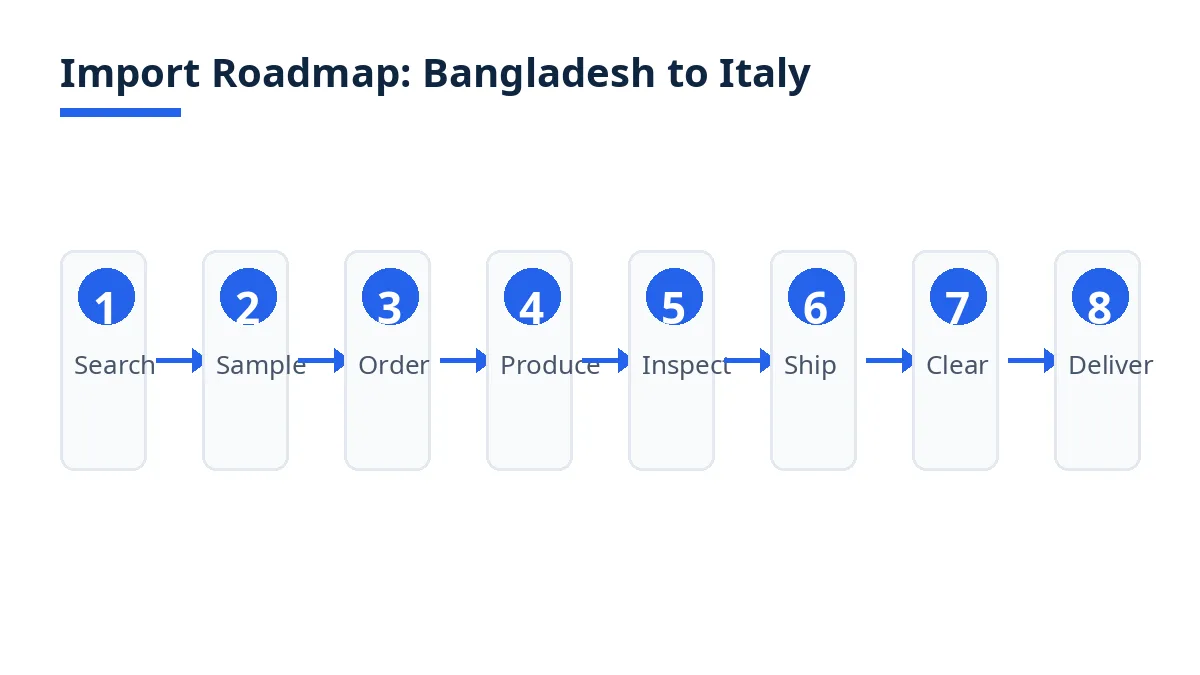
Write the program sheet by wearer group: garment type, fiber mix, fabric weight, color, size range, logo method, packing, and whether each item is an ordinary uniform or PPE.
Classify every style, starting from Chapter 62 headings 6203, 6204, and 6211, and confirm each full TARIC code and duty with your broker.
Shortlist woven suppliers whose current production includes your garment types, and request comparable quotes on the identical program sheet.
Verify the chosen supplier: company documents, woven capacity, fabric source, dyeing and finishing route, and a video or in-person factory check.
Order samples in stages, wash and wear-test them, and approve a pre-production sample of each style in production fabric, color, trims, and tape.
For PPE items, confirm the category, the notified body where one is required, and the declaration of conformity for your exact garment before bulk production.
Confirm the order in writing: purchase order, pro forma invoice, delivery and payment terms, inspection plan with AQL and defect limits, Italian-language labels, and shipment date.
Agree the proof of origin at order stage, and confirm who holds the EORI number and who files the import declaration in Italy.
Inspect during production and again on packed goods against the approved samples, checking measurements, construction, color match, labels, and packing.
Ship, clear customs in Italy with the confirmed code for each style, reconcile the actual landed cost, and keep the import file, including the proof of origin.
How Exportain helps
Browse suppliers for Bangladeshi workwear and uniform exporters and compare their ranges against your program sheet. Then post your specification as an RFQ and compare replies on the same terms before choosing a factory for sampling. Read how to buy for the buying steps on the platform.
FAQs
What is the typical MOQ for workwear and uniforms from Bangladesh?
There is no single typical minimum. It is set per style and usually per color, because fabric is produced in batches, dye lots are set per color, and cutting is planned per size range.
How long does shipping take?
Production time and transit time are separate, and neither has a single typical figure. Sea transit from Bangladesh to Italy takes weeks rather than days and varies by port, routing, transshipment, and season.
What import duty applies?
Duty follows the confirmed classification of each style, the origin, and the preference in force on the entry date. Under EBA, the EU removes tariffs and quotas for all imports of goods, except arms and ammunition, from least developed countries, and Bangladesh is listed among the EBA countries.9 For a qualifying shipment with a valid proof of origin, the duty rate is 0 percent. If the preference cannot be claimed, the TARIC rate for that code applies. Import VAT in Italy is separate from duty and is charged at the standard rate of 22 percent unless a reduced rate applies.10
How do I verify a supplier?
Check company documents first, so that name, address, and bank account agree across the trade license, export registration, and invoices. Then check capability: woven capacity, fabric source, dyeing and finishing route, and recent workwear production. For PPE items, check the category, the notified body where one is required, and the declaration of conformity for your exact garment.
Next steps on Exportain
Read how to import from Bangladesh for the full process, then use how to buy to set out your buying steps. When ready, browse suppliers on Exportain and compare workwear and uniform exporters against your program sheet.
Sources
- PPE - OSHwiki. European Agency for Safety and Health at Work (accessed )
- BGMEA sets new membership criteria to ensure factory safety, operational standards. The Financial Express, (accessed )
- ISO 2859-1:2026 - Sampling procedures for inspection by attributes — Part 1: Sampling schemes indexed by acceptance quality limit (AQL) for lot-by-lot inspection. International Organization for Standardization (accessed )
- Regulation (EU) No 1007/2011 on textile fibre names and related labelling and marking of the fibre composition of textile products, Article 16: The use of textile fibre names and fibre composition descriptions. legislation.gov.uk (accessed )
- Insider thoughts: Bob Ronai on Incoterms 2020 Rules; What are they about?. International Chamber of Commerce (accessed )
- Three million TEUs: Ports of Genoa hit a record high in container volumes in 2025. Western Ligurian Sea Port Authority (accessed )
- HS Code 62034211 - Men's or boys' industrial and occupational trousers and breeches of cotton. tariffnumber.com (accessed )
- Trade arrangements. European Commission, Access2Markets (accessed )
- Everything but Arms (EBA). European Commission (accessed )
- Italy Import Regulations 2026: Customs, VAT & EORI. Lawzana (accessed )
- European Commission FAQ. Agenzia delle Dogane e dei Monopoli (accessed )
About the author
Sourcing from Bangladesh?
Post a request for quotation and suppliers on Exportain can send you their quotes directly.
Post an RFQ


