

Importing Frozen Shrimp From Bangladesh to Belgium: Costs, Duties and Suppliers
Frozen shrimp from Bangladesh to Belgium through Antwerp: the FASFC control file and CHED-P, EBA and processing-quota duty routes, supplier checks, and a per-kilogram landed-cost example.
Short answer
To import frozen shrimp from Bangladesh to Belgium, present the consignment at an approved Belgian border control post with a CHED-P pre-notification filed in TRACES at least one working day before arrival, an official health certificate from a listed establishment, and the catch or origin file for the lot. Classify the shrimp on line 0306 17 92 20, settle the EBA, quota, or standard duty route with your broker, and confirm the Belgian import VAT rate before pricing.
On this page
Key takeaways
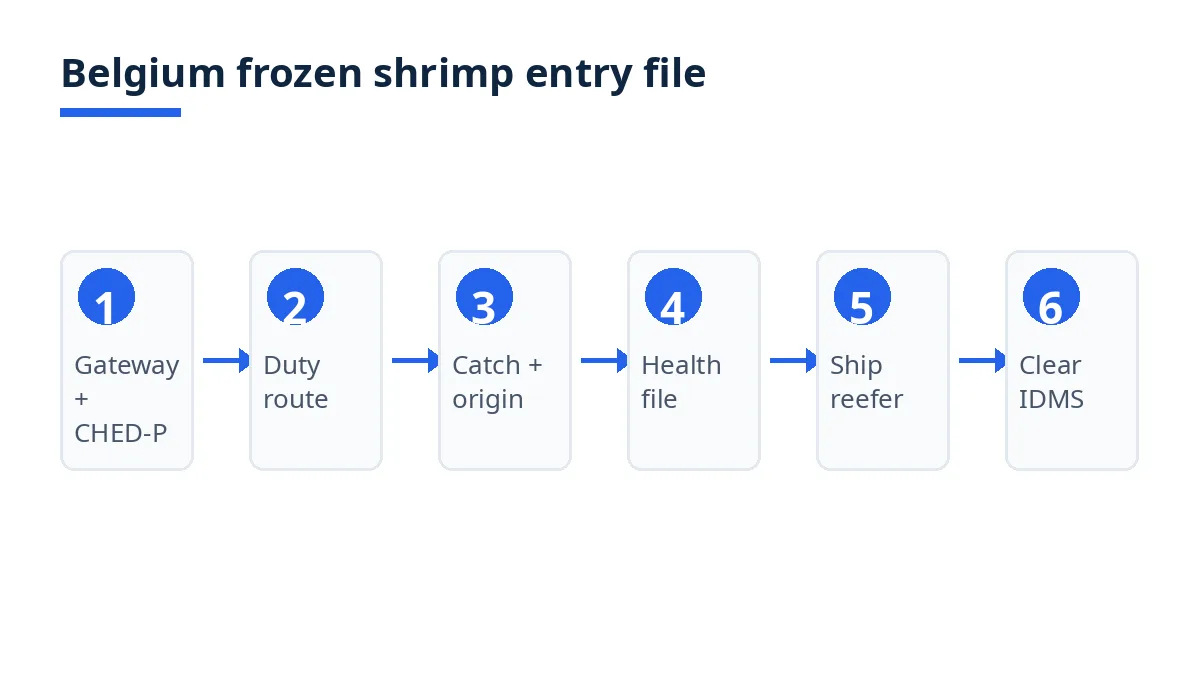
Fix the Belgian gateway first: an approved border control post, a CHED-P in TRACES filed at least one working day before arrival, a health certificate, and the catch or origin file for the exact lot.
Settle the duty route before pricing: the EBA preference, the 09.2802 processing quota at 0 percent to 31 December 2026, or the indicative 12 percent standard duty, each with its own proof.
Classify on line 0306 17 92 20 for Penaeus vannamei and Penaeus monodon, not cooked, for processing, and confirm the full Belgian TARIC code and rate with your broker.
Wild-caught lots need catch documents submitted through CATCH, while farmed lots follow the exempt route; keep the two files separate even in one container.
The example landed cost is EUR 10.00 per kilogram excluding VAT on the EBA route, rising to EUR 11.12 at the indicative standard duty; rework it at quote stage and after shipment.
A frozen shrimp order for Belgium is decided at the border control post before it is decided on price. The buyer who arrives in Antwerp with the FASFC control file agreed clears into free circulation across the European Union. Port of Antwerp-Bruges handled 1,170,394 TEU of reefer containers in 2025, its highest recorded volume, with imports up 13.5% on 2024.1
This guide is for buyers in Belgium importing frozen shrimp from Bangladesh for processing, wholesale, or retail-ready sale, and for the brokers filing their entries. Every cost figure is an example figure.
Fix the Antwerp gateway and the FASFC control file first
Name the gateway and the border control post before asking for a price. Port of Antwerp-Bruges manages the port platforms of Antwerp and Zeebrugge, and its reefer traffic is a stated strategic asset of the port.1 Confirm in writing that your post is approved for products of animal origin for human consumption. The FASFC is the Belgian authority for the border checks, and each consignment must be notified to the FASFC at the post of arrival at least one working day before its estimated arrival, by a Common Health Entry Document, the CHED, through TRACES, with a CHED-P for each consignment.2
File as soon as sailing, seal numbers, and certificate details are fixed, and confirm receipt in TRACES before the vessel sails. At the post, every consignment faces a documentary check and an identity check, and physical checks at 1%, 5%, 15%, or 30%, set by product and third country of origin.2 The documentary check tests whether the certificate is an original, follows the prescribed model, and comes from an approved country and establishment, while the identity check tests whether container and seal numbers, origin, description, codes, approval numbers, and labels match the certificate.2 Use one set of numbers identically on the certificate, CHED-P, invoice, packing list, and bill of lading. The decision is binary, and non-compliance may lead to reinforced controls on future consignments from the same origin.3
Choose the duty route before you price: EBA, quota, or standard duty
Three duty routes can apply to the same shrimp, and the route changes the landed cost by more than the freight. Settle the route with your broker before comparing quotes. The first route is preference under Everything But Arms, which gives full tariff and quota-free imports for all goods from United Nations-defined least developed countries, except for arms.4 The Bangladesh Customs hub records a 0% preferential tariff for the European Union under Regulation (EU) No 978/2012 for shrimps and prawns.5 Treat that as a route to confirm, not a rate to assume, and have your broker confirm status and proof for the entry date.
The second route is the autonomous tariff quota for processing. Council Regulation (EU) 2023/2720 opens Union autonomous tariff quotas for certain fishery products for 2024 to 2026.6 Quota order 09.2802 covers Penaeus vannamei and Penaeus monodon, whether in shell or not, fresh, chilled or frozen, not cooked, for processing, at 0% for 48,000 tonnes from 1 January 2024 to 31 December 2026, subject to end-use supervision and not for processing at retail or catering level.6 The third route is the standard third-country duty of 12.00% on the EU-derived line for the same product.7 That figure is read on the UK tariff page carrying the EU-derived line, not on the EU TARIC schedule, so treat 12% as indicative and confirm the exact TARIC rate on the entry date, including any successor quota after 31 December 2026.
Classify the shrimp on the 0306.17 line
Classification decides the duty route, quota line, and certificate model, so classify before negotiating. Frozen shrimp sits in heading 0306, and the line for most Bangladesh orders is 0306 17 92 20: shrimps and prawns of Penaeus vannamei and Penaeus monodon, whether in shell or not, not cooked, for processing.7 Species, shell state, cooked state, and "for processing" are all part of the line.
Work the classification lot by lot, since one order can contain farmed vannamei for processing and a separate line of black tiger shrimp for a different channel. The full Belgian TARIC code adds digits beyond the shared six, and the broker must confirm the complete code for each line. Read the HS code for frozen shrimp guide alongside the broker calculation, and never let a supplier code stand in for the broker code.
Prove origin and catch: two different files for farmed and wild shrimp
Origin and catch are separate files, and confusing them is the most common file error on shrimp. Origin proves where the product comes from for the duty route, while catch proves, for wild-caught fish, that the catch was lawful. For origin, the preference and quota routes each need their own proof, and the broker must confirm what that proof is for the route claimed. The supplier declaration, proof of origin, and transport documents must describe the same goods, in the same quantities, under the same code.
For wild-caught shrimp, the catch certification scheme applies. CATCH, the digital catch certification system, is part of TRACES NT, and its use is compulsory for EU importers for submitting catch certificates and related documents for products listed under Chapter 3 and headings 1604 and 1605 subject to IUU controls from 10 January 2026.8 CATCH is designed to detect fraudulent catch certificates and prevent overuse of one certificate across several consignments.8 Ask the supplier, before ordering, who validates the certificate, in what form it will arrive, and how its quantities reconcile with the health certificate and invoice, and confirm the CATCH route and deadline in writing. For farmed shrimp, CATCH applies only to wild-caught produce subject to the scheme, with no change for exempt produce, including aquaculture and freshwater species.8
Health certificate and the listed establishment
The health certificate is the document the border post checks first, and the one most likely to fail on a detail. Animals and animal products from non-EU countries can only enter the EU market if accompanied by an official certificate, containing a public health attestation and, for certain fish and fishery products, an animal health attestation.9 Official certificates must be signed by the official veterinarians in the non-EU country, guarantee compliance with EU legislation, and are always checked at border control posts.9 A single mistake is sufficient for rejection at entry, and an incorrectly stated weight, while not a sanitary issue, will lead to rejection.9 Hold shipment until the final certificate matches the CHED-P, invoice, and packing list exactly. Certificates can only be issued to establishments listed on the European Commission establishment lists.9
On the Bangladesh side, the export file starts with the Department of Fisheries. The Bangladesh Customs hub lists an export licence from the Deputy Director of Fish Inspection and Quality Control, a no objection certificate for each lot, and a salubrity certificate for each consignment, under the Fish and Fish Products (Inspection and Quality Control) Act, 2020, plus an IUU certificate where the product was extracted from marine sources, under the Marine Fisheries Rules, 2023.5 Confirm the exact set for the frozen 0306.17 line with the supplier and the Department of Fisheries.
Decide the Belgian channel: processing, wholesale, or retail-ready
Belgium is not one market for frozen shrimp. It is three channels with different buyers, specifications, and duty routes, and the channel decision belongs before the specification, because it changes the code, the quota claim, and the label. The processing channel buys raw material for further processing in Belgium or onward in the EU, and is the channel the 09.2802 quota was written for. The retail-ready channel buys for sale to the final consumer or a mass caterer, where consumer-information rules apply in full.
Specify the shrimp so the label, the certificate, and the carton agree
Write one specification document and send the identical document to every supplier. The specification is the contract between the label, the certificate, and the carton. Fix species and scientific name first, using the commercial designation accepted in Belgium. Member States draw up and publish lists of the commercial designations accepted in their territory, together with their scientific names.10 Ask the Belgian buyer which designation its customers and inspectors expect, and use it word for word. Then fix production method, count, form, and pack: count is the number of shrimp per unit weight, form covers head-on or headless, shell-on or peeled, and pack covers net weight, drained weight, and glaze percentage, stated separately from net weight.
Consumer information rules decide what the retail label must carry. Products marketed in the Union may be offered for sale to the final consumer or a mass caterer only if marking or labeling indicates the commercial designation and scientific name, the production method using the words caught, caught in freshwater, or farmed, the area caught or farmed and gear category for capture fisheries, whether the product has been defrosted, and the date of minimum durability where appropriate.10 For aquaculture products, the area indication is the Member State or third country where the product reached more than half its final weight or stayed for more than half the rearing period.10 Approve the finished label artwork before bulk packing, and add the cold-chain specification to the same document.
Find and verify suppliers against the Belgian file
Shortlist suppliers whose current range already includes frozen shrimp for the EU, and whose establishment is on the current TRACES-NT list. Browse suppliers on Exportain and read each profile against the Belgian file, not its headline price. Shortlist three or four suppliers, send each the identical specification, and ask for the same reply format: species and scientific name, count, form, glaze, net and drained weight, pack format, items per carton, price inclusions, validity, and minimum per count and form.
Verification has three layers, all before any payment. First, documents: export licence, establishment listing, and association membership where applicable, checked so name, address, establishment number, and bank account agree across every document. Second, capability: freezing capacity, cold storage, glaze control, count grading, and recent EU shipments shown in finished goods and shipping records.
MOQ, pricing, and samples
There is no single typical minimum for frozen shrimp from Bangladesh. The minimum is set per species, count, form, and glaze, because freezing, glazing, and grading run in batches and a packing plan is set up per count range. Ask how the minimum splits by count, form, and glaze, and get the split in writing. A supplier quoting one minimum for every count has not priced the grading work.
Build the price from the same specification every supplier received. Product price, freezing and glazing work, inner and master packing, and the delivery term are separate lines; a price bundling them cannot be checked against the landed cost. State currency, validity, and delivery term with the price, and confirm whether the price is per kilogram of net, drained, or gross weight.
Quality control, cold chain, and the reefer leg
Quality control for frozen shrimp is a chain of checks, not a single inspection at the end. Agree the inspection plan before production: checks during grading and glazing, checks on packed cartons, and checks at loading. Set defect classes first: critical defects at zero acceptance, major defects at an agreed limit, minor defects at a looser limit. The cold chain continues after loading: shrimp that warms and refreezes loses texture and count integrity even when the carton looks sound, so the temperature record matters as much as the label.
Incoterms, shipping, and the Chattogram to Antwerp leg
The Incoterms 2020 rules number eleven, split into seven rules for any mode of transport and four rules for sea and inland waterway transport only.11 An Incoterm settles who arranges and pays for carriage, who handles export and import formalities, where delivery happens, and where risk transfers, and it does not transfer title or ownership, set price or payment terms, or decide what happens if goods are defective.11 For containerized cargo, FCA is the correct choice, because goods handed to a carrier at a container yard are out of the seller's control long before they reach the ship, while under FOB risk stays with the seller until loading.11 Under FOB, risk passes when goods are on board the vessel, and under CIF the seller pays freight and buys insurance, but risk still passes on loading at origin.11 For insurance, the CIF rule keeps the Institute Cargo Clauses (C) as the default level of cover, while the CIP rule now requires the higher Institute Cargo Clauses (A) cover.12
Import VAT, the IDMS declaration, and documents
Duty is only the first charge at the Belgian border. Belgium applies a standard VAT rate of 21%, with a 6% rate for essential goods including basic food, and a 12% rate for certain restaurant services, public housing, and some foodstuffs.13 Work with 6% only as an indicative figure for basic food, and confirm the rate for the exact product and supply with a tax adviser before pricing.
Belgian import declarations now run through the IDMS system. The Belgian customs authorities called on economic operators to submit as many import declarations as possible through the new IDMS system from 30 September 2025, with the previous PLDA system remaining available as a backup for authorized exceptions or technical issues.14 Confirm with the broker, before the first shipment, that the declaration will be filed through IDMS, who files it, and what happens if the system is unavailable on arrival day.
Landed cost example
A landed cost is the full cost of one kilogram of frozen shrimp, cleared and delivered to the Belgian cold store. Every number below is an example figure only, for 20,000 kilograms net weight of Penaeus vannamei, shipped by reefer container from Chattogram to Antwerp and delivered to a Belgian cold store, with the EBA preference claimed and confirmed by the broker.
Example figures: per kilogram, net weight, EBA preference route.
Cost element | Example figures (per kilogram) | How to obtain your figure |
|---|---|---|
Product price, FCA Chattogram | EUR 8.60 | Pro forma invoice |
Freight and insurance, per kilogram | EUR 0.70 | Forwarder quote |
Customs value, per kilogram | EUR 9.30 | Price plus freight and insurance |
Duty at 0% under the EBA route, as confirmed | EUR 0.00 | Broker calculation |
Border post, port, clearance, and broker fees, per kilogram | EUR 0.42 | Broker and port invoices |
Delivery to the Belgian cold store, per kilogram | EUR 0.28 | Local carrier quote |
Total landed cost, excluding VAT, per kilogram | EUR 10.00 | Sum of all lines above |
VAT at 6% on customs value plus duty, in this example | EUR 0.56 | Tax adviser calculation |
Total landed cost, including VAT, per kilogram | EUR 10.56 | Total excluding VAT plus VAT |
If the preference claim fails and no quota is available, duty at the indicative 12% is EUR 1.12 per kilogram, and the total excluding VAT rises to EUR 11.12. Work the calculation twice: at quote stage, and again after shipment with actual invoices.
Step-by-step import checklist for Belgium
Name the Antwerp gateway and approved border control post for fishery products.
Settle the duty route with the broker: EBA preference, quota 09.2802, or standard duty.
Classify every lot on the 0306.17 line, and confirm each TARIC code and rate.
Split the file by production method: CATCH file for wild-caught lots, origin file for farmed lots.
Check the establishment on the current TRACES-NT list, and re-check it before shipment.
Fix the Belgian channel in writing: processing, wholesale, or retail-ready.
Write one specification covering species, count, form, glaze, weights, pack, and label.
Shortlist suppliers against the Belgian file, verify documents and capability, and add a factory check for a first order.
Order samples in stages, and approve a pre-production sample in writing.
Agree the certificate draft, CHED-P data, weights, and seal numbers before shipment.
Ship on the agreed delivery term, with reefer set point, temperature record, and export file.
File the CHED-P at least one working day before arrival, and confirm receipt in TRACES.
Clear through IDMS with the broker, with identical numbers throughout.
Reconcile the actual landed cost per kilogram, and use the gap to price the next order.
How Exportain helps
Browse suppliers on Exportain for Bangladeshi frozen shrimp exporters and compare their ranges against the Belgian file before sending an enquiry. Then post the specification, channel, quantities, and delivery date as an RFQ, and compare replies on the same specification, delivery term, and document set. Exportain is a B2B marketplace where buyers post RFQs, receive quotations, and message suppliers. It does not inspect goods, book freight, or clear customs. Post a free RFQ and get quotes from Bangladeshi suppliers at post an RFQ.
What is the typical MOQ for frozen shrimp from Bangladesh?
There is no single typical minimum. The minimum is set per species, count, form, and glaze, because freezing, glazing, and grading run in batches and a packing plan is set up per count range. Ask how the minimum splits by count, form, and glaze, and get the split in writing before comparing quotes.
How long does shipping take?
Production time and transit time are separate, and neither has a single typical figure. Sea transit from Bangladesh to Belgium takes weeks rather than days and varies by port, routing, transshipment, and season, so plan from the forwarder's current sailing schedule.
What import duty applies?
Duty follows classification, duty route, and origin, and there is no single rate for a whole programme. Frozen shrimp of Penaeus vannamei and Penaeus monodon, not cooked, for processing, sits on line 0306 17 92 20, with a third-country duty of 12.00% shown as an indicative working figure.7 Everything But Arms gives full tariff and quota-free imports for goods from United Nations-defined least developed countries, except for arms, and the Bangladesh hub records a 0% preferential tariff for the EU under Regulation (EU) No 978/2012.4 5 Quota 09.2802 covers the same species for processing at 0% for 48,000 tonnes to 31 December 2026, under end-use supervision.6
How do I verify a supplier?
Check the establishment first: the plant must appear on the current TRACES-NT establishment list, and certificates can only be issued to listed establishments.9 Then check company documents, so name, address, establishment number, and bank account agree across the export licence, establishment listing, and invoices, and payment goes to the company account named in them. Then check capability: freezing and cold storage, glaze control, count grading, and recent EU shipments.
Next steps on Exportain
Read the general guide to importing from Bangladesh for the full process from enquiry to delivery, and the general guide to importing frozen shrimp from Bangladesh to compare the Belgian file with the general entry file. When the gateway, duty route, and specification are fixed, post a free RFQ on Exportain with the channel, counts, and delivery date, and compare quotes on the same specification, delivery term, and document set.
Sources
- New record in the reefer segment for Port of Antwerp-Bruges in 2025. Port of Antwerp-Bruges, (accessed )
- Food of animal origin. Federal Agency for the Safety of the Food Chain (FASFC) (accessed )
- Import controls of food and feed Q&As. European Commission (accessed )
- Preferential European Union import tariffs for developing countries. EUR-Lex (accessed )
- Other shrimps and prawns: export requirements, HS Code 03063610. Bangladesh Customs, National Board of Revenue, (accessed )
- Council Regulation (EU) 2023/2720 opening and providing for the management of the Union autonomous tariff quotas for certain fishery products for the 2024-2026 period. Council of the European Union, (accessed )
- Commodity code 0306179220: Shrimps and prawns of the species Penaeus vannamei and Penaeus monodon, whether in shell or not, not cooked, for processing. GOV.UK (accessed )
- CATCH - NEW EU SYSTEM. Sea-Fisheries Protection Authority (accessed )
- EU official health certificates for exports to the EU – explained. AGRINFO (accessed )
- Regulation (EU) No 1379/2013 on the common organisation of the markets in fishery and aquaculture products. legislation.gov.uk, (accessed )
- Incoterms 2020 Explained: All 11 Rules. Blue Ocean Academy (accessed )
- Incoterms® 2020. International Chamber of Commerce (ICC) (accessed )
- VAT Calculator Belgium: Calculate VAT Online in Belgium. ClearTax, (accessed )
- Latest edition of EY Belgium's customs and excise update. EY Belgium (accessed )
About the author
Sourcing from Bangladesh?
Post a request for quotation and suppliers on Exportain can send you their quotes directly.
Post an RFQ


