

How to Import Cotton T-Shirts to USA From Bangladesh: Step-by-Step Guide
Import cotton t-shirts from Bangladesh to USA: supplier verification, samples, AQL checks, 6109.10 duty, USA labeling, Incoterms and a worked landed-cost example for one order.
Short answer
To import cotton t-shirts from Bangladesh to the USA, specify the tee in full, verify the supplier's documents and current cotton-tee production, and approve a pre-production sample in production fabric. Classify each style under 6109.10.00, confirm the 16.5 percent general rate and any additional duties with your broker, settle USA fiber, origin and care labeling, choose FCA or FOB, file the ocean Importer Security Filing, and build the landed cost before bulk production.
On this page
Key takeaways
Cotton t-shirts, knitted or crocheted, sit in heading 6109, subheading 6109.10.00, and the general rate in Revision 17 (2026) of the United States schedule is 16.5 percent, with a column 2 rate of 90 percent; confirm the current rate and any additional duties in force on your entry date.
There is no single typical MOQ or transit time for this route: the minimum is usually set per style and per color, and transit time must be planned from your forwarder's current sailing schedule.
The USA label must show true fiber content, country of origin as Made in Bangladesh, and the responsible business name or RN, plus a safe cleaning method; the United States importer is legally responsible for proper labeling.
For container shipments, weigh FCA at the named terminal against FOB at the port, write the term in full with the named place and Incoterms 2020, and confirm who files the ocean Importer Security Filing at least 24 hours before loading.
Example figures only: 10,000 men's cotton t-shirts at a 45,000 dollar customs value give a rounded landed cost of 5.78 dollars per shirt, using duty at the 16.5 percent general rate plus freight, insurance, MPF, HMF, broker and local delivery lines.
Importing cotton t-shirts from Bangladesh to the United States is a sequence of decisions that must agree with each other: the tee you specify, the code you file it under, the label you sew into it, the delivery term you sign, and the landed cost you sell against. This guide follows one USA order from specification to delivery, in the order a buyer faces those decisions.
The tariff starting point is fixed. Heading 6109 covers t-shirts, singlets, tank tops and similar garments, knitted or crocheted, and subheading 6109.10.00 covers those garments of cotton.1 In Revision 17 (2026), the general rate for 6109.10.00 is 16.5 percent, with a column 2 rate of 90 percent.1 That general rate is used in the landed-cost example below. Confirm the current rate and any additional duties in force on your entry date with your customs broker before you commit to a selling price.
Why source cotton t-shirts from Bangladesh
Bangladesh is a knitwear exporting country, and recent export data show the scale of that trade. In the first quarter of fiscal 2026-27, from July to September, ready-made garment export earnings reached 10.58 billion dollars, up 6.10 percent year on year, and knitwear exports generated 5.96 billion dollars, up 6.88 percent.2 September alone brought 1.77 billion dollars of knitwear exports.2 Those figures describe the sector, not any single factory.
Find and verify suppliers
Start from a written specification
Write the tee before you search for the factory. A complete specification includes fabric construction and weight, cotton content claimed, cut, size range with a measurement chart, neckline and sleeve finish, print or embroidery method and placement, label wording, and packing. Every quote you compare should be for that same specification.
Send the identical specification to each shortlisted supplier and ask for the same reply format: fabric assumed, price inclusions, validity, minimum per style and per color, and sample and production lead times. Compare only replies on the identical specification.
How do you verify a supplier before you pay?
Verification has three layers. The first is company identity: trade licence, export registration and association membership where applicable, checked so that company name, address and bank account name agree across every document. The second is capability: current cotton-tee production, knitting or fabric sourcing route, dyeing and printing route, and the size range the factory runs regularly.
The third layer is payment discipline. Pay only to the company account named in the documents, never to a personal account, and verify any change of bank details through a separate channel. On Exportain, supplier profiles carry document and photo review badges. A badge is a review of documents and photos, not a factory inspection or a guarantee, and Exportain is not a party to the goods contract.
Why do entry documents matter at the supplier stage?
The documents your supplier issues become the documents your broker files. Entry documentation required to secure release includes the entry itself, evidence of the right to make entry, a commercial invoice, and a packing list where appropriate, plus any other documents required by CBP or other agencies for that shipment.3 Agree invoice wording at order stage: each style on its own line, with fiber content, size breakdown, quantity, unit price, currency and delivery term.
MOQ, pricing and samples
What is the typical MOQ for cotton t-shirts from Bangladesh?
There is no single typical minimum order quantity for cotton t-shirts from Bangladesh. The minimum is usually set per style and per color, because fabric is knitted and dyed in batches, and a cutting plan is set up per size range. A plain white crew-neck tee in four sizes will not carry the same minimum as a garment-dyed tee in six colors with a chest print.
Ask each supplier how its minimum splits: per style, per color, and per size curve. If you need a smaller first order, say so plainly and ask what changes, and get the answer in writing before you approve a sample.
How is the price built, and how should you compare quotes?
A cotton-tee price is built from fabric, knitting or fabric purchase, dyeing, cutting, sewing, printing or embroidery, trimming, labeling, testing, packing and the factory margin. Fabric weight is often the largest single driver: a heavier tee uses more yarn per piece. A quote that omits one of these items is not cheaper, it is incomplete.
Compare quotes only on the same basis: same fabric weight and construction, same size range, same print or embroidery, same delivery term, same packing, and the same inclusions for testing and labeling. Ask each supplier to state what is excluded, for example print screens or special packing.
Which samples do you need, and how do you approve them?
Work in stages. A development sample shows whether the factory can construct the tee: neckline shape and recovery, shoulder seam stability, sleeve set, hem finish and print placement. A pre-production sample, made in the actual production fabric, color and print, is the sample you approve for bulk. Color, hand feel, shrinkage and print durability cannot be approved from a sample in substitute fabric.
Test samples as your customers will wear and wash them. Measure each size against your chart before and after washing, following the care instruction you intend to print. Approve in writing and keep one sealed counter-sample of each style.
Quality control and certifications needed
Which quality checks are specific to cotton t-shirts?
Against the approved sample and measurement chart, check fabric weight and construction, finished measurements within your agreed tolerances, and consistency across the size range. Then check construction piece by piece: neckline ribbing and recovery, shoulder seams, sleeve and body hems, stitch density, print adhesion and placement, and shade consistency across pieces and sizes.
Agree the inspection method and defect limits before production, in writing. ISO 2859-1 is the sampling standard for inspection by attributes, indexed by acceptance quality limit (AQL), and its tables translate lot size, inspection level and AQL into a sample size and an accept or reject number.4 A common textile assignment is AQL 2.5 for major defects and 4.0 for minor defects at General Inspection Level II, and the source table gives a worked case: a 600-shirt lot at Level II and AQL 2.5 takes a 32-piece sample, accepts on 2 or fewer defective pieces, and rejects on 3 or more.4 Those are standard-plan figures from that table, not a promise about your lot.
Which certifications do you actually need?
No single certificate covers every cotton-tee order, and a certificate for one product does not cover another. What you need follows your market, your customer and any claim you intend to print on the tee or its packaging. If you plan to claim a particular cotton origin, recycled content or chemical-safety property, name that claim in the specification, ask for the matching scope certificate or test report, and check its scope, product covered, issuing body and validity date. A report for a different fabric, color or unprinted version does not cover your printed tee.
What must the USA label carry?
USA labeling is where a Bangladesh order most often fails on a detail rather than on quality. Product labels must reflect the true fiber content, the country of origin, and either the name or the registered identification number (RN) of the manufacturer or marketer, and apparel labels must also show a safe cleaning method.5 The same FTC guidance notes that a United States importer is legally responsible for proper labeling of imported textile products, and that a guaranty from a foreign company is not a legal defence if the importer is charged with mislabeling.5 The label is your responsibility even though the factory sews it in.
Settle three label items at sampling stage. First, fiber content by generic name and percentage by weight, in descending order. Second, country of origin, shown as Made in Bangladesh for a tee manufactured in Bangladesh. Third, the responsible business identity: your company name or your RN, where you hold one. Check the finished label before bulk label sewing begins.
Incoterms, shipping and transit time
Which delivery term should a first USA order use?
The Incoterms 2020 rules allocate transport, costs and risk between seller and buyer, and the eleven clauses fall into two groups: clauses for any mode of transport, and clauses for sea and inland-waterway transport only.6 Under every clause, risk passes from seller to buyer at the place of delivery.6 For sea and inland-waterway transport only, FAS, FOB, CFR and CIF apply, with FOB, CFR and CIF placing risk transfer on board the ship at the port of shipment, while FCA transfers risk on handover to the carrier at the named place of delivery.6
For a first containerized order to the United States, weigh FCA at the named terminal against FOB at the Bangladeshi port. Under FOB, the factory delivers the goods on board and your forwarder handles the sea leg. Under FCA, delivery happens when the goods are handed to your carrier, which matches how containerized cargo actually moves. The ICC has pointed out for years that the sea-only clauses are suitable only for sea and inland-waterway transport, and recommends FCA, CPT or CIP instead for container shipments.6 Whatever term you choose, write it in full, with the named place and the words Incoterms 2020, and confirm who files the ocean Importer Security Filing and who arranges cargo insurance.
How long does shipping take?
There is no single typical transit time for cotton t-shirts from Bangladesh to the United States, and this guide gives no figure for it. Sea freight is the standard route for bulk orders, and the time from factory gate to your warehouse is the sum of production time, inland movement to port, ocean transit, United States clearance, and inland delivery. Each leg varies by port, routing, transshipment, season and clearance. Plan from your forwarder's current sailing schedule for your actual shipment date.
For ocean cargo, the Importer Security Filing is a separate transmission required at least 24 hours before loading at the foreign port, and it is almost never included in a broker's entry fee.7 Confirm at order stage who files it and what data they need from the supplier.
Import duty, taxes and documents
How are cotton t-shirts classified for USA duty?
Duty follows the classification of the tee in the United States schedule, not the supplier's product name. Heading 6109 covers t-shirts, singlets, tank tops and similar garments, knitted or crocheted, and 6109.10.00 covers those garments of cotton.1 The schedule splits the cotton line by statistical suffix: for men's or boys' other t-shirts the suffix shown is 12, and for women's t-shirts the suffix shown is 40.1 A men's tee, a women's tee and a child's tee in one order therefore need separate entry lines, even when the fabric is identical.
Check one trap at specification stage. Chapter note 5 for chapter 61 states that heading 6109 does not cover garments with a drawstring, ribbed waistband or other means of tightening at the bottom of the garment.1 A tee with a drawstring hem or ribbed tightening waistband is not a straightforward 6109 tee. Read the HS code for cotton t-shirts guide, and confirm the full 10-digit code for each style with your broker.
What import duty applies?
For cotton t-shirts of heading 6109.10.00, the general rate in Revision 17 (2026) is 16.5 percent, and the column 2 rate is 90 percent.1 Two cautions belong with that figure. First, confirm the current rate for your entry date, since revisions change through the year. Second, the general rate is not necessarily the whole duty bill: ask your broker whether any additional duties or trade measures in force on your entry date apply, and get the answer as a written calculation for your exact codes and values.
United States entry also carries government user fees on top of duty. The merchandise processing fee (MPF) is charged on formal entries at 0.3464 percent of entered value, floored at 34.58 dollars and capped at 670.86 dollars from October 1, 2026, and the harbor maintenance fee (HMF) is 0.125 percent of cargo value, applying only to commercial cargo arriving by vessel, with no minimum and no maximum.7 A customs bond is required for essentially every commercial import, and continuous bonds cover unlimited entries at all United States ports for 12 months, with the bond amount at least 10 percent of prior-year duties, taxes and fees and a 50,000 dollar minimum.7
Which documents do you need for USA clearance?
The standard import set for a USA ocean shipment is the commercial invoice, packing list, bill of lading, entry documentation, evidence of a customs bond, and the ocean Importer Security Filing. Entry documentation required to secure release includes the entry on CBP Form 3461 or its electronic equivalent, evidence of the right to make entry, a commercial invoice, and a packing list where appropriate.3 The entry summary, on CBP Form 7501 or its electronic equivalent, follows with the duty calculation. Keep the importer number consistent across every form: it is normally your employer identification number.
Quantities, weights, carton counts and values must agree across the invoice, packing list, bill of lading and entry. The invoice should name each style plainly, for example men's 100 percent cotton crew-neck tee, with size breakdown, quantity, unit price, currency, fiber content and delivery term on its own line.
Landed cost example (table)
A landed cost is the full cost of one tee, ready to sell in your warehouse. Every number below is an example figure only, not a quote, and the duty line uses the 16.5 percent general rate from Revision 17 (2026) applied to the example customs value. Confirm any additional duties in force on your entry date before you use this method for a real order.
Example figures: 10,000 men's cotton t-shirts, FCA Chattogram, ocean freight to a United States port, customs value 45,000 dollars.
Cost element | Example figures (per shirt) | How to obtain your figure |
|---|---|---|
Product price, FCA | $4.50 | Confirmed pro forma invoice |
International freight | $0.38 | Forwarder quote divided by shirts shipped |
Insurance | $0.02 | Policy or forwarder quote |
Duty at 16.5 percent on $45,000 | $0.74 | Broker calculation from confirmed codes and rates |
Merchandise processing fee at 0.3464 percent on $45,000 | $0.02 | CBP fee schedule applied to entered value |
Harbor maintenance fee at 0.125 percent on $45,000 | $0.01 | CBP fee schedule applied to ocean cargo value |
Broker, clearance and Importer Security Filing | $0.05 | Broker quote for one entry, divided by shirts shipped |
Local delivery to warehouse | $0.06 | Local carrier quote divided by shirts shipped |
Total landed cost | $5.78 | Sum of all lines above |
The per-shirt figures above are rounded, so the rounded lines sum to 5.78 dollars, while the unrounded total is 5.77 dollars. State sales tax treatment is separate from federal entry costs and depends on your business and resale position, so confirm it with your own tax adviser. See the landed cost for imports from Bangladesh guide for the full method.
Step-by-step import checklist
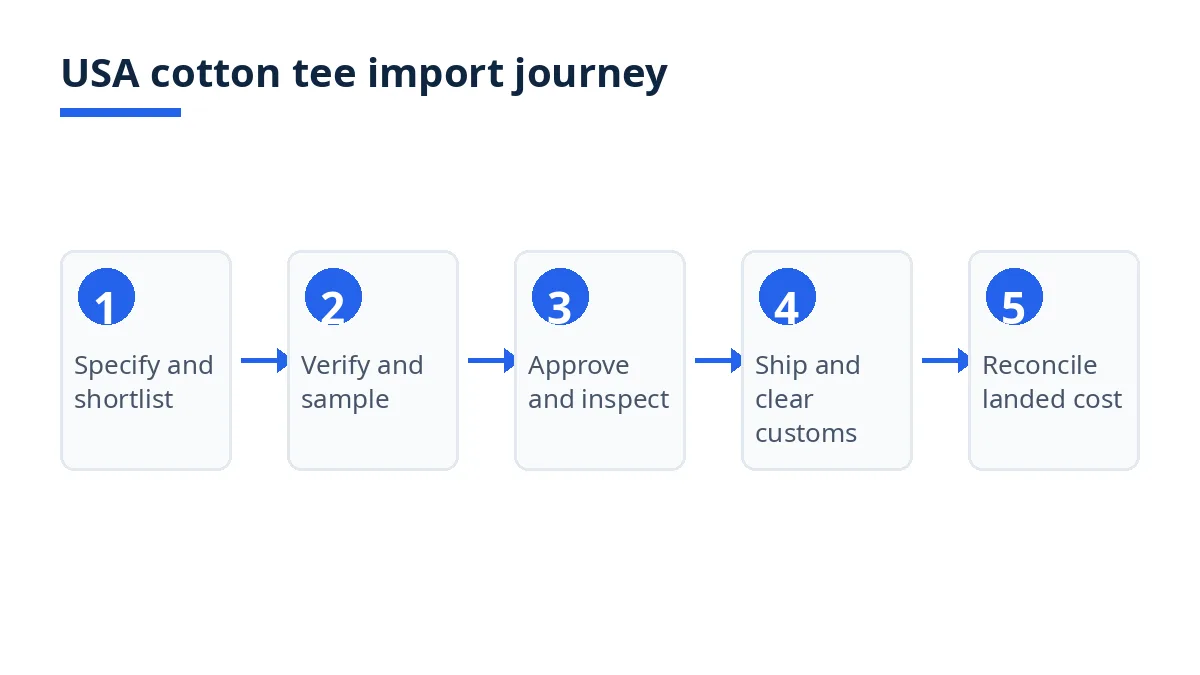
Write the specification style by style: fabric, cotton content, cut, size chart, finishes, print, label wording, and packing.
Classify every style from heading 6109 and subheading 6109.10.00, and confirm each full 10-digit code and duty with your broker, including the chapter note 5 check.
Shortlist suppliers whose current range includes cotton tees for the United States, and request quotes on the identical specification and delivery term.
Verify the chosen supplier: company documents, cotton-tee capacity, fabric and dyeing route, and a finished tee from current production.
Order samples in stages, wash and measure them against your chart, then approve a pre-production sample of each style in production fabric, color and print.
Confirm the order in writing: purchase order, pro forma invoice, delivery and payment terms, inspection plan, labeling, packing and shipment date.
Confirm who files the ocean Importer Security Filing, who arranges cargo insurance, and who holds the customs bond, before goods leave the factory.
Inspect during production and again on packed goods against the approved samples, checking measurements, shade, print placement and carton counts.
Ship, clear United States customs with the confirmed code for each style, and reconcile the actual landed cost against the quote-stage calculation.
File the complete entry set by entry number.
How Exportain helps
Browse suppliers for Bangladeshi cotton-tee exporters and compare their ranges against your style list, Then post your specification and target quantity as an RFQ and compare replies on the same terms before you choose a factory for sampling. Exportain is a B2B marketplace where buyers post RFQs, receive quotations and message suppliers. It does not inspect goods, book freight or clear customs.
FAQs
What is the typical MOQ for cotton t-shirts from Bangladesh?
There is no single typical minimum. It is usually set per style and per color, because fabric is knitted and dyed in batches and a cutting plan is set up per size range. Ask each supplier how its minimum splits by style, color and size curve, and get the answer in writing.
How long does shipping take?
Production time and transit time are separate, and neither has a single typical figure for this route. Sea transit varies by port, routing, transshipment and season. Plan from your forwarder's current sailing schedule for your actual shipment date.
What import duty applies?
Duty follows the confirmed classification of each style. Cotton t-shirts, knitted or crocheted, sit in heading 6109, subheading 6109.10.00, and the general rate in Revision 17 (2026) is 16.5 percent, with a column 2 rate of 90 percent.1 Confirm the current rate and any additional duties in force on your entry date with your broker, and add the merchandise processing fee and, for ocean cargo, the harbor maintenance fee.7
How do I verify a supplier?
Check company documents first, so that name, address and bank account agree across the trade licence, export registration and invoices. Then check capability: current cotton-tee production, fabric source and dyeing route, and a finished tee from current production. Keep payments to the company account named in the documents, and approve a pre-production sample of each style before bulk production.
Next steps on Exportain
Read the landed cost for imports from Bangladesh guide to build your own per-shirt calculation, then browse suppliers and post a free RFQ on Exportain with your specification attached, so replies can be compared on the same terms.
Sources
- Harmonized Tariff Schedule of the United States, Chapter 61: Articles of apparel and clothing accessories, knitted or crocheted (Revision 17, 2026). United States International Trade Commission (accessed )
- Bangladesh's garment exports grow 6.10% in Q1 of FY27. Business Mirror, (accessed )
- 19 CFR 142.3 | Entry documentation required. eCFR (accessed )
- ISO 2859 Sampling Plans. TextileTuts (accessed )
- Cachet of Cashmere: Complying with the Wool Products Labeling Act. Federal Trade Commission (accessed )
- Incoterms 2020: all 11 clauses, risk, and costs. INN.LAW (accessed )
- How Much Does a Customs Broker Cost in 2026?. Strix (accessed )
About the author
Sourcing from Bangladesh?
Post a request for quotation and suppliers on Exportain can send you their quotes directly.
Post an RFQ


