Importing Cotton T-Shirts From Bangladesh to UK: Costs, Duties and Suppliers
A UK buyer's end-to-end guide to importing cotton t-shirts from Bangladesh: DCTS duty treatment, import VAT, supplier verification, samples, QC, shipping terms and a worked GBP landed-cost example.
Short answer
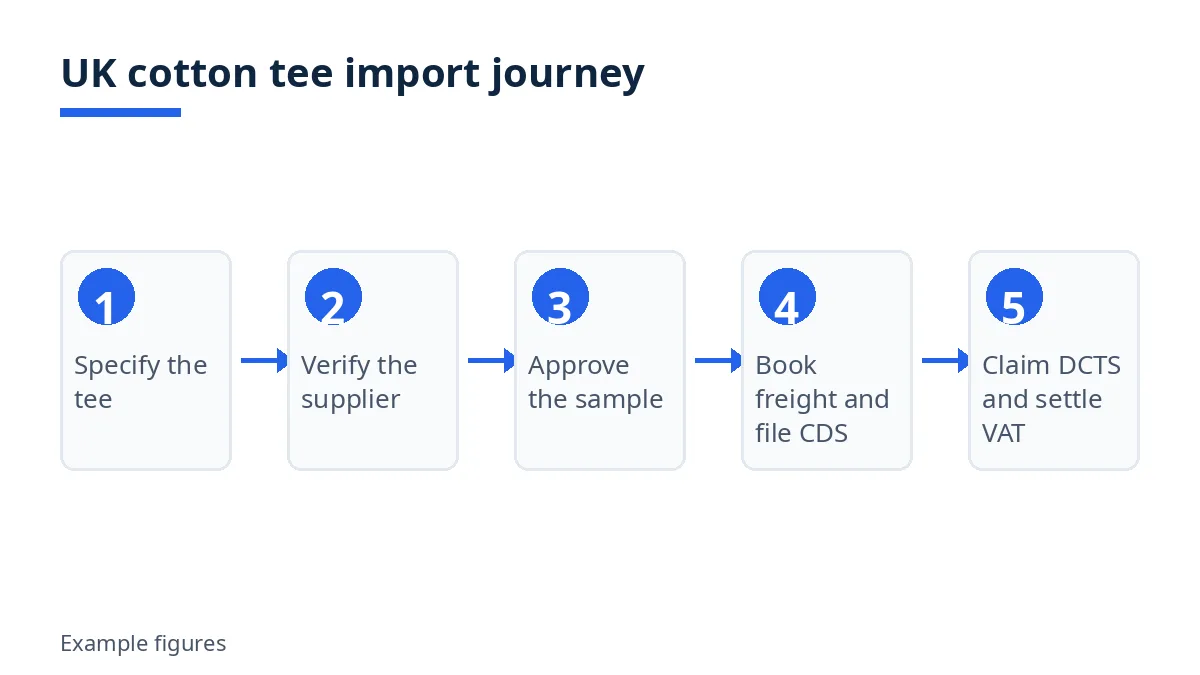
To import cotton t-shirts from Bangladesh to the UK, write a full specification, verify the supplier's documents and current cotton-tee production, and approve a pre-production sample in production fabric. Classify each style under commodity code 6109.10, claim the zero DCTS preference with valid origin proof, choose FCA or FOB, file the Customs Declaration Service declaration with your GB EORI number, use postponed VAT accounting, and build the landed cost before bulk production.
On this page
Key takeaways
Cotton t-shirts, knitted or crocheted, sit in heading 6109, commodity code 6109.10: the UK Global Tariff third-country rate is 12 percent, reduced to zero for qualifying Bangladeshi-origin goods under DCTS Comprehensive Preferences; budget at 12 percent until the origin position is documented.
Bangladesh is listed for DCTS Comprehensive Preferences, with 0 percent tariffs on 99.8 percent of products, and the garment origin rules liberalized from 1 January 2026 require only one significant manufacturing process, such as cutting and sewing, in a DCTS country.
There is no single typical MOQ or transit time for this route: the minimum is usually set per style and per color, and transit must be planned from your forwarder's current sailing schedule.
A VAT-registered UK business can use postponed VAT accounting, declaring and recovering import VAT on the same VAT return, by including its VAT registration number on the declaration and instructing its agent in writing; the standard import VAT rate is 20 percent.
Example figures only: 5,000 cotton t-shirts give a landed cost of 2.69 pounds per shirt excluding import VAT, and losing the DCTS preference adds 0.30 pounds per shirt in duty at 12 percent.
For a UK buyer, one piece of paperwork can move the duty on a cotton t-shirt order from 12 percent to zero: the proof that the shirts qualify as Bangladeshi origin under the United Kingdom's Developing Countries Trading Scheme. Everything else in the order — the specification, the sample approval, the delivery term and the customs declaration — has to line up behind it. This guide follows a UK order from the first specification to the warehouse shelf, with the UK duty, VAT and declaration steps in the order you actually meet them.
Why source cotton t-shirts from Bangladesh
Bangladesh remains a knitwear exporting country at scale. In the first quarter of fiscal 2026-27, from July to September, ready-made garment export earnings reached 10.58 billion dollars, up 6.10 percent year on year, and knitwear exports generated 5.96 billion dollars, up 6.88 percent.1 September alone brought 1.77 billion dollars of knitwear exports.1 Those figures describe the sector as a whole, not any single factory.
For a UK buyer, the commercial case has a second leg that a buyer in a non-preference market does not get: Bangladesh is listed for Comprehensive Preferences under the Developing Countries Trading Scheme, the scheme that can take the duty on qualifying cotton t-shirts to zero. The rest of this guide shows what has to be true for that zero rate to hold, and what the order costs if it does not.
Find and verify suppliers
Start from a written specification
Write the tee before you search for the factory. A complete specification fixes fabric construction and weight, the fiber content you intend to claim, the cut, the size range with a measurement chart, neckline and sleeve finish, print or embroidery method and placement, label wording, and packing. Every quote you compare should be for that same specification.
Send the identical specification to each shortlisted supplier and ask for the same reply format: fabric assumed, price inclusions, validity, minimum per style and per color, and sample and production lead times.
How do you verify a supplier before you pay?
Verification has three layers. The first is company identity: trade licence, export registration and association membership where applicable, checked so that company name, address and bank account name agree across every document. The second is capability: current cotton-tee production, the knitting or fabric sourcing route, the dyeing and printing route, and the size range the factory runs regularly.
The third layer is payment discipline. Pay only to the company account named in the documents, never to a personal account, and verify any change of bank details through a separate channel before you act on it. On Exportain, supplier profiles carry document and photo review badges: a review of documents and photos, not a factory inspection or a guarantee.
Why does the UK import setup belong in the supplier search?
The UK import steps start before the goods move. The GOV.UK import sequence asks you to get your business ready to import, decide who will make customs declarations and transport the goods, find the commodity code for your goods, and work out their value, before the goods go through customs.2 In practice that means you need a GB EORI number for imports into England, Scotland and Wales, and you need to know who files the Customs Declaration Service declaration — you or your agent — while you are still negotiating, because the declaration carries your EORI and VAT numbers and the preference claim.
MOQ, pricing and samples
What is the typical MOQ for cotton t-shirts from Bangladesh?
There is no single typical minimum order quantity for cotton t-shirts from Bangladesh. The minimum is usually set per style and per color, because fabric is knitted and dyed in batches and a cutting plan is set up per size range.
Ask each supplier how its minimum splits: per style, per color, and per size curve. If you need a smaller first order, say so plainly and ask what changes — a surcharge, a longer lead time, a narrower color range — and get the answer in writing before you approve a sample.
How is the price built, and how should you compare quotes?
A cotton-tee price is built from fabric, knitting or fabric purchase, dyeing, cutting, sewing, printing or embroidery, trimming, labeling, testing, packing and the factory margin. Fabric weight is often the largest single driver: a heavier tee uses more yarn per piece.
Compare quotes only on the same basis: same fabric weight and construction, same size range, same print or embroidery, same delivery term, same packing, and the same inclusions for testing and labeling. Ask each supplier to state what is excluded, for example print screens, special packing, or origin documentation.
Which samples do you need, and how do you approve them?
Work in stages. A development sample shows whether the factory can construct the tee: neckline shape and recovery, shoulder seam stability, sleeve set, hem finish and print placement. A pre-production sample, made in the actual production fabric, color and print, is the sample you approve for bulk.
Test samples as your customers will wear and wash them. Measure each size against your chart before and after washing, following the care instruction you intend to print. Approve in writing and keep one sealed counter-sample of each style.
Quality control and certifications needed
Which quality checks are specific to cotton t-shirts?
Against the approved sample and measurement chart, check fabric weight and construction, finished measurements within your agreed tolerances, and consistency across the size range. Then check construction piece by piece: neckline ribbing and recovery, shoulder seams, sleeve and body hems, stitch density, print adhesion and placement, and shade consistency across pieces and sizes.
Agree the inspection method and defect limits before production, in writing. ISO 2859-1 is the sampling standard for inspection by attributes, indexed by acceptance quality limit (AQL), and its tables translate lot size, inspection level and AQL into a sample size and an accept or reject number.3 The standard's worked textile case is directly useful here: a 600-shirt lot inspected at General Inspection Level II and AQL 2.5 takes a 32-piece sample, accepts on 2 or fewer defective pieces, and rejects on 3 or more.3 Those are standard-plan figures from that table, not a promise about your lot.
Which certifications do you actually need?
No single certificate covers every cotton-tee order, and a certificate for one product does not cover another. What you need follows your market, your customer and any claim you intend to print on the tee or its packaging. If you plan to claim a particular cotton origin, recycled content or chemical-safety property, name that claim in the specification, ask for the matching scope certificate or test report, and check its scope, the product covered, the issuing body and the validity date.
The GOV.UK import sequence also includes a step to check the labeling, marking and marketing rules for manufactured goods, so confirm fiber-content and care labeling for the UK market before the labels are printed, not when the cartons land.2 Never let a certificate substitute for the inspection above: a certificate describes a product or a system at a point in time, while the AQL inspection judges the lot you are about to pay for.
Incoterms, shipping and transit time
Which delivery term fits a container of t-shirts?
For container shipments, weigh FCA at the named terminal against FOB at the port, and write the term in full with the named place and Incoterms 2020 in the purchase order. The ICC summary of Incoterms 2020 makes the distinction that matters here: under FOB, CFR and CIF the seller must place the goods on board the vessel, and those four sea rules — FAS, FOB, CFR and CIF — are intended for port-to-port shipments and are not suitable for container shipments in their current form.4 FCA, by contrast, has the seller deliver the goods to the carrier, which fits a container handed over at a terminal.
The same summary sets out the cost and risk logic to check before you sign: in the E, F and D rules, costs before delivery are for the seller and costs after delivery are for the buyer, while in the C rules the seller also pays the cost of getting the goods to the destination, and in CIP and CIF also the insurance premium.4 Risk passes at the same point as delivery, and in all rules except CIP and CIF the buyer arranges its own insurance.4 For import formalities, the buyer carries them in every rule except DDP, so a DDP quote still needs a clear answer on who files the UK declaration and who holds the EORI.4
How long does shipping take?
Production time and transit time are separate, and neither has a single typical figure for this route. Sea transit varies by port pair, routing, transshipment and season. Plan from your forwarder's current sailing schedule for your actual shipment date, add a buffer for customs examination and port congestion at the UK end, and put the buffer in the delivery promise you make to your own customers.
Book the inspection before the container is sealed.
Import duty, taxes and documents
What import duty applies to cotton t-shirts from Bangladesh?
Cotton t-shirts, knitted or crocheted, sit in heading 6109, and the UK commodity code for cotton t-shirts is 6109.10. Bangladesh's place in the scheme is confirmed on GOV.UK: Bangladesh is listed among the countries entitled to Comprehensive Preferences, and exporters in Comprehensive Preferences countries receive 0 percent import tariffs on 99.8 percent of products.5 The UK Global Tariff third-country rate for commodity code 6109.10 is 12 percent, and the same 2026 tariff survey that records that rate records Bangladesh at an effective duty of zero under DCTS Comprehensive Preferences.6 That zero rate is not automatic: it depends on the goods meeting the DCTS origin rules and on a valid preference claim on the declaration.
The practical consequence for a tee buyer is a two-track calculation. Budget the order at the preference rate only when the origin position is documented; otherwise budget at 12 percent and treat any preference recovered later as a bonus. If the preference claim fails, the duty is charged on the customs value, so the size of the failure scales with the order.
What do the DCTS origin rules require for garments?
The DCTS rules of origin for garments were liberalized with effect from 1 January 2026, and the GOV.UK update records the change that matters most to a tee buyer: for garments under Chapters 61 and 62, only one significant manufacturing process — for example, cutting and sewing — must take place in a DCTS country.7 The update also records that eligible goods shipped or warehoused before 1 January 2026 can still qualify if declared for free circulation on or after that date with a valid proof of origin dated on or after 1 January 2026, and that a backdated claim is possible where proof of origin is not available until after release.7
For your order, that means three concrete asks of the supplier: confirmation of where cutting and sewing take place, the origin documentation that supports the claim, and agreement on what happens if the proof is late. Keep the origin file with the commercial documents for the shipment. Confirm the current product-specific rule and the proof required with your customs broker for your entry date, since the scheme and its transition rules change — GOV.UK notes a 3-year transition period when a country graduates from Comprehensive to Enhanced Preferences.5
How does UK import VAT work on a commercial shipment?
For a VAT-registered UK business importing goods for business use, postponed VAT accounting lets you declare and recover import VAT on the same VAT return instead of paying it at the border and recovering it later.8 GOV.UK states that you do not need approval to use postponed VAT accounting, that your business must be VAT-registered in the UK, and that you must include your VAT registration number on the import declaration.8 Import VAT itself is charged at the standard rate, recorded as 20 percent on the UK tariff pages for apparel commodities.9
If someone imports on your behalf — a freight forwarder, customs agent, broker or express operator — you must tell them in writing that you want to use postponed VAT accounting, and they must hold that written confirmation before they proceed with the declaration.8 Your VAT registration number goes at header level in Data Element 3/40, and VAT is recorded against your EORI number.8 If you pay import VAT at the border instead, a VAT-registered importer reclaims it using the import VAT certificate (C79).2 Agree the VAT route with your agent before the declaration is filed, because GOV.UK states you cannot change how you account for import VAT once the declaration is submitted.8
Which documents does the UK declaration need?
Assemble the file before the vessel sails: commercial invoice with each style on its own line, fiber content, size breakdown, quantity, unit price, currency and delivery term; packing list by carton; bill of lading or airwaybill; the DCTS origin proof; and your GB EORI and VAT numbers. The invoice wording matters twice over: it is the document your broker declares from, and it is the document an origin or valuation check will be tested against.
Landed cost example (table)
The table below is an example only. Example figures are used throughout: a 5,000-piece order of one men's cotton crew-neck style, bought FOB, shipped by sea to a UK port, with the DCTS preference claimed. Rebuild the table with your own quotes before you set a selling price.
Line | Example figures | Notes |
|---|---|---|
Goods, 5,000 shirts at £2.20 FOB | £11,000 | One style, one color, FOB port of loading |
Ocean freight and insurance to the UK | £1,400 | Forwarder quote for this sailing |
Customs value basis | £12,400 | Goods plus freight and insurance; broker confirms the declared value |
Import duty at 0% under DCTS Comprehensive Preferences | £0 | Preference claimed with valid origin proof |
Import duty without the preference, at 12% (memo) | £1,488 | 12% of £12,400; shows the cost if the claim fails |
UK port handling and customs broker | £650 | Example figure |
UK inland delivery to warehouse | £420 | Example figure |
Landed cost, excluding import VAT | £13,470 | £11,000 + £1,400 + £0 + £650 + £420 |
Landed cost per shirt, excluding import VAT | £2.69 | £13,470 divided by 5,000 |
Import VAT memo at 20% | £2,480 | 20% of £12,400; declared on the VAT return under postponed VAT accounting, not paid at the border |
Two points in that table deserve emphasis. First, the duty memo line is the whole reason the origin file matters: losing the preference adds £1,488 to this order, or £0.30 per shirt. Second, the import VAT line is a memo, not a cost added to the landed total, because under postponed VAT accounting it is declared and recovered on the same return subject to the normal input tax rules. If you cannot use postponed VAT accounting, the same £2,480 becomes cash paid at the border and recovered later.
Step-by-step import checklist
Write the full specification, including fabric weight, fiber content claimed, size chart, print method and packing.
Shortlist suppliers already making cotton tees in a close construction, and send every one the identical specification.
Verify company documents so that name, address and bank account agree, and check current cotton-tee production.
Confirm the minimum per style and per color in writing, and what changes for a smaller first order.
Agree the price basis, the delivery term in full with the named place and Incoterms 2020, and what is excluded.
Approve a development sample, then a pre-production sample in production fabric, color and print, in writing.
Agree the inspection plan before production: standard, level, AQL values per defect class, and who inspects.
Confirm the UK commodity code, the DCTS origin position, and the proof of origin the supplier will provide.
Get your GB EORI number, confirm your VAT registration, and agree the VAT route with your customs agent in writing.
Book freight on your forwarder's current sailing schedule, confirm who holds and releases the bill of lading, and inspect before sealing where the term allows.
File the Customs Declaration Service declaration with the correct code, value, origin claim and VAT treatment.
Reconcile the landed cost against the delivered invoice, file the invoice, packing list, declaration and C79 or postponed VAT statement, and keep the counter-sample until the goods are sold through.
How Exportain helps
Exportain connects international buyers with Bangladeshi suppliers, exporters and trade service providers. Browse supplier profiles for businesses already working in cotton knitwear, then post a request for quotation with your specification attached, so the replies you receive can be compared on the same terms. Supplier profiles carry document and photo review badges: a review of documents and photos, not a factory inspection or a guarantee. Exportain is not a party to the goods contract and does not inspect goods, book freight or clear customs, so the verification, sampling, inspection and declaration steps in this guide stay with you and your agent.
FAQs
What is the typical MOQ for cotton t-shirts from Bangladesh?
There is no single typical MOQ. It is set per style and per color, because fabric is knitted and dyed in batches and the cutting plan is set per size range. Ask each supplier for the split by style, color and size curve in writing before you approve a sample.
How long does shipping take?
There is no single figure for this route. Production time and sea transit time are separate, and transit varies by port pair, routing, transshipment and season. Plan from your forwarder's current sailing schedule for your shipment date, plus a buffer for UK customs and port handling.
What import duty applies?
Cotton t-shirts, knitted or crocheted, fall in heading 6109, commodity code 6109.10. The UK Global Tariff third-country rate is 12 percent, reduced to zero for qualifying Bangladeshi-origin goods under DCTS Comprehensive Preferences.6 Confirm the rate and the origin position with your customs broker for your entry date.
How do I verify a supplier?
Check company documents so that name, address and bank account agree, confirm current cotton-tee production with a finished tee from current production, and keep payments to the company account named in the documents. Approve a pre-production sample in production fabric before bulk production, and agree the inspection plan in writing.
Next steps on Exportain
Read the landed cost for imports from Bangladesh guide to rebuild the table above with your own quotes, then browse suppliers and post a free RFQ on Exportain with your specification attached, so replies can be compared on the same terms.
Sources
- Bangladesh's garment exports grow 6.10% in Q1 of FY27. Business Mirror, (accessed )
- Import goods into the UK: step by step. GOV.UK (accessed )
- ISO 2859 Sampling Plans. TextileTuts (accessed )
- Insider thoughts: Bob Ronai on Incoterms 2020 Rules; What are they about?. International Chamber of Commerce (accessed )
- Preference tiers under the Developing Countries Trading Scheme. GOV.UK (Department for Business and Trade), (accessed )
- Tariff Impact on Apparel Imports: US, EU, UK (2026). OneAim Apparel (accessed )
- Update: Improved Rules of Origin under the Developing Countries Trading (DCTS) are now in effect.. GOV.UK (accessed )
- Check when you can account for import VAT on your VAT Return. GOV.UK (accessed )
- Commodity code 6203191000: Of cotton - UK Integrated Online Tariff. UK Integrated Online Tariff, GOV.UK (accessed )
About the author
Sourcing from Bangladesh?
Post a request for quotation and suppliers on Exportain can send you their quotes directly.
Post an RFQ