

Hotel Linen Lead Time From Bangladesh: Production and Shipping Timeline
Plan a hotel linen lead time from Bangladesh by room sets and par levels: set approval, washed-sample approval, fabric, bulk by room set, inspection, documents and loading, with example planning windows replaced by dated quote lines.
Short answer
A hotel linen lead time from Bangladesh runs on room sets and par levels, not on loose piece counts: fix the set per room, approve a washed sample, confirm fabric availability, run bulk by room set, inspect by room set under an agreed AQL, then document and load by property. Every duration is an example planning window only. Replace it with the dated lines in the written quote and the dated forwarder estimate before setting an opening date.

On this page
Key takeaways
A hotel linen order is a set of complete room sets in par levels, most hotels needing three to four sets per bed, and a shortfall in one item leaves a room that cannot be made up.
The timeline runs on gates in a fixed order: room-set approval, washed-sample approval, fabric readiness, bulk by room set, inspection by room set, documents and loading.
Approve the sample only after washing it through the property laundry cycle, because colour, size, whiteness, seam strength and embroidery hold all change in washing.
Every duration in this guide is an example planning window only. The opening date must come from the dated lines in the written quote and the dated forwarder estimate.
Exportain verification is a document and photo review, not a factory inspection, and a badge is not a guarantee of capacity, quality or delivery.
A hotel linen order from Bangladesh is not one delivery of loose pieces. It is a set of complete room sets, ordered in par levels, that must survive industrial laundering and arrive in time for rooms to open. Plan the order around that reality and the timeline becomes a sequence of approvals, each of which must close before the next stage starts.
Most hotels need three to four par levels per bed: one set on the bed, one in the laundry, and one or two in clean storage as backup, with high-occupancy properties needing the fourth set to avoid running short during peak periods.1 That single fact shapes the whole schedule. A shortfall in one item of the set leaves a room that cannot be made up, even when the rest of the order has arrived.
Why this matters for buyers and sellers
For the buyer, the timeline decides whether a new property opens with full rooms or with borrowed stock, and whether a refurbishment finishes before the next season. Linen is bought in sets and consumed in cycles, so a late or partial delivery changes how many rooms can be sold.
For the seller, the order is a production program, not a single run. Sheets, pillowcases, duvet covers, towels and table linen each carry their own fabric, weave and finishing, and the set must match across all of them. A change to one item after bulk production has started can force rework on the rest of the set.
The discipline that protects both sides is to treat every stage as a gate. Nothing moves to bulk until the washed sample is approved, nothing ships until inspection by room set is signed off, and no selling date is set until the written quote dates and the forwarder estimate are in hand.
Step-by-step: how it works
Work through the stages in order. Each stage ends with a written approval, and the next stage starts from that approval, not from the original enquiry date.
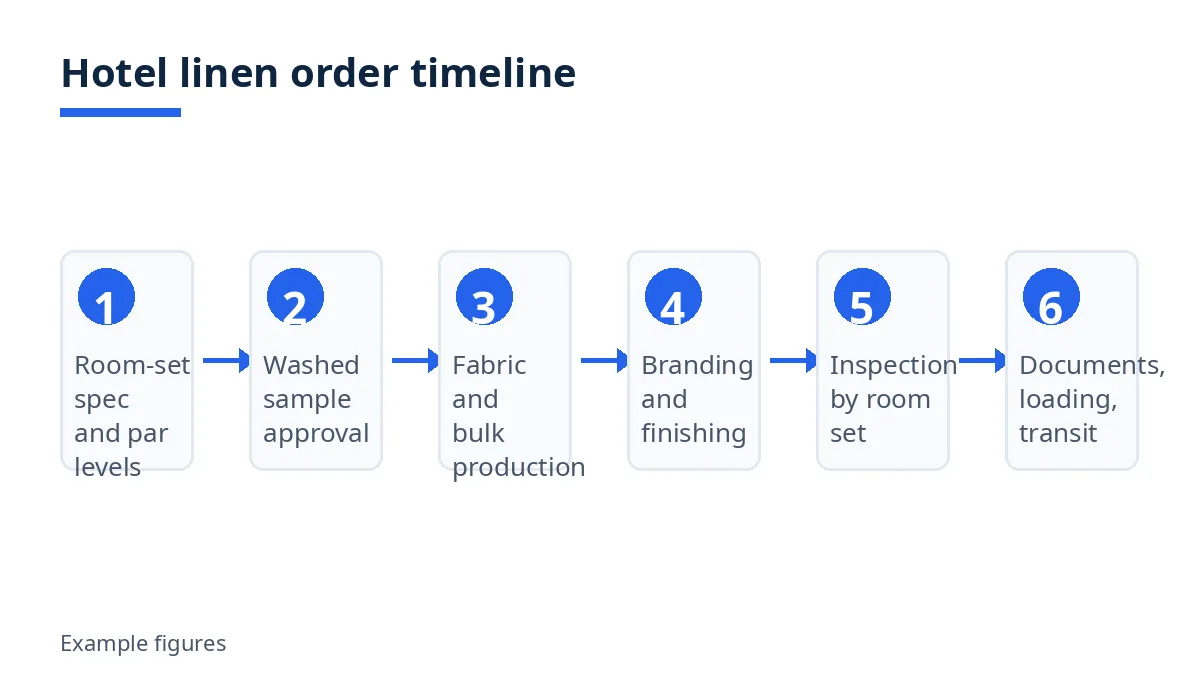
Fix the room set and the par levels first. List every item in one room set: flat sheet, fitted sheet, pillowcases, duvet cover, bath towel, hand towel, washcloth and bath mat, plus table linen where the property needs it. State the quantity per item as rooms multiplied by par levels. A 100-room property at three par levels needs 300 of each bed item, and the towel count follows the same arithmetic. Record the property tier, because tier sets the specification band: budget sheets at 150 to 200 thread count, mid-range at 200 to 300, upscale at 300 to 400 and luxury at 400 to 600.1
Lock the fabric specification per item. Sheets sit in a functional range of 120 to 160 grams per square meter (GSM), with lighter weights suiting warm climates and percale weaves and heavier weights suiting sateen and cooler environments.1 Towels are specified by GSM as well: 400 to 500 GSM for mid-range properties and 500 to 600 GSM for the premium range most hotels aiming for a luxury feel choose.1 State the fibre blend in the same line. A typical polycotton blend is 60 percent cotton and 40 percent polyester, or 50/50, with the polyester adding wrinkle resistance, faster drying and a longer lifespan under industrial washing.1 Percale gives a crisp, cool, matte finish and stands up to more wash cycles, while sateen gives a smooth, lustrous surface that degrades faster under commercial laundering.1
Approve a washed sample, not an unwashed one. Ask for the sample in the actual fabric, weave, thread count and GSM, with the property logo or embroidery where branding applies. Wash it through the property laundry cycle, or a cycle that matches it, and check size, whiteness, hand feel, seam strength and embroidery hold after washing. Hotel bed linen is washed several times per week at high temperatures, so durability under washing is the foundation of the purchasing decision.1
Confirm fabric and trim availability before bulk starts. Ask which fabrics are stocked and which must be woven or dyed for the order, and whether yarn, embroidery thread and labels are on hand. Record the fabric-ready date separately from the bulk start date, so a fabric delay shows up as its own line rather than as a vague production delay.
Run bulk by room set, with in-line checks. Cutting, sewing, hemming and finishing proceed item by item, and the set is checked as a set: sheet size against pillowcase and duvet cover, towel GSM against the approved sample, and embroidery placement against the property standard. In-line checks catch a size drift while it can still be corrected, rather than at final inspection when the whole lot is packed.
Inspect by room set against the agreed sampling plan. Agree the inspection level and acceptance quality limit (AQL) before production. ISO 2859-1 defines a system of acceptance sampling plans for inspection by attributes, indexed by AQL for lot-by-lot inspection, and AQL is the maximum average percentage of defective items considered acceptable during random sampling, which determines sample sizes and acceptance or rejection thresholds.2 Inspect a sample drawn across the set, not from one item only.
Pack, document and load by property and opening date. Where an order serves more than one property, or a phased opening, pack and mark cartons by property and by room set, and load in the order the properties need the goods. A carton mixed across properties costs days at the receiving end, when staff must sort before rooms can be made up.
Costs, timelines and documents
What are the typical costs and timelines?
There is no typical cost or timeline a guide can state as fact for hotel linen. Price follows the fabric band, the blend, the thread count and GSM, the embroidery and the delivery term, and the timeline follows fabric availability, correction rounds on the washed sample, bulk capacity and the shipping route. Ask for both as dated lines in the written quote: sampling dates, fabric-ready date, bulk dates, inspection date and a forwarder estimate for transit, each on its own line.
Stage | Example figures: planning window | What closes the stage |
|---|---|---|
Room-set spec and par levels | 1 to 2 weeks | Signed set list with quantities per item |
Washed sample and corrections | 2 to 4 weeks | Written approval of the washed sample |
Fabric, dyeing and weaving | 2 to 4 weeks | Fabric-ready confirmation for the full set |
Cutting, sewing, branding and finishing | 3 to 5 weeks | Bulk complete by room set |
Inspection and packing | 1 week | Signed inspection report by room set |
Documents and loading | 1 week | Approved export set and loaded cartons |
Transit to destination | Per forwarder estimate | Dated forwarder estimate, not a guess |
Example figures: a 120-room property at three par levels orders 360 of each bed item. If the washed sample needs two correction rounds, the bulk start moves by the correction time, and every later date moves with it. If one towel GSM is changed after approval, only that item restarts, but the set cannot ship complete until it catches up.
Two cost points belong in the same quote. The first is the delivery term: the Incoterms 2020 rules number 11, and for containers handed over at a terminal in Bangladesh, FCA, CPT or CIP usually match the handover better than FOB, CFR or CIF.3 Compare quotations only on the same rule and named place. The second is the cost of a failed gate: a remake, a partial shipment or an air-freight rescue costs more than the weeks saved by skipping the washed sample.
Which documents are needed?
For export clearance in Bangladesh, goods may not be loaded unless an export declaration, the Bill of Export or Shipping Bill, is submitted to Customs and approved.4 Enclosed documents include the export contract or purchase order where there is no export letter of credit, the commercial invoice, the packing list, the EXP form certified by an authorized dealer, and a certificate of origin issued by the EPB or a Chamber of Commerce and Industry.4
Bangladesh-specific rules and tips
Specify for laundering life, not for first feel. Expected wash cycles rise with tier, from 100 to 150 cycles for budget properties through 150 to 250 for mid-range and 200 to 300 for upscale, to 250 to 350 or more for luxury properties.1 Ask the supplier to state the wash-cycle expectation for the specification on offer, and test the washed sample against it.
Check fibre labelling for the destination market. The European Union regulation on textile fibre names and related labelling lays down harmonised provisions on fibre names and the labelling and marking of fibre composition of textile products.5 State the fibre composition per item in the specification, and check that the label on the packed goods matches it.
Ask what a certificate actually covers. OEKO-TEX STANDARD 100 is a label for textiles tested for harmful substances, and every thread, button and accessory is tested against a list of over 1,000 harmful substances, with stricter requirements the more intensive the skin contact.6 Bed linens fall in Product Class 2, products with direct skin contact.6 A certificate for one item does not cover the rest of the set, so ask for the certificate scope per item.
Order white goods with whiteness in mind. White is the hospitality standard, and optical brighteners wash out over time. Ask whether brighteners are used, and check the washed sample for whiteness retention after repeated washing, not only for size and seams. Long-staple yarn, embroidery thread and labels may also be bought in for the specification, and an imported input can set both the earliest bulk date and the minimum quantity, so agree the size and colour ratio per item before bulk starts.
Mistakes and red flags
What are the most common mistakes?
Ordering pieces instead of room sets. A piece count without par levels produces a delivery that cannot make up rooms. State rooms, par levels and quantities per item, and check the quotation against that arithmetic before confirming.
Approving an unwashed sample. Colour, size, whiteness and seam strength all change in washing. An approval on an unwashed sample is an approval of a product that will not reach the guest in that state.
Changing one item after bulk approval. A GSM change, a weave change or a logo change after the washed sample is approved restarts that item and delays the complete set. Freeze the specification in writing at sample approval.
Comparing quotations on different terms or different sets. A lower price on a lighter GSM, a different blend or a different delivery term is a different offer. Compare only replies to the same room-set specification on the same Incoterm and named place.3
Treating a badge or a profile as a capacity check. A profile is a starting point for enquiries. It does not test whether a supplier can produce the full set to the washed-sample standard, on the dates quoted. Sample approval and inspection stay with the buyer.
Setting an opening date before the gates close. A property opening, a refurbishment finish or a season start needs a delivery date backed by the written quote dates and the forwarder estimate. A date set from the enquiry date alone has no stage behind it.
Checklist
Before you confirm, every line should be answered in writing.
Room set listed per item, with rooms, par levels and quantities per item.
Fabric band per item: blend, weave, thread count or GSM, with the tier it serves.1
Washed sample approved in writing, after the property laundry cycle.
Logo, embroidery and label placement approved on the washed sample.
Fabric status per item recorded: stocked, woven or dyed to order, with a fabric-ready date.
Bulk dates, inspection date and packing by property and room set agreed.
Inspection level and AQL values in the purchase order.2
Quotations compared on the same set, specification and Incoterm.3
Export set agreed: invoice, packing list, EXP form, certificate of origin, Bill of Export.4
Transit covered by a dated forwarder estimate, and the opening date set from it.
How Exportain helps
On Exportain, browse suppliers and post a request for quotation (RFQ) on the RFQ board with the room-set list, the par levels, the fabric band per item and the delivery term, so suppliers quote against the same set. Ask each reply for its washed-sample plan, its fabric-ready date and its inspection plan by room set, with dated stage lines rather than a single delivery week. Exportain verification is a document and photo review, not a factory inspection.
FAQs
What should I know first about hotel linen?
A hotel linen order is a set of complete room sets ordered in par levels, most hotels needing three to four sets per bed.1 The specification is set per item: sheet GSM of 120 to 160, towel GSM by tier, thread count by tier, and blend by laundering need.1 The timeline runs on gates: room-set approval, washed-sample approval, bulk, inspection by room set, documents and loading.
What are the typical costs and timelines?
There are no typical figures a buyer can rely on, because each supplier prices the fabric band, blend, thread count, GSM, branding and delivery term for the set, and each timeline follows fabric availability, sample corrections, bulk capacity and the shipping route. Use the example planning windows in this guide only as a framework, and replace them with the dated lines in the written quote and the dated forwarder estimate.
Which documents are needed?
The order documents are the room-set specification, the itemized quotation with dated stage lines, the purchase order, the washed-sample approval and the inspection report by room set. The export set is the Bill of Export, commercial invoice, packing list, EXP form certified by an authorized dealer, and a certificate of origin issued by the EPB or a Chamber of Commerce and Industry.4
What are the most common mistakes?
The most common mistakes are ordering pieces instead of room sets, approving an unwashed sample, changing one item after bulk approval, comparing quotations on different specifications or terms,3 and setting an opening date before the approval gates have closed.
Next steps on Exportain
Browse suppliers, then post the room-set list, par levels and fabric band per item on the RFQ board so suppliers quote dated stage lines for the same set. Before you confirm, read the Incoterms guide and choose the rule and named place that match how the cartons will actually be handed over.
Sources
- What Type of Linen Is Used in Hotels? Complete Guide to Sheets, Towels and Specs. Hotemax (accessed )
- ISO 2859-1:2026 - Sampling procedures for inspection by attributes — Part 1: Sampling schemes indexed by acceptance quality limit (AQL) for lot-by-lot inspection. ISO (accessed )
- Incoterms for Shipments From Bangladesh. Exportain (accessed )
- Customs Clearance Procedures for Export. Bangladesh Customs, National Board of Revenue (accessed )
- Regulation (EU) No 1007/2011 on textile fibre names and related labelling and marking of the fibre composition of textile products. European Union, (accessed )
- OEKO-TEX Standard 100. OEKO-TEX (accessed )
About the author
Sourcing from Bangladesh?
Post a request for quotation and suppliers on Exportain can send you their quotes directly.
Post an RFQ


