

Top Generators Manufacturers in Bangladesh: How to Find and Verify Them
Generators manufacturers in Bangladesh, judged not by ranking but by evidence: nine checks covering rating class, alternator evidence, load tests, site derating, documents and after-sales service.
Short answer
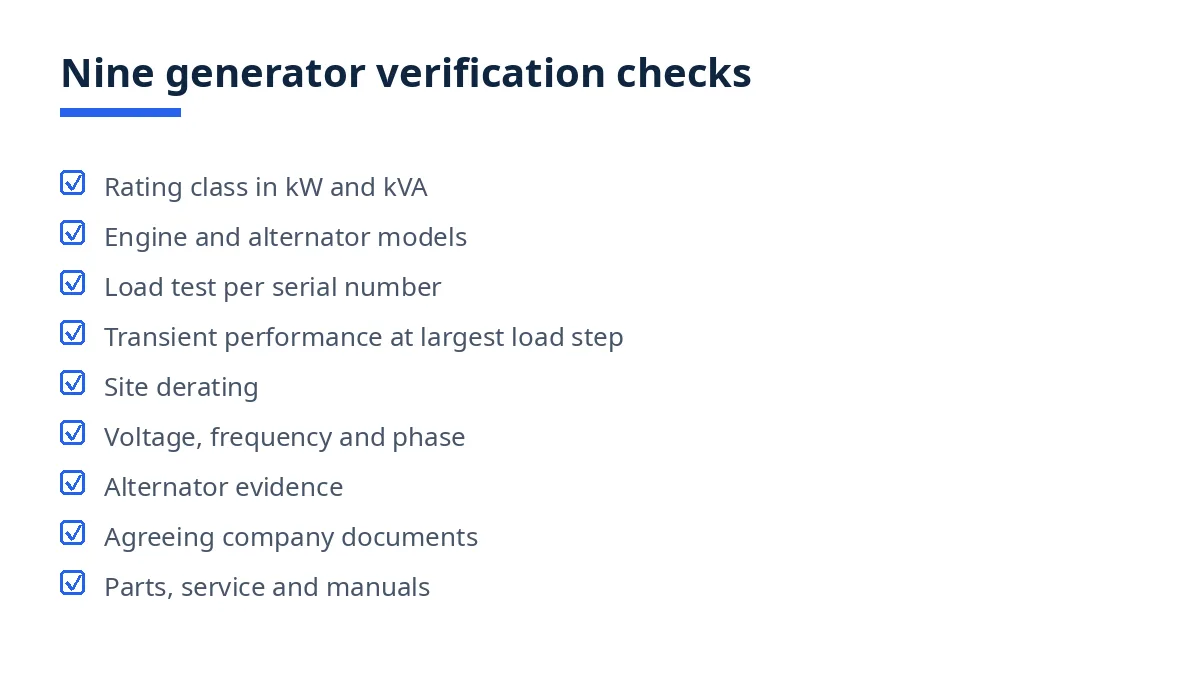
Generators manufacturers in Bangladesh should be judged by nine checks, not by the largest number on a quotation. Ask for the rating class in kW and kVA, the engine and alternator models, a load test record per serial number, transient performance for your largest load step, site derating, destination voltage and frequency, alternator evidence, agreeing company documents, and written parts and service terms, then compare every supplier on the same specification.
On this page
A generator quotation usually leads with one large number, and that number is the trap. The same engine and alternator package can carry several different ratings, and the headline figure may describe emergency standby duty while your site needs prime power for long running hours. Ask each candidate the same nine questions, in the same order, and keep only the suppliers whose documents answer them for your exact model, load and site.
A generator set here means an engine driving an alternator, with its controlgear and auxiliary equipment. ISO 8528-1:2018 defines classifications for the application, rating and performance of such sets, for land and marine use.1 Use that shared language in every message to a supplier.
Key takeaways
Compare the same rating class, not the largest number on a quotation: standby, prime and continuous ratings describe different duties for the same machine.
Ask for the engine model and the alternator model, not only a brand name, and check that both match the set you are buying.
A test report only counts when its serial number, load steps and ratings match your order.
State your site conditions, voltage, frequency and largest motor load in the first message, so derating and starting performance are priced in, not discovered later.
Company documents, parts availability and service terms belong in the order, not in a brochure promise.
The list: nine checks for generators manufacturers in Bangladesh
Each check below states what it is, why it matters, and how to fix a gap. A supplier that cannot pass check 1 or check 3 should not reach your shortlist.
1. Rated power stated by rating class, in kW and kVA
What it is. The rating class for the exact model you are buying, with both kilowatt (kW) and kilovolt-ampere (kVA) figures and the power factor behind them. ISO 8528-1 defines four rating classes, each with its own load profile, annual hours and overload rules.2 Emergency standby power (ESP) covers backup during a utility outage, with a 200-hour annual limit and no overload capability in the summary used by that guide. Prime power (PRP) covers unlimited hours on a variable load, with a 24-hour average load limit of 70 percent of PRP and a 10 percent overload for 1 hour in 12. Limited-time running power (LTP) covers a constant load for up to 500 hours per year, and continuous operating power (COP) covers a constant load for unlimited hours.2
Why it matters. A standby figure is normally higher than the prime figure for the same machine, so a quotation that leads with standby power flatters the set. Bought for long running hours, that set is undersized for its real duty.
How to fix a gap. Ask the supplier to restate the quotation in your duty class, with kW, kVA and power factor on one line for the model, not for the range. If the supplier will not name the class, or quotes only a single headline number, treat that as a failed check and move on.
2. Engine and alternator named by model
What it is. The engine model and the alternator model fitted to the set, with the alternator frame size where the datasheet gives one. A brand name alone is not a specification: one brand covers many engines and alternators of different outputs, cooling arrangements and service intervals.
Why it matters. The engine sets the fuel, cooling and service profile, while the alternator sets voltage behavior under load. When either is left vague, two quotations that look alike can describe different machines, and a later substitution can pass unnoticed.
How to fix a gap. Require a datasheet for the exact model, and check that its engine model, alternator model and rating class match the quotation. Write into the order that any change of either model needs your written approval and a revised datasheet.
3. A load test record for your set, by serial number
What it is. A test record for the set you will receive, filed against its serial number, showing load steps, voltage, frequency, current and power at each step, plus the alarms and shutdown functions tested. The record should state the rating class it was tested at, so a test at standby duty is not presented as proof of prime duty.
Why it matters. A type test for a model proves that the design can perform. It does not prove that your set was built and checked to that design, and a missing record is often the first sign that testing was done on a different set or load.
How to fix a gap. Put the record in the order terms: one record per serial number, delivered with the shipping documents, with any failed step and its correction shown.
4. Transient performance matched to your largest load step
What it is. Evidence of how the set behaves when load changes suddenly, for example when a large motor starts or a large load drops off. ISO 8528-5 defines performance classes for this behavior, with G3 described in the ratings guide as the class used for telecom, data center and medical loads, limiting frequency dip to 10 percent and voltage dip to 15 percent on the stated test.2
Why it matters. A set can hold a steady load and still fail your site, because a motor start can drag voltage down far enough for contactors to drop out or sensitive equipment to trip. Steady-load figures say nothing about that moment.
How to fix a gap. Name your largest single motor load, its starting method and any sensitive load in the specification, and ask what performance class the offered set meets at that step.
5. Site derating for altitude, temperature and enclosure
What it is. A site-specific statement of how much output remains at your altitude, ambient temperature and enclosure type, rather than the nameplate figure at standard reference conditions. The ratings guide describes standard reference conditions as 25 degrees Celsius ambient temperature, 100 kilopascals atmospheric pressure and 30 percent relative humidity, with derating applied above altitude and temperature thresholds.2
Why it matters. Thin air and hot air both reduce what an engine can deliver, and a canopy or a poorly ventilated room can add heat on top of that. A set that looks large enough on paper can arrive short of your load at your site.
How to fix a gap. Send the site altitude, highest expected ambient temperature and enclosure arrangement with the first enquiry, and ask for the derated output at those conditions in writing.
6. Voltage, frequency, phase and connection matched to destination
What it is. The set output stated as voltage, frequency, phase and connection type, checked against the system it will feed. For Bangladesh, the mains voltage is 230 volts and the frequency is 50 hertz.3 For any other destination, state that destination system in the same way, and do not assume that a set built for one market suits another.
Why it matters. A set built for the wrong frequency runs motors at the wrong speed, and a set wired for the wrong voltage or phase cannot feed the site without rework.
How to fix a gap. Write the destination voltage, frequency, phase and earthing arrangement into the specification, and ask the supplier to confirm each one for the offered model in writing.
7. Alternator evidence under IEC 60034-1
What it is. The alternator rating and performance basis, stated against IEC 60034-1, the standard for rotating electrical machines covering rating and performance. Cummins Generator Technologies notes that alternator performance complies with 60034-1, and that the standard defines the guidance for operating efficiency of an alternating current generator.4
Why it matters. Alternator efficiency figures are often quoted as typical values from a data library, with tolerances for material and manufacturing variation. A buyer who never asks which basis applies cannot compare two alternators at all.
How to fix a gap. Ask whether each quoted efficiency figure is typical or guaranteed for the offered alternator, and at which load points it applies. Compare alternators at the same load points and basis, and put the agreed basis in the order.
8. Company documents that agree with each other
What it is. The supplier company documents, with the company name, address and bank account name agreeing across the trade licence, the Export Registration Certificate (ERC), the quotation and the invoice. Ask for the documents yourself and compare them, rather than accepting a profile summary as a substitute.
Why it matters. Payment discipline starts with this check. An account name that differs from the registered company name cannot be traced through the supplier's own documents.
How to fix a gap. On Exportain, use trust badges only for what they state. Verification on Exportain is a document and photo review by staff, not a factory inspection, and membership plans never grant a badge.5 Pay only into the business account named in the agreed documents, and verify any change of bank details separately before you act on it. For what each badge covers, read how supplier verification works on Exportain.
9. Parts, service and manuals agreed before shipment
What it is. A written after-sales file: the parts list by part number for filters, belts, sensors and control parts, the service contact and response route, the warranty terms with their rating-class conditions, and the manuals and wiring diagrams that ship with the set.
Why it matters. A generator is bought for the years after delivery, not for the day it arrives. A set with no parts route, service contact or manuals can sit idle for a fault a stocked filter or wiring diagram would have fixed.
How to fix a gap. Agree the first-service parts list, the spares to be packed with the set, and the warranty conditions in the order, and check the rating class in the warranty against the duty you specified in check 1.
Summary table
Check | Evidence that passes | Red flag |
|---|---|---|
1. Rating class | ESP, PRP, LTP or COP named, with kW, kVA and power factor | One headline number, no class |
2. Engine and alternator | Both models named on the model datasheet | Brand name only, model left vague |
3. Load test record | One record per serial number, with load steps and ratings | One sample record for a batch, or no record |
4. Transient performance | Performance class stated for your largest load step | Steady-load figures only, no step-load answer |
5. Site derating | Derated output at your altitude, temperature and enclosure | Nameplate figure only, site conditions ignored |
6. Voltage and frequency | Destination system confirmed for the offered model | Market assumption, no written confirmation |
7. Alternator evidence | IEC 60034-1 basis, typical or guaranteed, at stated load points | Efficiency figure with no basis or load point |
8. Agreeing documents | Licence, ERC and bank account name agreeing | Account name differing from the registered company |
9. Parts and service | Parts list, service contact, warranty terms and manuals in the order | Brochure promise, nothing written |
How Exportain helps
Exportain is a B2B marketplace for sourcing from Bangladesh. Buyers search published products by keyword and category, review each supplier profile for its verification level, location, main products and declared certifications, and post a request for quotation (RFQ) stating quantity, destination, Incoterm, required certifications and deadline.6 Quotations on the platform are versioned, so unit price, minimum order quantity (MOQ), lead time, Incoterm, payment terms and validity can be compared field by field.6
Use that structure for this product. Put the nine checks into the RFQ itself: rating class, engine and alternator models, test record per serial number, site conditions, destination system, parts list and warranty terms. For orders where quantity rules matter, the guide to MOQ in the supply chain explains how minimum quantities are set.
Use badges as a starting filter, not a conclusion. Verification on Exportain is a document and photo review, not a factory inspection, and a badge is not a guarantee of capacity, quality or delivery.5 Exportain is not a party to your goods contract. Run the nine checks above on your shortlist, including the suppliers you found on the platform, and keep the whole exchange in the RFQ and message thread so the agreed terms are recorded.
FAQs
What is the biggest mistake?
Buying on the largest number on a quotation without checking which rating class it belongs to. A standby figure, a prime figure and a continuous figure for the same machine are different duties, not different machines, and the wrong duty leaves the set undersized for the hours and load your site actually needs.
How can I avoid it?
Send one specification to every candidate: duty class, load profile, largest motor load, site altitude and temperature, destination voltage and frequency, and the test record and parts list you require. Compare replies check by check, keep the rating class in the warranty, and put inspection, documents and payment terms in the order before production or shipment starts.
Who is responsible?
Responsibility is split, and no badge moves it. The buyer is responsible for a complete, checkable specification and for inspecting against it. The supplier is responsible for delivering the model, rating class and test evidence named in the order. The standards behind the checks give both sides the same language, but they do not replace the written order.1 4
Where can I get help?
Start with the records that exist: the model datasheet for ratings, the test laboratory or issuing body for any report, and the supplier document set for company details. On Exportain, read what each profile badge covers before relying on it, and message the supplier through its profile so questions and answers stay in one thread.5
Next steps on Exportain
Browse Bangladeshi suppliers and filter the electrical listings by badge and product category. Before you order, read how supplier verification works on Exportain so you know what each badge covers. Then post a free RFQ with your rating class, load profile, site conditions, destination system and test-record requirements, and compare the versioned quotations that come back.
Sources
- ISO 8528-1:2018 — Reciprocating internal combustion engine driven alternating current generating sets — Part 1: Application, ratings and performance. International Organization for Standardization (ISO) (accessed )
- Prime Power vs Standby vs Continuous: Generator Ratings. BLSH Diesel (accessed )
- Bangladesh — Power plug, socket and mains voltage in Bangladesh. WorldStandards, (accessed )
- Application Guidance Notes: Operating Efficiency of an Alternator (AGN 182). Cummins Generator Technologies (accessed )
- Supplier verification: Earn trust badges buyers can see. Exportain (accessed )
- How to source and buy from Bangladesh. Exportain (accessed )
- supplier verification
- pre-shipment inspection
- buyer guide
- importing from Bangladesh
- Bangladesh sourcing
- Electrical products
About the author
Sourcing from Bangladesh?
Post a request for quotation and suppliers on Exportain can send you their quotes directly.
Post an RFQ


