Generators Lead Time From Bangladesh: Production and Shipping Timeline
No single generators lead time fits every order: engine and alternator availability, rating class, canopy and control options, load testing and the sailing schedule each move the date. This guide sets out the stages in order, with typical ranges and the documents to agree before you confirm.
Short answer
Generators lead time from Bangladesh runs from specification to delivery, not from a single headline figure. Sets are listed at about 2 to 4 weeks after order confirmation, but engine availability at 2 to 45 days, alternator availability at 2 to 15 days, canopy build, load testing and export clearance add time. Ocean transit adds 21 to 27 days to the United Kingdom, 25 to 32 days to the United States East Coast and 10 days to Jebel Ali.

On this page
Key takeaways
There is no single generators lead time: engine availability at 2 to 45 days and alternator availability at 2 to 15 days set the production floor, and every option adds its own time.
The rating class decides the machine: ESP, PRP, LTP and COP carry different annual hour limits and overload rules, so compare quotations only on the same class.
The staged load test and protection demonstrations are the gate that proves the finished set; agree the witness and the report format before assembly ends.
Ocean transit adds 21 to 27 days to the United Kingdom, 25 to 32 days to the United States East Coast and about 10 days to Jebel Ali, on top of production and clearance.
Exportain verification is a document and photo review, not a factory inspection, and a badge is not a guarantee of capacity, quality or delivery.
A generator order from Bangladesh moves through gates that a simple week count hides: rating class, engine and alternator availability, canopy and control build, load testing, export packing and the sailing itself. Published listings for standard diesel sets quote delivery of about 2 to 4 weeks upon order confirmation.1 That figure covers a standard set only, and every option you add can move the date.
Plan from the full chain, not from the headline week count. The sections below set out each gate, its typical range, and the papers to agree before you confirm.
What sets the generators lead time in Bangladesh
What should I know first about generators?
A generator set is an engine coupled to an alternator, mounted on a base frame with a radiator, fuel system, control panel and usually a canopy. The first fact to settle is the rating class.
ISO 8528-1 defines four rating classes for reciprocating engine-driven alternating current generator sets.2 Emergency Standby Power (ESP) covers backup during utility outages only, with a maximum of 200 hours per year and no overload capability. Prime Power (PRP) covers unlimited hours on a variable load, with an average load factor up to 70 percent over 24 hours and a 10 percent overload permitted for 1 hour in 12. Limited-Time Running Power (LTP) covers a constant load for up to 500 hours per year, and Continuous Operating Power (COP) covers unlimited hours at a constant load.2 A quote that states only a kVA figure, without the class, cannot be compared with another quote.2
The second fact is component availability. One supplier component table lists engines at 2 to 45 days, alternators at 2 to 15 days, radiators at 2 to 7 days, canopies at 10 days, and base frames, control systems and exhaust systems at 3 days each.1 The engine is usually the longest pole: a standard engine in stock keeps the order near the published 2 to 4 weeks, while a special engine brand stretches it well beyond that.1 Ask for the availability of each major component in writing.
Component | Listed time | What moves it |
|---|---|---|
Engine | 2 to 45 days | Brand and model |
Alternator | 2 to 15 days | kVA and voltage |
Radiator | 2 to 7 days | Engine match |
Canopy | 10 days | Canopy type |
Base frame, control system, exhaust | 3 days each | Tank and controller |
The third fact is the test gate. Commissioning practice for diesel sets runs the set without load first, then applies load in steps, from 50 percent to 75 percent and then to 100 percent of rated load, recording voltage, frequency, oil pressure and temperatures at each step.3 Protection demonstrations come before the load test: fail-to-start, emergency stop, auto start, overspeed, high engine temperature, low oil pressure and alternator overvoltage and undervoltage are each demonstrated.3 A witnessed test adds scheduling time, so agree the witness and the test report format before assembly ends.
Classification and destination marking also sit on the critical path. Heading 8502 of the Harmonized System covers electric generating sets and rotary converters, and subheading 850212 covers diesel sets with an output exceeding 75 kVA but not exceeding 375 kVA.4 Confirm the code for your exact kVA band on the invoice and packing list, since duty and destination paperwork follow it. For sales into the European Union, electrical products fall under directives including the Low Voltage Directive 2014/35/EU, the Electromagnetic Compatibility Directive 2014/30/EU and RoHS 2011/65/EU, and the CE mark must be visible, legible and indelible, applied only once all applicable directives are met.5 Ask for the Declaration of Conformity naming the directives and standards for your exact model.
Why this matters for buyers and sellers
For the buyer, a wrong rating class or an untested set becomes downtime at site.2 For the seller, a late engine delivery or a failed load-test step holds the whole set, since the parts only ship as one finished unit. Both sides need one delivery term on every quotation: the Incoterms 2020 rules provide 11 rules with a clear allocation of cost, risk and obligations.6 Compare quoted dates only on the same rule and named place.
Step-by-step: how it works
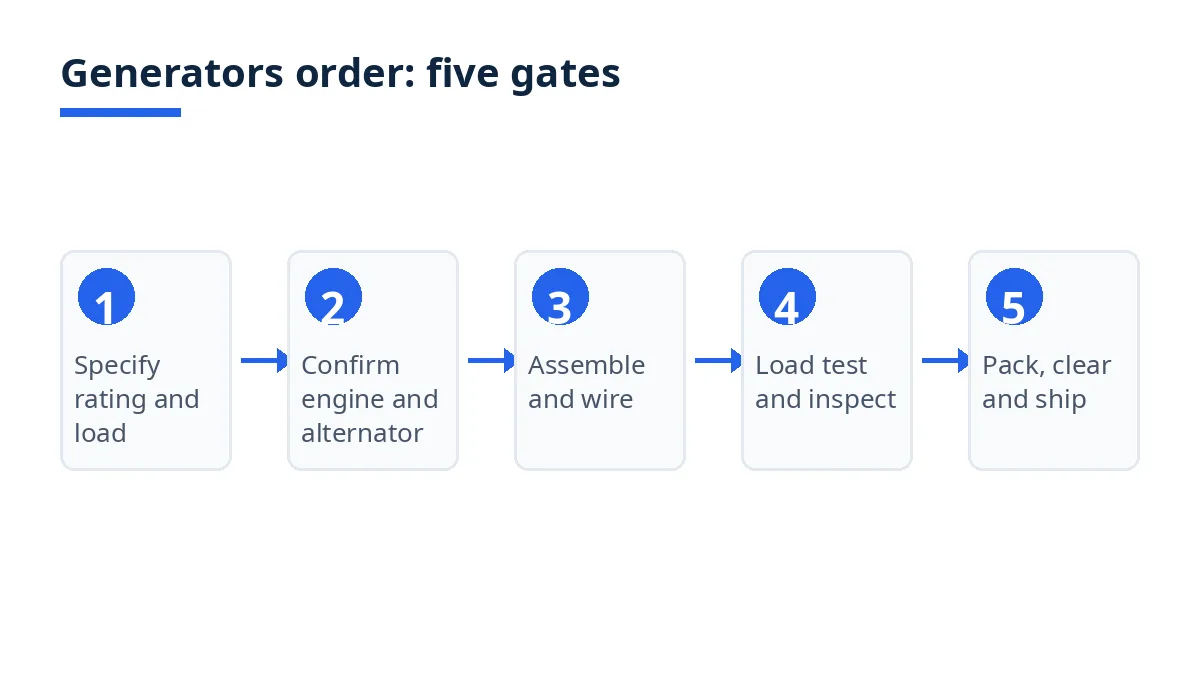
Specify the set in full, in writing. State the rating class, kVA and kW, voltage, frequency (50 Hz or 60 Hz), phase, canopy type, automatic transfer switch requirement, fuel tank size and site conditions such as altitude and ambient temperature. Where altitude or temperature exceed standard conditions, ask for the site-specific output.
Confirm engine and alternator availability in writing. Record brand, model and listed lead time for each, and what happens if the first choice slips: a named substitute, a revised date or a held deposit.1
Agree the build checkpoints. These are coupling and alignment, wiring and control panel programming, fuel lines and leak checks, battery and charger fitting, and canopy fitting. Ask for dated photos at coupling, wiring and final assembly.
Agree the test plan before assembly ends. Write down the no-load run, the staged load test at 50, 75 and 100 percent, the protection demonstrations and the test report format.3 Name the witness and the re-test rule if a step fails.
Approve packing before the set leaves the factory. Export packing means a crate or skid rated for the weight, moisture protection, lashing and lifting points, and markings showing model, rating class and serial numbers. Confirm packed dimensions and weight, since they decide container choice.
Complete the export papers and book the sailing on the agreed term. Build in buffer days for a document correction, a re-test or a missed sailing.6
Costs, timelines and documents
What are the typical costs and timelines?
No guide can state a typical price for a generator set, because price follows engine brand, alternator size, canopy class, control system, transfer switch, tank size, testing scope, packing, freight and the delivery term.6 Ask for the price broken down by engine, alternator, canopy, control system and testing.
Stage durations below are typical ranges for planning, not guarantees. Each range assumes the specification is settled at order.
Stage | Typical range | What moves it |
|---|---|---|
Specification and quotation | 1 to 2 weeks | Rating clarity, site data |
Engine and alternator sourcing | 2 to 45 days for engines, 2 to 15 days for alternators1 | Brand and model |
Assembly and wiring | 1 to 3 weeks | Canopy and controller |
Load testing and corrections | 3 to 10 days | Witnessed test, re-test |
Packing and export clearance | 1 to 2 weeks | Document errors |
Ocean transit | See destination table below | Routing, transshipment |
Destination | Typical FCL transit | Notes |
|---|---|---|
United Kingdom (Felixstowe, Southampton, London Gateway) | 21 to 27 days7 | Transships at Singapore, Colombo or Port Klang; LCL 25 to 33 days7 |
United States East Coast (New York) | 25 to 32 days8 | Suez routing; direct 25 to 28 days8 |
United Arab Emirates (Jebel Ali) | About 10 days9 | Carrier schedules about 10 days 9 hours9 |
Example figures: a standard 100 kVA standby set with a stocked engine and a standard silent canopy follows the published 2 to 4 weeks of delivery time after order confirmation.1 Add United Kingdom transit of 21 to 27 days7 and the order-to-port span becomes roughly 5 to 8 weeks before destination clearance. Change one variable, a special engine at 45 days,1 and the same span stretches by about a month.
Which documents are needed?
For export clearance in Bangladesh, goods may not be loaded unless an export declaration, the Bill of Export or Shipping Bill, is submitted to Customs and approved.10 The documents enclosed with the Bill of Export for all export consignments are the export letter of credit, or where there is none, the export contract, purchase order or export guarantee approved by the negotiating bank; the commercial invoice; the packing list; the EXP form certified by an Authorized Dealer; the certificate of origin issued by the Export Promotion Bureau or a Chamber of Commerce and Industry; the VAT registration certificate; and the Taxpayer Identification Number.10
The order documents are the specification sheet stating rating class, kVA, voltage, frequency and canopy type; the itemised quotation on one Incoterm with a named place;6 the purchase order repeating the same specification and term; the load-test report; the Declaration of Conformity for European Union sales;5 and a packing list showing model, rating class and serial numbers. Keep the serial numbers identical across all three, since a mismatch at destination can hold the consignment.
Bangladesh-specific rules and tips
Keep one legal name across every paper. The export declaration names the exporter and the foreign buyer,10 so the name on the trade licence, quotation, proforma invoice, EXP form and certificate of origin should match.
Confirm the rating class and test scope before you pay a deposit. A standby number is not a prime number,2 and a test report that omits the protection demonstrations is not a full load test.3 Put both points in the purchase order.
Plan around the local calendar. Monsoon season from June to September can delay inland transport and port operations, and factory closures during Eid ul-Fitr and Eid ul-Adha require advance planning.7 Place orders with buffer weeks around both windows.
Ask whether major components are stocked in Bangladesh or imported for your order. An imported engine or alternator sets the earliest possible start date, and its own shipping time sits in front of assembly time.1
Check the canopy against the site, not only the brochure. A silent canopy suits a building site with neighbours nearby, while an open set suits a fenced industrial yard. Confirm noise expectations, ventilation space and fuel storage rules before the canopy type is locked in.
Mistakes and red flags
What are the most common mistakes?
Comparing kVA without the rating class. A 500 kVA standby figure and a 500 kVA prime figure describe different machines in practice, because the standby rating allows only limited annual hours with no overload.2
Accepting a headline week count that excludes component sourcing. A delivery figure of 2 to 4 weeks usually assumes standard components.1 If your engine needs 45 days,1 the headline figure does not apply.
Skipping the protection demonstrations. A set that runs at full load but has never demonstrated low-oil-pressure shutdown, high-temperature shutdown or emergency stop has not passed its safety checks.3
Comparing quotations on different delivery terms. A date quoted ex works and a date quoted delivered to your port differ by the whole transit leg.6
Paying the balance before the test report and packing photos arrive. The test report and the packed dimensions are the last controls before the set becomes your freight. Hold the balance until both arrive and the serial numbers match.
Leaving voltage, frequency or phase off the purchase order. A 50 Hz set cannot serve a 60 Hz site, and a single-phase set cannot serve a three-phase load.
Checklist
Before you confirm, every line should be answered in writing.
Rating class stated: ESP, PRP, LTP or COP, with kVA and kW.2
Voltage, frequency, phase and site conditions on the specification sheet.
Engine brand, model and listed lead time confirmed; alternator brand and size confirmed.1
Canopy type, controller brand, transfer-switch requirement and tank size agreed.
Test plan agreed: no-load run, staged load test, protection demonstrations, report format.3
Packing approved: crate or skid, moisture protection, lashing and lifting points, packed dimensions.
Delivery term and named place identical across every quotation compared.6
Export set agreed: Bill of Export, invoice, packing list, EXP form, certificate of origin, VAT, TIN.10
Transit time checked for your destination port, with buffer days for a missed sailing.7 8 9
Declaration of Conformity requested for European Union sales.5
Balance payment tied to the test report and packing photos, with serial numbers matched.
How Exportain helps
On Exportain, browse suppliers and post a request for quotation on the RFQ board with your rating class, kVA, voltage, frequency, canopy type and delivery term, so suppliers quote against the same specification. Ask each reply for its engine and alternator availability, its test plan and its packed dimensions.2 6
Read the badges for what they record. Exportain Verified means Exportain has checked the seller's identity, phone, email and business registration, and Export Verified means it has checked the seller's Export Registration Certificate (ERC).11 Factory Verified means it has reviewed photos of the manufacturer's factory.11 Verification is a document and photo review by staff, free, and never granted by membership plans, and it is not a factory inspection.11 12 A badge is not a guarantee of capacity, quality or delivery,11 so the load-test report stays with you. See how supplier verification works on Exportain.
FAQs
What should I know first about generators?
Start with the rating class, the engine and alternator availability, and the test gate. ISO 8528-1 defines ESP, PRP, LTP and COP classes with different annual hour limits and overload rules,2 engines are listed at 2 to 45 days and alternators at 2 to 15 days,1 and the staged load test with protection demonstrations proves the finished set.3 Diesel generating sets fall under HS heading 8502, with subheading 850212 covering sets over 75 kVA up to 375 kVA.4
What are the typical costs and timelines?
There are no typical prices a guide can state, because engine brand, alternator size, canopy class, control system, testing scope, packing, freight and delivery term set the price for each order.6 For time, standard sets are listed at about 2 to 4 weeks after order confirmation,1 with ocean transit of 21 to 27 days to the United Kingdom,7 25 to 32 days to the United States East Coast8 and about 10 days to Jebel Ali.9
Which documents are needed?
The order documents are the specification sheet, itemised quotation on one Incoterm,6 purchase order, load-test report, Declaration of Conformity for European Union sales5 and packing list with serial numbers. The export set is the Bill of Export, commercial invoice, packing list, EXP form certified by an Authorized Dealer, certificate of origin, VAT registration certificate and Taxpayer Identification Number.10
What are the most common mistakes?
The most common mistakes are comparing kVA without the rating class,2 accepting a headline week count that excludes engine sourcing,1 skipping the protection demonstrations,3 comparing quotations on different delivery terms6 and paying the balance before the test report arrives.
Next steps on Exportain
Browse suppliers, then post your rating class, kVA, voltage, frequency, canopy type and delivery term on the RFQ board so suppliers state their engine availability and test plan against the same specification. Before you confirm, read the Incoterms guide for shipments from Bangladesh.
Sources
- 30kVA Silent Diesel Power Generator Set with Chinese Yto Engine. Mecca Power (accessed )
- Prime Power vs Standby vs Continuous: Generator Ratings. BLSH Diesel (accessed )
- Safe Work Method Of Statement For Testing and Commissioning of Diesel Generators. Safe Work Method of Statement (accessed )
- Classification Detail - HS Code 850212. United Nations Statistics Division (accessed )
- CE for Electronics: Understanding EU Directives and Compliance Requirements for the CE Mark. QIMA (accessed )
- Incoterms® 2020. International Chamber of Commerce (ICC) (accessed )
- Shipping from Bangladesh to United Kingdom. GoCubic (accessed )
- Shipping from Bangladesh to New York. GoCubic (accessed )
- Chittagong to Jebel Ali FCL Shipping Rates | Schedules & Transit Time. Cogoport (accessed )
- Customs Clearance Procedures for Export. Bangladesh Customs, National Board of Revenue (accessed )
- Trust & Safety Center. Exportain (accessed )
- Supplier verification: Earn trust badges buyers can see. Exportain (accessed )
About the author
Sourcing from Bangladesh?
Post a request for quotation and suppliers on Exportain can send you their quotes directly.
Post an RFQ