Typical MOQ for Frozen Fish Fillets in Bangladesh (and How to Negotiate It Down)
No single frozen fish fillets MOQ in Bangladesh: the minimum follows fillet yield, trim loss, glaze basis and pack format. This guide explains how the fillet batch is built, how IQF and block packs change the count, and how buyers negotiate a lower minimum without losing the specification.
Short answer
There is no single typical MOQ for frozen fish fillets from Bangladesh. Each processor sets its minimum per fillet form, pack style and carton, because fillet yield, skinning and trimming losses, glaze basis and the freezing run differ by form. Ask for the yield, glaze basis and carton count in writing, then negotiate the structure: fewer forms, one pack format, a standard carton, a consolidated shipment or a repeat commitment.
On this page
Key takeaways
There is no single typical MOQ for frozen fish fillets from Bangladesh, because each processor sets its minimum per fillet form, pack style and carton.
Fillet yield decides the input: the supplier must state its own yield for your species and form, with skinning and trimming effects stated separately, because a fillet weight is not a whole fish weight.
Glaze is not fish: where a product is glazed, declared net contents exclude the glaze, so price and MOQ must state a glazed or deglazed basis and a loading check.
IQF loose pieces and block packs are different products with different runs and cartons, so their minimums must be stated separately and never added into one total.
Negotiate the structure, not just the number: fewer forms, one pack format, a standard carton, a consolidated shipment or a repeat commitment, with the trade written into the order.
A buyer who asks a Bangladeshi processor for 500 kilograms of frozen fish fillets asks for a finished weight, while the factory plans in whole fish, cutting lines, freezing runs and cartons. That gap is where most fillet MOQ problems start. The factory cannot promise 500 kilograms of skinless, boneless, individually frozen portions until it knows how much whole fish that weight requires, how much skinning and trimming loses, whether fillets are frozen loose or as a block, and how many cartons the result fills. This guide works through that arithmetic, so a buyer can read a fillet quotation, find the binding minimum, and trade a real change for a lower one.
Why this matters for buyers and sellers
For a buyer, the fillet MOQ decides whether a product fits the market. A fillet is a cut, trimmed, skin-on or skinless, boneless or bone-in piece, frozen in one of two very different pack styles. Two quotations for "frozen fish fillets" can describe different products, net weights and carton counts at the same headline kilograms, so comparing only that headline may order a form customers do not want, or a pack size the cold store cannot break down.
For a seller, the fillet MOQ protects the cutting line. Filleting is labour and yield work before freezing: each fish is headed, gutted, filleted, skinned where required, trimmed and graded. A short run of a narrow form spreads that set-up over few kilograms, and an order mixing skin-on fillets, skinless portions and block packs is really several small runs. The minimum is the point at which one clean run of one form, in one pack format, makes sense to set up, cut, freeze and pack.
Step-by-step: how it works
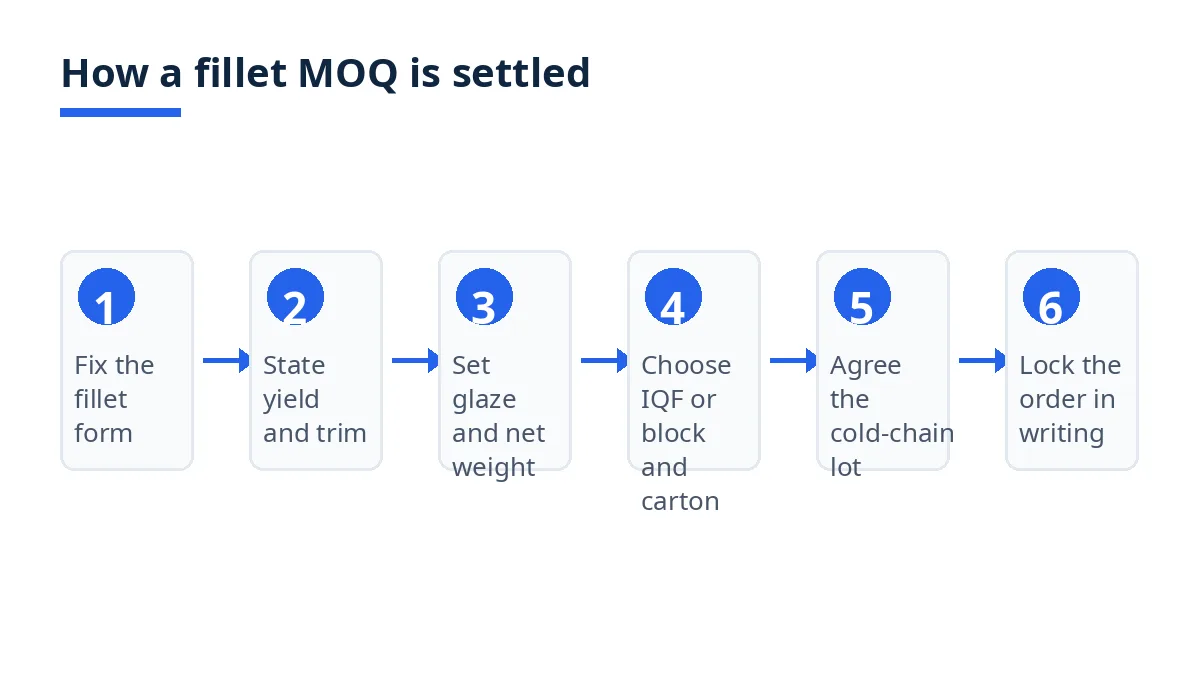
Work through the specification in this order, asking for the MOQ at each step.
1. Fix the fillet form before the quantity. State species, skin-on or skinless, boneless or pin bone position, whole fillet or portion, and size band or portion weight. Quick frozen fillets are slices removed from the carcass by cuts parallel to the backbone, and a fillet may be presented as boneless only when boning, including pin bone removal, is complete.1 A skinless boneless portion and a skin-on whole fillet are different products with different yields, so they need separate minimums.
2. Get the yield and trim statement in writing. Ask how many kilograms of fillets the factory expects from 100 kilograms of whole fish for your form, and how skinning and trimming change that figure. Reference yields show the spread: cod and haddock fillets at 50 percent, tilapia fillets at 40 percent, and trimmed John Dory fillets at 35 percent, skin-on unless stated, with skinless portions reducing yield by approximately 10 percent.2 Those are reference figures for those species and cuts, not a promise about any Bangladeshi factory, which must state its own yield. Example figures: 1,000 kilograms of whole fish at a stated 40 percent yield gives 400 kilograms of fillets before further skinning or trimming, so a buyer ordering 400 kilograms of skinless portions must know whether the MOQ is counted before or after that step.
3. Settle the glaze and net weight basis. Glaze is the thin ice layer protecting a frozen fillet, and it is not fish. Where a product has been glazed, declared net contents are exclusive of the glaze.1 A quotation in glazed weight therefore delivers less fish than the same figure in deglazed net weight. Ask for the glaze percentage, whether price and MOQ use a glazed or deglazed basis, and how net weight is checked at loading: the standard method weighs net weight in the frozen state, exclusive of packaging, after glaze is removed under a gentle spray of cold water.1
4. Choose IQF or block, and do not mix them in one minimum. Individually quick frozen (IQF) fillets are frozen as separate pieces, so a buyer can take pieces without thawing the rest. A block is a cohering mass of fillets frozen together, intended for further processing, and a block of one species or of species with similar sensory characteristics differs from loose IQF fillets.3 Freezing run, packing line and carton differ for each, so IQF and block minimums cannot be added into one order total. State one pack style per line.
5. Convert the order into cartons and cases. Ask for inner pack weight, inner packs per carton, carton net weight, and cartons per pallet or container load. Example figures: with a 10 kilogram carton, a 1,000 kilogram net order is 100 cartons, and 95 cartons is not a 1,000 kilogram order on that carton. Asking for 6 kilogram cartons against a 10 kilogram factory standard is a new packing run, so the MOQ may rise rather than fall.
6. Agree the cold-chain lot. A fillet lot is defined by species, form, pack style, glaze basis and freezing run, and it travels deep-frozen. Quick frozen fillets are not completely frozen until the product temperature reaches minus 18 degrees Celsius or colder at the thermal centre, and the product stays deep frozen through transport, storage and distribution.1 Blocks carry the same requirement.3 Ask for the temperature record, who checks it at loading, and what happens if it shows a break. A small order sharing a container needs its temperature and segregation terms agreed before loading.
7. Lock the changed specification in the order. When a lower MOQ is agreed, write down what changed to earn it: form dropped, pack format merged, carton standardised, shipment consolidated, or repeat commitment given. If only the number changes on paper, the next order may revert to the original minimum, because nothing in the production plan changed.
Costs, timelines and documents
No typical fillet price, MOQ cost or lead time exists, because each follows the fillet form, yield, pack style and delivery term. The table below shows the structure only. All figures here are Example figures, never market rates.
Cost or time driver | What moves it | What to ask for in writing |
|---|---|---|
Whole fish input | Species, size and stated fillet yield | Whole fish kilograms per 100 kilograms of fillets, for your form |
Filleting and trimming | Skin-on or skinless, boneless, portioning | Yield before and after skinning and trimming, stated separately |
Freezing run | IQF or block line, lot size | Freezing method and minimum per run, per form |
Glaze and net weight | Glaze percentage and weight basis | Glaze percentage, glazed or deglazed basis, loading check |
Inner pack and carton | Bag, tray or bulk pack, standard or custom carton | Inner pack weight, packs per carton, carton net weight |
Cold storage and handling | Lot size, storage time, container load | Storage terms, temperature record, pallet and container counts |
Documents divide into three groups. The order file holds the fillet specification, yield and trim statement, glaze and net weight basis, quotation, purchase order, packing specification and inspection plan. The Bangladesh export set includes the Bill of Export, commercial invoice, packing list, EXP form certified by an authorized dealer, and certificate of origin issued by the Export Promotion Bureau or a Chamber of Commerce and Industry.4 Where the destination country requires it, a Department of Fisheries quality control certificate is necessary for frozen fish.4 Confirm with the importer of record which market documents the destination requires for that species and form before the filleting run starts, because a lot cut to the wrong market specification cannot be re-cut after freezing.
Bangladesh-specific rules and tips
Start with the plant, not the listing. Under the Fisheries and Fish Products (Inspection and Quality Control) Act, 2020, no person may export fish and fish products, or establish and operate a processing factory, without a licence, and the competent authority sets the standards for production, processing, transport and storage.5 Ask the supplier to name the plant, state its licence position, and confirm that plant will fillet, freeze and pack the order. A trader who cannot name the plant cannot answer a yield, glaze or cold-chain question with authority.
Confirm the code per form, not per species alone. Heading 0304 covers fish fillets and other fish meat, whether or not minced, fresh, chilled or frozen, with frozen fillet lines by species group, for example frozen flat fish fillets under 030483.6 A skin-on fillet, a skinless portion and a block can fall under different lines, so code, form and MOQ should be confirmed together, line by line.
Mistakes and red flags
Ordering by whole fish weight. Ordering 1,000 kilograms thinking in whole fish, while the factory quotes in fillet net weight, is wrong in the unit, and again wrong after yield and trimming. State every quantity as fillet net weight on a stated glaze basis, and state whole fish input only as the yield statement behind it.
Mixing fillet forms in one MOQ. Skin-on fillets, skinless portions and block packs in one order are separate runs with separate minimums. A total passing only because three small forms are added together will fail on the line, because no single run reaches its minimum. Split the order by form and test each form against its own minimum.
Counting glaze as fish. A MOQ in glazed weight and a MOQ in deglazed net weight are different quantities of fish. Without a stated glaze percentage, the buyer cannot compare quotations, check delivery at loading, or price the order per kilogram of fish. Settle the basis first, and check it by the deglazing method in the standard.1
Confusing IQF and block quantities. An IQF carton and a block carton may weigh the same and hold the same species, but they are different products: loose pieces against a cohering block for further processing.3 Name the pack style on every line.
Accepting a lower MOQ without recording the trade. If the factory lowers the minimum by dropping a form, merging a pack format, standardising a carton, joining a run or consolidating a shipment, that change is part of the deal. If it is not written into the order, the next order may be quoted at the original minimum.
Red flags in a supplier reply. Pause on a reply that will not state its fillet yield, name the processing plant, state the glaze basis, separate IQF from block, or say which change would lower the minimum. Pause also on a reply that cuts the MOQ sharply with no change to form, pack format, carton or production plan: ask what changed, in writing, before confirming.
Checklist
Before confirming, every line below should be answered in writing.
Species, fillet form, skin position, boning, portion or whole fillet, and size band per line.
Fillet yield for your form, with skinning and trimming effects stated separately.2
Glaze percentage and weight basis: glazed or deglazed net weight, loading check agreed.1
Pack style per line: IQF loose pieces or block, never mixed in one minimum.3
Inner pack weight, packs per carton, carton net weight, cartons per pallet.
MOQ per form, per pack style and per carton count, converted to net kilograms.
Cold-chain lot defined, minus 18 degrees Celsius noted, temperature record agreed.1
Processing plant named, licence position confirmed.5
HS code per form, not per species alone.6
Delivery term stated once, on every quotation, on the same basis.7
Export set agreed: Bill of Export, invoice, packing list, EXP form, certificate of origin.4
Destination market documents confirmed before the filleting run.
Inspection plan agreed: net weight, glaze and temperature checks before loading.
The change behind any lowered MOQ recorded in the order.
How Exportain helps
On Exportain, browse suppliers and post a request for quotation (RFQ) on the RFQ board with your species, fillet form, skin and boning position, portion size, pack style, glaze basis and delivery term, and ask each reply to state its MOQ per form, per pack style and per carton, with its yield and trim statement. Quotations answering those lines can be compared on the same specification; quotations answering only a headline weight cannot.
Read the badges for what they record. Exportain Verified means Exportain has checked identity, phone, email and business registration, and Export Verified means it has checked the Export Registration Certificate (ERC).8 Factory Verified means it has reviewed photos of the manufacturer factory, while Trading Company Verified means it has reviewed photos of the trading company office or warehouse.8 Verification is a document review by staff, free, and never granted by membership plans.9 It is not a factory inspection,8 9 so yield, glaze, inspection and temperature decisions stay with the buyer.
FAQs
What should I know first about frozen fish fillets?
Start with the fillet form, not the quantity: species, skin position, boning, portion or whole fillet, and size. Quick frozen fillets are slices cut parallel to the backbone,1 and frozen fillets sit under heading 0304, with frozen fillet lines by species group.6 Until form, yield, glaze basis and pack style are written down, no MOQ quotation can be compared with another.
What are the typical costs and timelines?
There is no typical fillet cost or timeline to rely on, because both follow the form, yield, pack style, lot size and delivery term. Costs move with whole fish input, filleting and trimming, the freezing run, glaze treatment, inner pack and carton, cold storage, inspection and freight, and Incoterms 2020 allocates cost, risk and obligations under 11 rules.7 Ask for a date per stage, from raw material confirmation to loading. Example figures here show structure only, never market rates.
Which documents are needed?
The order file holds the fillet specification, yield and trim statement, glaze and net weight basis, quotation, purchase order, packing specification and inspection plan. The export set is the Bill of Export, commercial invoice, packing list, EXP form certified by an authorized dealer, and certificate of origin issued by the Export Promotion Bureau or a Chamber of Commerce and Industry, with a Department of Fisheries quality control certificate for frozen fish where the destination country requires it.4 Confirm the plant licence position under the 2020 Act as well.5
What are the most common mistakes?
The most common mistakes are ordering by whole fish weight instead of fillet net weight, mixing fillet forms into one MOQ, counting glaze as fish, confusing IQF and block quantities, accepting a lower MOQ without recording what changed, and reading a badge as a capacity guarantee. Fix each the same way: one form per line, one pack style per line, a stated yield, a stated glaze basis, a carton count, and the trade behind any lower minimum written into the order.
Next steps on Exportain
Browse suppliers, then post your species, fillet form, pack style and glaze basis on the RFQ board and ask each reply for its MOQ per form, per pack style and per carton. Before confirming, read the general MOQ guide.
Sources
- Standard for Quick Frozen Fish Fillets (CXS 190-1995). Food and Agriculture Organization of the United Nations (accessed )
- Yields. Seafish (accessed )
- Standard for Quick Frozen Blocks of Fish Fillet, Minced Fish Flesh and Mixtures of Fillets and Minced Fish Flesh (CODEX STAN 165-1989). Codex Alimentarius Commission (accessed )
- Customs Clearance Procedures for Export. Bangladesh Customs, National Board of Revenue (accessed )
- The Fisheries and Fish Products (Inspection and Quality Control) Act, 2020. InforMEA (accessed )
- HS Classification Detail: 030483 - Fish fillets; frozen, flat fish. United Nations Statistics Division (accessed )
- Incoterms® 2020. International Chamber of Commerce (ICC) (accessed )
- Trust & Safety Center. Exportain (accessed )
- Supplier verification: Earn trust badges buyers can see. Exportain (accessed )
About the author
Sourcing from Bangladesh?
Post a request for quotation and suppliers on Exportain can send you their quotes directly.
Post an RFQ