Typical MOQ for Formal Suits in Bangladesh (and How to Negotiate It Down)
No single formal suit MOQ in Bangladesh: how the suiting roll, size run and pressing lot set the minimum for a matched pair, and how to negotiate it down.
Short answer
There is no single typical MOQ for formal suits in Bangladesh. Each factory sets its minimum for your specification, and for a suit the binding minimum is usually the suiting roll yield, the size run or the pressing lot, because the jacket and trouser must match in shade and finish from one cloth. Ask for the roll yield, the minimum per size and the pressing-lot size in writing, then negotiate the structure.
On this page
Key takeaways
There is no single typical MOQ for formal suits in Bangladesh, because each factory sets its minimum for your specification and the binding minimum is usually the fabric minimum.
A suit is a matched pair cut from one cloth, so the suiting roll yield, the size run and the pressing lot set the floor, not a headline suit total.
Ask for the roll yield, the minimum per size and the pressing-lot size in writing, with canvas, lining, trim and label minimums stated apart from the garment quantity.
Negotiate the structure first: fewer colours, a shared suiting lot across styles where the factory agrees in writing, stocked inputs, and set-up or pressing charges priced as a separate line.
Exportain verification is a document review by staff, not a factory inspection, and a badge is not a guarantee of capacity, quality or delivery.
A suit fails as a product when its two halves drift apart. The jacket may fit, the trouser may fit, and the pair can still be unsaleable if the cloth shade, the surface finish or the pressed crease does not match between them. That matching requirement is the starting point for any quantity discussion in Bangladesh, because it ties the order to one lot of suiting, one cutting plan and one finishing batch rather than to a round total that a buyer invents in advance.
Start from the cloth, not from the suit count. A factory first works out how many metres of suiting one roll holds, how many metres a jacket plus its trouser consume together, and how many whole suits survive cutting loss from that roll. Colour then divides the result: a roll dyed or finished to one shade cannot cover a second shade, so each colour needs its own roll arithmetic. Sizes divide it again, because the yield must be spread across chest sizes and trouser lengths without leaving a size short. When a buyer understands that chain, the factory reply stops looking arbitrary and starts looking like a calculation the buyer can test.
That calculation is also why a single market figure for suits would mislead. Factories in Bangladesh cut different jacket blocks, offer different canvas constructions and hold different suiting stocks, so the roll, the size spread and the finishing batch that govern one enquiry do not govern the next. The useful question is therefore not what other buyers ordered. It is which constraint governs this specification, how large that constraint is, and what change to the specification moves it.
Why this matters for buyers and sellers
For a buyer, the risk sits in stock that cannot be sold as a pair. A missing size breaks a size curve, a shade gap between jacket and trouser breaks the suit itself, and a shortfall in one colour leaves a rail of jackets with no matching trousers. Capital is tied up in all three cases, because the pieces cannot be re-paired with cloth from a different lot without showing the difference. A buyer who checks only the grand total can approve an order that is short exactly where it hurts, in one size or one colour.
For a seller, the risk sits in cloth and labour committed to one buyer alone. Suiting finished to a buyer shade, canvas shaped to a buyer jacket block and linings chosen for a buyer colourway have no second buyer waiting if the order shrinks. Pressing adds a further fixed cost: setting the lapel roll, the shoulder line and the trouser crease takes a batch run, and running that batch for a handful of suits costs nearly as much in handling as running it for a full lot. Minimums protect that committed cloth and that batch labour, not a factory preference for large orders.
Two shared references keep the conversation precise. Sampling and inspection follow an agreed plan, and ISO 2859-1 sets out sampling procedures for inspection by attributes, including the acceptance quality limit concept that links lot size, inspection level and sample size.1 Commercial terms need the same discipline: Incoterms 2020 sets out 11 rules that allocate cost, risk and obligations between seller and buyer, so a quotation is only comparable with another quotation written on the same rule and named place.2
Step-by-step: how it works
Work through the constraints in the order a factory meets them, from cloth to finished pair, and get each one in writing before confirming.
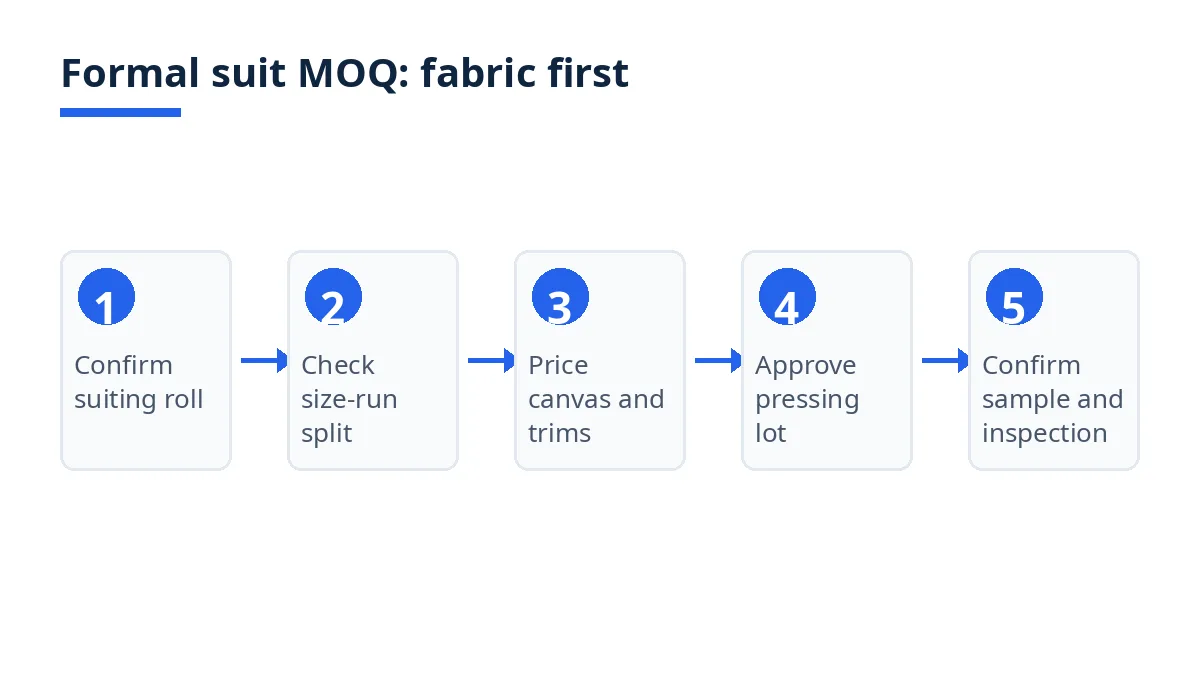
Describe the pair as one specification. State the jacket block, trouser cut, suiting composition and weight, canvas or fusible construction, lining, buttons, pockets, size chart and the quantity per size inside each colour. A specification that lists jackets and trousers apart invites separate counting later.
Get the roll arithmetic first. Ask for roll length, metres consumed by one jacket plus one trouser, cutting loss, and whole suits per roll. That figure is the first floor for each colour, and it should be stated per colour rather than averaged across colours.
Get the smallest quantity per size. Ask which size in the spread is hardest to fill and what quantity that size needs before cutting starts. A size curve with one thin size can hold up an otherwise adequate order.
Separate the input minimums. Canvas or interlining, pocketing, buttons, linings, labels and cartons each arrive in their own batch. Ask which input minimum sits above the garment quantity and whether any input is already stocked for your construction.
Get the pressing batch size. Ask how many suits form one pressing lot and what happens to a colour or size below that lot: a surcharge, a wait until the lot fills, or removal from the run. Pressing governs shape, so this answer belongs in the quotation, not in a later discussion.
Approve the pair together, in real materials. Order a proto sample, then a pre-production sample in the actual suiting, canvas, lining and trims, jacket and trouser side by side. Check shade match, drape, shoulder, lapel roll and trouser crease as a pair, and record approval or corrections in writing.
Fix inspection and delivery terms in the order. Write the inspection level and acceptance quality limit values into the purchase order, following ISO 2859-1,1 and state one Incoterm and named place for every quotation.2
Classification and labelling sit beside that sequence rather than inside it. In the Harmonized System, heading 6203 covers suits, ensembles, jackets, blazers and trousers for men and boys, not knitted or crocheted, and subheading 620312 covers suits of synthetic fibres within that heading.3 For sales into the European Union, Regulation (EU) No 1007/2011 requires a textile product to be labelled or marked with the name and percentage by weight of all constituent fibres in descending order.4
Example figures: a 55-metre roll at 2.9 metres per jacket-and-trouser pair leaves 18 whole suits, because 55 divided by 2.9 is 18.96 and a part suit cannot ship. Splitting that roll across two shades gives no colour the full 18, and splitting it across a wide size spread thins every size. The arithmetic is an illustration of structure only, not a typical MOQ, price or lead time.
Costs, timelines and documents
Price follows construction before it follows quantity. A fully canvassed jacket, a half-canvassed jacket and a fused jacket differ in handwork, pressing time and input cost even in identical cloth, and suiting weight, lining quality, button choice and packing add further differences. A lower quotation on a different construction or a different delivery term is a different offer, so compare replies only where the tech pack, the canvas method and the Incoterm match.2 Surcharges also belong in the price discussion: a below-lot pressing charge, a short-roll charge or a set-up charge for a small colour should appear as a separate line, so the buyer can see whether reducing colours or accepting a stocked input removes it.
Timelines follow input readiness before they follow sewing capacity. Sampling waits on suiting availability and correction rounds, bulk production waits on cloth delivery, canvas and trim arrival, cutting, sewing and pressing capacity, and inspection waits on a finished lot. Ask for sampling, cloth ready, production, pressing and inspection as separate dates rather than one delivery week, and treat a single-week promise with no staged dates as incomplete.
Order papers are the tech pack, the itemized quotation and the purchase order, each carrying the quantity per colour and per size as matched pairs, plus written sample approvals. For export clearance, confirm the current declaration and document set with your supplier or freight partner before loading.5
Bangladesh-specific rules and tips
Check association claims at the source. BGMEA has set membership criteria aimed at factory safety and operational standards,6 so a membership claim is worth confirming with the association itself. Membership describes standing, not the suiting on hand, the jacket block a factory cuts well, or the pressing capacity behind a particular order.
Watch where the market is moving. Reporting on Bangladeshi garments finding a foothold in the Turkiye market shows demand beyond established destinations,7 which matters when a buyer weighs a new suit programme against a familiar one. A growing destination does not change any factory minimum, but it does affect which factories are busy and which suiting stocks are already committed.
One name, all documents. A suit order stalls when the exporter's name differs between papers, so settle the registered name first and carry it unchanged through the trade licence, quotation, proforma invoice and payment account. Catching a variant before the order is placed costs minutes; catching it after documents are issued costs the shipment.
Ask which suit inputs are bought in for the order. Suiting, canvas, linings and some buttons may be imported for a particular specification, and an imported input can set both the minimum and the earliest cutting date. Agree the size ratio per colour before cutting, and get any agreement to share one suiting lot across a jacket-only style and a full suit in writing before assuming the roll can stretch.
Judge shade match on the worn pair. Ask for jacket and trouser to be cut from the same cloth lot and pressed as a pair in the pre-production sample. A shade difference invisible on a swatch becomes obvious when both pieces are worn together, and that sample is the last cheap moment to catch it.
Mistakes and red flags
Ordering a total with no split. A grand total can clear every headline while one colour stays below its roll yield or one size stays below its cutting quantity. The factory then applies a surcharge, carries cloth forward or drops the colour, and the buyer discovers the problem after approval.
Counting jackets and trousers apart. Separate counts invite a cloth or shade mismatch and make a shortfall in one piece look harmless. Keep the pair together in every quantity line, from enquiry to purchase order.
Comparing minimums across different constructions. A smaller minimum on a fused jacket, a stocked suiting or a different delivery term answers a different question from the one asked. Compare only replies to the same tech pack, same canvas method and same Incoterm.2
Accepting a smaller minimum by word of mouth. A reduced roll yield, a shared cloth lot, a waived pressing surcharge or a staged delivery means nothing unless it appears on the quotation and purchase order with the colour and size split it covers. Verbal flexibility disappears when cutting starts.
Reading a profile as proof of suit capability. A supplier profile is a starting point for enquiries. It does not show whether a factory cuts a particular jacket block cleanly, holds the pressing batch a suit needs, or matches shade across a pair, and a badge is not a guarantee of capacity, quality or delivery.8
Skipping the pair check to save a week. Inspection under an agreed sampling plan checks a lot against its acceptance quality limit,1 but it cannot repair a shade gap or a crease fault already pressed into finished suits. The pre-production pair check is the last control before matched suits become stock.
Checklist
Run down each line below and hold the written answer for it before you confirm.
Tech pack sent: suiting, jacket block, trouser cut, canvas construction, lining, trims, labels, sizes, packing.
Split stated per colour and per size, as matched pairs, with one size ratio per colour.
Roll arithmetic confirmed: roll length, metres per pair, whole suits per roll per colour.
Smallest quantity per size confirmed, with the hardest size named.
Canvas, lining, trim, label and carton minimums confirmed apart from the garment quantity.
Pressing batch size and below-lot rule confirmed in writing.
Pre-production sample checked as a pair, measured and approved in writing.
Inspection level and acceptance quality limit values in the purchase order.1
Quotations compared on the same specification, construction and Incoterm.2
Pre-loading paper confirmation obtained from the supplier or freight partner.
How Exportain helps
Use Exportain to put the same pair specification, colour and size split and delivery term in front of several suppliers at once, then compare their roll arithmetic, per-size quantity and pressing batch side by side instead of comparing headline totals. Ask each reply to state its roll yield, its hardest size and its pressing batch in writing, and read what each badge records on the verification page before treating it as capacity proof, since verification is a document review by staff, not a factory inspection.8 The supplier directory and request board are the place to start that comparison, and the MOQ definition guide explains the underlying concept for buyers new to minimums.
FAQs
What should I know first about formal suits?
A suit is a matched pair, so the quantity that matters is governed by the suiting roll, the size spread and the pressing batch for each colour, not by a single total. Heading 6203 covers suits, ensembles, jackets, blazers and trousers for men and boys, not knitted or crocheted.3 State the pair, the cloth and the split per size in the first enquiry.
What are the typical costs and timelines?
No reliable typical price or lead time exists for suits, because each factory prices a particular suiting, canvas method, lining, pressing and delivery term.2 Sampling depends on cloth availability and correction rounds, while bulk timing depends on input arrival, cutting, sewing, pressing capacity and inspection.
Which documents are needed?
The tech pack, itemized quotation and purchase order carry the quantity per colour and per size as matched pairs, with written sample approvals alongside them. The clearance pointer in the costs section above covers shipment papers, and the purchase order should also carry the agreed inspection level and acceptance quality limit values.1
What are the most common mistakes?
Ordering a total with no split, counting jackets and trousers apart, comparing minimums across different constructions or terms,2 accepting a smaller minimum verbally, and reading a badge as a guarantee of capacity, quality or delivery.8 Each mistake hides the constraint that actually governs the order.
Next steps on Exportain
Start with the formal suits quality control checklist, then read how to import formal suits from Bangladesh and the MOQ definition guide before sending suppliers a pair specification with its colour and size split.
Sources
- SIST ISO 2859-1:2003 - Sampling procedures for inspection by attributes, Part 1: Sampling schemes indexed by acceptance quality limit (AQL). International Organization for Standardization, (accessed )
- Incoterms 2020 Explained: All 11 Rules. Blue Ocean Academy (accessed )
- Classification Detail — HS Code 620312. United Nations Statistics Division (accessed )
- Regulation (EU) No 1007/2011 on textile fibre names and related labelling and marking of the fibre composition of textile products. European Union, (accessed )
- Custom Clearance in Bangladesh: Port Procedures and C and F Agent Guide. Bizmend (accessed )
- BGMEA sets new membership criteria to ensure factory safety, operational standards. The Financial Express, (accessed )
- Have Bangladeshi garments found a foothold in the Turkiye market?. bdnews24.com (accessed )
- Exportain | Bangladesh B2B Export Marketplace. Exportain (accessed )
About the author
Sourcing from Bangladesh?
Post a request for quotation and suppliers on Exportain can send you their quotes directly.
Post an RFQ