

Formal Suits Lead Time From Bangladesh: Production and Shipping Timeline
Formal suit lead-time guide for Bangladesh orders: seven construction gates from pattern and fit to pressing and packing, with illustrative timelines, documents, and a lapel-roll worked example.
Short answer
Plan a formal suit order from Bangladesh through seven gates: pattern and fit, cloth and lining, lapel and collar, trouser crease, buttonholes, labeling, and pressing and packing. Every duration in this guide is an illustrative example or an item to confirm in the written quote and a dated forwarder estimate, never a promise. Close each gate in writing before bulk cutting, and book freight only after inspection passes.

On this page
Key takeaways
A formal suit is a set of two or three pieces in identical fabric, matching in construction, color, composition, style and size, so jacket and trouser approvals must close together: cloth lot, canvas or fusing, lining, lapel, crease, button work, labels and packing.
The lapel-roll worked example shows why gates matter: a canvas cut that does not match the lapel shape is a small remake at the sample stage, but rework across finished, pressed suits if it is found after bulk.
Labels are a buyer specification, not a factory default: fiber wording, care method, destination language and label positions are approved before bulk labels are printed, and pressing and folding are approved as a packing stage on a rested sample suit.
Every span in this guide is an illustrative example only. Real dates come from the written quote and the dated forwarder estimate, costs are compared only on identical specifications, and the delivery rule, named place and edition are written together in the contract.
A formal suit order is judged as a set, not as separate pieces. A jacket and a trouser that each fit well can still fail together if their cloth shades differ, if the lapel roll does not match the collar, or if the trouser crease disappears in packing. The calendar risk is rarely sewing speed alone: it is an approval left open when bulk cutting starts.
This guide plans a suit order through gates: named approvals that must close in writing before the next stage starts. Every duration and cost note here is an illustrative planning example only, or an item to confirm in the written quote and the dated forwarder estimate. No figure here is a promise for any real order.
Why this matters for buyers
A suit has a stricter definition than a matching jacket and trouser bought together. For heading 6203 and 6204 purposes, a suit means a set of garments composed of two or three pieces made up, in respect of their outer surface, in identical fabric, and all components must be of the same fabric construction, color and composition, of the same style and of corresponding or compatible size.1 That is why suit planning starts with cloth and construction agreement, not with a delivery date: if jacket and trouser are cut from different cloth lots, the set can stop reading as one suit even when each piece measures correctly alone.
Construction faults also hide well. Canvas or fusing shapes the lapel and chest, the collar sets how the jacket sits at the neck, and the trouser crease must survive pressing, folding and packing. None of these can be judged from a flat photograph; they need a physical sample, checked on a form or a wearer, under the same light used for the bulk shade check.
Step-by-step: how it works
Read the order against seven gates, then bulk sewing, inspection and documents. No gate is skipped because an earlier gate went well, and a change to an approved item reopens its gate.
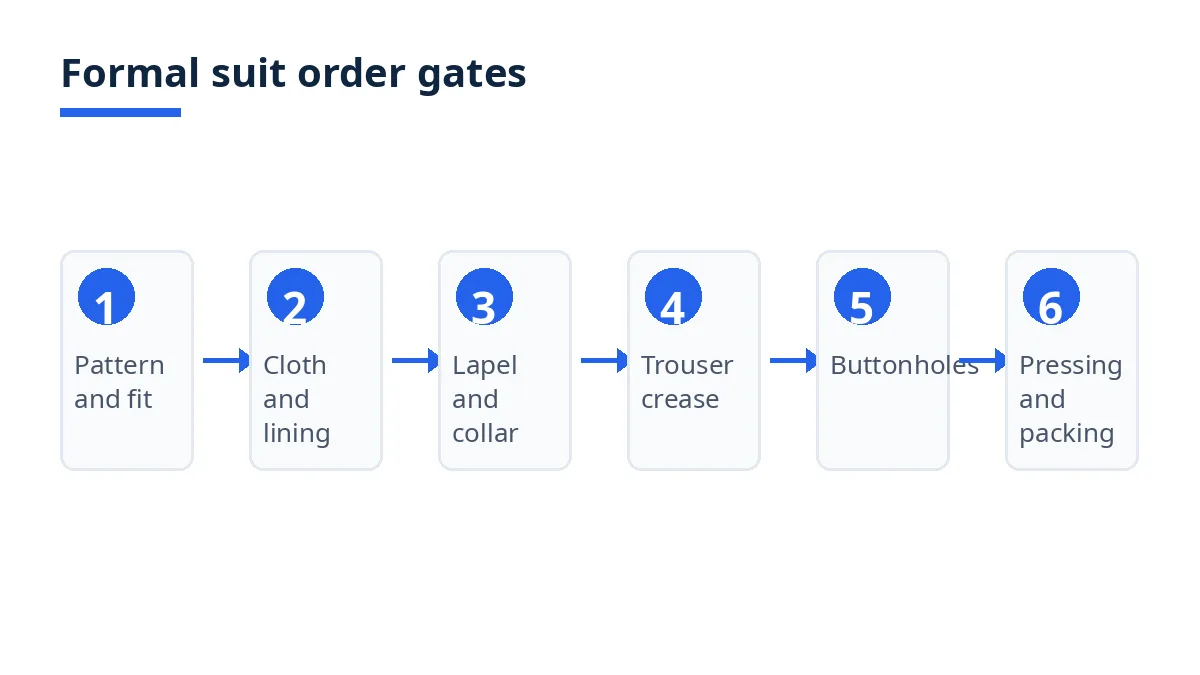
Gate 0: Suit pattern, grading and fit approval
Gate 0 approves the pattern, grading and fit of the suit as a set: a measurement table for every size, tolerances at each point of measure, and a fit standard covering jacket shoulder and chest balance, trouser waist and seat, and jacket length against trouser rise. Check fit on the smallest, largest and middle sizes, not on one middle size alone. If pattern, grading or the size range changes, Gate 0 reopens.
Gate 1: Cloth, canvas or fusing, and lining approval
Gate 1 fixes the cloth, chest construction and lining before cutting: cloth reference and shade, cutting lot for jacket and trouser, canvas or fusing and its weight, and lining cloth, color and coverage. A manufacturing guide notes that a manufacturer should confirm fabric composition, shrinkage, color fastness, hand feel, stretch and durability before bulk production.2 That confirmation must cover the set, not three separate swatches. A new cloth lot reopens Gate 1.
Gate 2: Lapel and collar construction approval
Gate 2 approves lapel roll, collar fit and their junction: lapel width and shape, roll line, collar stand and fall, gorge position and button stance, all checked on a physical sample jacket from the front, from the side and on a wearer or form. A lapel that looks correct lying flat can still break, gape or roll past its line once worn and buttoned, so check both sides against each other: a one-sided fault is a failed gate.
Worked example: a lapel roll caught at Gate 2. A fit sample jacket arrives with a left lapel that rolls cleanly to the button and a right lapel that breaks above the button and stands away from the chest. Inspection finds a lapel canvas cut that does not match the lapel shape on the right side. The fix here is small: re-cut canvas and lapel, remake the sample, and re-check both lapels before bulk cutting. Found after bulk pressing, the same fault would mean rework across finished suits, re-pressing, re-folding and a fresh inspection round. This example is illustrative only.
Gate 3: Trouser crease, waistband and lining approval
Gate 3 approves the trouser as the second half of the set: crease position front and back, waistband construction and closure, pocket construction, and lining coverage, checked on a sample trouser worn with the sample jacket. A crease is approved on a wearer, not on a flat trouser: it must run straight from waist to hem, survive sitting and walking, and be restorable by the Gate 6 pressing method. Check the trouser against jacket cloth and shade under one light.
Gate 4: Buttonhole and button attachment approval
Gate 4 approves buttonholes and button attachment as construction: buttonhole type and density, thread, button material, size and color, attachment method, and spare-button provision for each suit. Check buttonholes after pressing, because pressing can distort a buttonhole that looked clean before it, and check attachment by handling: a button that turns or lifts on the sample will not improve in bulk. If button, thread or buttonhole method changes, Gate 4 reopens.
Gate 5: Fiber, care and origin labeling as a buyer-specification item
Gate 5 approves every label on the suit as a buyer specification, before bulk production: fiber composition wording, the care method the buyer wants stated, label language for the destination market, label positions on jacket and trouser, and country-of-origin wording. Under Regulation (EU) No 1007/2011, the labeling or marking shall be provided in the official language or languages of the Member State on the territory of which the textile products are made available to the consumer, unless the Member State concerned provides otherwise.3 Treat the care method as a buyer decision, recorded before bulk labels are printed.
Gate 6: Pressing, folding and packing approval
Gate 6 treats pressing and folding as a packing stage with its own approval: pressing method for jacket and trouser, cooling and setting time before folding, folding method, packing presentation, and carton marking. Check a pressed and folded sample suit after it has rested, not straight off the press: lapel roll, collar shape and trouser crease must all survive the fold. For a suit, the final carton audit checks the set, not just the piece count. If pressing, folding or packing changes, Gate 6 reopens.
Bulk sewing, inspection and documents
Bulk sewing should add no new decisions: cutting follows Gate 1, sizes follow Gate 0, lapel and collar follow Gate 2, trouser follows Gate 3, button work follows Gate 4, labels follow Gate 5, and pressing and packing follow Gate 6. A manufacturing guide describes a quality system running through fabric, trims, cutting, inline sewing, measurement, finishing, final random and carton checks.2 In-line checks should compare finished pieces against the approved samples at each stage. Documents gate loading, so the set must be ready before a ship date is promised: commercial invoice, packing list, bill of lading or air waybill, certificate of origin, inspection certificate where required, test reports and buyer-specific compliance documents.2
Costs, timelines and documents
Cost follows the gates: cloth choice and lot, canvas or fusing weight, lining coverage, buttonhole work, sample rounds, re-pressing after a late change, inspection scope, and the freight and insurance split under the delivery rule. A quote that hides any of these lines is incomplete, not cheaper. Compare quotes only when every quote carries the same cloth, construction, lining, label and packing specification, the same size range, and the same delivery rule with its named place.
Spans below are illustrative examples only; replace each with the dates in the written quote and the dated forwarder estimate.
Stage | Confirm in the written quote | Illustrative example span only |
|---|---|---|
Pattern, grading and fit approval (Gate 0) | Measurement table, tolerances, sizes covered | 1 to 3 weeks |
Cloth, canvas or fusing, and lining readiness (Gate 1) | Cloth lot, construction, lining coverage | 1 to 4 weeks |
Lapel and collar sample round (Gate 2) | Lapel shape, roll line, collar fit | 1 to 2 weeks |
Trouser, buttonhole and label approvals (Gates 3 to 5) | Crease method, button work, label artwork | 1 to 3 weeks |
Bulk sewing after all gates close | Gate approvals referenced in the order | 3 to 6 weeks |
Pressing, folding and packing (Gate 6) | Pressing and folding method, carton audit | 1 to 2 weeks |
Inspection and document readiness | Inspection scope, document set, broker handover | 1 week |
Transit | Dated forwarder estimate, door to door | Confirm in the estimate |
Classification sits inside the document step. The Harmonized System is a multipurpose international product nomenclature developed by the World Customs Organization, comprising more than 5,000 commodity groups each identified by a six digit code, used by more than 200 countries and economies as a basis for their customs tariffs.4 Men's or boys' suits sit under heading 6203 on the opened tariff page, with suit lines split by fiber, including wool or fine animal hair at 6203 1100 00, synthetic fibers at 6203 1200 00 and cotton at 6203 1910 00.1 Your broker must confirm the full national code for the set exactly as presented, because the suit definition turns on identical fabric, construction, color, composition and style across the pieces.1
The delivery rule decides who pays for carriage and insurance and where risk passes. Under the Incoterms 2020 C rules, the seller arranges and pays for transport to the named destination, and for CIF and CIP also insurance, but delivery and risk transfer occur earlier, when the goods are handed to the carrier or loaded on board.5 Under the D rules, the seller delivers and transfers risk at the named place of destination, by placing the goods at the buyer's disposal.5 Write the rule, the named place and the edition together in the contract, for example FOB Chattogram, Incoterms 2020.
Bangladesh-specific rules and tips
The Bangladesh production chain described in one manufacturing guide runs from buyer inquiry and tech pack review through fabric sourcing, sampling, cutting, sewing, quality control, finishing, packing and export shipment.2 For a suit order, keep jacket and trouser cutting inside one cloth lot wherever the order allows, and record the lot on the Gate 1 approval. Agree the pressing and folding method before bulk finishing, since a suit pressed one way and folded another can lose its lapel roll and crease between factory and store. Settle label language and care wording at Gate 5 for the actual destination market, because the fiber labeling language rule follows the market where the product is made available.3 Book final inspection after Gate 6 approval, against the approved sample suit.
Mistakes and red flags
Approving fit on one middle size and discovering a grading fault across the size range in bulk.
Approving lapel roll from a photograph, where roll line, collar fit and symmetry cannot be judged.
Changing cloth lot, lining or canvas after Gate 1 without reopening the gate and re-checking the set.
Leaving care and fiber label wording until after bulk labels are printed.
Treating pressing and folding as a last-hour task, so lapel roll and trouser crease are never checked after packing.
Booking freight before inspection passes.
Comparing quotes written on different delivery rules without pricing both to the same point.
Accepting an order document that shows one delivery date and no gate dates.
Changing button, thread or buttonhole method during bulk without a new Gate 4 approval.
Checklist
Write the suit specification: cloth, shade, lot rule, canvas or fusing, lining, lapel, crease, button work, labels, packing.
Approve pattern, grading and fit across the smallest, largest and middle sizes, jacket and trouser together.
Approve cloth lot, chest construction and lining for the set before cutting.
Approve lapel roll and collar fit on a physical sample jacket, both sides checked.
Approve trouser crease, waistband and lining on a sample trouser worn with the sample jacket.
Approve buttonholes, buttons and spare-button provision after pressing on the sample.
Approve fiber, care and origin label artwork and language for the destination market before bulk labels are printed.
Approve pressing, folding and packing on a rested sample suit, with a carton audit of the full set.
Confirm costs, gate dates and the delivery rule in the written quote, replacing every illustrative span with quoted dates.
Book inspection after Gate 6 approval and freight only after inspection passes.
How Exportain helps
Exportain provides a supplier directory where you can search Bangladeshi suppliers by product and category and review supplier profiles, and a request-for-quotation route where you can state the suit specification, size range, delivery rule and deadline so suppliers quote against the same brief. Compare offers on identical gate specifications, rather than on headline price alone, and keep every gate approval in writing against the quotation it belongs to.
FAQs
What should I know first about formal suits?
Know that a suit is approved as a set. Jacket and trouser must agree on cloth, shade, construction, style and size compatibility, and the lapel, collar, crease, button work, labels and packing each need their own approval before bulk.
What are the typical costs and timelines?
Costs move with cloth and lot, canvas or fusing weight, lining coverage, buttonhole work, sample rounds, re-pressing, inspection scope and the freight and insurance split under the delivery rule. This guide gives no fixed price or duration for any real order: the table in the costs section lists illustrative example spans only, and the dates that matter are the gate dates in the written quote plus the dated forwarder estimate for transit.
Which documents are needed?
The document set for a suit shipment normally includes the commercial invoice, packing list, bill of lading or air waybill, certificate of origin, inspection certificate where required, test reports and any buyer-specific compliance documents.2 Add the classification confirmation from your broker for the set as presented, the approved label artwork, and the inspection result tied to the approved samples.
What are the most common mistakes?
The most common mistakes are approving fit on one size, approving lapel roll from a photograph, changing cloth lot or lining without reopening the gate, leaving label wording until after bulk, treating pressing and folding as an afterthought, booking freight before inspection passes, and comparing quotes written on different delivery rules.
Next steps on Exportain
Start with the supplier directory and compare suit makers against the gate specification, then work through the Incoterms guide for shipments from Bangladesh so the delivery rule and risk point are settled before you accept a quotation. When the specification is ready, post it through the RFQ route so suppliers quote on identical terms.
Sources
- Men's or boys' suits, ensembles, jackets, blazers, trousers, bib and brace overalls, breeches and shorts (other than swimwear). GOV.UK (accessed )
- Inside Bangladesh Garment Manufacturing Process. Minmax Textile (accessed )
- Regulation (EU) No 1007/2011 on textile fibre names and related labelling and marking of the fibre composition of textile products, Article 16. European Union, (accessed )
- What is the Harmonized System (HS)?. World Customs Organization (accessed )
- Incoterms® 2020 C rules vs D rules: Risk transfer explained. ICC Academy (accessed )
About the author
Sourcing from Bangladesh?
Post a request for quotation and suppliers on Exportain can send you their quotes directly.
Post an RFQ


