

Using Escrow Payment for B2B Trade When Buying From Bangladesh: Bank Rules and Tips
Escrow payment when buying from Bangladesh: how a third-party hold works, release conditions, costs to confirm, and Bangladesh Bank rules to check before depositing funds.
Short answer
Escrow payment means a neutral third party holds the buyer payment until agreed release conditions are met, such as shipment evidence and an inspection window. The agent releases funds only on the written conditions in the escrow agreement, and a disputed release follows the agreement dispute route. Confirm the agent, fee split, evidence, and Bangladesh bank handling in writing before depositing funds.
On this page
Key takeaways
Escrow payment uses an independent third party to hold buyer funds until written release conditions are met, such as shipment evidence and an inspection window, rather than paying the seller directly at the start.
An escrow agent gives no bank undertaking like a letter of credit: protection comes from the hold, the objective release evidence, and the written dispute route, not from a promise to pay.
A disputed release, agent neutrality, solvency, and governing terms must be agreed before deposit, because a disagreement freezes funds until the agreement route produces a decision.
Exportain's own pages describe a platform funds hold for goods and held service-order payments, not a goods-trade escrow in those words, so an independent escrow must be arranged as a separate agreement with a named agent.
Bangladesh Bank's consolidated export-trade circular opened for this guide contains no escrow-specific procedure, fee, or timeline, so confirm release handling and the four-month repatriation timetable with the seller authorised dealer bank.
Escrow payment means a neutral third party holds the buyer payment until agreed release conditions are met, such as shipment evidence and an inspection window. The agent releases funds only on the written conditions in the escrow agreement, and a disputed release follows the agreement dispute route. Confirm the agent, fee split, evidence, and Bangladesh bank handling in writing before depositing funds.
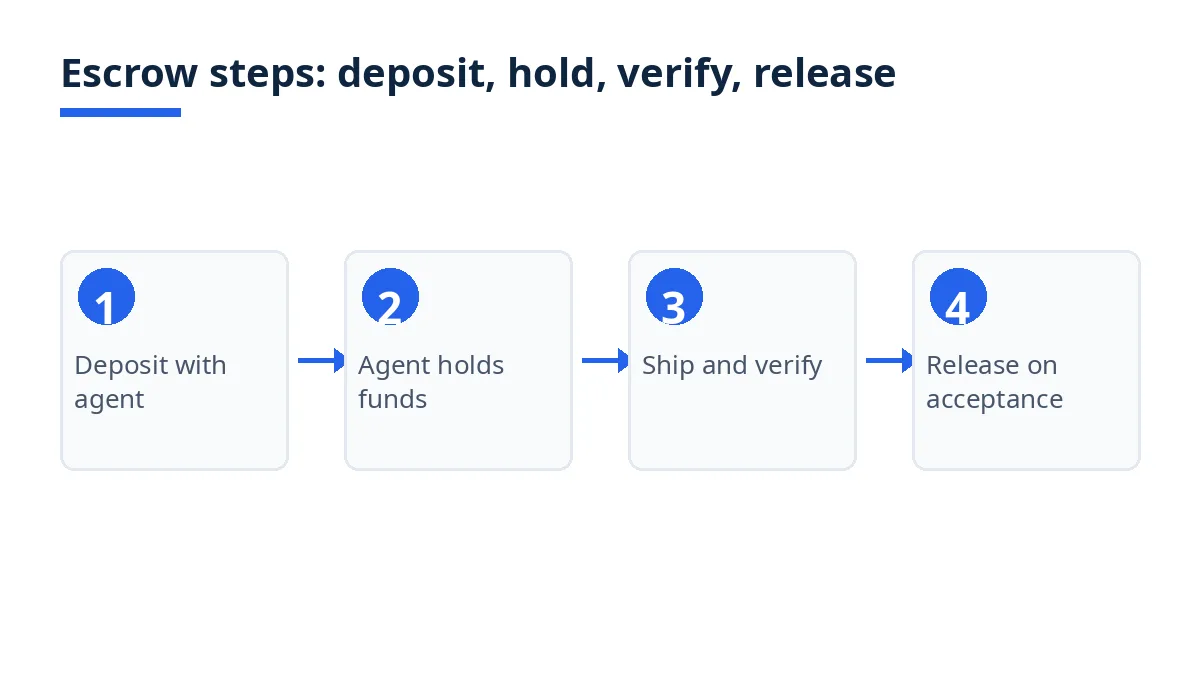
In this arrangement the buyer does not pay the seller directly at the start, and the seller does not ship on an unpaid promise. The buyer deposits the amount with an independent escrow agent, the agent holds it, and the seller ships after the deposit is confirmed.
An escrow service is described in trade guidance as a trusted third party that collects, holds and disburses funds according to exporter and importer instructions, with funds released after delivery and an inspection period.1 A law firm description states that funds remain in the custody of an independent escrow agent, who disburses them solely under the agreed instructions.2 The agent is not a guarantor of quality, so vague conditions produce weak protection.
Why this matters for buyers and sellers
For a buyer, escrow addresses the risk of paying in full before goods exist or ship. An advance payment leaves the buyer exposed if the seller fails to ship, ships the wrong goods, or stops replying. Escrow keeps payment out of the seller account until agreed evidence is in place, giving the buyer an inspection window and a route to object before release.
For a seller, escrow addresses the opposite risk: shipping to a new buyer with no payment security. A confirmed deposit shows funds are held for this order, subject to stated conditions. That differs from an open account, where the seller ships and waits for payment with no third party holding anything, and from a letter of credit, where a bank gives a written undertaking to pay against complying documents. Exportain's letter of credit guide defines a credit as a bank's written undertaking to pay a seller a stated amount, provided the seller presents documents that comply exactly with the credit terms.3 An escrow agent gives no such bank undertaking. Protection comes from the hold and the written conditions, not from a bank promise.
Escrow fits best where trust is still being built, the order value justifies a fee and extra paperwork, and both sides can agree on objective release evidence. It fits less well where goods cannot be inspected before release, or where the timeline is too tight for deposit, shipment, inspection, and release. The agent does not inspect goods unless the agreement names an inspector, a report, and a standard.
Step-by-step: how it works
Agree the transaction terms first. Record goods, specification, quantity, price, currency, shipment deadline, and delivery terms in the sales contract.
Choose the escrow agent together. Name the agent, its licence or regulatory status where applicable, the deposit account, and who bears the fee. Check the agent through a channel found independently, not only through a link the other party sent.
Sign a written escrow agreement. State the deposit amount, staged deposits if any, release conditions, inspection window, evidence for release, dispute route, governing terms, and what happens if a deadline passes with no action.
Deposit the funds with the agent. The seller should receive confirmation from the agent, not only from the buyer, that the deposit is held. One provider describes this sequence as agreed terms, buyer transfer into a holding account, seller shipment with tracking, buyer acceptance within a specified period, and release after acceptance.4
Ship and provide evidence. The seller ships within the agreed window and supplies the evidence named in the agreement, such as tracking, the transport document, and any required inspection report.
Inspect within the agreed window. The buyer checks goods or evidence against the specification, and either accepts in writing or objects in writing, with evidence, before the window closes. Silence at the end of the window must have a stated consequence: release, a hold pending review, or a dispute step.
Release, refund, or dispute. On acceptance, the agent releases funds to the seller. On a valid objection, funds stay held while the dispute route runs. No party should move funds alone outside the agreement.
Worked example
Example figures only, not an escrow offer and not a bank offer. A buyer in Poland buys handwoven jute rugs from a supplier in Bangladesh for USD 31,200. The parties agree a full deposit before shipment, shipment within 30 days of the confirmed deposit, and a 10-day inspection window after delivery. Release requires written acceptance, or the end of the window with no written objection. The seller ships after the agent confirms the deposit, the buyer inspects against the specification, accepts in writing, and the agent releases USD 31,200, less any fee split the agreement assigns.
If the buyer had objected within the window, funds would have stayed held while the dispute route ran. The agreement should state who decides, on what evidence, and by when, before deposit.
Costs, timelines and documents
There are no universal escrow charges or timelines. Every item below is a confirmation item to agree in writing, not a rate or a promise.
Item | Confirm before deposit |
|---|---|
Agent fee and fee split | Total fee, who pays it, whether deducted from payout or billed separately, and any dispute or conversion charge |
Deposit and release amounts | Full or staged amounts, currency, and account details verified through an independent channel |
Inspection window | Length in days, start event, end event, and the consequence of silence at the end of the window |
Release evidence | Shipment evidence, inspection report, acceptance wording, and who supplies each item |
Dispute route and cost | Negotiation period, arbitration or court route, governing terms, and who pays dispute costs |
Refund route | Conditions for a refund, deductions if any, destination account, and processing steps |
Agent failure plan | What happens to held funds if the agent becomes insolvent, loses its licence, or stops operating |
One trade guide notes that the escrow fee can either be paid in full by one party or split evenly between the exporter and the importer.1 Treat that as a negotiable split to record, not a standard rate. Provider fees, bank charges, and conversion charges are separate items, and each should appear in the agreement or in a written fee statement.
Timelines depend on the deposit method, shipment route, inspection method, and dispute route. Write each deadline as a calendar date or as days from a named event, and state what happens if the event is late. The documents for an escrow order are the sales contract, the escrow agreement, the deposit confirmation, the shipment evidence, and the inspection or acceptance record.
Bangladesh-specific rules and tips
Bangladesh Bank rules shape how the seller side is handled, even though escrow is a private agreement between buyer, seller, and agent. Confirm the Bangladesh side with the seller authorised dealer bank before depositing funds.
Bangladesh Bank's consolidated export-trade circular, issued to authorised dealer banks, states that greater care should be taken particularly in cases of shipments against contract alone and shipments on a CAD or DA basis, with discreet inquiries into the bona fides and credentials of buyers abroad where necessary.5 That passage is about collections and contract shipments, not escrow, but it signals why a seller bank may ask about the buyer and the payment route. Answer through the buyer bank where possible.
The same circular states that the prescribed period for repatriating export proceeds is four months.5 A dispute that freezes funds while the seller export clock runs can create a reporting problem for the seller. Agree dispute deadlines inside the seller repatriation timetable, and ask the seller bank how a release is reported and received. The circular opened for this guide contains no escrow-specific procedure, fee, or timeline, so no escrow figure here is a Bangladesh Bank rule. Ask the seller to confirm its bank can receive the release in the agreed currency.
Mistakes and red flags
The most common escrow mistakes are agreement gaps, not payment technology failures. Each gap below is avoidable before deposit.
Signing an agreement that names no agent, no account, and no release conditions, and treating a payment link or email promise as the agreement.
Accepting an inspection window that starts before the buyer can inspect, or ends with no stated consequence for silence.
Naming release evidence the seller cannot produce, such as a report from an inspector who has not been appointed.
Leaving the dispute route blank, so a disagreement freezes funds with no decision maker and no deadline.
Ignoring agent neutrality and solvency: an agent controlled by one party, or holding funds in its own operating account, is not a neutral hold.
Verifying account details only from a document supplied by the other party, which is how payment-redirection fraud operates.
Assuming the agent inspects goods, guarantees quality, or covers a seller failure beyond holding and releasing funds under the agreement.
Failing to confirm Bangladesh bank handling, so a release arrives in a form the seller bank cannot accept or report.
Red flags include pressure to deposit before the agreement is signed, an agent that cannot be checked independently, a fee that changes after deposit, a release condition based on one party private judgement with no evidence, and any request to send funds to a personal account or an account in a different name from the named agent.
Disputed release, agent neutrality, and governing terms
A disputed release is the escrow failure mode with no equivalent in a simple bank transfer. When the buyer objects and the seller rejects the objection, funds should stay held, and the agreement must state the next step. One provider describes a dispute process in two 14-day periods, a negotiation period followed by an arbitration commencement period, for its own service.6 That timetable is provider-specific, not a universal rule. Your agreement may use a different route, but it must name one, with deadlines and a decision maker. Agent neutrality means the agent follows the agreement, not the louder party.2 Ask how funds are segregated, what happens if the agent fails, and which law governs the agreement.
Checklist
Use this checklist before depositing funds with any escrow agent for an order from Bangladesh.
Sales contract and escrow agreement signed, with matching goods, amount, currency, and shipment deadline.
Escrow agent named, independently checked, and confirmed as the holder of the deposit account.
Release conditions written as objective evidence, with an inspection window, a start event, and a consequence for silence.
Fee split, dispute route, governing terms, refund conditions, and agent failure plan all written in the agreement.
Seller authorised dealer bank confirms it can receive and report the release in the agreed currency and account.
Dispute and inspection deadlines aligned with the seller repatriation and reporting timetable.
Account details verified through an independent channel, not only through a message from the other party.
No party can release, refund, or redirect funds alone outside the written agreement.
How Exportain helps
Exportain helps buyers structure the commercial side of an order before payment terms are chosen: post a sourcing requirement, compare quotations on the same terms, and keep agreed price, specification, and payment terms in a recorded quotation history. The buyer protection page states that payment for goods is settled directly between buyer and supplier on the accepted quotation terms, unless both agree to a funds hold.7 That funds hold is a platform mechanism described on Exportain's own pages, and it is not the same thing as the independent third-party escrow described in this guide. An Exportain funds hold follows Exportain terms and a supplier request, while an independent escrow follows a separate agreement with a separate agent.
Exportain's payment terms page describes the same distinction: money for a service order is held by Exportain, while money for an order in goods is held only under a funds hold that the supplier requests and the buyer pays.8 This guide does not claim that Exportain itself offers a goods-trade escrow service, because the live Exportain pages opened for this guide do not describe one in those words. If you want an independent escrow for a goods order, arrange it as a separate agreement with a named agent, and record the payment terms in the quotation.
Post your requirement through the Exportain RFQ route at https://exportain.com/rfqs and state that you are considering an escrow arrangement, so suppliers can confirm whether they will work with a named agent.
FAQs
What should I know first about escrow payment?
Know that escrow is a hold, not a promise about quality. A neutral third party holds the payment and releases it only when the written conditions in the escrow agreement are met.2 Before depositing, confirm the agent, the account, the fee split, the inspection window, the release evidence, and the dispute route, and check the agent through an independent channel.
What are the typical costs and timelines?
There are no typical escrow costs or timelines that apply to every order, and no figure in this guide should be treated as a standard rate. Confirm the agent fee and fee split, deposit method, shipment route, inspection window, and dispute timetable in writing for your order. A trade guide notes that the fee can be paid in full by one party or split between the parties,1 but the amount, the payer, and any dispute or conversion charge must be stated for your transaction.
Which documents are needed?
You need a sales contract, a signed escrow agreement, a deposit confirmation from the agent, shipment evidence, and an inspection or acceptance record. The escrow agreement controls release: it must name the agent, the amount, the release conditions, the inspection window, the dispute route, and the refund conditions. Keep goods description, amount, and currency identical across the contract, the agreement, and the shipment documents.
What are the most common mistakes?
The most common mistakes are signing without written release conditions, accepting an inspection window with no consequence for silence, leaving the dispute route blank, and ignoring agent neutrality and solvency. Other errors are verifying account details only from the other party, assuming the agent inspects goods, and failing to confirm Bangladesh bank handling. Work through the checklist before depositing.
Next steps on Exportain
For the bank-undertaking alternative, read the letter of credit guide at https://exportain.com/blog/lc-letter-of-credit. For how Exportain's own payment terms describe service-order holds and goods funds holds, read https://exportain.com/payment-terms. For the buyer protection measures that sit around a recorded quotation, read https://exportain.com/buyer-protection.
Sources
- What Are "Escrow Services" and How Can It Help My Business?. Specialty Equipment Market Association (accessed )
- Escrow Accounts: Security And Neutrality For Your Transactions. Mondaq, (accessed )
- LC Meaning (Letter of Credit). Exportain (accessed )
- How Escrow Works. Escrow.com (accessed )
- Consolidated circular on foreign exchange regulations — export trade transactions (FEPD-1 Circular No. 26, July 30, 2026). Bangladesh Bank (accessed )
- Escrow Disputes. Escrow.com (accessed )
- Buyer protection: What Exportain does to protect buyers. Exportain (accessed )
- Payment and Membership Terms. Exportain (accessed )
About the author
Sourcing from Bangladesh?
Post a request for quotation and suppliers on Exportain can send you their quotes directly.
Post an RFQ


