Using Export Development Fund (EDF) Financing When Buying From Bangladesh: Bank Rules and Tips
EDF financing is seller-side: Bangladesh Bank funds exporters' input imports through AD banks. What that means for buyers, its reported costs and tenor, and what it does not cover.
Short answer
EDF financing from Bangladesh Bank funds Bangladeshi manufacturer-exporters, through authorised dealer banks, to import production inputs behind export orders. It is not buyer financing and does not set the buyer's payment date, discount, or guarantee. Buyers should still fix the payment term, shipment date, quality standard, and inspection plan in the contract, and treat EDF availability as background to order capacity, not as payment protection.
On this page
Key takeaways
EDF financing is seller-side only: Bangladesh Bank funds Bangladeshi manufacturer-exporters, through AD banks, to import production inputs behind export orders. It is not buyer financing, does not set the buyer's payment date or discount, and does not guarantee shipment or quality.
As reported in July 2026 news reports of the master circular, AD-bank refinancing is six-month SOFR plus 0.5 percent and exporter lending is six-month SOFR plus 1.5 percent, with a standard tenor of 180 days extendable to 270 days with Bangladesh Bank approval. No fixed rate is asserted as a current fact because SOFR moves.
Exporters with overdue export proceeds are reported as barred from further EDF financing until proceeds are realised or the delay is exempted, so buyers should keep payment documents consistent and agree any extension in writing through the proper bank channel.
Example figures only: a US$120,000 buyer order with US$60,000 of imported inputs shows EDF funding supporting input purchase and repayment from export proceeds, without changing the buyer's payment, the letter of credit trigger, or the price.
The most important fact about Export Development Fund (EDF) financing comes first, because the usual buyer reading gets the direction wrong. The Bangladesh Bank Export Development Fund finances Bangladeshi exporters, not foreign buyers. It gives manufacturer-exporters foreign currency funding, through authorised dealer (AD) banks, to import raw materials and other production inputs behind export orders. It is seller-side working-capital support. It is not buyer financing, not a payment method, and it does not set the buyer's payment date, give the buyer a discount, or guarantee quality, shipment, or delivery.
A buyer therefore cannot apply for EDF funding. The useful questions are whether the exporter can fund inputs on time, what happens if funding is delayed, and what payment protection the buyer still needs. EDF funding can support order capacity and pricing stability, because an exporter that can buy inputs without tying up its own foreign currency may confirm an order, hold a price, and start production sooner. It does not replace the payment term.
Bangladesh Bank lists FEPD-1 Circular No. 24, Master Circular on Export Development Fund, dated 23 July 2026, in its circular index.1 News reports dated 23 and 24 July 2026 describe it as a consolidation of earlier instructions into a single framework, replacing FE Circular No. 45 of 2017 and later directives.2 3 The full circular text was not opened through the download link on the circular index during preparation, so figures below are labelled as reported in those July 2026 news reports, not as circular wording. Confirm any figure with the exporter's AD bank, because a benchmark moves and a limit is applied case by case.
Why this matters for buyers and sellers
For the seller, EDF funding addresses a timing gap. A manufacturer-exporter often must pay for imported fabric, yarn, accessories, chemicals, or other inputs before receiving export proceeds. Foreign currency funding lets production start without waiting for payment for goods that do not yet exist. For the buyer, the benefit is indirect: input funding can protect the start date, reduce pressure for a larger advance, and reduce the chance that a quoted price is reopened. News reports state that financed inputs must comply with value-addition requirements and the import policy order.4
If funding is refused, delayed, or capped, the exporter may ask for a larger deposit, shorter payment terms, a price change, or a later shipment date. News reports state that exporters with overdue proceeds are barred from further EDF financing until those proceeds are realised or the delay is exempted by the Discount Committee.3 4 A buyer will not normally see that bank position, so the contract should still carry its own shipment date, quality standard, inspection right, and payment trigger. Ask which inputs are imported and what happens to the shipment date if funding is not approved.
Each other tool answers a different question. A letter of credit is a bank undertaking to pay the seller against complying documents, and it governs how the buyer pays, not how the seller funds inputs.5 Packing credit, or pre-shipment finance, is a separate pre-shipment facility, not EDF funding. A telegraphic transfer, commonly sent by MT103, is a direct bank payment with no EDF element. Documents against payment means the buyer pays to obtain shipping documents, while documents against acceptance means the buyer accepts a time draft to obtain them, and neither funds input imports. Open account means the buyer pays after shipment on agreed terms, with no bank undertaking or input funding. Factoring means a seller sells its receivables, a post-shipment choice, not EDF input funding.
Step-by-step: how it works
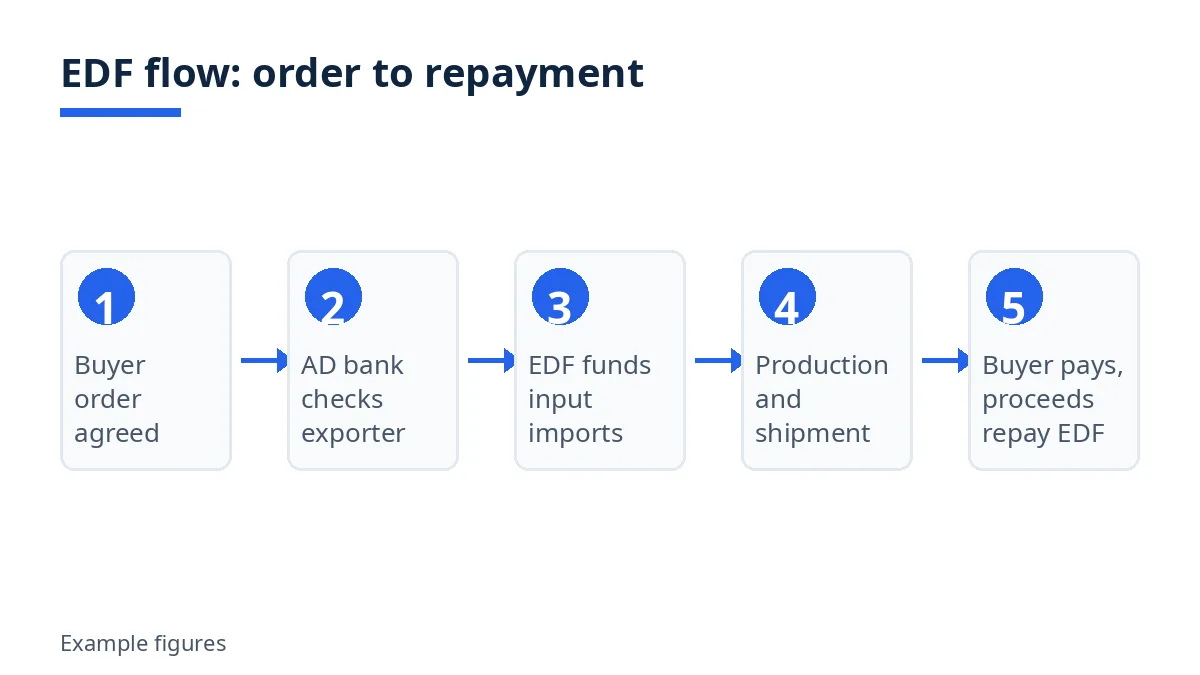
The flow follows the seller side. The buyer appears at the start, with the order, and at the end, with payment under the contract term, but the EDF steps belong to the exporter and its AD bank.
First, buyer and exporter agree the order in writing: goods, specification, quantity, price, delivery term, shipment date, quality standard, inspection arrangement, and payment term. Second, the exporter identifies which inputs must be imported, and whether they are covered by a back-to-back letter of credit, a bulk import arrangement, or another eligible route, including back-to-back letters of credit for direct exports and local supplies of intermediate goods as reported.4 Third, the exporter applies through its AD bank on a standardised Form-A with electronic calculation worksheets, with deemed-exporter eligibility verified before refinancing is sought.2 The buyer does not file or sign this application. Fourth, the AD bank disburses foreign currency funding, or seeks refinancing from Bangladesh Bank, whose Forex Reserve and Treasury Management Department-1 administers the fund as reported; AD banks may also use their own resources, including up to 50 percent of Non-Resident Foreign Currency Deposit balances as reported.2 Fifth, the exporter imports inputs, manufactures, and ships by the contracted date, with buyer protection coming from the contract, inspection plan, and shipping documents. Sixth, the buyer pays under the agreed term, proceeds are repatriated, and the EDF loan is repaid from those proceeds.
Worked example (example figures only). A buyer orders 20,000 cotton shirts for an example US$120,000, payable by letter of credit at sight against shipping documents. The exporter needs imported fabric and accessories worth an example US$60,000, obtains EDF-backed funding for those inputs through its AD bank, manufactures, and ships on time. The buyer pays US$120,000 on complying documents, proceeds are repatriated, and the EDF loan for the US$60,000 input value is repaid from those proceeds. EDF funding never changes the buyer's payment, the letter of credit trigger, or the price. If funding had been refused, the exporter would have needed another way to buy the fabric, or a revised shipment date agreed in writing.
Costs, timelines and documents
Costs first, with attribution explicit. News reports of the July 2026 master circular state Bangladesh Bank refinances AD banks at six-month Secured Overnight Financing Rate (SOFR) plus 0.5 percent per year, and AD banks may lend to exporters at six-month SOFR plus 1.5 percent per year.3 4 An additional 1 percent per year may be charged for the period between import payment and receipt of refinancing, as reported.2 Those spreads are reported figures, not a fixed rate that can be quoted today, because SOFR moves. No fixed EDF rate is asserted here as a current fact, and an older fixed-rate figure from before July 2026 should not be used now. Ask for a dated AD-bank indication of benchmark, spread, and interim charge, and treat it as background unless reflected in the quoted price.
Timelines are reported the same way. News reports state a standard tenor of 180 days, extendable to 270 days with Bangladesh Bank approval, with extension applications submitted at least 10 days before maturity and signed by an official not below deputy managing director rank.3 4 Those figures describe the EDF loan, not the buyer's payment term, and do not extend shipment, inspection, or payment dates unless the contract is amended.
Limits are sector-based and reported, not uniform. News reports state ceilings of US$20 million for garment and textile mills association members, US$15 million for knitwear and linen/flax association members, US$10 million for several other sectors, and US$5 million for frozen food exporters, with smaller limits of US$1 million to US$2 million also prescribed.2 News reports also state a US$500,000 facility for eligible bulk imports regardless of sector, capped at the lower of prior-12-month import performance or US$500,000, with an exporter using both bulk and back-to-back facilities restricted to one association ceiling.3 6 Eligibility and the eligible input value are usually the binding questions.
Documents split by party. The exporter and its AD bank handle the EDF application, Form-A and worksheets, input import documents, and export-proceeds documentation. The buyer handles the purchase order or sales contract, specification and quality standard, payment instrument where used, inspection instruction, and import documents for its own country. A buyer should not sign an EDF application or guarantee the EDF loan without separate legal advice, and should not accept a clause making payment conditional on EDF approval.
Bangladesh-specific rules and tips
The July 2026 framework, as reported, ties EDF access to proceeds discipline. Exporters that fail to repatriate proceeds within the statutory 120-day period become ineligible until overdue proceeds are realised or the delay is exempted.2 4 Exporters whose EDF liabilities were settled through funded facilities are likewise reported as ineligible until regularised.3 AD banks that fail to repay on time are reported as barred from further refinancing until overdue liabilities are cleared.2 A buyer cannot check another company's repatriation record, but can reduce exposure by paying on the contracted date, keeping documents consistent, and avoiding informal extensions without a written, bank-aware plan.
Islamic banks are reported as able to access EDF funding through deal-to-deal Restricted Mudaraba Agreements, with equivalent compensation for overdue amounts under Shariah principles, while penal interest of four percentage points above the prevailing rate is reported for overdue conventional loans.2 If the exporter banks with an Islamic bank, its funding structure may differ, but the buyer's contract, shipment date, and payment term should not change. Three tips follow: confirm the input story in plain terms, without asking for bank statements; keep shipment, inspection, presentation, and payment dates each stated in the contract; and test any claim that EDF funding makes an order cheaper, faster, or safer against the contract, so a real saving appears in price, shipment date, or payment term, in writing.
Mistakes and red flags
The first mistake is the direction error this guide opens with: treating EDF funding as buyer finance, a discount, or a payment option. If a seller offers a buyer EDF financing, that offer is mislabelled; ask in writing what facility is actually offered, from which bank, and on what terms. The second mistake is leaving the payment term vague because EDF funding was mentioned. A contract that says payment follows EDF approval leaves the buyer without a fixed payment trigger. State the payment term, shipment date, and the consequence of missing either date.
The third mistake is assuming a large ceiling means a large order is fundable. Ceilings are sector maxima, not approvals for one order. The fourth mistake is ignoring proceeds discipline: late payment, inconsistent documents, or informal extensions can contribute to overdue proceeds. Keep documents consistent and agree any extension in writing through the proper bank channel. Red flags include a request for the buyer to sign EDF papers or guarantee the loan, a price said to depend on EDF approval without a written breakdown, a shipment date that moves whenever EDF timing is mentioned, and a refusal to state the payment term separately. Any of those should pause the order until the contract is rewritten plainly.
Checklist
Confirm in writing that EDF funding is seller-side and does not change the buyer's payment date, discount, or guarantee.
Record the order completely: goods, specification, quantity, price, delivery term, shipment date, quality standard, inspection plan, payment term.
Ask which inputs are imported, and what happens to shipment if funding is delayed or refused.
Ask for a dated AD-bank indication of benchmark, spread, and interim charge, for background only.
Check the payment term stands on its own, with its own trigger and date.
Confirm inspection and document plans separately from funding discussion.
Agree in writing how missed shipment, missed payment, and disputed documents are handled, without reference to EDF approval.
Keep order, invoice, packing list, transport document, and payment instruction consistent.
Do not sign EDF applications or guarantees, or make payment conditional on EDF approval, without legal advice.
File the exporter's answers with the order, and revisit them if price, shipment date, or payment term changes.
How Exportain helps
Exportain helps on the commercial side of the order, not on the EDF facility. A buyer can post a request for quotation, compare quotations, and keep accepted terms in a recorded quotation trail, including unit price, minimum order quantity, lead time, delivery term, payment terms, and validity date.7 Fix shipment date, inspection plan, and payment trigger in that record, so a later EDF discussion does not quietly change them. Exportain does not arrange EDF funding, assess eligibility, or act as a party to the buyer-seller contract.7
Exportain's payment-terms and buyer-protection pages describe a different mechanism. Those pages describe funds holds: a supplier may ask a buyer to place a funds hold, Exportain holds the paid amount until the supplier files an export clearance document and the buyer confirms the trade complete, and a dispute freezes the amount for a staff decision.8 7 A funds hold is a platform payment arrangement for one order. It is not EDF funding, does not fund input imports, and does not change the exporter's AD-bank standing. Agree a funds hold and a payment term separately, in writing.
FAQs
What should I know first about EDF financing?
Know the direction first. EDF financing is foreign currency funding for Bangladeshi manufacturer-exporters to import production inputs, channelled through AD banks against export orders. It supports seller input procurement. It is not buyer financing, does not set the buyer's payment date or discount, and does not guarantee shipment or quality. Buyer protection still comes from the contract, payment term, inspection plan, and shipping documents.
What are the typical costs and timelines?
No fixed EDF rate is stated here as a current fact, because the July 2026 framework as reported uses a moving benchmark. News reports state AD-bank refinancing at six-month SOFR plus 0.5 percent and exporter lending at six-month SOFR plus 1.5 percent, with a possible additional 1 percent for the interim period.2 3 News reports state a standard tenor of 180 days, extendable to 270 days with Bangladesh Bank approval.4 Confirm benchmark, spread, and tenor with the AD bank, and keep the buyer's payment date separate from the EDF tenor.
Which documents are needed?
The EDF application, Form-A, and calculation worksheets belong to the exporter and its AD bank, with input import and export-proceeds documents.2 The buyer needs the commercial set: purchase order or sales contract, specification and quality standard, payment instrument where used, inspection instruction, and import documents for its own country. The buyer should not sign EDF papers or guarantee the EDF loan, and should not make payment conditional on EDF approval.
What are the most common mistakes?
Treating EDF funding as buyer finance or a discount, leaving the payment term vague, assuming a sector ceiling guarantees funding for one order, and letting funding timing move the shipment or inspection date. Avoid those errors by fixing payment term, shipment date, quality standard, and inspection plan in the contract, and treating any EDF statement as background unless reflected in price or dates in writing.
Next steps on Exportain
Start with the payment term that will govern the order. Compare a bank undertaking against documents with the terms in this guide, and check platform terms before agreeing a funds hold: Letter of Credit guide, Payment terms, and Buyer protection. Then fix the order in writing: specification, shipment date, inspection plan, and payment trigger.
Sources
- Bangladesh Bank circular index: FEPD-1 Circular No. 24, Master Circular on Export Development Fund, 23 July 2026. Bangladesh Bank (accessed )
- Cenbank tightens EDF eligibility for overdue borrowers. The Business Standard, (accessed )
- BB tightens EDF lending rules. The Financial Express, (accessed )
- BB allows EDF loan repayment tenure extension up to 270 days under new Master Circular. United News of Bangladesh (accessed )
- LC Meaning (Letter of Credit). Exportain (accessed )
- Bangladesh Bank Issues Master Circular for Export Development Fund to Simplify Export Financing. Voice7 News, (accessed )
- Buyer protection: What Exportain does to protect buyers. Exportain (accessed )
- Payment and Membership Terms. Exportain (accessed )
About the author
Sourcing from Bangladesh?
Post a request for quotation and suppliers on Exportain can send you their quotes directly.
Post an RFQ