

Duvet Covers Lead Time From Bangladesh: Production and Shipping Timeline
Duvet covers lead time from Bangladesh: shell weave, fill weight and warmth rating, baffle construction, size and loft, closure and corner ties, labeling, and vacuum or rolled packing gates, with example timelines and documents.
Short answer
A duvet cover order is a two-piece order: the cover is the washable sleeve and the insert is the filled layer. Approve shell weave, fill weight with fill power and warmth rating, baffle construction, size and loft on a filled pair, closure and corner ties, labeling, and vacuum or rolled packing in that order. Every duration is an illustrative example only; replace it with the written quote and dated forwarder estimate.

On this page
Key takeaways
A duvet cover order is a two-piece order: approve the cover shell and the insert shell, fill, baffle construction, size and loft, closure and corner ties, labeling, and packing as separate gates, in that order, before bulk starts.
Fill weight alone does not fix warmth: state fill weight in gsm together with fill power where it applies and the warmth rating the order must meet, and check the sample against that rating.
Baffle box construction uses internal fabric walls to create compartments that let fill loft and stay distributed, while stitched-through seams compress fill and can leave thin spots; check distribution across the full surface of a finished insert.
Vacuum or rolled packing changes carton volume and the freight basis, so agree the packing method, compressed dimensions, and carton marking in writing, and pass a loft recovery check after opening before bulk packing.
Goods must not load until the Bill of Export or Shipping Bill is approved, with the commercial invoice, packing list, EXP form certified by authorized dealers, and certificate of origin enclosed; confirm each document owner and gate date early.
A duvet cover order is a two-piece order, and that is where its schedule usually slips. The cover is the washable sleeve that sits against the sleeper, and the insert is the filled layer that provides warmth. A duvet cover is a removable, washable fabric sleeve that encases a duvet insert, and the two pieces work together: the insert provides warmth while the cover provides style and hygiene.1 When a buyer specifies only the cover print or only the insert weight, the pair can arrive mismatched: a cover compressing the fill, a loose corner, or a label describing a wash method the pair cannot survive. This guide reads a duvet cover order through approval gates. Every duration here is an illustrative planning example only, or an item to confirm in the written quote and the dated forwarder estimate.
Why this matters for buyers
A duvet cover order fails in places that a flat sheet order never reaches. The cover must fit the insert, not just the mattress. A cover bought to match the mattress can still fail if the insert inside it is larger: a smaller cover compresses the fill, while a much larger cover leaves the insert swimming inside it.1 The insert side carries its own failure points: fill drifting to the corners, a baffle wall too low to loft, or a shell weave trapping heat. Shell and fill decide warmth, size and closure decide alignment, and labeling and packing decide market clearance in the volume the freight quote assumed.
Step-by-step: how it works
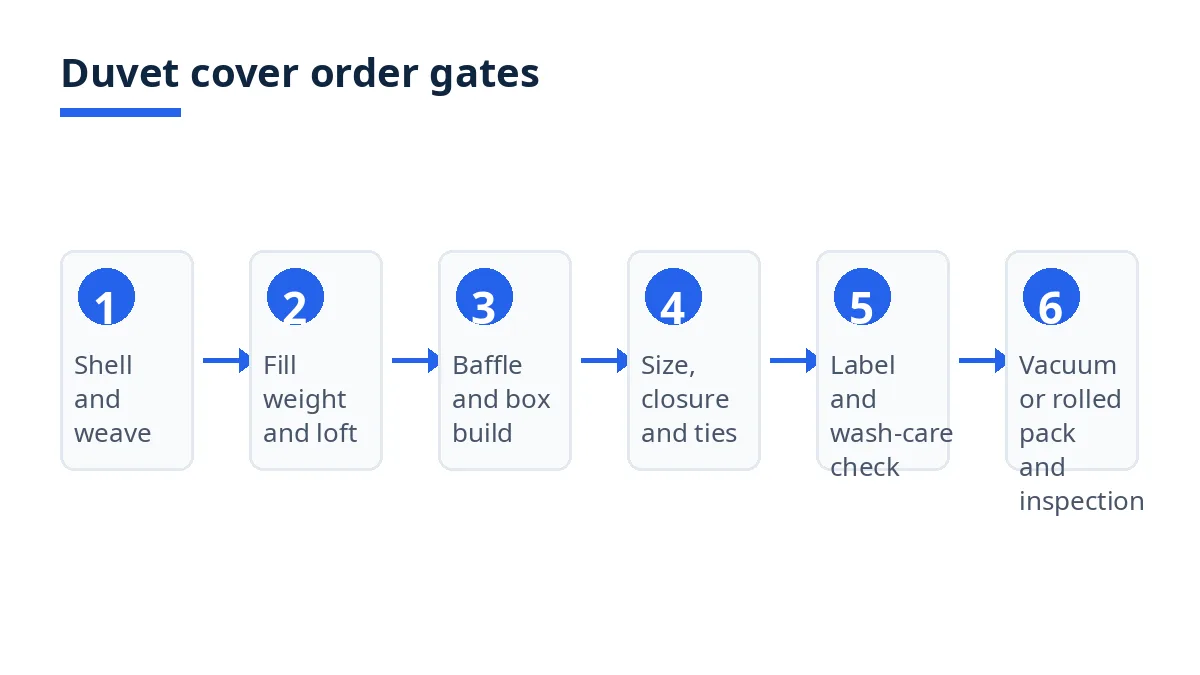
Read a duvet cover order against seven gates, in this order.
Gate 0: Shell fabric and weave
Gate 0 fixes the shell fabric and weave for the cover and for the insert shell, before any fill weight or color is approved. Percale gives a crisp, cool, matte surface, sateen gives a smoother surface with a slight sheen, and linen gives visible texture.1 For the insert shell, weave also controls air movement and fill containment: a tightly woven cotton sateen can block airflow and create a damp, warm microclimate under the duvet, while a cotton percale allows more air exchange and feels crisper.2 Most hotel down duvets use a cotton or cotton-blend shell with a downproof weave, which stops feathers from escaping but also determines breathability.2 Gate 0 closes when the buyer states, in writing, the fiber, weave, and thread count for each shell, checked on a finished sample.
Gate 1: Fill weight, fill power, and warmth rating
Gate 1 approves fill weight, fill power, and warmth rating as three separate items. Fill power measures loft, or how many cubic inches one ounce of down occupies, and a higher fill power means larger clusters and more loft per ounce.3 Fill weight is the actual amount of down inside the duvet, measured in grams per square meter (gsm), and that number directly controls total heat output.2 A 700-fill duvet can be warmer than a 550-fill duvet at the same weight, but a lighter 700-fill duvet can also be cooler, so neither number alone fixes warmth.2 The Tog rating measures thermal resistance, on a scale from 1 to 15, where a higher number indicates a warmer duvet, and it measures warmth, not weight.3 A rating between 2.5 and 4.5 suits summer use, 7.0 to 10.5 suits spring and autumn, and 12.0 to 13.5 suits colder winter nights.3 For non-down fills, the buyer states the fill material and its weight in gsm, plus the warmth rating the order must meet.
Gate 2: Baffle and box construction and fill distribution
Gate 2 approves how the fill is held in place. In baffle box construction, internal fabric walls, or baffles, are sewn between the top and bottom layers of the shell, creating three-dimensional compartments that allow the filling to expand fully, maximize loft, and prevent shifting or clumping.3 That even distribution removes cold spots where the material is compressed.3 In stitched-through construction, the top and bottom layers are sewn directly together in a grid pattern, which secures the filling but compresses it at the seams, reduces loft, and creates thin spots where heat can escape.3 Gate 2 fixes, in writing and on a marked sample, the construction type, compartment size, and baffle height, plus fill per compartment, and closes only with a full-surface check of a finished insert after shaking out.
Gate 3: Size, loft, and overhang checks
Gate 3 approves size as a measurement system, not as a size name. Duvet covers are sized to the insert, not the mattress, and the cover should be the same size as the insert or up to 2 inches larger in either dimension.1 A UK king and a US king are not the same size, so a buyer ordering across regions must match by centimeter dimensions, not by the size name.1 For overhang, a duvet that extends at least 12 inches longer and 16 inches wider than the mattress gives adequate overhang, and a deeper mattress needs a wider duvet to keep that overhang on the sides.3 Gate 3 closes when the buyer states, in writing, the finished cover and insert dimensions in centimeters, the loft height at rest, and the overhang on the stated mattress depth, checked on a filled pair.
Gate 4: Closure type and corner ties
Gate 4 approves the closure and the corner anchoring as one system. A duvet cover is a fabric envelope with a closure at one end, usually buttons, ties, or a zipper, and an opening through which the insert slides.1 Internal corner ties are loops sewn inside the cover that tie to corner loops on the insert, and they keep the insert aligned inside the cover.1 Buttons last longest among the closure options, while zippers can break sooner, and ties stay aligned through washing.1 Gate 4 fixes, in writing and on a finished pair, the closure type, position, corner tie placement, and tie length, and closes only when the pair, fitted, shaken, and refitted, still holds its corners with the closure closing flat.
Gate 5: Wash-care labeling as a buyer-spec item
Gate 5 fixes the wash-care labeling wording for the pair. Products for export should carry labels with the required information, such as size, material composition, care instructions, and country of origin.4 The label set must state the fiber content of the cover and of the insert shell and fill separately where they differ, the size in the destination market format, the care method the pair can survive, and the origin marking the destination market requires. Gate 5 closes when label wording, position, and care symbols are approved in writing and checked on a finished, filled, closed pair. A care method suiting the cover alone can still damage a down or wool insert.
Gate 6: Vacuum and rolled packing, inspection, and loading
Gate 6 runs bulk production only after Gates 0 to 5 have closed, and it ends with packing, inspection, and loading. Vacuum and rolled packing is a stage in its own right, because it changes carton volume, carton weight, and the freight basis. The buyer states, in writing, whether each pair ships flat, rolled, or vacuum-compressed, the pairs per polybag and per carton, the rolled or compressed dimensions, and the carton marking. Final inspection measures packed pairs against the approved samples, and failures stay out of the cartons. It includes a recovery check on a vacuum or rolled sample: opened, shaken out, and laid flat, its loft and distribution are checked again, since a pair packing small but staying flat has failed Gate 6.
Costs, timelines and documents
The table below is a stage framework only.
Stage | Illustrative planning example only | Gate that closes the stage |
|---|---|---|
Shell fabric and weave | Illustrative example: 1 to 2 weeks | Gate 0 approved |
Fill weight, fill power, and warmth rating | Illustrative example: 1 to 2 weeks | Gate 1 approved |
Baffle and box construction and fill distribution | Illustrative example: 1 to 2 weeks | Gate 2 approved |
Size, loft, and overhang checks | Illustrative example: 1 week | Gate 3 approved |
Closure type and corner ties | Illustrative example: 1 week | Gate 4 approved |
Wash-care labeling | Illustrative example: 1 week | Gate 5 approved |
Bulk, vacuum or rolled packing, inspection, and loading | Illustrative example: 3 to 4 weeks | Gate 6 approved |
Documents and transit | Confirm in the dated forwarder estimate | Documents complete |
A worked example shows how the gates change a date. A percale pair with a baffle box insert arrives with fill thin at one edge, a cover compressing the insert at the corners, and a zipper pulling the cover out of shape. Gates 2, 3, and 4 stay open until the compartments are rebalanced, the dimensions are corrected, and the closure is re-approved on a filled pair. Then the vacuum-packed sample stays flat after opening, so Gate 6 stays open for a revised compression level.
For cost reading, use example figures only to compare quotes, and replace them with the written quote before planning. Illustrative example only: a single shipment at USD 19,800 on one delivery term, USD 1,420 for ocean freight, and USD 260 for marine insurance.
The document set gates loading and clearance. Export documentation for garments from Bangladesh includes commercial invoices, packing lists, bill of lading or air waybills, export declaration forms, and certificates of origin.4 Goods shall not be loaded for export unless an export declaration, known as the Bill of Export or Shipping Bill, is submitted in the prescribed format and approved by Customs, with the commercial invoice, packing list, EXP form certified by authorized dealers, and certificate of origin enclosed.5 Assign the correct Harmonised System codes for the goods.4 The Incoterms guide on Exportain explains the 11 rules and the split between cost and risk under each rule.6 Write the rule, named place, and edition together.
Bangladesh-specific rules and tips
Bangladesh-specific timing comes from the document chain as much as from production: the set must be complete before loading, and a buyer who treats loading as a factory date will misread the schedule. Confirm, in writing, who prepares each document and by which gate date, and confirm the EXP form and certificate of origin owners early, since both sit inside the Bill of Export set.5 The freight quote must also state whether it prices flat, rolled, or vacuum-compressed dimensions, and the packing list must match that basis. Fix label wording at Gate 5, before bulk cutting.
Mistakes and red flags
Approving shell weave without naming the fiber, weave, and thread count for the cover shell and the insert shell separately.
Approving fill weight with no fill power or warmth rating stated alongside it, or borrowing a down figure for a non-down fill.
Approving baffle construction on a diagram, with no full-surface fill distribution check on a finished insert.
Approving size by name, with no centimeter dimensions for cover and insert and no overhang check on a filled pair.
Approving a closure on an empty cover, with no fitted and shaken check of corner ties on a filled pair.
Approving label wording on a label sheet, with no check on a finished, filled, and closed pair.
Approving vacuum or rolled packing with no loft recovery check after opening.
Starting bulk before shell, fill, baffle, size, closure, and label wording are approved.
Treating a quoted delivery date as a loading date when the document set is not complete.
Checklist
Use this checklist before bulk starts.
[ ] Shell fiber, weave, and thread count approved for both shells, checked on a finished sample.
[ ] Fill material, fill weight in gsm, fill power where it applies, and warmth rating approved in writing.
[ ] Baffle construction and compartment size approved; fill distribution checked across the full surface.
[ ] Cover and insert dimensions in centimeters approved; loft and overhang checked on a filled pair.
[ ] Closure type and position approved; corner ties checked fitted and shaken on a filled pair.
[ ] Fiber content, size, care, and origin wording approved; labels checked on a filled, closed pair.
[ ] Packing method approved; pairs per carton, compressed dimensions, and carton marking agreed.
[ ] Loft recovery check passed on a vacuum or rolled sample after opening and laying flat.
[ ] Invoice, packing list, EXP form, certificate of origin, and shipping bill owners and dates confirmed.
[ ] Dated forwarder estimate received, replacing every illustrative planning example here.
[ ] Price validity period confirmed in writing on the quote.
How Exportain helps
Exportain gives buyers a place to put the gate table from this guide into a sourcing request, so each reply can be compared gate by gate rather than date by date. A buyer can list the shell, fill, baffle, size, closure, label, and packing points as requirements, and ask each seller to reply against them in writing.
FAQs
What should I know first about duvet covers?
Start with the two-piece order: the cover is the washable sleeve and the insert is the filled layer.1 Fix shell and fill first, then baffle construction, size and loft, closure and ties, labeling, and finally packing.
What are the typical costs and timelines?
Read costs and durations as a stage framework only. Every duration is an illustrative planning example, and every cost figure is an example figure for comparing quotes. Replace both with the written quote and the dated forwarder estimate before setting a selling date, and keep a buffer after baffle, size, and closure approval, and after the loft recovery check.
Which documents are needed?
The core set is the commercial invoice, packing list, bill of lading or air waybill, export declaration, and certificate of origin, with the EXP form certified by authorized dealers enclosed with the Bill of Export or Shipping Bill.5 Confirm who prepares each document and by which gate date, and confirm the Harmonised System codes before the packing list is finalized.4
What are the most common mistakes?
The most common mistakes are approving fill weight with no warmth rating, baffle construction with no full-surface check, size by name with no centimeter check, a closure on an empty cover, labels on a label sheet, and packing with no loft recovery check. Each reopens a gate.
Next steps on Exportain
Browse the Exportain suppliers page and compare replies gate by gate.
Read the Incoterms guide for shipments from Bangladesh before agreeing a delivery term.
Post the gate table as a requirement on the Exportain RFQs page and ask each seller to reply against each gate in writing.
Sources
- What Is a Duvet Cover? Complete 2026 Guide (Sizing + Materials). Or & Zon (accessed )
- Are Down Comforters Hot? A Hotel Buyer's Guide to Warmth, Weight & Fill. Hotel Bed Linen Supplier (accessed )
- Which Duvet Is Best? A Guide to Materials and Warmth. Engineer Fix (accessed )
- How to export garments overseas from Bangladesh. DHL (accessed )
- Customs Clearance Procedures for Export. Bangladesh Customs, National Board of Revenue (accessed )
- Incoterms for Shipments From Bangladesh. Exportain (accessed )
About the author
Sourcing from Bangladesh?
Post a request for quotation and suppliers on Exportain can send you their quotes directly.
Post an RFQ


