Dried Fish Exporters in Bangladesh: Verified Supplier Checklist
A pre-order supplier gate for dried fish from Bangladesh: 20 numbered checks across identity, drying and moisture evidence, salt and species declarations, storage and packing, and lot traceability, scored pass, conditional, or fail on an evidence file.
Short answer
Use this pre-order gate to score dried fish exporters in Bangladesh before any bulk order: check identity and capacity, drying method and moisture evidence, salt and additive declarations, species identity, storage and packing controls, and lot traceability, then release the order only on a scored trial lot.
On this page
A dried fish order usually fails before shipment, not after it. The species is wrong, the salt level is unstated, the lot arrives damp, or the cartons cannot be traced to a drying batch. This checklist turns that risk into a gate: a supplier passes only with documents and evidence in hand, and every gap is scored as pass, conditional, or fail before any bulk order is placed.
Why this checklist matters
Dried fish is a processed product, not a single-grade commodity. The same species name can cover different drying methods, salt levels, sizes, and moisture levels, each changing shelf life, taste, and price. A quotation naming only species and price leaves all of that open.
A scored gate changes the conversation. Instead of asking whether quality is good, you ask for the drying record, the moisture evidence, the salt declaration, and the lot code, and you record what came back. Suppliers who produce those items quickly show a working system; those who answer with assurances show a gap, and the gate lets you act on it: fix it, condition it with a deadline, or walk away.
Before you start
Write your specification on one page first: species by common and scientific name, presentation (whole, split, or fillet), drying method accepted, salt position and limit, size band, pack format, and destination market. Without it, two suppliers can pass while offering different products.
Note the destination market rules, label requirements, and broker documents. Dried fish falls under heading 0305 (fish dried, salted or in brine), with separate subheadings for dried fish other than cod and for salted fish not dried.1 Confirm the subheading with your broker, since it follows treatment, not trade name.
Agree who scores the gate: pass (evidence seen and matching), conditional (a named fix by a named date), or fail (order does not proceed). One person should hold the evidence file.
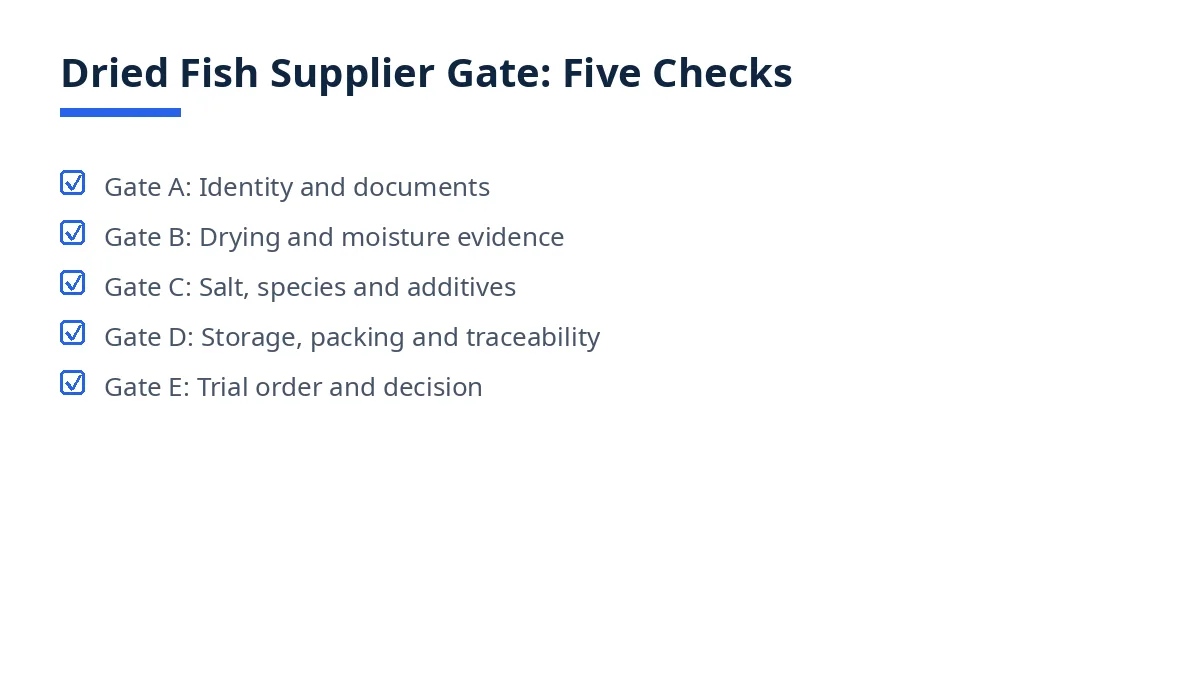
The full checklist (numbered, printable)
Gate A: Identity and capacity
Record the supplier legal name, trade licence, drying and packing site addresses, and whether it owns the drying site or buys from others.
Ask for export documents the supplier has used for dried fish before, and check the company name matches your contracting company.
Ask for drying and packing capacity in the supplier's own words (batch size, batch time, booking lead time) and orders already committed for the same period. Test the answers against the trial lot.
Confirm the minimum order quantity (MOQ) per species and pack format, and its basis: drying batch, pack run, or carton count.
Gate B: Drying and moisture
Ask the supplier to state the drying method in writing (natural open-air drying or mechanically circulated air drying, per the Codex standard for salted and dried salted fish)2 and a recent batch drying record.
Ask for moisture or water-activity evidence for the trial lot, naming the method. Set your limit in your specification.
Use product-specific benchmarks only as reference points: a Codex draft for dried salted anchovies caps water activity at 0.75 and sodium chloride at 15 percent dry basis.3 Those figures do not apply to every dried fish.
Check the trial lot on arrival for flexibility, breakage, and damp patches, and record the date and lot code.
Gate C: Salt, additives, species
Ask for a written salt declaration: salted or unsalted, the salt content or range, and whether the salt is food grade. Salt for salted fish should be clean and free from foreign matter and visible contamination.2
Ask for a written additive declaration, including preservatives and levels. That standard permits only sorbic acid and its sodium and potassium salts as preservatives, at a combined maximum of 200 mg/kg expressed as sorbic acid, for fish within its scope.2
Ask for species confirmation in writing, with common and scientific names, checked against the trial lot. Within that Codex standard scope, the label name must appear with the species name, and each container must hold one presentation from one species.2 Ask how mixing is prevented at the drying site.
Gate D: Storage and packing
Ask for storage controls in writing: storage between drying and packing, protection from insects and damp, and the fate of a lot showing mould, pink, or insect signs. The draft standard for dried salted anchovies requires freedom from visible fungal growth, insect infestation, spoilage odour or colour, and foreign matter.3
Ask for the packing specification: inner and outer materials, inner-pack moisture resistance, and carton sealing and marking. The same draft standard requires moisture-proof, gas-impermeable packing.3 Require the supplier to name the materials.
Ask for the carton marking plan: species, presentation, lot code, net weight, and manufacturer or packer name. Under that standard, food name, lot identification, and manufacturer or packer name and address must always appear on non-retail containers.2
Ask how a wet-season shipment is handled: extra drying, different inner pack, or delayed shipment, and who pays.
Gate E: Traceability and decision
Ask for lot traceability in writing: one lot code linking drying batch, packing run, and shipping cartons, with a post-shipment record. For bulk fishery products, European rules allow accompanying documentation to replace the identification mark.4
Ask whether the supplier can produce health or quality documentation for export, and from which authority. In Bangladesh, the Department of Fisheries enforces quality control and issues health certificates for exportable fish products.5
Place a trial order before any bulk order, sized to test drying, packing, marking, and arrival condition. Example figures: a 25 kg trial lot across two cartons from the same lot gives a packing check and a spare carton. Set your own trial size from your market and budget.
Score the trial lot against the specification, and file the score sheet with the moisture evidence, declarations, and carton photos. This is the evidence file for bulk release.
Make the decision in writing: pass, conditional, or fail. A conditional pass must name the fix, the proving evidence, and the checker; a missed condition becomes a fail. Agree bulk-order controls before release (lot code system, pre-shipment check, travelling documents, mismatch remedy) and write them into the purchase order.
Common failures and how to fix them
Failure | What it looks like | Fix in the gate |
|---|---|---|
Species or presentation not pinned down | Trade name only | Return to Gate C; require names plus presentation, then re-score |
Salt level unstated | Different salt expectations | Require the salt declaration in Gate C; set the limit in your specification |
Damp lot on arrival | Damp cartons or sticky fish | Fail Gates B and D; require fresh moisture evidence and revised packing |
Mixed lot | Two species or sizes in one carton | Fail Gates C and E; require single-species lots and a lot code per batch |
Cartons cannot be traced | No lot code or record | Fail Gate E; require the traceability record before release |
Capacity promised, not tested | Bulk order slips | Treat Gate A as conditional; test capacity on the trial lot dates |
Price moves after agreement | Price changes on clarification | Return to Gate A; record MOQ per species and pack format |
Downloadable template / summary table
Score each gate before release. A bulk order needs a pass in every gate, or a conditional pass whose conditions are closed and evidenced.
Gate | Evidence required | Pass | Conditional | Fail |
|---|---|---|---|---|
A. Identity, capacity, MOQ | Legal details, capacity, MOQ | All details consistent | One detail pending | Site unconfirmed |
B. Drying and moisture | Drying method and record, moisture evidence | Evidence meets specification | Fresh evidence due | No evidence |
C. Salt, additives, species | Salt, additive, species declarations | Declarations match your market | Declaration awaited | Position unknown |
D. Storage and packing | Storage controls, packing, markings | Cartons pass | Pack change re-tested | Mould, pests, or damp packing |
E. Traceability and decision | Lot code, score sheet, decision | Chain traced and scored | Condition with deadline | No traceability |
Your evidence file should hold your specification, supplier and site details, drying record, moisture evidence, declarations, species confirmation, packing specification, carton photos, lot code record, score sheet, and decision.
Compare prices only after the gate, on the same specification, recording species and size band, drying method, salt and moisture positions, pack format, MOQ, and timing.
How Exportain helps
Exportain supplier profiles show verification information for each supplier, and the supplier verification guide explains what each item covers. Read it before relying on a profile: badges reflect document and photo reviews, not factory inspections or guarantees. Exportain is not a party to the goods contract and does not inspect goods, book freight, or clear customs, so these checks remain the buyer responsibility.
Use the platform to shortlist suppliers, compare profile verification information, and send the same specification to each shortlisted supplier. Score every reply against the same gate and file it in the same evidence file. When a reply is incomplete, send the gate back with the missing items named.
FAQs
When should this checklist be used?
Use it before a first order, a new species or supplier, or a change of pack format, salt position, or market, while the order can still be changed or stopped.
Who should complete it?
The buyer, or its buying agent acting on written instructions, should complete it. The supplier supplies evidence but must not score its own gate. An agent should file the evidence file, including the decision, with the buyer.
What are the most common failures?
The most common failures are an unstated salt position, an unpinned species or presentation, moisture evidence missing the specification, untraceable cartons, and a price agreed before MOQ and pack format were fixed. Each is a documentation failure first, hence documents first.
Can a third party do it?
A third party can carry out the checks, including pre-shipment inspection, but the buyer should still set the specification, receive the evidence file, and decide. A third-party report is only useful when scored against your specification and filed by lot code, and mapped to your gate if it uses its own standard.
Next steps on Exportain
Browse Bangladeshi suppliers and filter dried fish listings by the verification information shown. Before relying on a profile, read how supplier verification works on Exportain. Then post your specification as a free RFQ through RFQs, score replies against the gate, and use the minimum order quantity guide for order size.
Sources
- Classification Detail — HS Code 0305. United Nations Statistics Division (accessed )
- Standard for Salted Fish and Dried Salted Fish of the Gadidae Family of Fishes (CXS 167-1989). Food and Agriculture Organization of the United Nations (accessed )
- Proposed draft standard for dried salted anchovies (Codex, at Step 5). Food and Agriculture Organization of the United Nations (accessed )
- Regulation (EC) No 853/2004 laying down specific hygiene rules for food of animal origin. European Union (accessed )
- About the Department of Fisheries (Bangladesh). Department of Fisheries, Bangladesh (accessed )
About the author
Sourcing from Bangladesh?
Post a request for quotation and suppliers on Exportain can send you their quotes directly.
Post an RFQ