

Using Documents Against Payment (D/P) When Buying From Bangladesh: Bank Rules and Tips
Documents against payment (D/P) in Bangladesh: how a URC 522 collection releases shipping documents only on sight payment, what it costs, and what to confirm with your bank.
Short answer
Documents against payment (D/P) is a URC 522 documentary collection: the seller ships and sends the shipping documents through banks, and the buyer's bank releases them only when the buyer pays at sight. Banks act as agents with no payment undertaking, unlike a letter of credit. The collection instruction must state the release terms, and if the buyer refuses to pay, the documents stay with the bank while the seller decides on storage, return, or resale.
On this page
Key takeaways
D/P releases shipping documents only when the buyer pays at sight; banks act as agents under instruction, with no payment undertaking of their own.
Under URC 522, a complete collection instruction must accompany the collection, and the presenting bank follows that instruction, not the sales contract.
D/A differs sharply from D/P: documents are released on acceptance of a time draft, before payment, so the release trigger in the instruction must be stated in words.
There are no universal D/P charges, timelines, or approval conditions: confirm every charge, handling step, AD bank route, and eURC condition in writing, and agree the non-payment plan before shipment.
Documents against payment, usually shortened to D/P, is a documentary collection in which the seller ships the goods, hands the shipping documents to a bank, and the buyer's bank releases those documents only when the buyer pays at sight. The banks in the chain act as agents that handle documents and payment under instruction. They give no payment undertaking of their own, and they do not check the goods. D/P therefore controls the documents, not the shipment, and payment still depends on the buyer paying when the documents are presented.1 2
The rules most banks follow are the ICC Uniform Rules for Collections, URC 522. The ICC describes URC 522 as a practical set of rules for bankers, buyers, and sellers, and stresses that a separate collection instruction must accompany every collection subject to the rules. Banks will not examine documents in order to look for instructions, and they have no obligation to store and insure goods when instructed to hold them.1 A D/P deal must therefore be written clearly twice: in the sales contract, and again in the collection instruction. It is more structured than open account, and simpler and usually less costly than a letter of credit, because no bank promises to pay.2
Why this matters for buyers and sellers
For a buyer, D/P has a clear attraction: no payment before shipment, and a chance to check the documents before paying. The buyer can check that the invoice amount, document list, and transport document match the contract. That check is a document check, not a goods check: banks do not verify accuracy, and they do not inspect the cargo.
For a seller, D/P keeps control of the documents until payment, but it does not remove the risk: the seller has already paid for production and shipment before the buyer is asked to pay. If the buyer refuses to pay, the seller owns goods in another country. The usual options are to renegotiate, return the goods and absorb shipping, find another buyer nearby, or dispose of the goods if the other options cost more than they recover.3 Perishable, custom-made, or time-sensitive goods make every option weaker, so D/P suits repeat trade in stable goods better than a first order in a fragile product.
Two nearby instruments are often confused with D/P, and each differs in one line. A letter of credit is a bank undertaking to pay on complying documents, while D/P gives no bank promise and pays only if the buyer itself pays at sight. A standby letter of credit pays on a demand showing default or non-performance, while D/P pays on sight payment against the shipping documents themselves.4 D/P also works best where the documents control delivery, notably ocean shipments with established relationships and stable markets; control is harder for air and overland shipments, where the buyer may receive the goods with or without the documents.2
Step-by-step: how it works
Agree D/P in the sales contract. State the goods, price, currency, shipment terms, and the words documents against payment, plus the document list and who pays each bank charge.
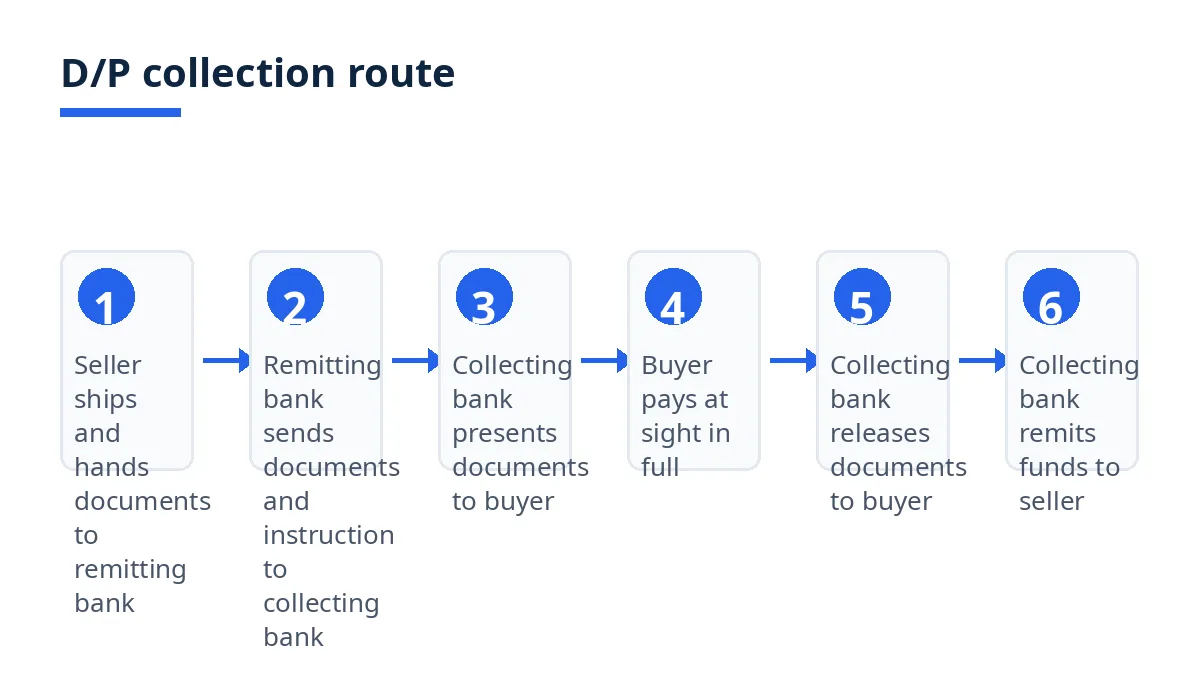
The seller ships and collects the documents. The seller ships the goods and obtains the transport document, commercial invoice, and packing list.
The seller presents the documents to the remitting bank. The seller, as principal, entrusts the collection to its own bank, the remitting bank, with a collection instruction.
The remitting bank forwards the collection. It sends the documents to the collecting bank in the buyer's country, with the instruction that documents are released only against payment.
The presenting bank presents the documents to the buyer. The presenting bank, the collecting bank making presentation to the drawee, shows the documents to the buyer and asks for payment at sight.5
The buyer pays at sight. Sight payment means payment when the documents are presented, not at a later date. If the buyer pays in full, the bank releases the documents.
The buyer takes delivery and the funds travel back. The buyer uses the transport document to take delivery and clear customs. The collecting bank sends the proceeds to the remitting bank, which credits the seller.
The collection instruction must be complete and precise: details of the bank from which the collection was received, the principal, the drawee, and the presenting bank, plus the amount and currency, a list of the documents, and the terms for delivery of those documents.5 The presenting bank follows that instruction, not the sales contract, and will not search the documents for terms it left out.
Worked example
Figures below are illustrative only, not a bank offer. A buyer in the Netherlands agrees D/P terms with a producer near Sylhet for hand-woven bamboo baskets priced at USD 14,800. The seller ships by ocean, then presents the sight draft, invoice, packing list, and ocean bill of lading, with an instruction stating documents against payment. The buyer checks the invoice and bill of lading, pays USD 14,800 at sight, and takes delivery. If the buyer had refused to pay, the documents would have stayed with the presenting bank, and the seller would have faced storage, return, or resale, with the goods already overseas.
D/P compared with D/A
In a D/P collection, documents are released only against payment at sight. In a documents against acceptance, or D/A, collection, documents are released when the buyer accepts a time draft, promising to pay on a future date, so the buyer holds the goods before paying.2
Feature | D/P | D/A |
|---|---|---|
Release trigger | Payment at sight | Acceptance of a time draft |
Buyer holds goods | Only after paying | Before paying, on acceptance |
Seller control | Documents held until payment | Documents released before payment |
Buyer credit | None from the collection | Credit until draft maturity |
Seller risk on default | Goods overseas, resale or return needed | Goods delivered, payment at maturity not assured |
Confirm that the instruction says documents against payment in words, with no time draft that could be read as a D/A term.
Costs, timelines and documents
No universal bank charge, timeline, or approval condition applies to every D/P collection. Charges depend on the banks, amount, currency, document set, and handling route, so every figure must be confirmed in writing with both banks before shipment. Timelines come from the shipment and the banks, not a fixed schedule: allow time to assemble and forward the documents, present them, and return the funds. Electronic presentation can shorten transit where both banks agree to it, but it does not change the sight-payment rule.
The document set is set by the contract and instruction, not by a single standard list. A typical set includes a sight draft where required, a commercial invoice, a packing list, and the transport document that controls delivery, most often an ocean bill of lading. Other certificates are included only where named.
Item | Confirm before shipment |
|---|---|
Contract term | Documents against payment, stated in words |
Instruction | Principal, drawee, presenting bank, amount, currency, document list, release terms |
Sight payment | Payment at sight, in full, before release |
Transport document | The document that controls delivery |
Bank charges | Each charge, and who pays it, confirmed with each bank |
Non-payment plan | Storage, return, resale, and protest instructions |
Shipment method | Whether documents control delivery for this method |
Route | Paper, electronic records, or both |
If the buyer refuses to pay, the presenting bank does not pay in the buyer's place, and it does not release the documents. It advises the bank from which it received the collection, and the seller, through the remitting bank, must give further instructions. A pre-agreed non-payment plan avoids days of messages while storage charges build, and banks have no obligation to store and insure held goods.1
Bangladesh-specific rules and tips
Export transactions through Bangladeshi banks run through authorized dealer, or AD, banks. Confirm the AD bank route, the authenticated channel where one is used, and the foreign exchange paperwork with the seller's AD bank at contract stage. Do not assume a route that worked for a letter of credit will work unchanged for a collection.
Bangladesh Bank has also moved export document handling toward electronic presentation. Under guidelines reported in January 2026, AD banks may process export documents through bank-to-bank electronic means for both documents against payment and documents against acceptance, following URC 522 and its Supplement for Electronic Presentation, eURC.6 The conditions matter in practice: the two banks must have a prior mutual agreement on record format and place of presentation, and the sales contract must state that the collection will be handled electronically under eURC. Where local law permits Electronic Transferable Records, title documents may be presented electronically; where it does not, bills of lading and bills of exchange must still be sent physically, while other documents may travel electronically.6
Three tips follow. First, confirm with the seller's AD bank that it will handle a D/P collection on the agreed route before the term is signed. Second, name the presenting bank and place of presentation in the instruction, and keep the parties, amount, currency, and document list identical across the contract, invoice, and instruction. Third, ask the AD bank what foreign exchange paperwork the collection requires, and who must file it.
Mistakes and red flags
Treating D/P as a bank guarantee. No bank promises to pay. If the buyer does not pay, the seller is not paid by a bank.
Assuming the bank checks the goods or documents. Banks handle documents under instruction. They do not verify accuracy, quality, or condition.
Leaving the release trigger unstated. An instruction without the words documents against payment invites a D/A reading or delay.
Including a time draft by mistake. A future-dated acceptance term confuses the release terms.
Shipping by air without a delivery hold. For air and overland shipments, the buyer may take the goods without the documents.2
Naming documents in the contract but not in the instruction. The presenting bank follows the instruction, not the contract.
Agreeing charges in vague words. Confirm each charge and who pays it, in writing, with each bank.
Having no non-payment plan. Agree storage, return, resale, and protest instructions before shipment.
Pricing on assumed timelines. Confirm handling steps and cut-off times, and allow for paper transit.
Ignoring eURC conditions. For an electronic route touching Bangladesh, confirm the bank agreement, format, place, and contract wording.6
Assuming payment before shipment. Under a collection, the buyer pays at presentation, against the documents, not before shipment.2
Checklist
[ ] The contract states documents against payment in words, with goods, price, currency, and shipment terms.
[ ] The instruction names the principal, drawee, presenting bank, amount, currency, documents, and release terms.
[ ] The document list matches across the contract, instruction, and presented set.
[ ] The transport document controls delivery for the shipment method.
[ ] Sight payment means payment at presentation, in full, before release.
[ ] No time draft or acceptance term is included by mistake.
[ ] Each bank charge, and who pays it, is confirmed in writing.
[ ] Non-payment, protest, storage, return, and resale instructions are stated.
[ ] The seller's AD bank has confirmed the route.
[ ] For an electronic route, the bank agreement, format, place, and contract wording are confirmed.
[ ] The buyer has a window covering presentation, checking, and funds transfer.
[ ] Both sides agree what happens to the goods if the buyer refuses to pay.
How Exportain helps
Exportain helps buyers and sellers agree D/P terms in writing before either side approaches a bank. A buyer can post a request for quotation stating the goods, quantity, price, shipment terms, and the payment term documents against payment, and compare supplier responses on the same terms. The recorded quotation trail keeps the request, every quotation version, every counter-offer, and the accepted terms in one place, so the contract and instruction can be checked against each other.7
Suppliers who apply for verification submit separate checks covering identity, business registration, export registration, and factory or office photos, each reviewed before any badge is shown. A badge is a record of checks reviewed, not a capacity, quality, or delivery guarantee. Before paying, agree the Incoterm, payment schedule, inspection, and shipment terms in writing.7
Exportain's payment terms are separate from bank charges on any collection: they cover payments to Exportain and platform memberships, not money paid directly between buyer and seller outside the platform.8 Exportain's letter of credit guide explains the bank-undertaking route that D/P deliberately does not use, so a buyer who needs a bank promise can compare the two routes before choosing.4
FAQs
What should I know first about documents against payment?
Documents against payment means the buyer's bank releases the shipping documents only when the buyer pays at sight. The seller ships first, the documents travel through banks under a collection instruction, and the banks act as agents with no payment undertaking. It controls the documents, not the goods, and suits established relationships and ocean shipments.
What are the typical costs and timelines?
There are no typical costs or timelines for every D/P collection. Charges depend on the banks, amount, currency, and handling route, and timelines depend on shipment, document assembly, and funds return. Confirm every charge and cut-off time in writing with each bank before shipment.
Which documents are needed?
The documents are those named in the contract and the collection instruction. A typical set includes a sight draft where required, a commercial invoice, a packing list, and the transport document that controls delivery, usually an ocean bill of lading. Other certificates are included only where named.
What are the most common mistakes?
The most common mistakes are treating D/P as a bank guarantee, assuming banks check the goods or documents, leaving the release trigger unstated, including a time draft by mistake, shipping by air without a delivery hold, naming documents in the contract but not in the instruction, agreeing charges vaguely, having no non-payment plan, and ignoring eURC conditions. Avoid them by writing the term, instruction, and non-payment plan clearly before shipment.
Next steps on Exportain
Start with the deal terms, not the bank form. Post a free RFQ on Exportain at https://exportain.com/rfqs, stating the goods, quantity, shipment terms, and the payment term documents against payment. Read the letter of credit guide at https://exportain.com/blog/lc-letter-of-credit, platform payments at https://exportain.com/payment-terms, and buyer protection at https://exportain.com/buyer-protection. Once terms are agreed in writing, take the contract to both banks and confirm the instruction, charges, and non-payment plan before the first shipment.
Sources
- URC 522 - Uniform Rules for Collections. ICC Knowledge 2 Go (accessed )
- Documentary Collections. International Trade Administration (accessed )
- Know the Risks of Using a Documentary Collection When Exporting. Shipping Solutions (accessed )
- LC Meaning (Letter of Credit). Exportain (accessed )
- Is eURC online trade finance collections provided by your bank?. Trade Finance Global (accessed )
- BB digitalizes export procedures with new electronic document framework. Bangladesh Sangbad Sangstha, (accessed )
- Buyer protection: What Exportain does to protect buyers. Exportain (accessed )
- Payment and Membership Terms. Exportain (accessed )
About the author
Sourcing from Bangladesh?
Post a request for quotation and suppliers on Exportain can send you their quotes directly.
Post an RFQ


