Using Documents Against Acceptance (D/A) When Buying From Bangladesh: Bank Rules and Tips
Documents against acceptance (D/A) in Bangladesh: how a URC 522 collection releases documents on acceptance of a time draft, what it costs, and what to confirm with your bank.
Short answer
Documents against acceptance (D/A) is a URC 522 documentary collection in which the buyer's bank releases the shipping documents when the buyer signs, or accepts, a time draft promising payment on a stated future date. The buyer can take delivery before paying, while the seller holds the accepted draft rather than the goods. Banks act as agents with no payment undertaking, so the acceptance, tenor, and non-payment plan must be agreed in writing before shipment.
On this page
Key takeaways
D/A releases shipping documents when the buyer signs a time draft promising payment at maturity; the buyer takes the goods before paying, and the seller holds the accepted draft, not the goods.
Under URC 522, the collection instruction must state documents against acceptance in words: without that statement, a future-dated bill is released only against payment.
Acceptance and non-payment at maturity are two different failures: non-acceptance leaves the goods undelivered, while default at maturity leaves the seller pursuing the accepted draft.
There are no universal D/A charges, timelines, or approval conditions: confirm every charge, tenor basis, AD bank route, and eURC condition in writing, and agree both failure plans before shipment.
Documents against acceptance, usually shortened to D/A, is a documentary collection in which the buyer takes the shipping documents before paying. The buyer signs a time draft, a bill of exchange promising payment on a stated future date, and the bank releases the documents against that acceptance. The buyer can then take delivery, while the seller waits for the maturity date to be paid.1
After acceptance, the seller no longer holds the documents, and therefore no longer controls delivery. What the seller holds instead is the accepted draft, a claim against the buyer at maturity. Banks act as agents under instruction. They give no payment undertaking, and they do not check the goods.1 The rules most banks follow are the ICC Uniform Rules for Collections, URC 522, which stress that a separate collection instruction must accompany every collection subject to the rules.2 A D/A deal must therefore be written clearly twice: in the sales contract, and again in the collection instruction. In documents against payment, or D/P, documents are released only when the buyer pays at sight. In a letter of credit, a bank undertakes to pay on complying documents. In D/A, neither protection applies.
Why this matters for buyers and sellers
For a buyer, D/A is a credit term, not a discount. Acceptance gives time between taking the goods and paying for them. But acceptance is not a trial period. By accepting the draft, the buyer becomes legally obligated to pay at a specific date, as the International Trade Administration explains.1 A quality dispute found after acceptance therefore sits alongside an existing payment obligation. Agree inspection and any rejection route in the sales contract before the draft is signed.
For a seller, D/A extends credit, and the credit decision should be made as deliberately as a loan decision. The seller has already paid for production and shipment before the buyer is asked to accept, and after acceptance has no goods to fall back on if payment fails at maturity. The accepted draft is the seller's security, and its value depends on the buyer paying on the date stated. D/A therefore suits established relationships, stable markets, and ocean shipments where documents control delivery, the same conditions the International Trade Administration lists for documentary collections generally.1 It is a poor fit for a first order with an untested buyer.
The two failure points are different. Non-acceptance means the buyer refuses to sign, so the documents stay with the bank. Non-payment at maturity is harder: the buyer has signed, taken the documents and goods, and still does not pay. The seller then pursues the accepted draft, not the shipment.
Step-by-step: how it works
Agree D/A in the sales contract. State the goods, price, currency, shipment terms, documents against acceptance in words, the tenor and its basis, bank charges, and both failure plans.
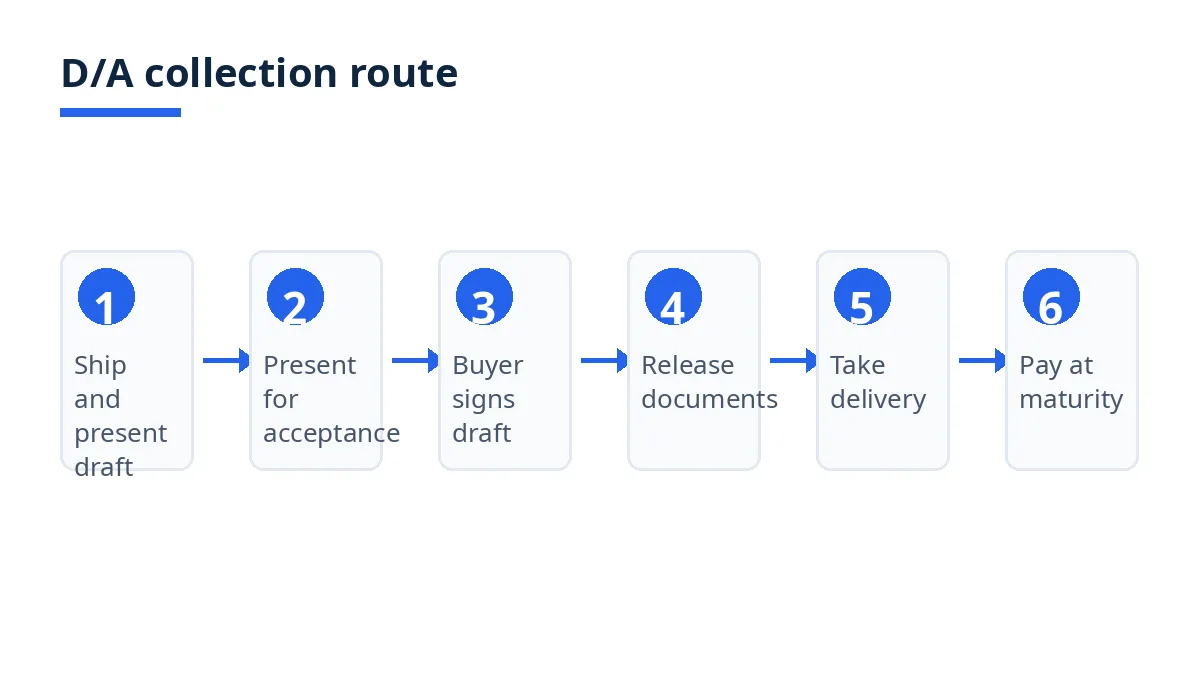
The seller ships and collects the documents. The seller ships the goods and obtains the transport document, invoice, and packing list, plus any named certificate.
The seller presents the documents and a time draft to the remitting bank. The seller, as principal, entrusts the collection to its own bank, with an instruction stating documents against acceptance in words.
The remitting bank forwards the collection. It sends the documents and time draft to the collecting bank in the buyer's country, for release against acceptance.
The presenting bank presents the documents for acceptance. The presenting bank shows the documents and the time draft to the buyer. Where acceptance is called for, presentation for acceptance must be made without delay.3
The buyer accepts by signing the time draft. Acceptance creates the payment obligation at maturity. The tenor clock runs from the basis stated in the contract and instruction, so that basis must be unambiguous.
The bank releases the documents. On acceptance, the bank hands the documents to the buyer, who uses the transport document to take delivery.
At maturity, the buyer pays and the funds travel back. The presenting bank presents the accepted draft for payment at maturity, and sends the proceeds to the remitting bank, which credits the seller.
The instruction must state the release term. URC 522 is explicit: where a collection contains a bill of exchange payable at a future date, the instruction should state whether documents are released against acceptance or against payment, and without such a statement, documents will be released only against payment.3 The presenting bank follows the instruction, not the sales contract, and banks will not examine documents in order to look for instructions.2
Worked example
Figures below are illustrative only, not a bank offer. A buyer in Germany agrees D/A terms with a producer near Khulna for woven jute shopping bags priced at USD 21,600, with a tenor of 60 days after acceptance. The seller ships by ocean and presents the time draft, invoice, packing list, and ocean bill of lading, with an instruction stating documents against acceptance. The buyer signs, takes delivery, and pays USD 21,600 sixty days after acceptance.
If the buyer had refused to sign, the documents would have stayed with the presenting bank. If the buyer had signed and then failed to pay at maturity, the seller would have held an accepted draft for USD 21,600 and no goods. The first branch is a delivery problem. The second is a credit problem, and it is the branch that makes buyer creditworthiness the deciding factor in D/A.
D/A compared with D/P and with a letter of credit
Feature | D/A | D/P | Letter of credit |
|---|---|---|---|
Release trigger | Acceptance of a time draft | Payment at sight | Complying documents under the credit |
Buyer holds goods | Before paying, on acceptance | Only after paying | After documents are released under the credit |
Seller holds after release | An accepted draft | Payment received | A bank undertaking, honoured on compliance |
Bank promise to pay | None | None | Yes, from the issuing bank |
A buyer who needs time to sell before paying, and a seller who trusts that buyer to pay at maturity, may choose D/A. A seller who needs payment before giving up document control should choose D/P. A seller who needs a bank to stand behind payment should look at a letter of credit, explained in Exportain's letter of credit guide.4
Costs, timelines and documents
No universal bank charge, timeline, or approval condition applies to every D/A collection. Charges depend on the banks, amount, currency, document set, and handling route, so every figure must be confirmed in writing with both banks before shipment. One D/A guide for exporters describes the time draft payment date as typically 30, 60, or 90 days after acceptance.5 Treat those figures as examples, not as a rule. Your contract must state your own tenor and its basis.
Days after acceptance, days after the bill of lading date, and days after shipment are three different clocks, each giving a different maturity date. State the basis in words, and confirm the maturity date calculation with both banks before shipment. The presenting bank's own timing duties are narrower: presentation for acceptance is made without delay, and presentation for payment is made not later than maturity.3 Interest, where collected, is also an instruction item: the instruction should state the rate, period, and basis, and whether charges may be waived.3
The document set is set by the contract and instruction, not by a single standard list. A typical set includes a time draft, a commercial invoice, a packing list, and the transport document that controls delivery. Other certificates are included only where named. Under URC 522, the time draft is a financial document, while invoices and transport documents are commercial documents.3
Item | Confirm before shipment |
|---|---|
Contract term | Documents against acceptance, stated in words |
Instruction | Principal, drawee, presenting bank, amount, currency, documents, release terms |
Time draft | Amount, currency, drawee, tenor, tenor basis |
Maturity | Date calculation, presentation for payment, funds return route |
Bank charges | Each charge, and who pays it, confirmed with each bank |
Interest | Rate, period, basis, where interest is to be collected |
Non-acceptance plan | Holding, return, resale, protest instructions |
Non-payment plan | Steps on default at maturity, and who takes them |
If the buyer refuses to accept, the presenting bank does not pay in the buyer's place, and it does not release the documents. If the buyer accepts and then fails to pay at maturity, the goods are gone, and the seller's claim rests on the accepted draft. Banks have no obligation to store and insure held goods.2
Bangladesh-specific rules and tips
Export transactions through Bangladeshi banks run through authorized dealer, or AD, banks. Confirm the AD bank route and the foreign exchange paperwork with the seller's AD bank at contract stage. Do not assume a letter of credit route, or a D/P route, will work unchanged for D/A.
Under guidelines reported in January 2026, AD banks may process export documents through bank-to-bank electronic means for both documents against payment and documents against acceptance, following URC 522 and its Supplement for Electronic Presentation, eURC.6 The conditions matter: the two banks must have a prior mutual agreement on record format and place of presentation, and the sales contract must state that the collection will be handled electronically under eURC.6 Where local law permits Electronic Transferable Records, title documents may be presented electronically. Where it does not, bills of lading and bills of exchange must still be sent physically.6
Confirm with the seller's AD bank that it will handle a D/A collection on the agreed route, paper or electronic, before the term is signed, since electronic processing was reported as a phased and pilot-based rollout.6 Name the presenting bank and place of presentation in the instruction, and keep the parties, amount, currency, and document list identical across the contract, invoice, and instruction.
Mistakes and red flags
Treating acceptance as payment. Acceptance is a promise to pay at maturity, not payment.
Treating an accepted draft as a bank guarantee. No bank promises to pay.
Leaving the release term unstated. Without a D/A statement, documents are released only against payment.3
Mixing sight and time terms. Sight and time terms in one instruction invite delay and a wrong release.
Leaving the tenor basis vague. Days after acceptance and days after shipment give different maturity dates.
Offering D/A to an untested buyer. Check payment history and finances first.5
Having no maturity diary. Record acceptance and maturity, and chase payment before the date passes.
Having a non-acceptance plan but no non-payment plan. The second branch cannot recover the goods.
Assuming the bank will chase payment as a guarantor. The bank presents the draft. It does not stand behind the buyer's promise.
Naming documents in the contract but not in the instruction. The bank follows the instruction, not the contract.2
Agreeing charges and interest in vague words. Confirm each charge, any interest term, and who pays each, in writing.
Ignoring eURC conditions. For an electronic Bangladesh route, confirm the bank agreement, format, place, and contract wording.6
Checklist
[ ] The contract states documents against acceptance in words, with goods, price, currency, and shipment terms.
[ ] The tenor and its basis are stated in the same words in the contract and the instruction.
[ ] The instruction names the principal, drawee, presenting bank, amount, currency, documents, and release terms.
[ ] The time draft states the amount, currency, drawee, and tenor correctly.
[ ] Each bank charge, and who pays it, is confirmed in writing.
[ ] Any interest rate, period, and basis are stated, or interest is confirmed as not applying.
[ ] Non-acceptance and non-payment at maturity steps are stated, with who takes them.
[ ] Acceptance and maturity dates are recorded by both sides.
[ ] The seller's AD bank has confirmed the route, paper or electronic.
[ ] For an electronic route, the bank agreement, format, place, and contract wording are confirmed.
How Exportain helps
A buyer who needs a bank promise instead of a buyer promise can compare the two routes before choosing: Exportain's letter of credit guide explains the bank-undertaking route that D/A deliberately does not use.4 Exportain's payment terms are separate from bank charges on any collection: they cover payments to Exportain and platform memberships, not money paid directly between buyer and seller outside the platform.7
Exportain also helps buyers and sellers agree D/A terms in writing before either side approaches a bank. A buyer can post a request for quotation stating the goods, shipment terms, and the payment term documents against acceptance, including the tenor and its basis. The recorded quotation trail keeps the request, every quotation version, every counter-offer, and the accepted terms in one place.8
FAQs
What should I know first about documents against acceptance?
Documents against acceptance means the buyer's bank releases the shipping documents when the buyer signs a time draft promising payment on a stated future date. The buyer takes the goods before paying, and the seller holds the accepted draft.
What are the typical costs and timelines?
There are no typical costs or timelines for every D/A collection. Charges depend on the banks, amount, currency, and handling route. Common tenor examples are 30, 60, or 90 days after acceptance, but your own tenor and basis must be confirmed in writing with each bank before shipment.5
Which documents are needed?
The documents are those named in the contract and the collection instruction. A typical set includes a time draft, a commercial invoice, a packing list, and the transport document that controls delivery, usually an ocean bill of lading. Other certificates are included only where named.
What are the most common mistakes?
The most common mistakes are treating acceptance as payment, treating an accepted draft as a bank guarantee, leaving the release term unstated, leaving the tenor basis vague, offering D/A to an untested buyer, having no maturity diary, and ignoring eURC conditions. Avoid them by writing the term, tenor basis, instruction, and both failure plans clearly before shipment.
Next steps on Exportain
Start with the deal terms, not the bank form. Post a free RFQ on Exportain at https://exportain.com/rfqs, stating the goods, quantity, shipment terms, and the payment term documents against acceptance, including the tenor and its basis. Read the letter of credit guide at https://exportain.com/blog/lc-letter-of-credit, platform payments at https://exportain.com/payment-terms, and buyer protection at https://exportain.com/buyer-protection. Once terms are agreed, take the contract to both banks and confirm the instruction, charges, and both failure plans before the first shipment.
Sources
- Documentary Collections. International Trade Administration (accessed )
- URC 522 - Uniform Rules for Collections. ICC Knowledge 2 Go (accessed )
- URC 522: Uniform Rules for Collections. Scribd (accessed )
- LC Meaning (Letter of Credit). Exportain (accessed )
- Documents against acceptance: Meaning, process, and example. Amazon Global Selling (accessed )
- BB digitalizes export procedures with new electronic document framework. Bangladesh Sangbad Sangstha, (accessed )
- Payment and Membership Terms. Exportain (accessed )
- Buyer protection: What Exportain does to protect buyers. Exportain (accessed )
About the author
Sourcing from Bangladesh?
Post a request for quotation and suppliers on Exportain can send you their quotes directly.
Post an RFQ