

Denim Jeans Lead Time From Bangladesh: Production and Shipping Timeline
Plan a denim jeans lead time from Bangladesh by approval gates: fabric and wash choices, washed fit across sizes, hardware, shrinkage and labelling checks, inspection, export documents, and transit.
Short answer
A denim jeans lead time from Bangladesh runs on approval gates, not a single production run: fabric and indigo dyeing, construction sampling, wash and finishing approval, hardware approval, washed size-set fit approval, shrinkage and labelling confirmation, then bulk inspection, export documents, and transit. Every duration is an illustrative planning example only. Replace it with the dated figures in the written quote and the dated forwarder estimate before setting a selling date.

On this page
Key takeaways
A denim jeans order runs on approval gates in a fixed order: fabric and shade before cutting, wash after sewing, fit after washing, and documents before loading.
Treat rope-dyed indigo, stone wash, enzyme wash, laser finishing, and ozone finishing as buyer-spec options, each closed by a named reference sample approved in writing.
Fit approval must come from a washed size set across the full range, with every size measured against the written tolerance, not from a single middle size or an unwashed jean.
Record hardware samples, the shrinkage measurement method, and the wash-care labelling wording in writing for this order, and reopen the relevant gate if any of them changes.
Read every duration as an illustrative planning example only, replace it with the dated figures in the written quote and the dated forwarder estimate, and keep a buffer after wash approval and after inspection.
A denim jeans order is decided twice: once when the fabric and wash are chosen, and again when the finished jean is measured after washing. Between those decisions sit dyeing, cutting, sewing, wash, fit, hardware, and inspection approvals.
This guide uses a gate framework for denim jeans from Bangladesh. A gate is a named approval or document that must close before the next stage starts. Every duration here is an illustrative planning example only, or an item to confirm in the written quote and the dated forwarder estimate.
Why this matters for buyers and sellers
For a buyer, the risk is concentrated in the wash. A wash that looks right on one sample can shift shade, hand feel, or size after a full bulk wash. Approving the wash on a single pair, without a washed size set and a written wash reference, leaves that stage loosely defined.
For a seller, the same gates protect the schedule. A seller who records the fabric choice, wash reference, fit measurements by size, and hardware sample in writing gives the buyer a fixed target to approve.
The denim-specific point is the order of approvals: shade before cutting, wash after sewing, and fit after washing.
Step-by-step: how it works
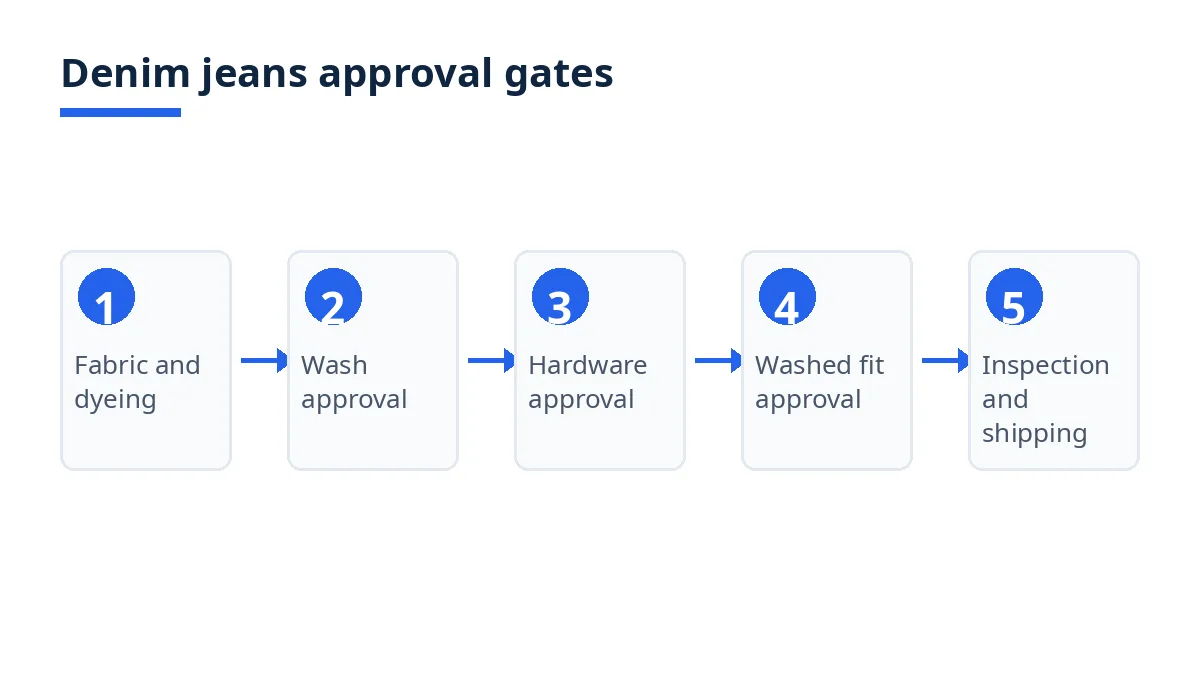
Read a denim jeans order against seven gates, in this order. If a reply skips a gate, ask where that check sits.
Gate 0: Denim fabric and dyeing as a buyer-spec choice
Gate 0 fixes the fabric before cutting starts. The buyer specifies construction, weight, stretch content if any, and shade direction in the tech pack, and the seller confirms whether that fabric is in stock, is to be dyed, or is to be woven for the order. Indigo dyeing needs reduction to a soluble form before application and oxidation afterward to regenerate the blue pigment, and multiple dip-and-oxidation cycles progressively build shade.1 In rope dyeing, warp yarns are gathered into rope-like assemblies and passed repeatedly through indigo dye boxes and oxidation zones.1
Rope-dyed denim is a buyer-spec option, not a default. Write into the tech pack whether rope-dyed indigo is required, what shade reference applies, and whether any companion dye is used for cast or depth.1 A Gate 0 approval should name the fabric sample, the shade reference, and the dyeing route.
Gate 1: Sampling, pattern, and the first jean
Gate 1 produces the first complete jean from the approved fabric: pattern, cut, sewing, pockets, waistband, fly, and trims in place. This sample tests construction, not wash. Check pocket placement, stitching, waistband fit, fly function, and leg shape, and record every correction in writing, with a revised sample where a correction changes shape. Fit measured before washing is a construction check only; the fit approval that matters comes at Gate 4, after the wash.
Gate 2: Wash and finishing approval as a buyer-spec choice
Gate 2 is where a denim order differs most from a plain woven order. Washing techniques developed for denim include stone wash, enzyme wash, and related treatments that change shade, softness, and surface character, and garments washing in Bangladesh covers dry and wet processes.2 Stone washing uses abrasive stones in the wash bath, while cellulase enzyme washing achieves a wash-down appearance with reduced or no stones.2
Treat each wash and finishing route as a buyer-spec option, never as a universal process for every jean. Stone wash, enzyme wash, laser finishing, and ozone finishing are options the buyer selects and the seller confirms in writing, with a named wash reference sample for each. A laser pattern or ozone fade approved on one fabric can read differently on another weight or shade. Gate 2 closes only with a washed sample approved in writing, plus a record of the wash route used. If the route changes after Gate 2, the order returns to Gate 2 with a new washed sample.
Gate 3: Hardware approval, rivets, buttons, and zippers
Gate 3 approves every piece of metal and fastening before bulk sewing locks them in. Rivets, buttons, zippers, and any decorative hardware are buyer-spec items: the buyer approves a physical sample of each piece, its finish, any marking on it, and the attachment method. A rivet that looks right in a photograph can fail in bulk if its setting does not suit the fabric weight. Record the approved hardware sample against the fabric weight and wash route. If a hardware piece is substituted, Gate 3 reopens.
Gate 4: Fit approval across jean sizes, after washing
Gate 4 is the fit gate, and it happens after washing, not before. The seller provides a washed size set: the same jean, in the full size range, washed by the approved Gate 2 route, with measurements taken after washing and pressing. The buyer checks waist, hip, thigh, knee, leg opening, inseam, and rise on each size against the tech pack, and records the tolerance for each measurement. A buyer who approves only a middle size has approved the pattern, not the range. Gate 4 closes when every size measures within the written tolerance, or when sizes outside tolerance have been corrected and remeasured.
Gate 5: Shrinkage after washing and wash-care labelling as buyer-spec items
Gate 5 fixes two buyer-spec items often left vague until the goods arrive. First, shrinkage after washing: the buyer states in writing how shrinkage will be measured, on which sizes, and after which wash route, and the seller reports the washed measurements against the unwashed measurements for that route. No shrinkage figure here is a universal percentage, and no figure should be copied from another jean, fabric, or wash route into this order. Second, wash-care labelling: the buyer states the care instructions, fiber content wording, size marking, and country-of-origin marking required for the destination market, in writing, before bulk labelling starts. Labelling for exported garments includes size, material composition, care instructions, and country of origin among the required information.3 Any market-specific requirement the buyer needs is a buyer-spec item to confirm in writing for this order, not a blanket rule for every market.
Gate 6: Bulk production, final inspection, and packing
Gate 6 runs bulk production only after Gates 0 to 5 have closed, and it ends with final inspection against the approved samples: shade against Gate 0, wash against Gate 2, hardware against Gate 3, fit against Gate 4, and labelling against Gate 5. Inspection should cover shade variation, wash consistency, hardware attachment, measurement by size, and label position and wording. Packing follows inspection. Cartons are packed by size and shade lot where the order requires it. Goods that fail inspection stay out of the packed cartons.
Costs, timelines and documents
Costs move with fabric, dyeing route, wash route, hardware, inspection, freight, and the delivery term, and the timetable moves with sample revisions, wash re-approval, fit corrections, and document arrival. The table below is a stage framework only, and every duration in it is an illustrative planning example.
Stage | Illustrative planning example only | Gate that closes the stage |
|---|---|---|
Fabric and dyeing | Illustrative example: 2 weeks | Gate 0 sample approved |
First sample | Illustrative example: 2 weeks | Gate 1 sample approved |
Wash and finishing | Illustrative example: 3 weeks | Gate 2 washed sample approved |
Hardware | Illustrative example: 1 week | Gate 3 samples approved |
Washed size-set fit | Illustrative example: 2 weeks | Gate 4 measurements within tolerance |
Shrinkage and labelling | Illustrative example: 1 week | Gate 5 method and wording approved |
Bulk, inspection, packing | Illustrative example: 4 weeks | Gate 6 report and packing list complete |
Documents and transit | Confirm in the dated forwarder estimate | Documents complete, goods loaded |
A worked example shows how the gates change a date. A buyer orders a tapered jean in mid-blue indigo, with a laser whisker pattern as the buyer-spec finishing route, a button fly, and a washed size set across the range. The first washed sample comes back with the whisker pattern sitting higher on the thigh than the reference, so Gate 2 stays open for another wash round. The corrected wash is approved, but the washed size set then shows the largest size outside tolerance at the thigh, so Gate 4 stays open for a pattern correction and a remeasured size set. Bulk cannot start while a gate is open.
For cost reading, use example figures only to compare quotes, and replace them with the written quote before planning. Illustrative example only: a single shipment at USD 24,000 on one delivery term, USD 1,850 for ocean freight as an example figure, and USD 320 for marine insurance as an example figure. Those figures are not a price for any real order, and they do not include destination handling, duty, broker fees, or inland delivery unless the quote says so.
The document set gates loading and clearance. Export documentation for garments from Bangladesh includes commercial invoices, packing lists, bill of lading or air waybills, export declaration forms, and certificates of origin.3 The shipping bill is an essential document issued by the Bangladesh Customs Authority after the exporter applies to acquire it, and it is the mandatory required document to complete customs clearance, load the goods, and claim duty drawbacks.4 Documents required to obtain it include the commercial invoice, the packing list, the EXP form certified by authorized dealers, and the certificate of origin.4 Keep the invoice, packing list, inspection report, and shipping bill consistent on quantity, description, and marks. The Incoterms guide on Exportain explains the 11 rules and the split between cost and risk under each rule.5 Write the rule, the named place, and the edition together in the contract.
Bangladesh-specific rules and tips
Bangladesh-specific timing comes from the document chain as much as from production. The export document set must be complete before loading, and a buyer who treats loading as a factory date, rather than a document date, will misread the schedule. Ask the seller to confirm, in writing, who prepares each document.
Wash capacity is a second Bangladesh-specific point. Washing plants in Bangladesh run a wide range of dry and wet processes, and a wash route that needs a specific plant or machine should be confirmed as available for the bulk dates, not only for the sample.2 A sample washed at one plant and bulk washed at another can read differently.
A third point is shade continuity across lots. Indigo shade builds through repeated dip-and-oxidation cycles, and variation in dye chemistry or yarn preparation can become visible across the finished fabric width.1 For an order split across lots, ask how shade will be matched lot to lot.
Mistakes and red flags
Approving fit on an unwashed jean and treating it as the washed fit approval.
Approving a wash on a photograph or swatch, rather than on a washed finished jean.
Changing the wash route, hardware, or fabric after approval without a new sample and written re-approval.
Approving only a middle size and assuming the full range will measure within tolerance.
Copying a shrinkage figure from another jean, fabric, or wash route.
Starting bulk before the size set, hardware samples, and label wording are approved in writing.
Setting a selling date from the first sample date, with no buffer after wash approval and after inspection.
Treating a quoted delivery date as a loading date when the document set is not yet complete.
Comparing quotes on different delivery terms without pricing each quote to the same point.
Accepting a reply that names a date but no gate, sample, or document that closes each stage.
Checklist
Use this checklist before bulk starts.
[ ] Fabric, shade reference, and dyeing route in the tech pack, with the Gate 0 sample named.
[ ] Construction sample approved in writing, with corrections recorded.
[ ] Wash and finishing route selected as a buyer-spec option, with a washed sample approved in writing.
[ ] Rivet, button, zipper, and decorative hardware samples approved in writing.
[ ] Washed size set measured after washing, with every size within tolerance.
[ ] Shrinkage method, sizes, and wash route recorded in writing for this order.
[ ] Care, fiber content, size, and origin wording approved in writing.
[ ] Bulk inspection plan agreed: shade, wash, hardware, measurements, and labels.
[ ] Invoice, packing list, EXP form, certificate of origin, and shipping bill owners and dates confirmed.
[ ] Delivery term, named place, and edition in the contract, with the cost split confirmed.
[ ] Dated forwarder estimate received, replacing every illustrative planning example here.
[ ] Buffer held after wash approval and after final inspection.
How Exportain helps
Exportain gives buyers a place to put the gate table from this guide into a sourcing request, so each reply can be compared gate by gate rather than date by date. A buyer can list the fabric route, wash route, hardware samples, washed size set, and document dates as requirements, and ask each seller to reply against them in writing.
FAQs
What should I know first about denim jeans?
Start with the order of approvals: shade before cutting, wash after sewing, fit after washing, and documents before loading. Ask for the gate table and the named samples before discussing a date.
What are the typical costs and timelines?
There is no single figure fitting every denim jeans order. Costs move with fabric, dyeing route, wash route, hardware, inspection, freight, and the delivery term, and the timetable moves with sample revisions, wash re-approval, fit corrections, and document arrival. Use the illustrative planning examples here only to read a quote, and replace them with the written quote figures and the dated forwarder estimate.
Which documents are needed?
The export set gates loading and clearance from Bangladesh: the contract or purchase order, commercial invoice, packing list, EXP form, certificate of origin, and shipping bill, with the bill of lading or air waybill issued by the carrier.4 3 The approval set gates bulk: the fabric sample, the washed sample, the hardware samples, the washed size-set measurements, and the approved label wording.
What are the most common mistakes?
The most common mistakes are approving fit before washing, approving a wash on a photograph or swatch, changing a wash route or hardware piece without a new sample, approving only a middle size, and copying a shrinkage figure from another jean. Put a dated check at each gate.
Next steps on Exportain
Write the fabric route, wash route, hardware samples, washed size set, and document dates into one requirement.
Post a request on Exportain at https://exportain.com/rfqs with that requirement, browse suppliers at https://exportain.com/suppliers, and confirm the delivery term in the Incoterms guide at https://exportain.com/blog/incoterms-for-shipments-from-bangladesh.
Sources
- Indigo Dyeing: Chemistry, Denim Processes and Sustainability. TextileGlossary (accessed )
- Garments Washing Techniques Used in Bangladesh. TextileLearner (accessed )
- How to export garments overseas from Bangladesh. DHL (accessed )
- Bangladesh Trade Portal FAQ: Export Registration Certificate (ERC). Bangladesh Trade Portal (accessed )
- Incoterms for Shipments From Bangladesh. Exportain (accessed )
- Incoterms
- export documents
- quality control
- buyer guide
- Bangladesh sourcing
- bangladesh garments
- Denim jeans
About the author
Sourcing from Bangladesh?
Post a request for quotation and suppliers on Exportain can send you their quotes directly.
Post an RFQ


