

Typical MOQ for Denim Jackets in Bangladesh (and How to Negotiate It Down)
No single denim jacket MOQ in Bangladesh: the roll, wash load, hardware set and size run each set a floor. Learn which floor binds for your jacket and how to change it.
Short answer
There is no single typical MOQ for denim jackets in Bangladesh. Each factory sets its minimum from four batch floors for your specification: the denim roll, the wash load, the hardware set and the size run. Ask for each floor separately, in writing, with the quantity per colour and size. Then negotiate the binding floor, by sharing a wash recipe, using stocked denim or hardware, or paying set-up as a separate line.
On this page
Key takeaways
There is no single typical MOQ for denim jackets in Bangladesh, because each factory sets its minimum from four batch floors for your specification: the denim roll, the wash load, the hardware set and the size run.
A jacket minimum is the largest of the four floors, not their average, so find which floor binds before you negotiate.
Negotiate the binding floor: share a wash recipe across styles, use stocked denim and stock hardware finishes, pay set-up as a separate line, and narrow the size range for a first order.
Exportain verification is a document and photo review, not a factory inspection, and a badge is not a guarantee of capacity, quality or delivery.
A denim jacket order stands or falls on four batch floors that sit underneath the headline quantity: the denim roll, the wash load, the hardware set and the size run. A factory can accept your total and still refuse one colour, one wash or one size, because that part of the order does not fill the batch it needs. The way to a workable minimum is to find which of the four floors binds for your specification, then change that floor rather than pressing for a lower total.
In 2024 Bangladesh was the top denim supplier to both the United States and the European Union, at $675.65 million to the United States and $1.28 billion to the European Union. That position held into early 2025: in January and February 2025, denim exports to the United States reached $138.75 million, up 56.33 percent year on year, and denim exports to the European Union reached $285.52 million, up 32.43 percent, according to data compiled by the Bangladesh Garment Manufacturers and Exporters Association (BGMEA).1 For a jacket buyer, those figures say the denim base is deep enough that the binding constraint is usually your own minimums, not national supply.
A jacket differs from a simpler denim garment in what has to match. Body panels, sleeves, collar, lining and pocketing must come from the same shade lot, the wash must treat every piece in a colour the same way, and buttons, rivets, zips and labels must arrive as one matching set. The jacket minimum becomes the largest of the four floors, not their average.
Why this matters for buyers and sellers
For a buyer, the jacket minimum decides how much capital is tied up in a first range and whether a new wash or fit can be tested before committing to depth. A jacket that needs its own roll, its own wash recipe and its own hardware set cannot be tested in a handful of pieces without paying for those batches in some form, either as a higher unit price, a surcharge or a separate set-up line.
For a seller, the floors protect batches that cannot be reused. Denim cut for your jacket, a wash recipe run for your shade and hardware made for your trim cannot be sold on to another buyer if you cut the order. A short run still opens the roll, fills the wash machine and orders the hardware set, so cost per jacket rises as quantity in any one batch falls.
Anchor the negotiation on two things agreed up front: an inspection plan set before production, and one delivery term carried on every quotation. For inspection, ISO 2859-1 provides sampling plans by attributes indexed by AQL for lot-by-lot checks.2 AQL caps the average share of defective items a lot may carry while still passing random sampling, and it fixes how large the sample is and where the pass-fail line falls.2 For delivery terms, the Incoterms 2020 rules give 11 rules that split cost, risk and obligations between buyer and seller.
Step-by-step: how it works
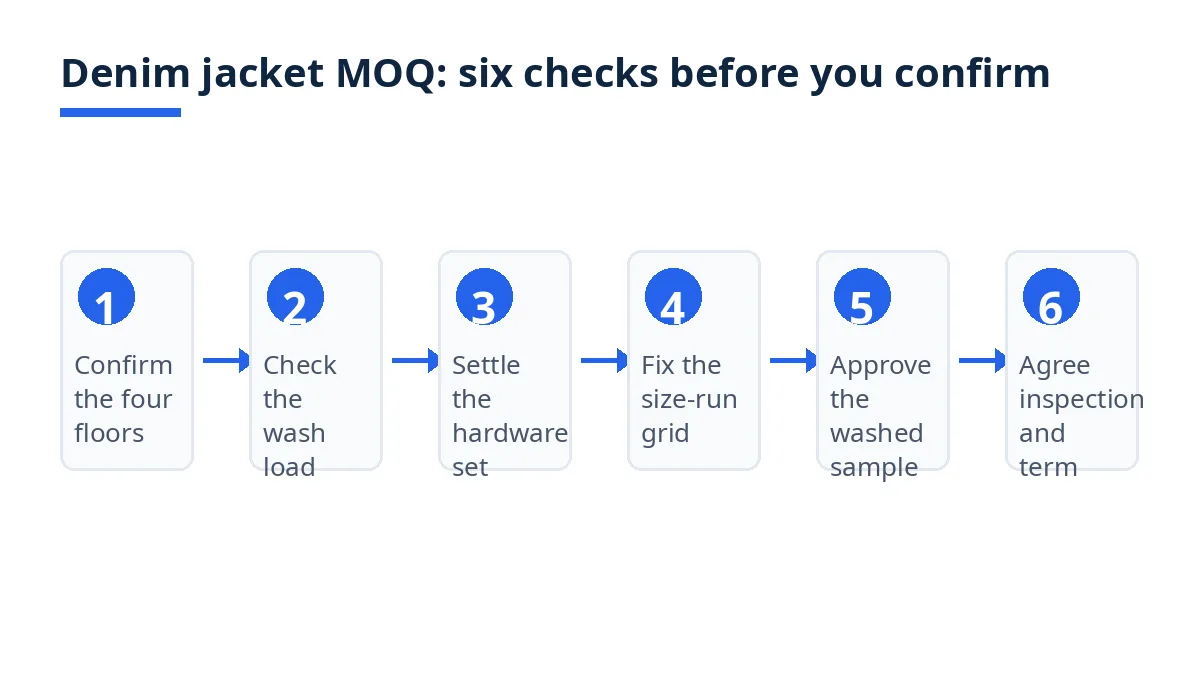
1. Send one specification sheet to every candidate. State the jacket style, denim weight and stretch, lining, collar and pocket construction, wash and shade target, hardware finish and placement, label and carton requirements, and the full size range. No factory can quote a usable jacket minimum from a photograph or a total quantity alone.
2. Ask for the four floors separately. Request the minimum for the denim roll in your weight and shade, the minimum wash load for your recipe, the minimum order for each hardware item, and the minimum per size within each colour. Record which floor binds for your split, and what happens to leftover cloth, leftover hardware and part wash loads.
3. Work the roll first. Jacket denim arrives on rolls of a fixed width and length, and the marker must fit body fronts and backs, sleeves, collar pieces, pocketing and lining across that width. A colour ordered below one roll yield still opens a whole roll. Example figures: a roll of 150 metres with consumption of 2.2 metres per jacket yields about 68 jackets, since 150 divided by 2.2 is 68.2. A colour ordered at 40 jackets draws on the same roll, and the balance must be carried to a repeat, shared with another jacket style in the same denim, or paid for.
4. Work the wash load next. Finished jackets are washed in machine loads run to one recipe, and every jacket that must match in shade and hand feel goes through the wash together. A colour split across two small loads can drift apart. Ask for the load size for your recipe, whether a part load is possible, and what a part load costs. Example figures: a wash load of 120 jackets means a colour ordered at 70 jackets either waits for a second colour in the same recipe, pays a part-load charge, or moves to a load size the laundry can run.
5. Settle the hardware set before you fix quantities. Buttons, rivets, zips, buckles and labels are ordered per finish and per placement, each with its own run. A brass button set, a gunmetal rivet set and a branded zip puller are three separate orders, not one trim line. Ask whether hardware sits inside the garment minimum or carries its own minimum, and whether a stock finish can replace a custom finish for a first order. Example figures: a hardware set ordered at 500 sets for an order of 300 jackets leaves 200 sets to be held for a repeat or charged to the first order.
6. Fix the size-run grid, not just the total. A jacket size run spreads across chest sizes, and the smallest and largest sizes often hold the fewest pieces. A grid that puts 15 jackets in the smallest size and 15 in the largest while the centre sizes hold 60 each can fail on the edge sizes even when the colour total looks comfortable. State the quantity per size per colour, and ask which size cells fall below the cutting or wash floor.
7. Approve a washed sample in writing. Order a proto sample for fit, then a pre-production sample in your actual denim, lining, hardware and wash. Measure it, wash it again to your care standard, and approve or list corrections in writing.
8. Agree inspection and delivery term before you confirm. Write the inspection level and AQL values into the purchase order, following ISO 2859-1,2 and state one Incoterm and named place for every quotation. The Incoterms 2020 rules allocate cost, risk and obligations for each rule,3 so compare minimums only on the same term.
Negotiation levers that change a floor. Cut the wash list before you cut the order: one wash recipe across two jacket styles lets both styles share a wash load. Use a stocked denim and a stock hardware finish for a first order, so the roll and the hardware set are already open. Pay wash set-up and hardware tooling as separate lines where the floor comes from set-up rather than cloth, so the repeat order reuses them. Narrow the size range for a first order and add edge sizes on the repeat, rather than spreading a small order thinly across every size. Each lever works because it fills a batch, not because it asks the factory to ignore one.
Costs, timelines and documents
What are the typical costs and timelines?
There are no typical costs or timelines a guide can state as fact, because each factory prices your denim weight, lining, wash recipe, hardware set, label run and delivery term separately.3 A heavyweight rigid denim, a lined collar, a multi-step wash and a custom hardware finish each add a batch or a process a lighter, unlined, single-wash jacket does not carry.
For timelines, sampling depends on denim availability, wash approval rounds and hardware delivery, while bulk production depends on roll delivery, wash capacity and line time. Ask for sampling, denim ready, wash approval, production and inspection dates as separate lines, not a single delivery week.
Which documents are needed?
The order documents are the specification sheet, the itemized quotation showing each of the four floors, and the purchase order carrying the split per colour and size, the wash recipe reference, the hardware finishes and the inspection plan.2 For the export declaration itself, see the Bangladesh Customs export clearance procedures for the current filing route.4
Bangladesh-specific rules and tips
Check wash capacity, not just sewing capacity. A jacket factory may sew well and still queue behind its laundry. Ask whether washing runs in-house or at a separate laundry, what the load size is for your recipe, and how many loads per week your colour can take. A factory that sews in two weeks but washes in six has a six-week order.
Confirm association claims at the source. A claimed BGMEA membership is a question to put to the association itself, not an answer about the minimum on offer, the wash capacity for your recipe or the hardware stock for your finish.
Keep shade control inside one lot. Denim shade can drift between rolls and between wash loads, and a jacket shows drift across body, sleeves and collar at once. Ask how shade is checked across a full jacket rather than on a swatch, and what happens when a second roll or load does not match the approved sample.
Classify the jacket before you quote freight and duty. In the tariff, heading 6203 covers men's or boys' suits, ensembles, jackets, blazers, trousers and related garments, and cotton jackets and blazers sit under 6203.32.5 Confirm the code for your exact jacket, including lining and gender cut, with your broker before you compare landed costs, since a wrong code changes the duty line even when the factory price is identical.
Label fibre content for the destination market. If you sell into the European Union, Regulation (EU) No 1007/2011 covers textile fibre names and the labelling and marking of fibre composition.6 State the fibre composition and percentages for the shell, lining and any other component the regulation covers, and confirm the label wording before production, not at packing.
Mistakes and red flags
What are the most common mistakes?
Quoting a total instead of a grid. The binding floor is usually one colour, one wash load, one hardware set or one size cell. An order can clear the total and still fail on a single cell, which then carries a surcharge, a dropped size or a dropped colour.
Comparing minimums on different jackets. A lower minimum on an unlined jacket in stocked denim with a single wash and stock buttons is a different offer from a lined jacket in dyed-to-order denim with a multi-step wash and custom hardware. Compare only replies to the same specification sheet on the same Incoterm.3
Approving a sample before washing. An unwashed sample hides shade change, shrinkage and hardware reaction to the wash. Approve the washed sample, in your actual denim and hardware, before bulk cutting.
Accepting a shared batch verbally. A shared roll, shared wash load or shared hardware run only helps if it is written on the quotation and purchase order, with the styles, colours and quantities it covers. A verbal share disappears when the other style is cancelled.
Taking a profile or a badge as capacity proof. A profile opens the enquiry; it cannot prove a factory washes your shade or holds your hardware finish, and a badge on its own guarantees nothing about capacity, quality or delivery.7
Skipping inspection to save time on a small order. An agreed AQL turns sampling into a gate: under ISO 2859-1 the lot is measured against it,2 and on a small jacket order that gate is the only thing stopping a shade or hardware fault from reaching your warehouse shelf.
Checklist
Before you confirm, every line should be answered in writing.
Specification sheet sent: style, denim weight and stretch, lining, collar, pockets, wash, hardware, labels, sizes, packing.
Split stated per colour and per size, with edge sizes named, not averaged away.
Denim roll floor confirmed per weight and shade, with leftover cloth terms agreed.
Wash load size and recipe confirmed, with part-load terms agreed.
Hardware minimums confirmed per finish and placement, apart from the garment minimum.
Size cells checked against cutting and wash floors, with short cells fixed or dropped.
Washed pre-production sample measured and approved in writing.
Inspection level and AQL values in the purchase order.2
Quotations compared on the same specification and Incoterm.3
Export declaration route confirmed with the supplier before shipment.4
How Exportain helps
On Exportain, open suppliers and raise a request for quotation (RFQ) on the RFQ board with your specification sheet, split per colour and size, wash recipe reference and delivery term, so every supplier quotes the same jacket. Insist each reply states its roll, wash, hardware and size floors separately. Once you accept a quotation, Exportain turns the accepted terms into one order and one proforma invoice.7
Read badges for what they record: a document and photo review, not a factory inspection, and a badge is not a guarantee of capacity, quality or delivery.7 Verification is free and never granted by membership plans.8 See how supplier verification works on Exportain before you rely on any badge.
FAQs
What should I know first about denim jackets?
A denim jacket minimum is four minimums, not one: the denim roll, the wash load, the hardware set and the size run. Find which floor binds for your specification first, because that floor decides whether the order can run and what a negotiation can actually change. Men's or boys' cotton jackets sit under heading 6203.32 in the tariff.5
What are the typical costs and timelines?
There are no typical figures a buyer can rely on, because each factory sets its price, minimum and lead time for your denim, lining, wash, hardware and delivery term.3 Sampling, wash approval, roll delivery and laundry capacity drive the timeline, so ask for each stage as a separate date.
Which documents are needed?
The order documents are the specification sheet, the itemized quotation with each floor shown, and the purchase order carrying the split, wash reference, hardware finishes and inspection plan.2 For the export declaration itself, see the Bangladesh Customs export clearance procedures for the current filing route.4
What are the most common mistakes?
The most common mistakes are quoting a total instead of a grid, comparing minimums on different jackets or terms,3 approving a sample before washing, accepting a shared batch verbally, and reading a badge as a guarantee of capacity or delivery.7
Next steps on Exportain
Browse suppliers, then post your specification sheet, split per colour and size and wash reference on the RFQ board so suppliers state their roll, wash, hardware and size floors separately. Before you confirm, read the MOQ definition guide and how to import denim jackets from Bangladesh.
Sources
- Denim exports to US, EU up 56pc, 32pc. The Financial Express, (accessed )
- ISO 2859-1:2026 - Sampling procedures for inspection by attributes — Part 1: Sampling schemes indexed by acceptance quality limit (AQL) for lot-by-lot inspection. ISO (accessed )
- Incoterms® 2020. International Chamber of Commerce (ICC) (accessed )
- Customs Clearance Procedures for Export. Bangladesh Customs, National Board of Revenue (accessed )
- Men's or boys' suits, ensembles, jackets, blazers, trousers, bib and brace overalls, breeches and shorts (other than swimwear). GOV.UK (accessed )
- Regulation (EU) No 1007/2011 on textile fibre names and related labelling and marking of the fibre composition of textile products. European Union, (accessed )
- Trust & Safety Center. Exportain (accessed )
- Supplier verification: Earn trust badges buyers can see. Exportain (accessed )
About the author
Sourcing from Bangladesh?
Post a request for quotation and suppliers on Exportain can send you their quotes directly.
Post an RFQ


