Denim Jackets Exporters in Bangladesh: Verified Supplier Checklist
A 32-point checklist for checking denim jacket exporters in Bangladesh: pattern and fit, denim cloth and shade, wash and colour fastness, rivets, buttons and zips, sewing, papers, capacity and order terms.
Short answer
Use this checklist before confirming a denim jacket supplier in Bangladesh and again at final inspection. Check jacket pattern and fit across the size run, denim cloth weight and shade, wash match and colour fastness, rivet and button hardware, sewing and lining, export papers and capacity, and agree defect classes and acceptance numbers in the purchase order.
On this page
Key takeaways
Start from the jacket as a worn shape: check collar sit, sleeve hang, button stance and the full size run against the chart before judging cloth or papers.
Judge wash on bulk jackets against the approved wash standard under the same light, and back it with washing, rubbing and dimensional-change evidence where required.
Test hardware as it will be used: pull rivets, buttons and snaps, cycle closures, and run zips the full length on sampled jackets.
Agree defect classes, acceptance numbers, the inspection point and the rejection route in the purchase order before inspection, not after a failure.
A denim jacket order fails in places a flat fabric check never reaches: a collar that will not sit, a sleeve that twists after washing, a rivet that loosens at a pocket corner, or a wash that drifts from the approved sample in bulk. This checklist covers those jacket-specific risks in one pass before bulk is confirmed. Agree the sampling plan before inspection starts, and draw the sample at random rather than accepting pieces the factory selects. ISO 2859-1 specifies an acceptance sampling system for inspection by attributes, indexed in terms of the acceptance quality limit (AQL), applicable to end items.1
Why this checklist matters
A denim jacket is a structured garment, not a length of cloth. Body, sleeves, collar, placket and pockets must hold their shape together, and each part is cut, sewn and washed under different stresses. A jacket that measures correctly flat can still pull at the shoulder, gape at the button stance, or lose its hand feel after its first wash. Checking the jacket as a finished shape catches those faults while correction is still possible.
Before you start
Assemble the references before scoring any item: the approved jacket sample for each wash and colour, the tech pack with the measurement chart and tolerances, the wash standard, the hardware list, and the packing specification. Check the label plan before bulk labels are printed.
Under Regulation (EU) No 1007/2011, textile products made available on the market must be labelled or marked to give an indication of fibre composition, and the labelling must be durable, easily legible, visible and accessible.2 ISO 3758 establishes a system of graphic symbols for care labelling, covering the most severe treatments that do not cause irreversible damage during care.3 Record every result as pass, fail or not applicable, with the measurement or report reference beside it.
The full checklist
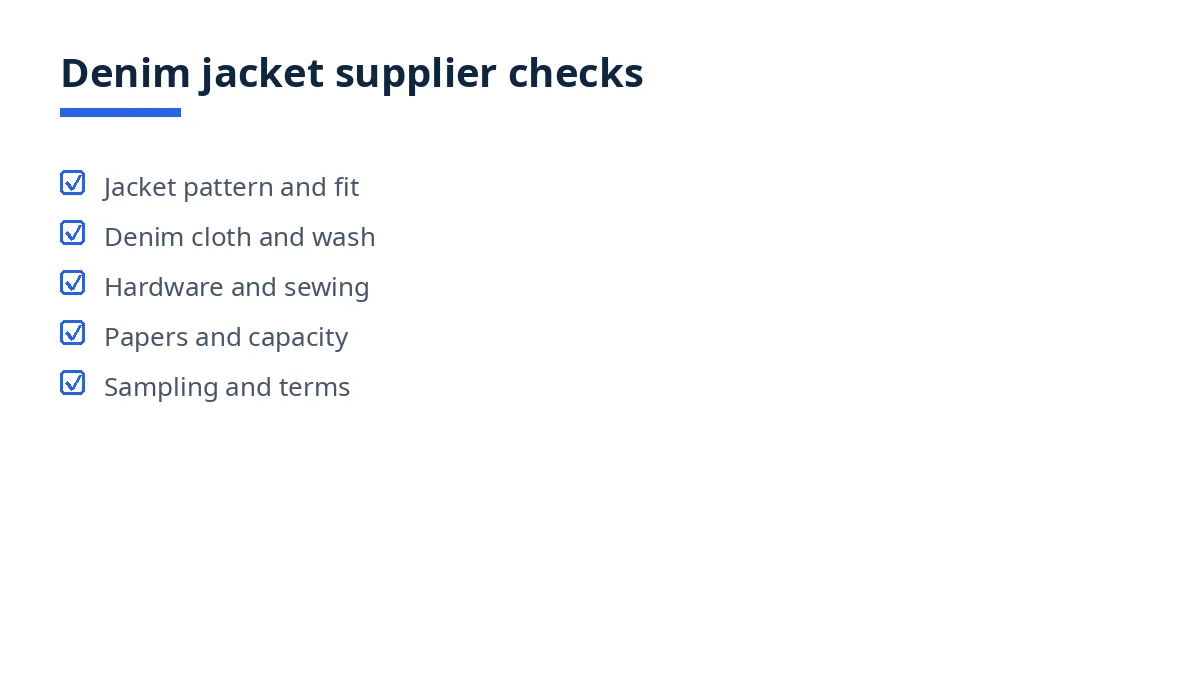
A. Jacket pattern, fit and size run
Compare the bulk jacket with the approved sample: body length, shoulder, chest, sleeve length and cuff opening, against the chart tolerance for each size.
Try the jacket on the intended form or size: the collar should sit flat when closed, the fronts should meet without pulling, and the shoulders should sit on the shoulder point.
Check the sleeve: straight hang from the shoulder, no twist at the seam, and a cuff that closes at the stated circumference without straining its button or snap.
Check the size run, not one size only: measure the smallest, middle and largest sizes, and confirm grading steps between sizes match the chart.
Check pocket placement and size on sample and bulk jackets: pockets at the chart positions, opening cleanly, holding shape when the jacket is buttoned.
B. Denim cloth: weight, weave, stretch and shade
Confirm the bulk denim matches the approved cloth: fibre composition, weave, weight and stretch behaviour as named in the tech pack, with the cloth reference recorded.
Check shade across the order: bulk jackets against the approved wash standard under the same light, within one carton and across cartons, since indigo lots drift.
Inspect the cloth panel by panel, front and back, for holes, slubs, broken yarns, streaks, stains and oil marks, including inside the collar and under pocket flaps.
For stretch denim, check recovery: stretch at the elbow and across the back, release, and confirm it returns without bagging or a visible surface change.
Confirm any special claim in the pack, such as a harmful-substances claim, is backed by the certificate named in the order. Under OEKO-TEX STANDARD 100, the label is awarded only if all components of an item meet the required criteria.4
C. Wash, colour and after-wash behaviour
Compare the bulk wash against the approved sample for tone, contrast at seams and pocket edges, and hand feel, and note any jacket that reads as a different wash.
Review washing fastness evidence where required. ISO 105-C06 specifies methods for determining the resistance of textile colour to domestic or commercial laundering using a reference detergent.5
Review rubbing fastness evidence for dark indigo jackets, since cuffs, collars and pocket edges rub in wear. ISO 105-X12 specifies a method for determining the resistance of textile colour to rubbing off and staining other materials, with one dry and one wet test.6
Review dimensional change evidence after washing where required. ISO 5077 specifies a method for determining the dimensional change of fabrics, garments or other textile articles in specified washing and drying procedures.7
Wash a sample jacket by the label care method where required, then re-measure body, sleeve and chest, and check for twisting, puckering or a collar that no longer sits flat.
D. Hardware: rivets, buttons, zips and snaps
Check every rivet at pocket corners and stress points: centred, fully set, free of sharp edges or cracks, and matched in finish across the jacket.
Pull-test rivets, buttons and snaps by hand on sampled jackets, with the test method and result agreed in advance where a pull test is required.
Work each button through its buttonhole and each snap through several cycles: closures should engage cleanly, without forcing, and buttonholes should be clean-cut with no fraying.
Run each zip the full length several times: no catching, the slider stays on track, and the zip tape lies flat when closed.
Check hardware finish against the sample: no rust spots, plating loss or colour mismatch between buttons, rivets and zips on one jacket.
E. Sewing, lining and finishing
Check seams at shoulder, armhole, side, cuff and collar for skipped or broken stitches, uneven density and puckering, pulling each seam gently by hand.
Check topstitching against the sample: stitch type, thread colour, distance from the edge and straightness, especially on collar, placket and pocket flaps.
Where the jacket is lined, check the lining for correct size, secure attachment at hem and cuffs, and no twisting that pulls the outer shell out of shape.
Check finishing: loose threads trimmed, no shine marks or press damage, pocket bags fully sewn with no raw edges showing, and the jacket pressed to the sample shape.
F. Maker identity, papers and capacity
Confirm the supplier's legal name, factory address and contact route match across profile, quotation and order documents, and record any mismatch before payment terms are agreed.
Ask for the export and association papers the order needs, such as trade licence and membership evidence, and check names, dates and scope rather than accepting a logo or verbal assurance.
Check capacity for this jacket specifically: cutting, sewing, laundry and finishing lines that fit the order size and window, and whether washing is in-house or subcontracted, since it changes who controls washing.
Ask for references from comparable jacket orders, and follow up on at least one: what was ordered, what wash was used, and whether delivery and quality matched the agreement.
G. Sampling, acceptance and order terms
Agree defect classes and acceptance numbers in the purchase order before inspection, using the ISO 2859-1 sampling system as the reference for how the sample is drawn and judged.1
Confirm the inspection point in writing: during production, at final inspection, or both, and who may stop a line or reject a lot.
Confirm in the order what happens above the agreed acceptance level: sorting and re-inspection, rework, partial acceptance, or rejection, and who bears each cost.
Confirm labels, packing and carton markings against destination rules and the packing specification, including fibre composition under Regulation (EU) No 1007/20112 and care symbols under ISO 3758.3
Common failures and how to fix them
Wash drift is the most common jacket failure: bulk jackets come back lighter, darker or less contrasted than the approved sample. Stop the laundry run, compare bulk against the wash standard under the same light, and re-agree the wash recipe before more jackets are processed.
Loose or cracked rivets usually trace to setting pressure or a rivet size that does not suit the cloth weight. Re-set a test batch at the corrected pressure and pull-test it before bulk continues. A twisting sleeve usually traces to cutting or sewing alignment: re-check the sleeve pattern and armhole seam on a test jacket first.
Shade differences across cartons point to more than one denim or wash lot packed together. Re-sort complete sets before packing so one carton does not mix lots.
Summary table
Block | What it covers | Evidence to file |
|---|---|---|
Pattern and fit | Fit, pockets | Measurements |
Denim cloth | Cloth, shade | Cloth reference |
Wash and colour | Wash, fastness | Wash reports |
Hardware | Rivets, zips | Pull checks |
Sewing and finishing | Seams, lining | Seam checks |
Papers and capacity | Papers, lines | Documents |
Sampling and terms | Acceptance, rejection | Order wording |
How Exportain helps
Settle the jacket specification, wash standard and hardware list at the enquiry stage, before bulk starts — that is the point of this checklist. The supplier directory and the verification guide show which document and photo checks a profile already records, so the enquiry can open from evidence rather than claims.
FAQs
When should this checklist be used?
Use it before confirming a new denim jacket supplier, and again at final inspection for first and large orders. For repeat orders, use the fit, wash and hardware blocks on every shipment.
Who should complete it?
The checklist is completed by the buyer, by a local agent acting for the buyer, or by an independent inspector — the role matters less than the kit they carry: the approved sample, the tech pack, the wash standard, and a sample drawn at random from the lot.
What are the most common failures?
Wash drift from the approved sample, shade differences across cartons, loose or cracked rivets, twisting sleeves, collars that will not sit flat, and mismatched hardware finishes are the failures buyers find most often on denim jackets.
Can a third party do it?
Yes, provided the approved sample, tech pack, wash standard, tolerances and acceptance levels reach them first. A third party still needs the physical jacket in hand, not photographs alone, to judge fit, hardware and how the garment behaves after washing.
Next steps on Exportain
Before you confirm a supplier, agree your wash standard, hardware list, tolerances and acceptance numbers in writing, then read the MOQ guide for order size and the AQL acceptance quality limit explainer for sampling. You can also post a free RFQ via RFQs and compare quotes from Bangladeshi suppliers.
Sources
- ISO 2859-1:1999 - Sampling procedures for inspection by attributes — Part 1: Sampling schemes indexed by acceptance quality limit (AQL) for lot-by-lot inspection. International Organization for Standardization (accessed )
- Regulation (EU) No 1007/2011 on textile fibre names and related labelling and marking of the fibre composition of textile products. European Union, (accessed )
- ISO 3758:2023 - Textiles — Care labelling code using symbols. International Organization for Standardization (accessed )
- OEKO-TEX STANDARD 100 for textiles tested for harmful substances. Hohenstein (accessed )
- ISO 105-C06:2010 Textiles — Tests for colour fastness — Part C06: Colour fastness to domestic and commercial laundering. International Organization for Standardization, (accessed )
- ISO 105-X12:2016 - Textiles — Tests for colour fastness — Part X12: Colour fastness to rubbing. International Organization for Standardization (accessed )
- ISO 5077:2007 - Textiles — Determination of dimensional change in washing and drying. International Organization for Standardization (accessed )
About the author
Sourcing from Bangladesh?
Post a request for quotation and suppliers on Exportain can send you their quotes directly.
Post an RFQ