DDP Documents Required: A Complete Checklist for Importers
Under DDP the seller carries the paper trail to the named place, cleared for import. This checklist names every document, its owner, and the check that closes it, in shipment order.
Short answer
Under DDP, the seller must prepare the sale, export, transport, origin, and import papers, including the import declaration and duty payment, and deliver the goods ready for unloading at the named place. The buyer signs the delivery note. This checklist covers twelve documents in shipment order, each with its owner, the contents it must show, and the failure that follows when it is missing or wrong.
On this page
Key takeaways
Under DDP the seller owns the import papers: the import declaration, the registration behind it, and duty and tax payment. A broker can file them, but the responsibility stays with the seller.
DDP is an any-mode rule. Only FAS, FOB, CFR, and CIF are limited to sea and inland waterway transport, so the transport document must match the mode, not the rule.
Under DDP, the seller need not insure the goods for the buyer. Agree the insurance position in writing, or a damaged shipment becomes an argument about cover that was never bought.
For EU preference claims, the exporter must be REX-registered to make out a statement on origin, except for consignments up to EUR 6,000 ex-works. Without valid proof, duty is charged at the full rate.
The DDP documents required on a shipment from Bangladesh are the papers that carry the goods from the seller's warehouse to the named place, cleared for import, with duty and taxes paid. Under DDP, the seller carries that paper trail. The buyer has one paper job: signing for the goods when they arrive. This checklist names each document's owner, what it must show, and what breaks without it, in shipment order.
DDP stands for Delivered Duty Paid, one of the eleven Incoterms 2020 rules. The seller delivers the goods when they are at the buyer's disposal at the agreed place, ready for unloading, and bears the cost and risk of the journey up to that point. The seller handles and pays for export, transit, and import clearance, including duty and taxes. The buyer unloads the goods and bears the unloading risk and, typically, the unloading cost.1
What a DDP paper set has to prove
A DDP paper set has to prove four things: the sale was agreed on DDP terms to a named place; the goods match the invoice, at the value stated; the goods were cleared lawfully, with duty and taxes paid; and the goods reached the named place and were handed over.
Two file rules apply throughout. First, consistency: the description, quantity, weight, and value must read the same on the invoice, the packing list, and the transport document. Descriptions and weights on a bill of lading are typically taken from the shipper's instructions, so an error typed at origin travels with the goods.2 Second, naming: give the full address or terminal, never a city alone.
Agree the filing roles before the goods move
Before booking, answer in writing: who files the import declaration, in whose name, and with what registration; and who signs at the named place. Under DDP the seller remains responsible for import clearance even when a broker does the filing, and the buyer must assist with documents or information the import authorities require.1 If the seller cannot complete import clearance in the destination country, DDP cannot be used as written and DAP is the more suitable rule.1
The DDP documents required, in shipment order
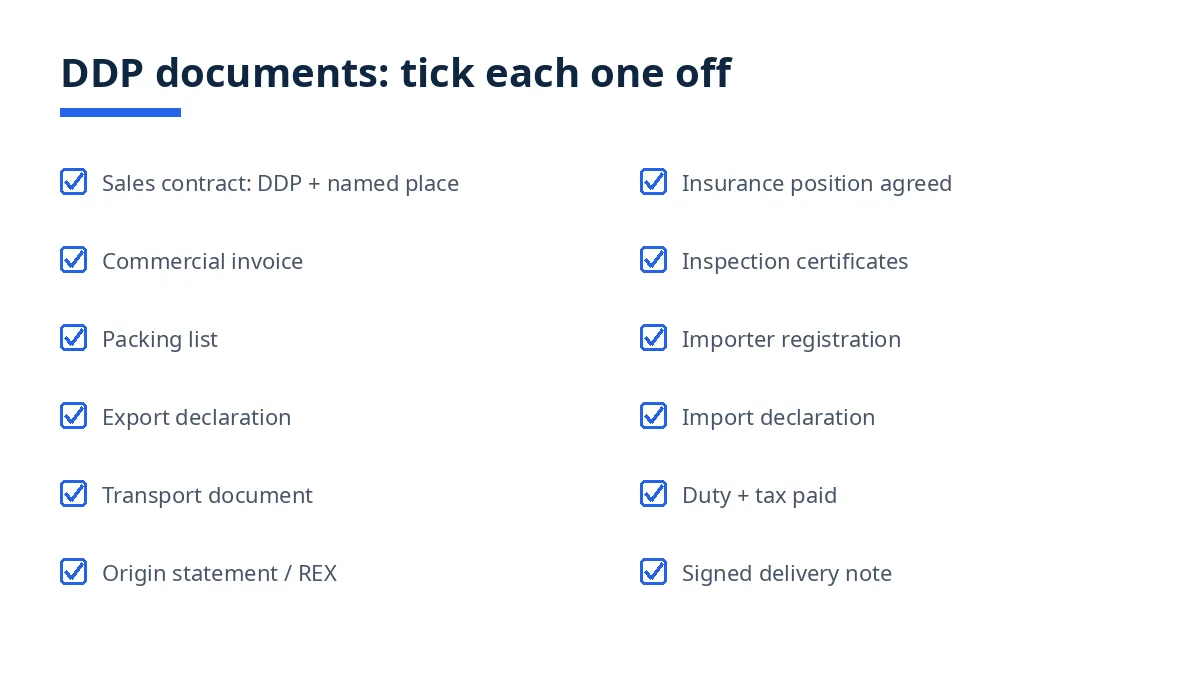
Tick an item only when the paper itself is in the file.
Before shipment: the sale and export papers
1. Sales contract or order confirmation. Owner: seller and buyer jointly. It must state DDP, the named place as a full address or terminal, Incoterms 2020, the goods, the quantity, and the price basis. Without it, the parties can disagree over who clears the goods.1
2. Commercial invoice. Owner: seller. It must show the seller and buyer, a full description of the goods, the quantity, the value, the country of origin, and the delivery term. The seller pays the duty and taxes on the shipment it describes.1
3. Packing list. Owner: seller. It must show each package's contents, count, net and gross weight, dimensions, marks, and invoice number. It must match the invoice in quantities and descriptions, and the transport document in weights and marks.2
4. Export declaration. Owner: seller. It must show the shipment declared for export in Bangladesh and accepted for departure. The seller must complete and pay for export customs formalities under DDP.1 Enclosures depend on the goods and filing route; confirm them with the broker.
At shipment: the transport document
5. Transport document. Owner: carrier issues it; seller approves the draft. It must match the mode: bill of lading for sea, air waybill for air, consignment document for road or rail. DDP works for any mode or combination.1 Only four rules are limited to sea and inland waterway: FAS, FOB, CFR, and CIF. CPT, DPU, and DDP apply on any mode. It must show shipper, consignee, and notify party as agreed, with description, marks, count, and weight matching the invoice and packing list. A bill of lading is a receipt, carriage-contract evidence, and, in some forms, a document of title.2 The consignee box decides who collects the cargo; the notify party is only informed.2 Agree the release method before loading; cargo can arrive before originals do.2 See the Incoterms guide for shipments from Bangladesh and the CIF cost, insurance and freight guide when a supplier quotes a sea-only rule.
6. Certificate of origin or statement on origin. Owner: seller. Where preference is claimed, it must show the proof the arrangement requires. Proof of origin certifies where a product was made and supports a preferential claim.3 Under the Generalised Scheme of Preferences, EU-bound exporters must be Registered Exporter (REX) registered to make out a statement on origin; unregistered exporters may do so only up to EUR 6,000 ex-works.3 Without valid proof, duty is charged at the full rate, on the seller under DDP. Keep copies for at least three years from the date of issue.3
7. Insurance document. Owner: seller decides; no DDP duty to insure. Nothing in DDP requires the seller to buy insurance cover for the buyer, even though the seller carries the transit risk as far as the named place.1 Hold the policy in the file if cover is agreed; record its absence in writing if not.
8. Inspection and certification documents. Owner: seller arranges; the inspector or certifier issues them. They must show the certificates the goods and destination require: quality, weight, sanitary, or others named in the contract. In one ICC Academy DAP case, the seller provided the air waybill with the invoice and origin, quality, and sanitary certificates.1 Goods needing a license or certificate can be held at the border when the paper is missing.4
At import: clearance, duty, and origin
9. Importer registration documents. Owner: seller, through its broker. They must show the registration the destination requires of the filer. For Great Britain, a GB EORI number is needed for England, Wales, or Scotland; an XI number may be needed for Northern Ireland.4 For the EU, USA, and UAE, no rule is stated here: confirm with the broker before the goods arrive.
10. Import declaration. Owner: seller, filed through its broker. It must show the declaration filed in the agreed name, with classification, value, and origin matching the invoice. The seller must carry out and pay for import clearance under DDP and notify the buyer in good time of arrival.1
11. Duty and tax payment proof. Owner: seller pays; the broker files the proof. It must show duty and taxes paid on the declared value, with the proof kept beside the declaration. The seller pays duty and taxes under DDP.1 Goods can be held at the border when the right amount of duty or VAT has not been paid.4 No duty rate is stated here; the broker must confirm it.
At delivery: proof the goods arrived
12. Delivery note or signed receipt. Owner: buyer signs; seller keeps the signed copy. It must show the named place, handover date and time, goods, apparent condition, and the receiver's signature. The seller must give timely notice of arrival, and the buyer must take delivery once the goods are placed at the agreed destination.1
Six breaks in the DDP paper set, and the repair for each
Break | Repair |
|---|---|
Invoice and packing list disagree | Correct at origin; re-check all three papers |
Origin statement missing or unregistered | Register or reissue before filing |
Transport document consigned wrongly | Amend the draft before loading |
Import declaration filed by the wrong party | Re-file in the agreed name |
Duty paid late or on the wrong value | Rework the value from the invoice; pay and file the proof |
No delivery note signed | Sign at handover; record place, time, condition |
At a glance: document, owner, and closing check
Document | Owner and closing check |
|---|---|
Sales contract | Seller and buyer; DDP and named place stated |
Commercial invoice | Seller; matches the declaration |
Packing list | Seller; matches the invoice and transport document |
Export declaration | Seller; filed and accepted before the goods leave |
Transport document | Carrier; seller approves; mode-matched |
Origin proof | Seller; REX where required, proof valid |
Insurance document | Seller decides; cover agreed, or absence recorded |
Inspection certificates | Seller arranges; required certificates in file |
Importer registration | Seller through broker; registration in place |
Import declaration | Seller through broker; agreed name, matches invoice |
Duty and tax proof | Seller pays; proof filed with the declaration |
Delivery note | Buyer signs; place, time, goods, signature recorded |
When should this checklist be used?
Use it on every DDP shipment from Bangladesh, from the order confirmation to the signed delivery note, and reopen it whenever the named place, the mode, the destination country, or the goods change. Do not reuse a past file: the origin statement, declaration, and duty figure are shipment-specific.
Who should complete it?
The seller completes the export, transport, origin, and import papers, directly or through a broker, because DDP puts those duties on the seller.1 The buyer completes only the delivery end: receiving the notice of arrival, taking delivery, and signing the delivery note.
What are the most common failures?
The failures that recur are an invoice and packing list that disagree, an origin statement missing or made out without the required registration, a transport document consigned to the wrong party, an import declaration filed by the wrong party, duty paid late or on the wrong value, and a delivery with no signed note. Each is a paper failure first: the evidence was missing, inconsistent, or late.
Can a third party do it?
A broker or forwarder can prepare and file the declarations and transport arrangements, and advise on registration, origin, and duty. That help does not transfer the seller's responsibility under DDP: the seller remains answerable for export, transit, and import clearance, and for duty and taxes.1 The buyer must still assist with documents or information the import authorities require.1 Ask the broker to confirm in writing, before shipment, that the seller can clear the goods. If not, use DAP.1
Next steps on Exportain
Read the Incoterms guide for shipments from Bangladesh beside the contract terms before you agree DDP, and the how to buy guide for the buying steps around the shipment. When the goods, quantity, named place, and DDP terms are fixed, post a free RFQ on Exportain and get quotes from verified Bangladeshi suppliers: post a free RFQ. Ask each supplier who files the import declaration.
Sources
- DAP & DDP Incoterms 2020 explained: Key differences. ICC Academy (accessed )
- Reading a Bill of Lading: Consignee and Release. Maqboola (accessed )
- Proof of origin. European Commission (accessed )
- Get UK customs clearance when importing goods into the UK: step by step. GOV.UK (accessed )
About the author
Sourcing from Bangladesh?
Post a request for quotation and suppliers on Exportain can send you their quotes directly.
Post an RFQ