Custom Workwear and Uniforms Manufacturer in Bangladesh: OEM Process From Tech Pack to Bulk
Workwear and uniforms from Bangladesh need a job-first OEM process: a durability tech pack, wash-tested samples, fit and grading approval, and bulk checks for tape, seams and sizing.
Short answer
A custom workwear and uniforms order from Bangladesh starts with a job-first tech pack stating the wearer, task, fabric, reinforcements, protective standard and class, tape placement, size set and wash method. Factories then prove the garment through wearer fit samples, wash-tested durability sampling and a pre-production sample in bulk materials before bulk inspection.
On this page
Key takeaways
Workwear buying starts with the job, not the garment: wearer, task, environment, protective standard and class, tape placement, size set and wash method all belong in the tech pack.
High-visibility claims are checked against ISO 20471 class areas and tape rules, and EU Category II and III protective garments need the Notified Body examination route for their category.
Fit and durability are proved before bulk: wearer trials, wash-tested durability samples and a pre-production sample in bulk materials, with results recorded in writing.
Tape lots, dye lots and embroidery set-up each carry their own minimum, so the quantity split, size ratio and delivery term must be compared on the same specification.
Exportain verification is a document and photo review, not a factory inspection, and a badge is not a guarantee of capacity, quality or delivery.
A uniform that looks right on a hanger can still fail on a work site. The jacket may pull across the shoulders when a wearer reaches overhead, the reflective tape may sit too low to be seen from behind, or the trouser knee may wear through after a few industrial washes. For workwear and uniforms, the order is a specification for daily use, repeated washing, and, where the garment is protective clothing, a safety function that must last the life of the garment. State the job, the conditions, and the standard before discussing price or quantity. This guide follows that sequence, from the workwear tech pack through durability sampling, fit approval, and bulk checks.
Why this matters for buyers and sellers
For the buyer, workwear is bought for a workforce, not for a single wearer. One style may need to fit warehouse staff, drivers, cleaners, and supervisors of different builds, and the same style may be reordered for new starters over several seasons. For the seller, workwear is unforgiving of vague input: heavy twill, reinforced seams, bar tacks, reflective tape, and embroidered names each add a process step, and a correction late in bulk production costs far more than a correction at sample stage.
The Bangladesh Garment Manufacturers and Exporters Association (BGMEA) represents the readymade garment industry, particularly woven garments, knitwear, and sweater sub-sectors, and states that it has around 4,500 member factories, with about 60 percent woven garment manufacturers.1 Workwear is largely woven work, so that woven base is the natural starting pool. Membership alone says nothing about one factory and its ability to make a particular protective garment.
Protective workwear adds a second layer of responsibility. Where a garment is sold as high-visibility clothing, its fluorescent and reflective areas, tape width, and placement are not matters of taste. ISO 20471 sets minimum areas of fluorescent material and retroreflective material by class: Class 1 requires 0.14 square metres of fluorescent material and 0.10 square metres of retroreflective material, Class 2 requires 0.50 and 0.13, and Class 3 requires 0.80 and 0.20.2 Tape bands should be no less than 50 mm wide, background material must encircle the torso and, where applicable, the sleeves and trouser legs, and only fluorescent red-orange, fluorescent yellow, and fluorescent red are permitted as background colours.2 A logo over tape reduces the counted reflective area, so settle branding before approving the tape layout.
The conformity route depends on the risk category. Regulation (EU) 2016/425 classifies personal protective equipment into three risk categories, each requiring an EU Declaration of Conformity, with Category II products such as high-visibility clothing requiring EU Type Examination by a Notified Body, and Category III products requiring that examination plus ongoing assessment of compliance.3 Ask at enquiry stage who holds the type examination and whether the bulk garment matches the examined type exactly.
Step-by-step: how it works
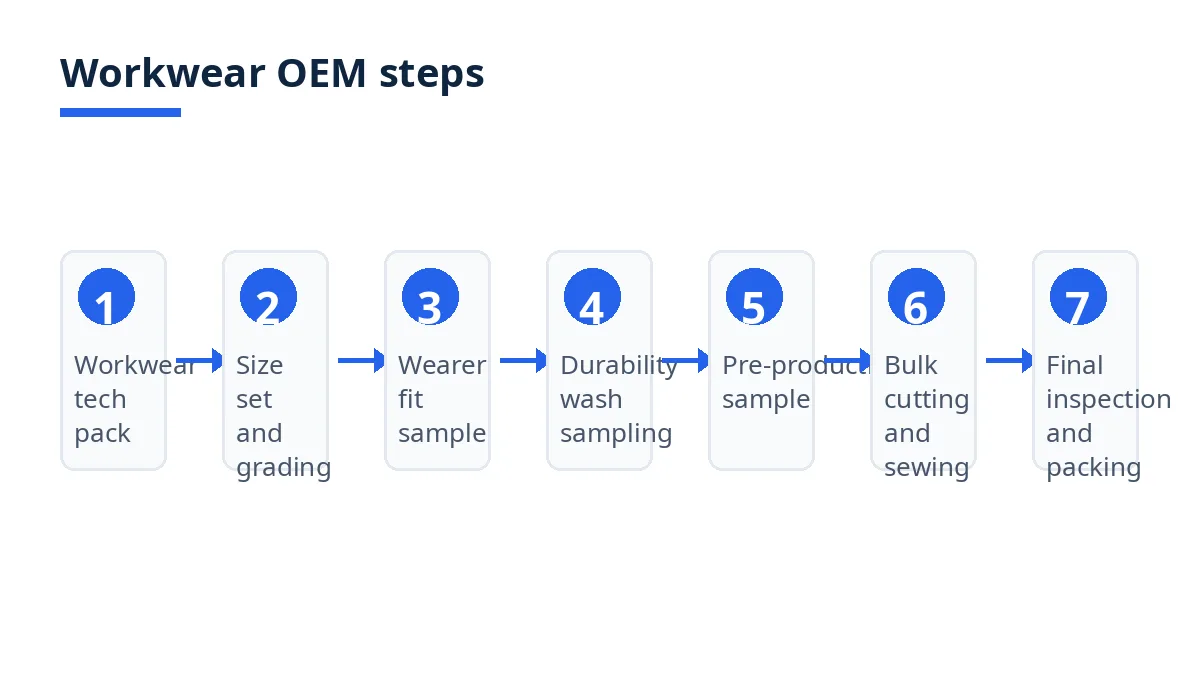
Write the job into the tech pack. State the wearer, the task, the fabric composition, weave, and weight, the garment pieces, and every reinforcement: bar tacks, double-stitched seams, knee and elbow panels, pocket positions, closures, and fastenings. For protective styles, state the standard, class, tape placement, and wash method.
Fix the size set and grading before sampling. Give the full size range, the measurement points that matter for movement, and the size ratio across the workforce. Uniform orders fail most often on fit spread, not on a single sample size, so agree which sizes will be tried on real wearers.
Order a proto sample, then a wearer fit sample. Check reach, bending, sitting, and pocket access on people doing the actual task. Record every correction in writing, with a revised measurement table.
Run durability sampling on the real materials. Wash the sample by the end-use method, including industrial laundering where that applies, and check tape adhesion and reflectivity, seam strength, colour retention, shrinkage, and fastening function after washing.
Approve a pre-production sample in bulk materials. It must use the bulk fabric, tape, thread, trims, and labels, and carry the final artwork and name embroidery positions. Sign it off with the measurement table, the wash result, and the inspection plan attached.
Confirm bulk controls before cutting. Agree the cutting marker, the tape placement template, the inline check points for tape alignment and seam construction, and the final inspection level, including who inspects and what happens to a lot that fails.
Inspect, pack, and ship by size set. Pack by size and wearer group where the buyer needs it, label cartons by style, colour, and size, and keep the approved sample and measurement table with the inspection record so a repeat order starts from the same reference.
Tech-pack field | Specify for workwear |
|---|---|
Fabric | Composition, weave, weight, finish, wash method |
Protection | Standard, class, tape type, width, placement |
Construction | Seam type, stitch density, bar tacks, reinforcements |
Fit and grading | Size range, movement points, size ratio, trial sizes |
Branding | Method, size, placement, clearance from tape |
Labelling | Fibre content, care, size, protective marking |
Packing | Carton breakdown by size, matched pairs or separates |
Classification matters at enquiry stage. Heading 6203 covers suits, ensembles, jackets, blazers, trousers, bib and brace overalls, breeches, and shorts for men or boys, not knitted or crocheted.4 Pieces in one uniform set can therefore sit under different headings, so confirm the heading for each piece. If the goods are sold into the European Union, Regulation (EU) No 1007/2011 governs textile fibre labelling, and a textile product shall be labelled or marked with the name and percentage by weight of all constituent fibres in descending order.5
Costs, timelines and documents
Cost drivers. Workwear pricing turns on fabric weight and durability, tape type and coverage, reinforcement labour, embroidery or print set-up, size range, and wash or finish requirements. A Class 3 high-visibility jacket costs more than a plain uniform jacket not only because of the shell fabric, but because of the fluorescent material area, the tape length and placement labour, and the testing behind it.2
Timelines. Sampling time depends on fabric and tape availability, fit and wash rounds, and whether type examination or laboratory testing is needed for a protective style. Bulk time depends on fabric delivery, tape and trim delivery, line capacity, and the inspection plan. Ask for sampling, fabric ready, production, and inspection dates as separate lines, not a single delivery week.
Example figures: a buyer orders 2,400 uniform sets split across six sizes, with two wash-test rounds before pre-production approval. The example shows structure only, not a typical MOQ, price, or lead time.
Delivery terms and inspection. The Incoterms 2020 rules set out 11 rules with a clear allocation of cost, risk, and obligations.6 Compare quotations only on the same rule and named place, since a price that includes freight and insurance is not comparable with a price that ends at the factory gate. For inspection, ISO 2859-1 defines a system of acceptance sampling plans for inspection by attributes, indexed by acceptance quality limit (AQL) for lot-by-lot inspection.7 Agree the defect list in the purchase order: tape misalignment, open seams, broken bar tacks, wrong size markings, and failed reflectivity after washing should be classified before inspection, not argued about at the inspection table.
Documents. The order documents are the tech pack, the itemised quotation, the purchase order with the inspection plan, and the signed pre-production sample record. For the export set, see the Bangladesh Customs clearance page for the declaration and enclosed documents required before loading.8
Bangladesh-specific rules and tips
Treat a membership claim as a lead, not evidence. Confirm any BGMEA claim with the association itself: around 4,500 member factories, about 60 percent woven garment manufacturers, and 100 percent of woven garment exports from its members.1 That breadth helps a buyer find woven capacity, but it proves nothing about whether one factory can make a particular protective garment, hold a tape stock, or pass a wash test.
Settle the protective claim before the price. A garment described as high-visibility, flame-resistant, or chemical-protective must name the standard, the class or level, and the test evidence behind it. For high-visibility styles, check the fluorescent and retroreflective areas against the class claimed.2 For protective clothing sold into the European Union, check the risk category and whether EU Type Examination by a Notified Body is required, since Category II and Category III products cannot rest on a manufacturer declaration alone.3
Plan for tape and trim supply. Reflective tape, heavy-duty zips, and flame-resistant thread may be bought in for a specific order, and an imported tape can set both the minimum quantity and the earliest production date. Ask which tape and trim items are stocked and which are ordered for the job. A second tape source should be approved before bulk cutting, not found during it.
Keep one legal name and one style reference across every paper. The export declaration names the exporter and the foreign buyer,8 so the name on the trade licence, quotation, proforma invoice, and payment account should match. Keep one style code and one measurement table across every repeat order, so a new starter set ordered six months later matches the first issue. Agree the wash standard in writing too: state the wash method, temperature, and number of cycles the garment must survive, and what counts as a pass for tape adhesion, reflectivity, shrinkage, and colour.
Mistakes and red flags
Approving a sample that has never been worn or washed. A garment measured flat can still bind at the shoulder or lose tape adhesion after laundering. Require a wearer trial and a wash test before pre-production approval, and record both results with the sample.
Placing branding over reflective tape. Embroidery or print laid across tape cuts the counted reflective area and can drop a garment below its claimed class.2 Fix branding positions on the tech pack, clear of tape bands, and check the final artwork against the tape layout on the pre-production sample.
Accepting a protective claim without the category route. A claim that names no standard, class, or examination route should stop the order until the evidence is produced. Category II products require EU Type Examination by a Notified Body, and Category III products require that examination plus ongoing assessment.3
A cheaper quote is not a cheaper garment if the specification moved. A lighter fabric, a lower tape class, or no wash testing each change the offer, so compare replies only when they answer the same tech pack, the same tape specification, and the same Incoterm.
Treating a profile or a badge as proof of workwear capability. A profile is a starting point for enquiries. It does not test whether a factory can sew reinforced seams, place tape accurately at volume, or hold sizing after industrial washing, and a badge is not a guarantee of capacity, quality, or delivery.9
Skipping inline checks to save time. Tape alignment and seam construction are hard to correct after a lot is finished. Sampling under ISO 2859-1 checks a lot against an agreed AQL,7 but that final check works only when inline checks have already caught drift during production.
Checklist
Before you confirm, every line should be answered in writing.
Job and wearer: task, environment, wash method.
Standard and class for every protective piece, with conformity route and test evidence.2 3
Tech pack complete: fabric, reinforcements, tape placement, closures, branding clear of tape.
Size range, movement points, size ratio, and wearer trial sizes agreed.
Proto sample worn by real wearers; durability sample washed by the end-use method.
Pre-production sample approved in bulk materials, with measurement table and inspection plan.
Tape and trim supply confirmed, with a second approved source where tape is critical.
Inspection level, AQL values, and defect classifications in the purchase order.7
Quotations compared on the same specification, tape class, and Incoterm.6
Export set confirmed against the Bangladesh Customs clearance page.8
Repeat reference kept: one style code, one measurement table, approved sample retained.
How Exportain helps
On Exportain, browse suppliers and post a request for quotation (RFQ) on the RFQ board with the job description, the standard and class where the garment is protective, the size set, and the wash requirement, so suppliers quote against the same workwear specification. Read the MOQ guide before setting the quantity split, since tape lots, dye lots, and embroidery set-up each carry their own minimum. When you accept a quotation, Exportain creates one order and issues one proforma invoice from the accepted terms.9
Read badges for what they record on the seller-verification page, and remember that verification is a document and photo review, not a factory inspection.10 That distinction matters most for workwear: sample approval, wash testing, and inspection stay with you, whatever badges a profile carries. See how supplier verification works on Exportain.
FAQs
What should I know first about workwear and uniforms?
Know the job before the garment. State the wearer, the task, the environment, and the wash method, and name the standard and class for any protective piece. Workwear trousers for men or boys fall under heading 6203, which covers suits, ensembles, jackets, blazers, trousers, bib and brace overalls, breeches, and shorts, not knitted or crocheted,4 but each piece in a uniform set needs its own heading check.
What are the typical costs and timelines?
There are no typical figures a buyer can rely on, because each factory prices the fabric weight, tape type and coverage, reinforcement labour, embroidery or print set-up, size range, and testing for the specification given.2 Timelines depend on tape and fabric availability, fit and wash rounds, type examination where a protective category requires it,3 and line capacity. Ask for sampling, fabric ready, production, and inspection dates as separate lines, and compare quotations only on the same Incoterm.6
Which documents are needed?
The order documents are the tech pack, the itemised quotation, the purchase order with the inspection plan and defect classifications, and the signed pre-production sample record with its wash results. For the export set, see the Bangladesh Customs clearance page for the declaration and enclosed documents required before loading.8
What are the most common mistakes?
The most common mistakes are approving a sample that has never been worn or washed, placing branding over reflective tape and cutting the counted reflective area,2 accepting a protective claim without its standard, class, and examination route,3 and reading a badge as proof of workwear capability. A badge is not a guarantee of capacity, quality, or delivery.9
Next steps on Exportain
Browse suppliers, then post the job description, standard and class, size set, and wash requirement on the RFQ board so suppliers quote against the same workwear specification. Before you confirm, read how to import workwear and uniforms from Bangladesh and the workwear and uniforms quality control checklist.
Sources
- BGMEA at a glance. Bangladesh Garment Manufacturers and Exporters Association (BGMEA) (accessed )
- Scotchlite Standards. 3M (accessed )
- Personal Protective Equipment (PPE). SGS (accessed )
- Classification Detail — HS Code 6203. United Nations Statistics Division (accessed )
- Regulation (EU) No 1007/2011 on textile fibre names and related labelling and marking of the fibre composition of textile products. European Union, (accessed )
- Incoterms® 2020. International Chamber of Commerce (ICC) (accessed )
- ISO 2859-1:2026 - Sampling procedures for inspection by attributes — Part 1: Sampling schemes indexed by acceptance quality limit (AQL) for lot-by-lot inspection. ISO (accessed )
- Customs Clearance Procedures for Export. Bangladesh Customs, National Board of Revenue (accessed )
- Trust & Safety Center. Exportain (accessed )
- Supplier verification: Earn trust badges buyers can see. Exportain (accessed )
About the author
Sourcing from Bangladesh?
Post a request for quotation and suppliers on Exportain can send you their quotes directly.
Post an RFQ