Custom Women's Dresses Manufacturer in Bangladesh: OEM Process From Tech Pack to Bulk
Custom women's dresses from Bangladesh, from tech pack to bulk: dress silhouette and drape decisions, print and fitting samples, grading approvals, and the bulk checks that catch hem, seam and print faults before shipment.
Short answer
A custom women's dress order from Bangladesh runs from a dress tech pack through fabric and print approval, proto and fit samples, grading approval and a bulk check built around dress faults. Settle the silhouette, drape, lining, print seam rule and size range in writing first, approve grading at the smallest, middle and largest sizes, and confirm a pre-production sample in bulk materials before cutting starts.
On this page
Key takeaways
A custom women's dress is a fitted garment: silhouette, drape, lining, print placement across seams and grading must all be settled in writing before bulk cutting starts.
Approve fabric and print strike-off separately from garment fit, then run a proto sample for shape and a fit sample on a form or model in the base size.
Approve grading at the smallest, middle and largest sizes, checking waist-to-hip proportion, skirt flare and hem length at each end of the range.
Build the bulk check around dress faults: hem evenness, waist seam level, print placement across seams, closure function, lining attachment and stitch quality at gathers, pleats and tiers.
Exportain verification is a document and photo review, not a factory inspection, and a badge is not a guarantee of capacity, quality or delivery.
A custom women's dress order is decided by how the dress holds its shape on a body, not only by how it looks flat on a table. The silhouette, the drape of the skirt, the fit across the bust and waist, and the way a print falls across a seam are the points where a dress sample most often fails, and each of them has to be settled in writing before bulk cutting starts. This guide follows that thread from the first tech pack through fitting samples, grading approval and the final bulk check, so a buyer can judge a quotation on the dress itself rather than on a general factory claim.
For context on scale, ready-made garment exports from Bangladesh reached $10.578 billion in July to September of the current fiscal year, with woven garment exports at $4.614 billion, according to data released by the Export Promotion Bureau (EPB).1 The Bangladesh Garment Manufacturers and Exporters Association (BGMEA) represents the readymade garment industry, including woven garments, and reports around 4,500 member factories, with about 60 percent making woven garments.2 That scale does not remove the need to test drape, fit and print on the buyer's own specification.
Why this matters for buyers and sellers
For a buyer, a dress is a fitted garment with several measurements that must move together. A bodice that fits, a waist seam that sits level, a skirt that falls without pulling at the hip, and a hem that stays even after washing are four separate results, and a failure in any one of them reaches the customer. For a seller, the same points decide whether bulk production can run without rework: once fabric is cut to a graded pattern, a correction to the waist or the skirt flare is no longer a small edit.
Dresses also carry decoration that interacts with construction. A print, a pleat, a gather or a tier changes where the fabric stretches and where a seam must carry weight. A print placed without reference to the bust dart, the waist seam or the side seam can break across the body in a way that no flat artwork review will show. Dress sampling therefore has to include a fitted check, not only a measurement table, and the approval record should name the size and the fit model or form used for each round.
Step-by-step: how it works
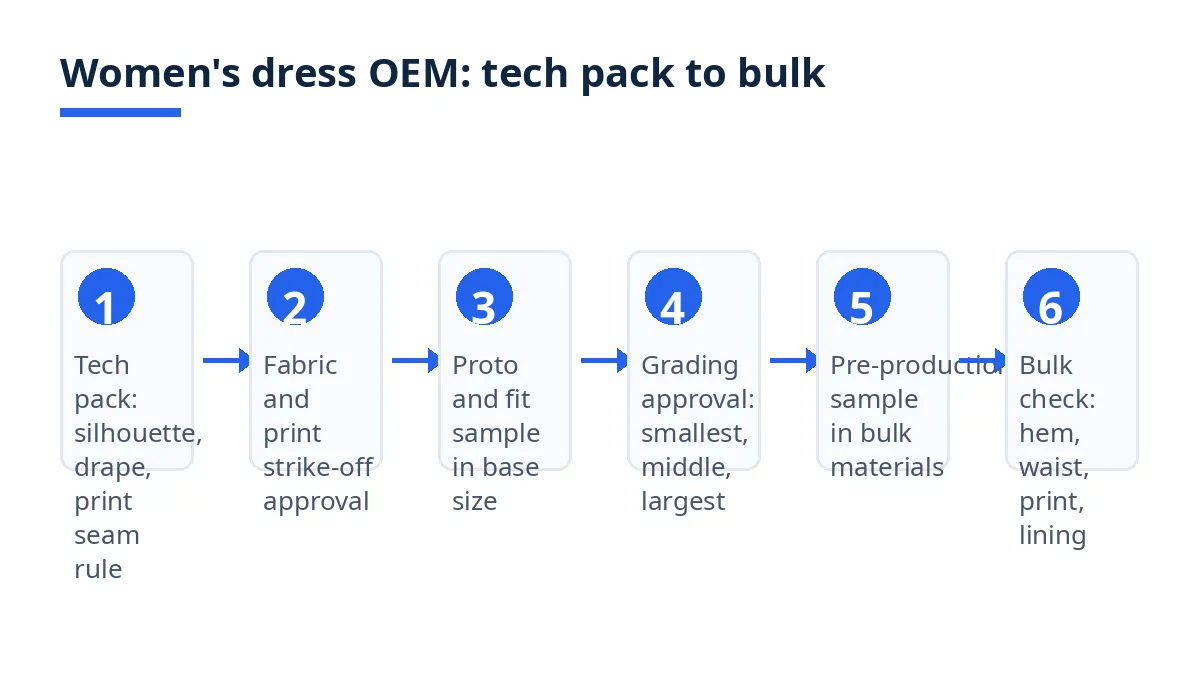
Write the dress tech pack around silhouette and drape. State the silhouette and length, the bodice construction, neckline, sleeve type, waist treatment, skirt shape and hem finish, plus the fabric composition, weight, drape behaviour and lining. Add a flat sketch with the print or motif position marked against the bust, waist and side seams, and state whether the print must match across seams or may fall freely.
Lock the measurement set before sampling. Give the point-of-measure list for bust, waist, hip, shoulder, bodice length, skirt length and hem, with the tolerance for each point and the size range the order will cover. A dress grade moves bust, waist and hip together, so the ratio between sizes matters as much as any single measurement.
Approve the fabric and the print strike-off first. Confirm the base cloth, the lining cloth and the print or dye result on the actual fabric. A strike-off shows colour and motif scale; it does not show how the printed cloth will drape, so keep the fabric approval and the garment fit approval as separate decisions.
Run a proto sample for shape, then a fit sample for the body. The proto sample tests whether the pattern produces the intended silhouette. The fit sample is tried on a form or model in the base size, and corrections are recorded point by point: bodice length, waist position, hip ease, sleeve hang, skirt flare and hem level.
Approve grading across the size range. Ask for graded samples or a graded measurement check in at least the smallest, middle and largest sizes, and confirm that the waist-to-hip proportion, the skirt flare and the hem length hold at each end of the range.
Confirm the pre-production sample in bulk materials. The pre-production sample should use the approved fabric, lining, print, trims, labels and packing, and it should be measured and washed under the buyer's stated method. Approve it in writing, with any remaining corrections listed, before bulk cutting is released.
Set the bulk quality check around dress faults. Agree the inspection level, the sampling plan and the defect list before production, with dress-specific points: hem evenness, waist seam level, print placement across seams, zip or closure function, lining attachment, and stitch quality at gathers, pleats and tiers. ISO 2859-1 defines a system of acceptance sampling plans for inspection by attributes, indexed by acceptance quality limit (AQL) for lot-by-lot inspection, and AQL is the maximum average percentage of defective items considered acceptable during random sampling.3
Woven women's dresses fall under heading 6204 in the Harmonized System, which covers suits, ensembles, jackets, dresses, skirts and related women's or girls' garments, not knitted or crocheted, and the fibre-specific subheading follows the dress material, for example 620443 for dresses of synthetic fibres.4 For sales into the European Union, Regulation (EU) No 1007/2011 covers textile fibre names and related labelling and marking of fibre composition.5
Costs, timelines and documents
What are the typical costs and timelines?
There is no typical dress price or lead time that a guide can state as fact, because the fabric, the lining, the print method, the number of pattern pieces, the decoration and the size range all move the result. A tiered skirt with a lining and a placed print carries more cutting, sewing and checking work than a plain straight dress in one cloth, and a wide size range adds grading and marker work even when the total quantity stays the same.
Cost driver | Why it moves a dress quotation | State in your enquiry |
|---|---|---|
Silhouette and skirt shape | Pattern pieces, flare, gathers and tiers change cutting and sewing time | Silhouette, length, skirt shape, hem finish |
Drape and lining | A fluid cloth and a separate lining add handling and attachment steps | Fabric, weight, drape, lining cloth |
Print and motif placement | Placed prints need marker control and seam matching | Print method, motif position, seam-match rule |
Fit and grading | More sizes and tighter tolerances add sample and checking rounds | Size range, ratio, tolerances, fit approval sizes |
Trims and closures | Zips, buttons, belts and labels each carry their own supply step | Trim, closure, label and carton specification |
Delivery term | Who pays freight and insurance and where risk passes | One Incoterm and named place for every quotation |
Example figures: a buyer orders 900 dresses in three prints at 300 per print, with the same silhouette and size range for each print. The total looks like one order, but each print still needs its own strike-off, marker check and seam-match decision, so the per-print quantity, not the total, decides whether each print can run. The example shows structure only, not a typical price, minimum or lead time.
For timelines, ask for sampling, fabric and print ready, fit approval, grading approval, bulk production and inspection dates as separate lines, not a single delivery week. Print approval and fit corrections are the two stages most likely to move a dress schedule.
Which documents are needed?
The order documents are the dress tech pack, the itemized quotation and the purchase order, with the silhouette, measurement tolerances, print placement rule, grading approval sizes and inspection plan on both the quotation and the order. For shipment, confirm the export declaration route with your supplier and forwarder; Bangladesh Customs states that goods are not loaded for export until the Bill of Export is submitted and approved.6
Bangladesh-specific rules and tips
Check woven-dress experience, not garment experience in general. A factory that sews straight woven tops may never have handled a lined, flared or printed dress, where drape and skirt balance matter. Ask for the dress types the factory has actually cut, and which silhouettes, linings and print methods those orders used. A claim of association membership can be confirmed with the association itself; BGMEA reports around 4,500 member factories, with about 60 percent in woven garments.2
Agree the print and fabric supply route early. Some dress fabrics and print bases are imported for the order, and an imported base cloth can set both the earliest production date and the minimum for that print. Record whether each fabric and lining is stocked, dyed or printed to order, and which print base each colourway uses, before the fit sample is cut.
One delivery term on every quotation. Freight and insurance treatment can hide a higher dress price behind a lower delivered figure, or the reverse, so judge dress quotations only on the same term and named place. The Incoterms 2020 rules give 11 rules that split cost, risk and obligations between buyer and seller.7
Mistakes and red flags
What are the most common mistakes?
Approving a dress from a flat photo. A flat sample hides waist pull, skirt imbalance and hem swing. Require a fitted check in the base size, with the waist seam, hip ease and hem level reported, before the pattern is graded.
Leaving print placement to the marker room. When the tech pack shows a motif without a seam rule, the factory must guess whether the print should match across the side seam, continue over the waist seam or sit clear of both. State the rule on the tech pack and check it on the pre-production sample.
Grading from the middle size only. A dress grade checked only at the middle size can pass there and fail at the smallest or largest size, where bust, waist and hip proportions shift most. Require a graded check at both ends of the range.
Approving fabric and fit in the same decision. A cloth that looks right and a bodice that fits are two approvals. Merging them lets a fabric change slip through under a fit approval, or a fit correction hide behind a fabric approval, and neither decision is then traceable.
Taking a profile or a badge as a dress capability check. A profile opens the enquiry; it cannot prove a factory holds drape, print placement and grading on your dress, and a badge on its own guarantees nothing about capacity, quality or delivery.8
Skipping the bulk dress-fault list. A general inspection that checks only measurements will miss hem unevenness, print breaks across seams, lining twist and closure faults. Write the dress-specific defect list into the inspection plan before production, using an agreed sampling plan under ISO 2859-1.3
Checklist
Before you confirm, every line should be answered in writing.
Tech pack sent: silhouette, length, bodice, neckline, sleeve, waist treatment, skirt shape, hem finish, fabric, drape, lining.
Print or motif position marked against bust, waist and side seams, with the seam-match rule stated.
Measurement set and tolerances agreed for bust, waist, hip, shoulder, bodice length, skirt length and hem.
Fabric, lining and print strike-off approved separately from garment fit.
Fit sample tried in the base size, with waist position, hip ease, skirt flare and hem level reported.
Grading approved at the smallest, middle and largest sizes, with waist-to-hip proportion checked at each end.
Pre-production sample in bulk materials measured and washed under the stated method, then approved in writing.
Bulk defect list agreed: hem evenness, waist seam level, print placement across seams, closure function, lining attachment, stitch quality at gathers, pleats and tiers.
Inspection level and AQL values in the purchase order.3
Quotations compared on the same dress specification and the same Incoterm and named place.7
How Exportain helps
On Exportain, raise a request for quotation (RFQ) on the RFQ board after browsing suppliers, carrying your dress tech pack summary, silhouette, print placement rule, size range and delivery term, so every supplier quotes the same dress specification. Ask each reply for its dress experience by silhouette and print method, its grading approval sizes and its bulk dress-fault list. Once you accept a quotation, Exportain turns the accepted terms into one order and one proforma invoice.
Read badges only for the document and photo checks they record, as described on the Trust & Safety Center, and treat them as no guarantee of capacity, quality or delivery.8 Verification is a document and photo review, not a factory inspection.9 Sample approval, fit approval and bulk inspection therefore stay with you. See how supplier verification works on Exportain and the MOQ definition guide.
FAQs
What should I know first about women's dresses?
A custom women's dress is a fitted garment whose silhouette, drape, print placement and grading must all be settled before bulk cutting. Woven dresses fall under heading 6204, which covers women's or girls' dresses, not knitted or crocheted, with the fibre-specific subheading following the dress material.4 Start with the silhouette, the fabric drape, the lining, the print seam rule and the size range, and require a fitted sample before grading.
What are the typical costs and timelines?
There are no typical figures a buyer can rely on, because each factory prices your silhouette, fabric, lining, print method, pattern pieces, size range and delivery term. The Incoterms 2020 rules allocate cost, risk and obligations across 11 rules,7 so compare quotations only on the same term. Sampling, print approval, fit corrections and grading approval each move the timeline, so ask for them as separate dates.
Which documents are needed?
The order documents are the dress tech pack, the itemized quotation and the purchase order, with the silhouette, measurement tolerances, print placement rule, grading approval sizes and inspection plan recorded on both. For shipment, confirm the export declaration route with your supplier and forwarder; Bangladesh Customs states that goods are not loaded for export until the Bill of Export is submitted and approved.6
What are the most common mistakes?
The most common mistakes are approving a dress from a flat photo, leaving print placement without a seam rule, grading from the middle size only, merging fabric and fit approvals, and treating a badge as a capability check. A badge is not a guarantee of capacity, quality or delivery,8 and bulk inspection under an agreed sampling plan stays with the buyer.3
Next steps on Exportain
Raise your dress tech pack summary, silhouette, print placement rule and size range as an RFQ after browsing suppliers, so suppliers quote on one identical dress specification. Before confirming, read how to import women's dresses from Bangladesh and the women's dresses quality control checklist.
Sources
- Exports up over 6% to $13.1bn in Q1 of current fiscal. United News of Bangladesh (accessed )
- BGMEA at a glance. Bangladesh Garment Manufacturers and Exporters Association (BGMEA) (accessed )
- ISO 2859-1:2026 - Sampling procedures for inspection by attributes — Part 1: Sampling schemes indexed by acceptance quality limit (AQL) for lot-by-lot inspection. ISO (accessed )
- Classification Detail — HS Code 620443. United Nations Statistics Division (accessed )
- Regulation (EU) No 1007/2011 on textile fibre names and related labelling and marking of the fibre composition of textile products. European Union, (accessed )
- Customs Clearance Procedures for Export. Bangladesh Customs, National Board of Revenue (accessed )
- Incoterms® 2020. International Chamber of Commerce (ICC) (accessed )
- Trust & Safety Center. Exportain (accessed )
- Supplier verification: Earn trust badges buyers can see. Exportain (accessed )
About the author
Sourcing from Bangladesh?
Post a request for quotation and suppliers on Exportain can send you their quotes directly.
Post an RFQ