Custom Winter Coats Manufacturer in Bangladesh: OEM Process From Tech Pack to Bulk
Custom winter coats OEM process in Bangladesh: tech pack, sample ladder, bulk controls and coat failure points, with costs, documents and supplier checks.
Short answer
A custom winter coats manufacturer in Bangladesh turns a buyer tech pack into bulk coats through a sample ladder and controlled production. Lock the shell, fill distribution, lining, grading and labels in the tech pack, approve a sealed pre-production sample in production materials, and inspect bulk against that sample under an agreed AQL standard.

On this page
Key takeaways
The OEM process starts with the coat decision: construction, shell, fill distribution, lining and fit over layers, all locked in the tech pack.
A winter-coat tech pack needs a fill distribution map by panel, quilt drawing, grading rules, tolerances, trim specifications and label wording.
The sample ladder is proto, fit, salesman and pre-production; the pre-production sample, in production materials, is the sealed bulk reference.
Bulk controls catch coat-specific failures: fill migration, seam opening, closure failure, shade variation, shrinkage, fill leakage and label errors.
Exportain verification is a document and photo review, not a factory inspection, and a badge is not a guarantee.
A winter coat fails or succeeds on decisions made before cutting starts: shell cloth, fill, how the fill is held in place, and how the coat is graded for the sizes and layers it will be worn over. The search term custom winter coats manufacturer bangladesh returns factories, trading companies and listings. This guide separates them by what each one does with a tech pack, a sample and a bulk order.
A custom winter coats manufacturer in Bangladesh turns your specification into a repeatable production process. Make the specification complete enough that two factories quote the same coat, and hold each stage gate until the coat in front of you matches the coat you specified.
The coat decision comes before the factory decision
Start with construction, because it decides the machines, skills and checks needed. A quilted coat needs quilting that holds fill in even panels. A bonded coat needs shell and membrane joined without delamination. A wool-blend overcoat needs fusing and pressing a quilted-coat line may not run daily. A parka with hood, storm placket and drawcords needs hood and closure work a plain overcoat does not. Ask which constructions the factory runs regularly, by construction type.
Fit comes next. A winter coat is worn over other layers, so grade it for the body plus a mid-layer, and state the layer the fit sample is measured over. State the fit intent, close, regular or relaxed, the chest and hip ease at each size, and sleeve length with the arm in a natural position. Agree the base size for grading.
Classification follows the garment. Heading 6201 covers overcoats, car-coats, capes, cloaks, anoraks, wind-cheaters, wind-jackets and similar articles for men or boys, not knitted or crocheted, other than those of heading 6203.1 Heading 6202 covers the equivalent coats for women or girls, other than those of heading 6204.2 Subheadings separate coats by shell material: wool or fine animal hair, cotton, man-made fibres, and other textile materials.1 2 Confirm the subheading with your customs broker against the finished coat.
What a winter-coat tech pack must contain
A tech pack is a manufacturing instruction, not a mood board. Send the same pack to every candidate, and require every quotation to answer it line by line. A quotation that answers a different coat is not a cheaper quotation.
Section | Lock in writing |
|---|---|
Sketch and construction | Front, back, hood, pocket and closure drawings, seam and edge callouts |
Shell cloth | Fibre, weave or knit, weight, width, colour reference, finish, coating or membrane |
Fill | Fill type, weight or fill power, distribution by panel, test method |
Lining and interlining | Lining fibre and weight, quilted or plain lining, fusing areas and specification |
Pattern and grading | Base size, grade rules, layer allowance, measurement points |
Measurements | Point-of-measure list, target values per size, tolerance at each point |
Seams and stitching | Seam type per join, stitch type, reinforcement at pockets, hood, closures |
Trims and closures | Zip, button, snap, drawcord, eyelet and label specifications, with references |
Labels and packing | Fibre, care and origin labels, hang tags, polybag, folding, carton specification |
Testing and inspection | Tests required, lab or method, inspection standard, AQL values |
Fill needs its own page. State the fill for each panel, not one weight for the whole coat. Include a fill distribution map: a drawing with the fill amount written on each panel. State how the fill is held, quilt lines, channels, baffles or bonded layers, with quilt spacing drawn to scale. If the fill is down or a down blend, state the down content, the fill specification, and the shell requirement that limits leakage, plus the test evidence you will accept before bulk. Do not accept "warm fill" or "premium down"; those words cannot be measured at inspection.
Labels are part of the tech pack. For the European Union, a textile product shall be labelled or marked with the name and percentage by weight of all constituent fibres in descending order.3 In the United States, federal law requires most textile and wool products to carry a label listing the fibre content, the country of origin, and the identity of the manufacturer or another business responsible for the product, 4 Confirm the cleaning-instruction (care labelling) requirement in writing with your importer before labels are printed. Approve label artwork as a separate gate from the coat sample. For the United Kingdom and the United Arab Emirates, no labelling rule is stated here, because no source for those markets was opened for it; get the current requirement in writing from your importer before labels are printed.
The sample ladder: proto, fit, salesman and pre-production
Each sample answers one question, and the next stage starts only when that question is answered in writing. Moving to bulk on an unanswered question moves the cost of the answer into the bulk lot.
Sample | Proves | Cloth and trims | Gate decision |
|---|---|---|---|
Proto | Construction, pattern, seams, hood, pockets, closures | Substitute cloth acceptable if stated in writing | Approve construction, or list corrections |
Fit | Fit and measurements, base size, over the agreed layer | Production cloth preferred; state any substitute | Approve fit, or list grading corrections |
Salesman | Coat as sold and photographed, for sales and listing use | Production cloth, fill, lining, trims | Approve appearance, or correct colour, trim, finish |
Pre-production | Full production coat, by the production method | Production materials, locked bill of materials | Approve for bulk, or stop and correct |
At the proto stage, check hood shape and attachment, pocket placement and depth, closure alignment, and how quilt lines meet at seams. Record corrections against the drawing or measurement point they change.
The fit sample is measured, not only tried on. Measure every point, compare it with the target and tolerance, and record the result. If fit changes the pattern, grade the change across the size range and check the end sizes, not only the base size.
The pre-production sample is the bulk reference. It must carry production labels, hang tags and packing, and be made from the locked bill of materials. Seal it, photograph it, and keep the approval in writing with the sample reference, the bill of materials version, and the date.
Custom winter coats manufacturer Bangladesh: from approved sample to bulk
Bulk production is a sequence of controlled handoffs. An error at one handoff travels into the next. Agree the sequence and the check at each handoff before cutting starts, and name the role who signs each check.
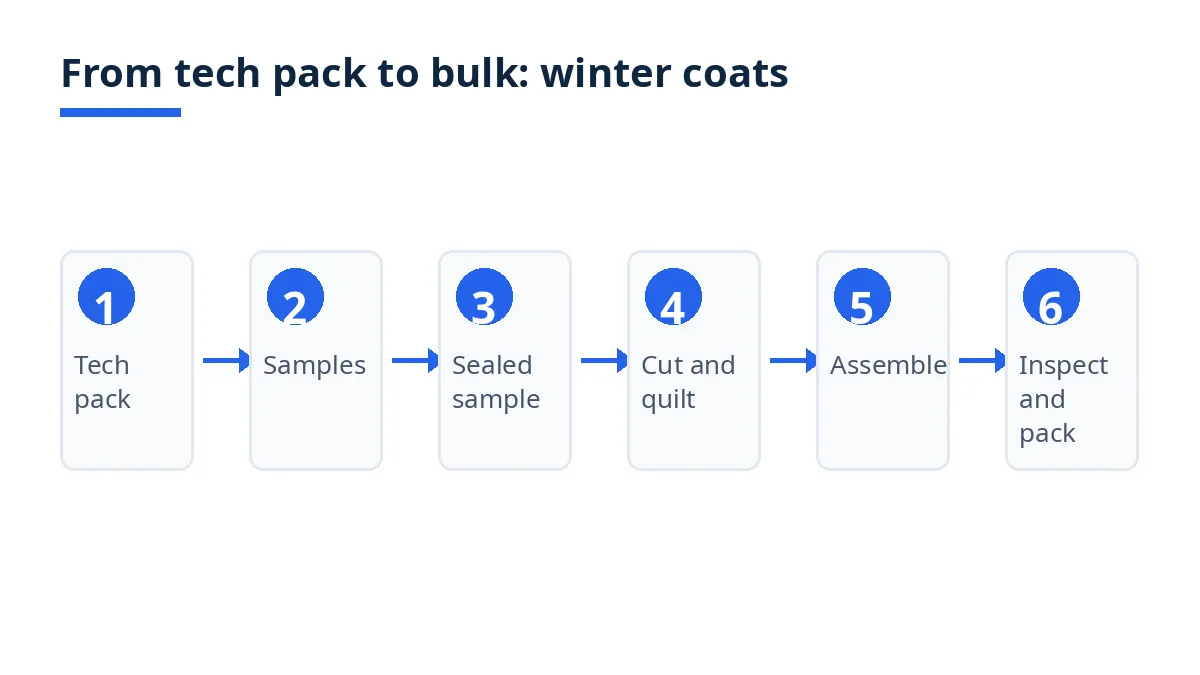
Lock the bill of materials and the sealed sample. No material, trim or label changes after this point without a written change note and, where needed, a new sample.
Marker, shade sorting and cutting. Shell cloth is sorted by shade before cutting, so one coat is cut from one shade lot, and fill lots stay separate by panel.
Panel preparation and quilting. Quilt lines, channels or baffles are formed to the drawing, and fill is placed panel by panel to the distribution map. Check fill per panel on a defined frequency.
Main assembly. Body, sleeves, hood and lining are assembled in the stated sequence. Stress points at pockets, hood attachment and closures are reinforced as specified.
Closures and trims. Zips, buttons, snaps, drawcords and eyelets are attached and tested for function on every coat at the station.
Pressing and finishing. Pressing follows the shell and lining specification. Loose threads are trimmed, and each coat is checked for shine, pressing marks and shape distortion before packing.
Inspection and packing. Inline checks run during production, and final inspection runs on the finished, packed coat against the sealed sample, measurement list and label artwork. Cartons are packed to specification, with the size and colour mix per carton recorded.
Bulk-production controls and coat-specific failure points
A winter coat has failure points a lighter garment does not, and most are invisible on a folded coat in a carton. Check them at the stage where they can still be fixed.
Failure point | Check | When |
|---|---|---|
Fill migration, cold spots | Fill per panel, quilt spacing, even distribution | Panel preparation, inline, final |
Seam slippage, opening | Seam construction at armholes, hood, pockets | Proto, pre-production, inline |
Zip, button, snap failure | Function, alignment, pull strength at the station | Assembly, final |
Shade variation | Shade sorting, panel-to-panel shade in one coat | Cutting, final |
Shrinkage, shape change | Washed measurements against tolerances, production cloth | Pre-production, inline |
Fill leakage | Shell and seam performance, agreed test evidence | Pre-production, before bulk |
Label, packing errors | Fibre percentages, care wording, size marking, carton mix | Pre-production, final |
Agree the inspection standard before production, and write it into the purchase order. ISO 2859-1 defines a system of acceptance sampling plans for inspection by attributes, indexed by acceptance quality limit (AQL) for lot-by-lot inspection, and AQL is the maximum average percentage of defective items considered acceptable during random sampling.5 The standard uses AQL to determine sample sizes and acceptance or rejection thresholds, and includes switching rules that move to tightened inspection when defects increase.5 Set AQL values by defect class: critical, major and minor.
Costs, timelines and documents
What drives cost
There is no typical cost for a custom winter coat that a guide can state as fact, because each coat prices its own shell, fill, lining, construction, trims, testing and delivery term. Cost follows construction order: shell cloth, fill and lining, cutting and sewing, closures and trims, finishing, testing and packing, then inland transport and port handling. Compare quotations only on one specification, one quantity basis and one delivery term, with each cost line shown separately.
Example figures: in a 100-unit example, shell cloth is 34 units, fill is 22 units, lining and interlining are 8 units, trims and closures are 10 units, cutting and sewing are 16 units, and testing, packing, inland transport and port handling together are 10 units, for a total of 100 units. The example figures show structure only. They are not a price, a typical cost, or a quotation for any coat.
How timelines are built
Build the timeline as separate lines, not one delivery week: tech pack and quotation, sampling rounds, shell and fill ordering, trim ordering, bulk production, inspection, and shipping. Sampling rounds are the most common source of delay. State the number of rounds in the quotation, who pays for extra rounds, and how many working days each approval step is allowed. Agree the calendar backwards from your retail date.
The delivery term is part of the timeline and the cost. The Incoterms 2020 rules set out 11 rules with a clear allocation of cost, risk and obligations.6 The rules provide different levels of insurance cover under CIF, reserved for maritime trade, and CIP, and FCA was revised for cases where an on-board bill of lading is requested.6 State one Incoterm and one named place on every quotation, and compare delivery dates only on the same term. For minimum quantities, see the MOQ minimum order quantity guide, and ask each factory for its minimum per style, per colour and per size, in writing, against your tech pack.
Which documents are needed
The order documents are the tech pack, itemized quotation, purchase order with inspection standard and delivery term, written sample approvals, test reports, and final inspection report. Keep the bill of materials version with the sealed sample reference on the purchase order.
For export clearance in Bangladesh, goods may not be loaded unless an export declaration, the Bill of Export or Shipping Bill, is submitted to Customs and approved.7 Documents enclosed include the export contract or purchase order where there is no export letter of credit, the commercial invoice, the packing list, the EXP form certified by an authorized dealer, and a certificate of origin issued by the Export Promotion Bureau or a Chamber of Commerce and Industry.7 Ask the supplier which documents it will provide, and keep the names on the trade licence, quotation, invoice and payment account consistent across every paper.
Bangladesh-specific rules and tips
Winter coats are woven outerwear, and the trade body for the garment sector is the Bangladesh Garment Manufacturers and Exporters Association (BGMEA). BGMEA describes Bangladesh apparel as made by more than 4,000 factories and reaching more than 150 countries.8 Its website offers a member search, so if a supplier claims BGMEA membership, confirm the claim with the association itself. Membership does not prove capacity for your coat, and it does not replace a sample, a test report or an inspection.
Ask where the shell cloth and fill come from for your order, and whether either is imported for your specification. An imported shell or a fill ordered to your weight sets both the earliest cutting date and the minimum lot. Agree the order of arrivals in writing, with a named date for each arrival: shell and fill, lining and interlining, trims, labels and cartons.
Mistakes and red flags
Approving fit on the wrong cloth. A fit sample in a substitute shell does not prove fit in the production shell. State the cloth for each sample in the approval.
Writing "warm" instead of a fill specification. Fill type, weight by panel, distribution and test method are the specification. A description that cannot be measured cannot be inspected.
Skipping the pre-production sample. It is the only sample made from production materials by the production method. Skipping it moves every material and trim question into bulk.
Comparing quotations for different coats. A lower price on a lighter shell, simpler closure, different fill or different delivery term is a different coat. Compare only replies to the same tech pack on the same Incoterm.6
Accepting a change verbally. A material substitution, trim change or shade acceptance agreed by voice has no record at inspection. Record every change on the quotation and purchase order.
Ignoring shade lots. A coat cut from two shade lots looks like two coats when sewn together. Shade sorting before cutting is a control, not a preference.
Treating a profile or a badge as a factory check. A listing and a badge are starting points for enquiries. They do not test whether a factory can make your coat, and a badge is not a guarantee of capacity, quality or delivery.9
Checklist
Before you confirm a bulk order, every line should be answered in writing.
Tech pack sent to every candidate: sketch, shell, fill map, lining, pattern, measurements, seams, trims, labels, packing, testing.
Construction and fit intent agreed, with the layer the fit is measured over.
Fill specified by panel, with distribution map, quilt drawing and test method.
Label wording, fibre percentages and care instructions approved as a separate gate.3 4
Sample ladder agreed: proto, fit, salesman and pre-production, with the decision at each gate.
Pre-production sample sealed and approved, with bill of materials version and sample reference recorded.
Minimum quantity confirmed per style, per colour and per size, against the tech pack.
Inspection standard and AQL values by defect class in the purchase order.5
Delivery term and named place on every quotation, with timelines as separate lines.6
Input arrival order agreed: shell, fill, lining, trims, labels and cartons.
Export document set agreed: invoice, packing list, EXP form, certificate of origin, Bill of Export.7
Change control agreed: no material or trim change after the sealed sample without a written note and, where needed, a new sample.
How Exportain helps
On Exportain, browse suppliers and post a request for quotation (RFQ) on the RFQ board with your tech pack summary, fill specification, size range, quantity per colour and delivery term, so suppliers quote against the same coat. State the quantity and unit, target price, destination, Incoterm, required certifications and deadline in the RFQ.10 When you accept a quotation, Exportain creates one order and issues one proforma invoice from the accepted terms.9
Read the badges for what they record. Exportain Verified means Exportain has checked identity, phone, email and business registration, Export Verified means it has checked the Export Registration Certificate (ERC), Factory Verified means it has reviewed photos of the factory, and Trading Company Verified means it has reviewed photos of the trading company office or warehouse.9 Verification is a document and photo review, not a factory inspection, and a badge is not a guarantee.9 11 Verification is free and never granted by membership plans.11 See how supplier verification works on Exportain before you rely on a badge.
What should I know first about winter coats?
A winter coat is decided by construction, shell, fill distribution, lining and fit over layers, before any factory is chosen. Heading 6201 covers men's and boys' coats and heading 6202 covers women's and girls' coats, with subheadings by shell material.1 2 Lock the tech pack, fill map and label wording before sampling.
What are the typical costs and timelines?
There are no typical cost or timeline figures a buyer can rely on, because each factory prices and schedules your specification. Shell, fill, lining, construction, trims, testing and the delivery term drive cost, and sampling rounds, input arrivals and line capacity drive time.6 Ask for cost lines and timeline lines separately, on one specification and one Incoterm.
Which documents are needed?
The order documents are the tech pack, itemized quotation, purchase order, written sample approvals, test reports and inspection report. The export set is the Bill of Export, commercial invoice, packing list, EXP form certified by an authorized dealer, and a certificate of origin issued by the Export Promotion Bureau or a Chamber of Commerce and Industry.7
What are the most common mistakes?
The most common mistakes are approving fit on the wrong cloth, writing a fill description that cannot be measured, skipping the pre-production sample, comparing quotations for different coats or terms,6 and reading a badge as a factory inspection. A badge is a document and photo review, not a factory inspection, and it is not a guarantee.9
Next steps on Exportain
Browse suppliers, then post your tech pack summary, fill specification and size range on the RFQ board so suppliers state their minimum and price for the same coat. Before you confirm, read the MOQ minimum order quantity guide and check what each badge covers in how supplier verification works on Exportain.
Sources
- Classification Detail — HS Code 6201. United Nations Statistics Division (accessed )
- Classification Detail — HS Code 6202. United Nations Statistics Division (accessed )
- Regulation (EU) No 1007/2011 on textile fibre names and related labelling and marking of the fibre composition of textile products. European Union, (accessed )
- 15 U.S. Code § 70b — Misbranded and falsely advertised textile fiber products. Legal Information Institute, Cornell Law Institute (accessed )
- ISO 2859-1:2026 - Sampling procedures for inspection by attributes — Part 1: Sampling schemes indexed by acceptance quality limit (AQL) for lot-by-lot inspection. ISO (accessed )
- Incoterms® 2020. International Chamber of Commerce (ICC) (accessed )
- Customs Clearance Procedures for Export. Bangladesh Customs, National Board of Revenue (accessed )
- BGMEA | Home. Bangladesh Garment Manufacturers and Exporters Association (BGMEA) (accessed )
- Trust & Safety Center. Exportain (accessed )
- How to source and buy from Bangladesh. Exportain (accessed )
- Supplier verification: Earn trust badges buyers can see. Exportain (accessed )
About the author
Sourcing from Bangladesh?
Post a request for quotation and suppliers on Exportain can send you their quotes directly.
Post an RFQ