Custom School Uniforms Manufacturer in Bangladesh: OEM Process From Tech Pack to Bulk
School uniforms from Bangladesh need a school-first OEM process: a crest and house-colour tech pack, wash and durability sampling, fit approval across the full size set, child-safety checks, and bulk inspection by school and size.
Short answer
A custom school uniform order from Bangladesh starts with a school tech pack naming every garment by school and year group, with crest artwork, house colours, fabric and the full size set. Factories then prove the order through a physical crest sample, wash and durability sampling, fit approval at the smallest and largest sizes, and bulk inspection by school and size before packing.
On this page
Key takeaways
A school uniform order is defined by its crest, its house colours and its size set: approve a physical crest sample, a wash result and fit at the smallest and largest sizes before bulk cutting.
Wash durability is proved, not claimed: agree colourfastness, pilling, seam strength and appearance-after-laundering levels in writing before bulk approval.
Child safety is a pre-bulk check: cords, drawstrings, buttons and small attachments are reviewed against the destination market's rules, including the EN 14682 limits for young children.
Minimums are set per colour and per size run, and set-up lines for crest and dye lots sit apart from the unit price, so compare quotations on the same split and delivery term.
Exportain verification is a document and photo review, not a factory inspection, so crest approval, wash sampling and bulk inspection stay with the buyer.
A school uniform order is judged in classrooms and playgrounds, not on a sample rail. The same shirt, trouser, skirt or blazer is worn several days a week and washed at home many times. A crest that sits a few millimetres off, a house colour that drifts between batches, or a size set that runs short at the top end will be noticed by parents and schools. The OEM process for school uniforms therefore puts three approvals ahead of bulk cutting: the crest, the wash result, and the full size set.
Bangladesh has a large woven base for this kind of order. The Bangladesh Garment Manufacturers and Exporters Association (BGMEA) states that it has around 4,500 member factories, with around 60 per cent making woven garments and the rest making knitwear and sweaters, and that its member factories account for 100 per cent of the country's woven garment exports.1 A school range usually mixes both sides of that base: woven shirts, trousers, skirts and blazers alongside knitted polo shirts and sweatshirts. For woven boys' pieces, Harmonized System heading 6203 covers suits, ensembles, jackets, blazers, trousers, bib and brace overalls, breeches and shorts, other than swimwear, not knitted or crocheted.2 Confirm the heading for each garment with the supplier.
Why this matters for buyers and sellers
For the buyer, a school uniform order is rarely a one-off purchase. Schools reorder before each term, distributors restock by year group, and parents expect the new intake's uniform to match the uniform already in use. That repeat pattern makes the first order a template: the crest standard, the house colour swatch, the size measurements and the wash standard agreed now will govern every repeat. A vague first approval leaves every repeat argued from memory.
For the seller, the cost of a school order sits in set-up work that cannot be reused for another school. Each school has its own crest, its own house colours and its own size set, so embroidery digitising, woven crest runs and dye lots are specific to that school. A short first order still carries that set-up, which is why factories state minimums per colour and per size run rather than one total for the whole range.
Step-by-step: how it works
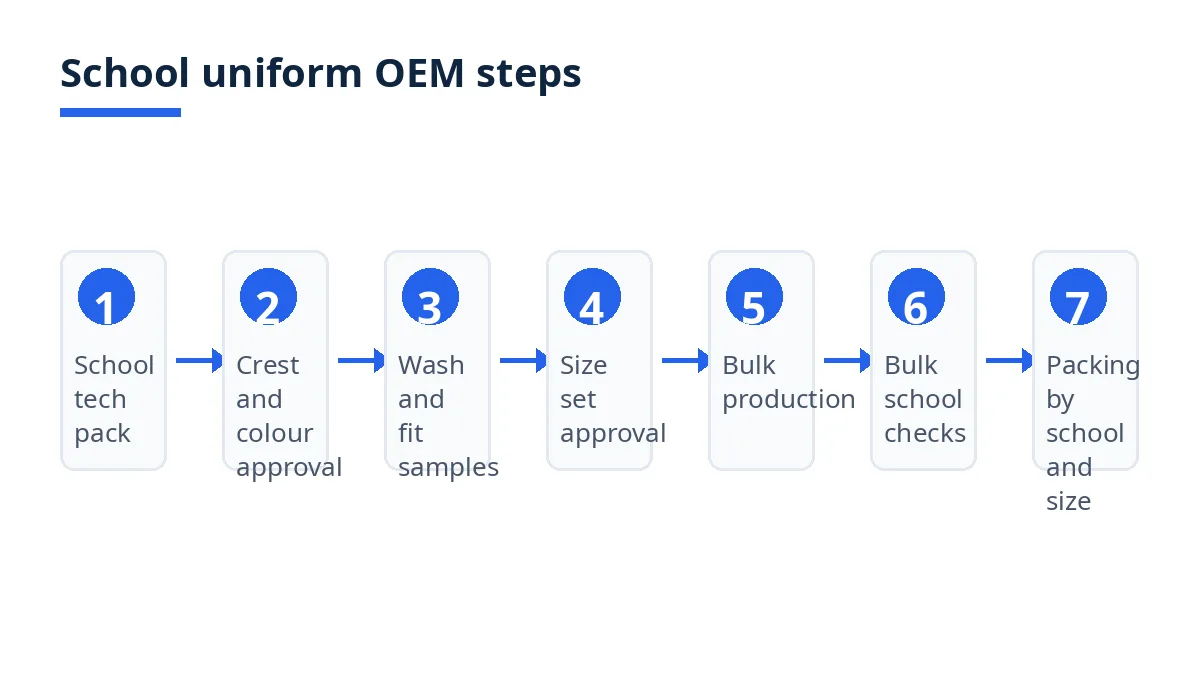
Write the school tech pack. List every garment by school and year group, with fabric composition and weight, house colours, crest artwork with thread colours and placement, collar and pocket construction, size measurements by age and body measure, care label wording, and packing by school and size.
Approve the crest and the house colours. Ask for an embroidered crest sample and a woven label sample in the actual threads, plus dyed fabric swatches for each house colour checked in daylight. Record the approved crest size, thread colours and placement measurements in writing, with a photograph of the approved sample attached to the approval.
Run wash and durability sampling. Put the sample through repeated home washing before bulk approval, and check colourfastness to water, perspiration and rubbing, pilling resistance, seam strength and appearance after laundering. A school uniform testing package of the kind offered by testing laboratories covers banned azo colourants, formaldehyde content and pH value on the chemical side, and colourfastness, appearance after 50 launderings, pilling resistance, tensile strength and seam strength on the performance side.3 Agree the pass levels for each test in writing.
Approve the full size set. Ask for fit samples at the smallest, middle and largest sizes, not only the middle size, and check them on children or fit forms in the right age band where possible. Decide the growth allowance with the school: whether trousers carry an adjustable waistband or a let-down hem, and how much extra length is built in. A grade that works at the middle size can fail at the ends of the range, and the ends are where parents complain first.
Check child safety before bulk. Review every cord, drawstring, button and small attachment against the destination market's rules. Under the European standard EN 14682:2014, garments intended for young children shall not be designed, manufactured or supplied with drawstrings or functional cords in the head, neck or upper chest area, and decorative cords elsewhere in the neck and upper chest areas shall have free ends no longer than 7.5 cm, with no knots, toggles or three-dimensional embellishments, and shall not be positioned so they can tie across the throat.4 Remove or redesign any hood cord, neck tie loop or waist drawstring that fails that check.
Run bulk production with in-line checks. Agree inspection points during production: first-off pieces checked for crest placement and shade, mid-production checks for size measurements and seam quality, and a shade check that compares pieces from different dye lots against the approved swatch. House colours drift when lots change, so the shade check belongs in the production plan, not only at the end.
Inspect bulk by school and size. Sample the finished bulk under an agreed acceptance sampling plan before packing. ISO 2859-1 defines a system of acceptance sampling plans for inspection by attributes, indexed by acceptance quality limit (AQL) for lot-by-lot inspection, and AQL is the maximum average percentage of defective items considered acceptable during random sampling, which determines sample sizes and acceptance or rejection thresholds.5 Check crest placement, colour, measurements, button attachment and packing by school, year group and size, and record results per lot.
Costs, timelines and documents
Cost drivers
No guide can state a typical school uniform price, because each school's crest, house colours, fabric and size set produce a different cost. The drivers to itemize on every quotation are fabric and dye lots per house colour, crest set-up for embroidery digitising or woven crest runs, cutting markers across the size range, trims, labels and cartons per school, inspection, and the delivery term. The Incoterms 2020 rules set out 11 rules with a clear allocation of cost, risk and obligations,6 so compare quotations only when they state the same term and the same size split. Read the MOQ definition guide before asking a factory for its minimum, and ask for the minimum per colour and per size run, not only a total for the range.
Example figures: a 2,400-piece order split across six sizes and two house colours gives 200 pieces per size and colour combination, while the same 2,400 pieces split across twelve sizes and four house colours gives 50 per combination. The second split carries more dye lots, crest runs and markers at the same total. The example shows structure only, not a typical price, minimum or lead time.
Timelines
Ask for sampling, crest approval, fabric ready, bulk production and inspection dates as separate lines, not a single delivery week. Crest approval and wash sampling usually take the longest early time, because a failed wash result sends the fabric choice back to the start, and a crest correction needs a fresh embroidery sample. Work backwards from the school term start and leave a re-order window.
Order documents
The order documents are the school tech pack, the itemized quotation showing set-up lines apart from the unit price, the purchase order carrying the split by school, year group and size, and the written sample approvals for crest, wash result and size set. Goods may not be loaded for export unless an export declaration is submitted to Customs and approved.7
Bangladesh-specific rules and tips
Confirm association claims at the source. If a supplier claims BGMEA membership, confirm it with the association. BGMEA states that it has around 4,500 member factories, with around 60 per cent making woven garments,1 which frames the woven capacity available for shirts, trousers, skirts and blazers, but membership alone says nothing about whether a factory can match a particular school's crest, house colour or size set. Ask for a crest sample and a wash result instead of treating membership as evidence of capability.
State fibre composition for the destination market. Regulation (EU) No 1007/2011 covers textile fibre names and related labelling and marking of the fibre composition of textile products.8 Put the fibre composition, care instructions and size marking for each garment in the tech pack, and check the label on the pre-production sample against the tech pack before bulk.
Keep one shade standard across repeats. House colours are the identity of the school, and a repeat order dyed months later will drift unless a physical standard exists. Keep the approved dyed swatch, the thread colour reference and a photograph of the approved crest with the purchase order record, and send the same references with every repeat enquiry.
Mistakes and red flags
Approving a crest from a screen image. Thread colours and stitch density change between a digital artwork and an embroidered crest. Approve a physical crest sample in the actual threads, at the actual size, on the actual garment fabric.
Approving one middle size only. A size set is a curve, and the smallest and largest sizes carry the most risk. Approve fit samples at both ends of the range before bulk cutting.
Skipping the wash trial to save time. Colourfastness, pilling and shrinkage appear after repeated washing, not on the inspection table. A sample that passes measurement and fails after home washes will fail for every pupil at once.
Accepting a verbal size split. A split agreed in conversation is forgotten when cutting starts. Put the quantity per school, per year group and per size on the quotation and the purchase order, and check the packing list against the same split.
Mixing dye lots without a shade check. Two lots of the same house colour can differ enough for pupils standing side by side to look mismatched. Require a shade comparison against the approved swatch during production and again at bulk inspection.
Cutting inspection to meet a term start. Sampling under ISO 2859-1 checks a lot against an agreed AQL,5 and that check is the last control before the uniforms become a school's stock. Removing it to save a week moves the risk to the first day of term.
Checklist
Before bulk cutting, every line should be answered in writing.
School tech pack sent: garments by school and year group, fabric, house colours, crest artwork and placement, sizes, care label, packing.
Crest sample approved in actual threads on actual fabric, with placement measurements recorded.
House colour swatches approved in daylight and kept as the repeat standard.
Wash and durability results agreed: colourfastness, pilling, seam strength, appearance after laundering.3
Fit samples approved at the smallest, middle and largest sizes, with growth allowance decided.
Child-safety check done: cords and drawstrings reviewed against destination rules,4 buttons and small attachments covered in inspection.
Quantity split confirmed per school, per year group and per size, on the quotation and purchase order.
Set-up lines itemized apart from the unit price; paid crest set-up recorded for repeats.
Inspection level and AQL values in the purchase order.5
Quotations compared on the same specification, size split and delivery term.6
Packing order agreed by school term start, with packing checked by school and size.
How Exportain helps
On Exportain, browse suppliers and post a request for quotation on the RFQ board with the school tech pack summary, the split by school, year group and size, the crest and wash requirements, and the delivery term, so suppliers quote against the same specification. Ask each reply for its minimum per colour and per size run, plus a physical crest sample and a wash result. Read the badge definitions on the verification page to see what each badge records, and see how supplier verification works on Exportain. Verification is a document and photo review, not a factory inspection,9 10 so crest approval, wash sampling and bulk inspection stay with the buyer. After a quotation is accepted, Exportain creates one order and issues one proforma invoice from the accepted terms.9
FAQs
What should I know first about school uniforms?
A school uniform order is defined by its crest, its house colours and its size set, not only by its fabric. The buyer supplies a tech pack naming every garment by school and year group, the factory proves the crest in actual threads, proves wash durability through colourfastness, pilling and seam tests,3 and proves fit at the smallest and largest sizes before bulk cutting.
What are the typical costs and timelines?
There are no typical figures a buyer can rely on, because each school's crest, house colours, fabric and size set produce a different price and lead time. Fabric and dye lots per house colour, crest set-up, cutting markers across the size range and the delivery term drive the price,6 while crest approval, wash sampling, dyeing and line capacity drive the timeline. Ask for each date as a separate line.
Which documents are needed?
Four papers carry the order: a school tech pack, an itemized quotation with set-up lines apart from the unit price, and a purchase order split by school, year group and size. Add written approvals for the crest, the wash result and the size set before bulk starts.
What are the most common mistakes?
The most common mistakes are approving a crest from a screen image, approving one middle size only, skipping the wash trial, accepting a size split verbally, mixing dye lots without a shade check, and cutting bulk inspection to meet a term start. Sampling under ISO 2859-1 checks a lot against an agreed AQL,5 and that check is the last control before the uniforms reach pupils.
Next steps on Exportain
Browse suppliers, then post your school tech pack summary and split by school, year group and size on the RFQ board so suppliers state their minimum per colour and per size run. Before you confirm, read how supplier verification works on Exportain and the MOQ definition guide.
Sources
- BGMEA at a glance. Bangladesh Garment Manufacturers and Exporters Association (BGMEA) (accessed )
- Classification Detail — HS Code 6203. United Nations Statistics Division (accessed )
- School Uniforms Quality and Safety Assurance. Intertek (accessed )
- PRISM: Narrative style risk assessment - non-compliant cords and drawstrings identified in clothing intended for children. GOV.UK (accessed )
- ISO 2859-1:2026 - Sampling procedures for inspection by attributes — Part 1: Sampling schemes indexed by acceptance quality limit (AQL) for lot-by-lot inspection. ISO (accessed )
- Incoterms® 2020. International Chamber of Commerce (ICC) (accessed )
- Customs Clearance Procedures for Export. Bangladesh Customs, National Board of Revenue (accessed )
- Regulation (EU) No 1007/2011 on textile fibre names and related labelling and marking of the fibre composition of textile products. European Union, (accessed )
- Trust & Safety Center. Exportain (accessed )
- Supplier verification: Earn trust badges buyers can see. Exportain (accessed )
About the author
Sourcing from Bangladesh?
Post a request for quotation and suppliers on Exportain can send you their quotes directly.
Post an RFQ