

Custom Leather Wallets Manufacturer in Bangladesh: OEM Process From Tech Pack to Bulk
Custom leather wallets made to order in Bangladesh: the OEM gates from tech pack to bulk release, the documents that sign off each gate, and example costs for a first wallet order.
Short answer
To order a custom leather wallet from a manufacturer in Bangladesh, write one version-numbered tech pack per wallet, starting with the construction, fold and slot plan. Approve the proto sample for construction, the leather, lining, thread and hardware as separate lots, and the pre-production sample in production materials. Bulk production starts only on a signed bulk-release note naming the approved lots and the tech pack version, with final inspection against the sealed counter-sample.
On this page
Key takeaways
Choose the wallet construction, fold and slot plan before the leather: a bifold, a card holder and a zip wallet are different manufacturing jobs with separate tech packs.
Write the tech pack from the inside out, with a tolerance and a hand test for every measurement, and keep one current version only.
Approve the proto sample for construction, the leather, lining, thread and hardware as separate lots, and the pre-production sample in production materials.
Bulk production starts only on a signed bulk-release note naming the approved lots and the tech pack version; final inspection checks packed goods against the sealed counter-sample.
Wallets normally carried in the pocket or handbag with a leather outer surface fall under subheading 4202.31; confirm the full national code with a broker before pricing.
A card slides into a new wallet and sticks halfway. The slot was cut to the card size on paper, but the lining, the stitch line and the edge finish each took a fraction of a millimetre, and together they closed the opening. The leather was not at fault. The inside of the wallet was never specified as carefully as the outside.
This guide is for buyers who want a wallet made to their own design by a manufacturer in Bangladesh. In this guide, OEM means the buyer supplies the design and the specification and the factory makes the wallet to that specification. The tech pack is the single version-numbered specification document for one wallet. Every gate ends with a written approval, and the pre-production sample is the gate that releases bulk production.
Start with the fold: choose the wallet construction first
Choose the construction before you choose the leather. It decides how many panels the wallet has, where it folds, and how cards enter and leave. A bifold, a card holder and a zip wallet are three different manufacturing jobs, even when they share a leather and a color. Price, sample and write a tech pack for each one separately.
Wallet construction | What it decides first | Test in the hand |
|---|---|---|
Bifold | One fold, two card panels, bill section | Fold lies flat, cards release cleanly |
Trifold | Two folds, stacked panels | Closed thickness, fold alignment |
Card holder | Slot stack, no fold or one fold | Slot tension with the stated card count |
Zip wallet | Zip run, lining | Zip runs the full length without snagging |
Long wallet | Length, closure, section for phone or cheque | Closure holds, contents sit flat |
Fix the closed size, the open size and the thickness with the contents you specify. State the card size, how many cards each slot must hold, and whether the wallet is tested empty, loaded, or both. A slot that works empty and fails full was never tested in its real condition. Record the fold direction too.
Decide the closure now. A snap, a zip, a magnetic closure and no closure each change the panel layout, the hardware list and the hand tests. Changing the closure later changes the pattern.
Write the tech pack from the inside out
Write the tech pack from the inside out, because the inside is where a wallet order fails. Start with the slot layout, then the lining, then the panels, and only then the outer leather and the brand mark.
One complete tech pack, in one document with one version number and one date, contains: the wallet identity (construction, closed and open measurements, thickness with the stated contents, fold direction); a flat drawing of the outside and the inside, with every panel, slot, pocket and closure marked; the slot plan (each slot numbered, with opening width, depth, card size and card count); the bill of materials (outer leather, lining, thread, edge finish, hardware and brand mark, each with the exact wording the factory must use when ordering); construction notes (stitch density, stitch distance from the edge, fold treatment, edge finish steps, and the order in which panels are assembled); the brand mark (position, size, method, artwork file name and version); labels and packing (label wording and position, box, sleeve, insert and carton); and the approval record (who approves each sample, in what form, and what a pass means).
Give every measurement a tolerance, in the same unit, on the same line. A slot width without a tolerance cannot be checked. State the test for each measurement: the card used, the count used, and whether the wallet is empty or loaded.
When a measurement, material or artwork changes, issue a new version number, date it, and list the change. A factory that builds to an older version without either party knowing has built to the wrong document. Keep one current version only, and withdraw the old version in writing.
Run the sample ladder in wallet order
Samples work in a ladder, and each rung has a different job. The ladder has three rungs: the proto sample, the salesman sample and the pre-production sample. Each is approved or rejected in writing, against the current tech pack version.
The proto sample answers one question: does the construction work in the hand. Check the fold, the slot openings with the stated cards, the closure, and the closed thickness. It may use a substitute leather. Its leather is not the point. Its construction is. If the fold springs open or a slot grips, fix the pattern now.
The salesman sample shows the wallet as it will look when sold, in the production leather and color, with the brand mark applied. Use it to check shade, grain, edge finish and the brand mark at arm's length. It does not release bulk production. It releases selling, photography and customer approval. Record that limit in the approval note.
The pre-production sample is the gate that releases bulk. It is made in the production leather, lining, thread and hardware, on the production pattern, with the production edge finish and brand mark. Check it against the tech pack line by line, run every hand test with the stated contents, and keep one sealed counter-sample. Note the leather, lining and hardware lots on the approval: bulk production must use the approved lots, or be re-approved.
Run the hand tests the same way every time: insert and remove the stated card count from each slot, fold and unfold the wallet, open and close the closure, and check the closed thickness. Write the result for each test, not a general impression.
Approve leather, lining and hardware as separate lots
Approve the materials as separate lots. The leather lot, the lining lot, the thread lot and the hardware lot each need their own approval, against their own standard, before bulk cutting starts.
For the outer leather, approve a physical swatch, not a shade name. Keep the swatch with the tech pack, and state the thickness range, finish and shade standard in the same approval note. Check the first bulk panels against the swatch. Leather varies across a hide and between hides, so agree in advance how much variation is acceptable and where it may sit. A panel acceptable on an inside pocket may not be acceptable on the outer face.
For the lining, approve the exact material, color and weight. The lining decides how a slot grips and how a fold sits. Lining thickness is part of the slot opening, not an addition to it. If the lining changes, run the slot test again on a new sample.
For hardware, approve the finish and the function separately. A zip must run the full length without snagging the lining, a snap must close and open with the same hand effort across the order, and a magnetic closure must hold the stated contents. Approve hardware against the leather it will sit on. Keep one approved hardware set with the counter-sample.
When any lot changes, re-approve it. A new leather lot, lining delivery or hardware batch is a new approval, even when the supplier and specification are unchanged. Bulk goods made from an unapproved lot have no approved reference.
Gates and documents: who signs what, and when
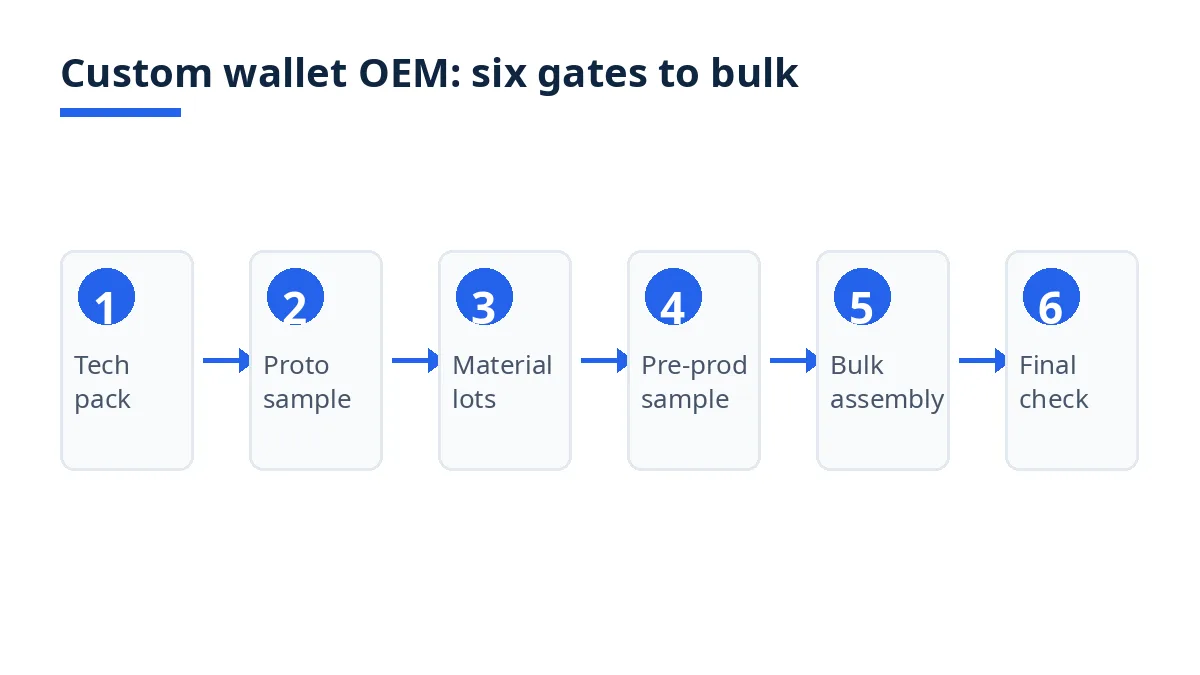
Each gate ends with a document and a written confirmation. If a gate has no document, it has not happened, however much work has been done around it.
Gate | Decision | Document | If it fails |
|---|---|---|---|
1. Tech pack | Construction, measurements, tolerances, materials | Signed version-numbered tech pack | Revise the pack, do not sample |
2. Proto sample | Pattern and construction work in the hand | Written proto approval with test results | Correct the pattern, make a new proto |
3. Material lots | Leather, lining, thread, hardware lots approved | Lot notes, swatches, hardware set kept | Source a new lot, do not cut bulk |
4. Pre-production sample | Wallet as sold, in production materials | Written bulk-release approval, counter-sample sealed | Correct and re-sample, do not release bulk |
5. Bulk release | Cutting and assembly start on approved lots | Bulk release note naming lots and pack version | Hold cutting until the failed gate passes |
6. Final inspection | Packed goods match the counter-sample | Inspection report against the agreed plan | Hold shipment, rework or remake |
Name the approver for each gate in the tech pack. Keep every approval with the order file: tech pack versions, sample approvals, lot notes, the bulk release note and the inspection report.
Agree the sampling plan and defect classes before bulk production starts: how many wallets will be checked, how defects are classed, and what happens to a failed lot. Critical defects, such as a closure that does not close or a slot that will not take the stated card, stop the lot. A plan agreed after the goods are made is an argument, not a plan.
From bulk release to packed cartons
Cutting comes first. Panels are cut to the approved pattern, and the first cut panels are checked against the pattern and the leather swatch before the full cut proceeds. A pattern error found after the full cut is a full-cut error.
Skiving thins the leather at folds and edges so the wallet folds flat and the edges sit level. Check the fold thickness after skiving, with the stated contents. Assembly follows the construction notes: panels in the stated order, stitch lines at the stated distance from the edge, and the closure fitted before the final edge work where the pack requires it.
Edge finishing is the visible signature of a wallet. Check the finish, the color and the smoothness along the full edge, including the fold edges, against the pre-production sample. Apply brand marks to the production leather and check them at arm's length, in the stated position and size.
Inspect during production, not only at the end. Check the first finished wallets against the counter-sample, then check at the agreed points during the run. Final inspection checks the packed goods against the counter-sample, the label wording, the box and sleeve, and the carton marks. Keep counts, weights and quantities identical across the packing list, the invoice and the shipping documents.
Costs, timelines and documents in one view
There is no single typical price or timeline for a custom leather wallet from Bangladesh. The figures below are example figures only, for one bifold order of 1,000 wallets. Replace every line with a confirmed figure for the exact wallet, leather, quantity and delivery term.
Example figures: one bifold, 1,000 wallets, one color, one leather lot.
Cost line | Example figure | How to obtain your figure |
|---|---|---|
Proto sample, per style | $120 | Factory sample quotation |
Pre-production sample, per style | $90 | Factory sample quotation |
Die and tooling, one-off | $350 | Factory quotation |
Unit price, per bifold | $8.40 | Pro forma invoice on the approved tech pack |
Goods total, 1,000 wallets | $8,400 | Unit price multiplied by quantity |
Order total before freight and duty | $8,960 | Goods total plus samples and tooling |
Freight, insurance, duty and local delivery sit outside that total. Work them as separate lines, on the delivery term you agree, and confirm the duty line with your broker against the classification for the exact wallet. The timeline below is also an example, in working weeks, starting when the tech pack version is signed.
Stage | Example weeks | Gate at the end |
|---|---|---|
Tech pack writing and sign-off | 1 | Gate 1, tech pack signed |
Proto sample | 2 | Gate 2, proto approved |
Material lot approval | 2 | Gate 3, lots approved |
Pre-production sample | 2 | Gate 4, bulk release signed |
Bulk cutting and assembly | 4 | Gate 5, bulk in progress |
Final inspection and packing | 1 | Gate 6, report signed |
Total, tech pack to packed cartons | 12 | All six gates passed |
The documents for the order are the tech pack and its versions, the sample approvals, the lot notes, the purchase order, the pro forma invoice, the bulk release note, the inspection report, the commercial invoice, the packing list and the shipping document for the agreed delivery term. Agree the full list before bulk release.
Bangladesh checks: classification, naming and supplier evidence
Classification comes before pricing, because the code decides the duty line. Wallets and similar small cases of a kind normally carried in the pocket or in the handbag, with an outer surface of leather or of composition leather, fall under subheading 4202.31 in the Harmonized System.1 Heading 4202 covers cases and containers wholly or mainly covered by leather, composition leather, plastic sheeting, textile materials, vulcanised fibre or paperboard.1 The subheading for pocket and handbag articles with an outer surface of sheeting of plastics or of textile materials is 4202.32, and other cases and containers with an outer surface of leather or of composition leather fall under 4202.91.1 Confirm the full national code for the exact wallet, outer surface material and destination market with your broker before you fix a price. Do not price from the subheading alone.
Agree the leather wording in writing, in the tech pack and on the invoice, and check it against the rules of each selling market with your adviser. Where a market requires a specific label or marking, agree the exact wording, position and language at the tech pack stage, and check it on the pre-production sample.
Check the supplier on the same evidence as any custom order. Read the company documents so the name, address and bank account agree across every document, and pay only the company account named in them. Check current production: the wallet constructions the factory makes now, the leather lots it holds, the cutting and edge capacity for your quantity, and finished wallets from recent orders. Add a factory check, by video or in person, for a first order. On Exportain, supplier profiles carry document and photo reviews. A review of documents and photos is not a factory inspection or a guarantee, and Exportain is not a party to the contract for the goods, does not inspect goods, book freight or clear customs. For the classification detail, read the HS code guide for leather wallets, and for inspection points, read the quality control checklist for leather wallets.
Mistakes that send a wallet order back to sampling
These mistakes return an order to sampling, because they change the pattern, the materials or the approval record.
Approving a sample from a photograph alone is the first. A photograph cannot show slot tension, fold resistance or edge smoothness. Approve the physical sample, run the hand tests, and keep the counter-sample.
Sampling in a substitute leather and treating the result as a material approval is the second. The proto sample may use substitute leather for construction, but material lots need their own approval, on production materials.
Changing one material without re-running the related test is the third. A new lining changes the slot opening, a new thread changes the stitch appearance, and a new hardware batch changes the closure. Each change needs its own approval note and, where it touches a test, a new test.
Leaving the brand mark to the sample stage is the fourth. The mark needs its artwork version, position, size and method in the tech pack, and approval on production leather.
Starting bulk cutting before the pre-production sample is signed is the fifth. Bulk goods cut to an unsigned sample have no approved reference. If the sample is then rejected, the choice is rework, remake or accept. None is as cheap as waiting for the signature.
Gate checklist before bulk release
Do not release bulk until every line is signed. Keep the signed checklist with the order file.
The tech pack is at its current version, signed by buyer and factory, with every change listed.
The construction is fixed: wallet type, fold direction, closed and open sizes, thickness with contents, and closure.
The slot plan is complete: every slot numbered, with opening, depth, card size and card count.
The proto sample is approved in writing, with hand test results recorded.
The leather, lining, thread and hardware lots are approved separately, with swatches and a hardware set kept.
The pre-production sample is approved in writing, in production materials, with a sealed counter-sample kept.
The brand mark is approved on production leather, in the stated position, size and method.
Label wording, box, sleeve, insert and carton marks are agreed and checked on the sample.
The sampling plan and defect classes are agreed in writing, with the action for a failed lot stated.
The purchase order, pro forma invoice and delivery term agree with the tech pack, quantity and lots.
How Exportain helps
Browse suppliers on Exportain for Bangladeshi leather goods manufacturers, and read each profile against your tech pack rather than against a headline price. Shortlist makers whose current range already includes the wallet construction you want. Send each one the same version-numbered tech pack, asking for the same reply format: materials assumed, sample charges, tooling, unit price inclusions, validity, and the minimum per wallet and per color. Then post the specification, quantities and in-service date as an RFQ, and compare replies on the same gates, lots and delivery term. Exportain is a B2B marketplace where buyers post RFQs, receive quotations and message suppliers. It does not inspect goods, book freight or clear customs.
What should I know first about custom leather wallets?
Know the construction before the leather. A bifold, a card holder and a zip wallet are different manufacturing jobs, each needing its own tech pack, slot plan and sample ladder. Fix the fold, sizes, thickness with contents, closure and card test for each slot, and pass each gate in writing before bulk release.
What are the typical costs and timelines?
There is no single typical price or timeline. The example figures here, for 1,000 bifolds in one color, are a $120 proto sample, a $90 pre-production sample, $350 one-off die and tooling, and $8.40 per wallet, with 12 working weeks from a signed tech pack to packed cartons. Replace every line with a confirmed figure, and confirm the duty line with your broker.
Which documents are needed?
The order file holds the version-numbered tech pack, sample approvals, lot notes, purchase order, pro forma invoice, bulk release note, inspection report, commercial invoice, packing list and shipping document for the agreed delivery term. Bulk production starts only on the signed bulk release note naming the lots and the tech pack version.
What are the most common mistakes?
Approving a sample from a photograph, treating a substitute-leather sample as a material approval, changing one material without re-running the related test, leaving the brand mark to the sample stage, and starting bulk cutting before the pre-production sample is signed. Each returns the order to sampling. Work the gates in order, and hold bulk release until the checklist is signed.
Next steps on Exportain
Read the HS code guide for leather wallets to confirm the classification for your exact wallet, and the quality control checklist for leather wallets to set inspection points before bulk production. When the tech pack is signed, post a free RFQ on Exportain with the quantities, lots and in-service date, and compare quotes on the same tech pack version, gates and delivery term.
Sources
- HS, 2017 - Code 4202 Classification Detail. United Nations Statistics Division (accessed )
About the author
Sourcing from Bangladesh?
Post a request for quotation and suppliers on Exportain can send you their quotes directly.
Post an RFQ


