Custom Formal Suits Manufacturer in Bangladesh: OEM Process From Tech Pack to Bulk
Custom formal suits from Bangladesh, ordered as matched sets: what the suit tech pack must fix, how canvas, fitting and grading approvals work, and which bulk checks catch faults before shipment.
Short answer
A custom formal suit order from Bangladesh starts with a suit tech pack that fixes canvas method, lapel and shoulder shape, lining, button work and tolerances. The factory proves the pattern on a fitting sample, proves grading on the smallest and largest sizes, and proves bulk cloth and pressing on a pre-production sample. Bulk is then cut, sewn, pressed and inspected as matched jacket and trouser sets.

On this page
Key takeaways
A formal suit is a matched set: the jacket and trouser must share a cloth lot rule and a shade standard, and they must be approved and inspected together.
The tech pack must name the canvas method per style, since fused, half-canvas and full-canvas construction change drape, pressing behaviour and price.
Fitting approval proves the pattern, grading approval proves the smallest and largest sizes, and the pre-production sample proves bulk cloth, trims and pressing.
Cost and time are set per specification by cloth, canvas method, lining, button work, pressing and the delivery term, so quotations are comparable only on the same tech pack and Incoterm.
Exportain badges record document and photo reviews, not a factory inspection, so sample approval and inspection stay with the buyer.
A jacket that looks correct on a hanger can still fail on a person. The shoulder may pull toward the neck, one lapel may break lower than the other, or the chest may ripple once the jacket is buttoned and worn for an hour. Those faults sit inside the jacket's structure, not on its outer cloth, and they are hard to correct after a bulk run is finished. A suit order therefore rewards a buyer who settles construction early, before cloth is cut, and who treats each sample as a test of one part of the suit.
A suit also has to stay a pair. Jacket and trouser are worn together, judged together, and returned together when they do not match, so the order has to protect the relationship between the two pieces from the first cutting plan to the last carton. Shade, cloth hand, lining tone, button finish and crease behaviour all have to agree across the set.
Why this matters for buyers and sellers
For a buyer, most of the risk in a suit order sits in the jacket, because its shape is built from a chest piece, a shoulder pad, a lapel turn and a sleeve setting working together. A weakness in any one of them shows up as a visible distortion, and once bulk jackets are finished there is very little room left to fix a shoulder or lapel problem without remaking jackets.
For a factory, a suit order concentrates skilled work in a small number of operations: cutting a shaped chest, setting a sleeve into a structured armhole, forming a lapel roll, finishing buttonholes to a set standard, and pressing a jacket on a form. Those jobs need operators who have done them before, plus pressing equipment that holds a jacket's shape instead of flattening it. That preparation has to be built once for the style, whether the run is short or long, and it sits inside the price of every suit in the order.
The pair point matters commercially too. A buyer who receives jackets and trousers that disagree in shade or cloth feel cannot sell the weaker half of the pair on its own, and a seller who has to replace one half of many sets faces rework across cutting, sewing and pressing a second time. A cloth lot rule for pairs, a shade standard, and a joint approval for jacket and trouser together cost far less to write into the order than to repair after shipment.
Step-by-step: how it works
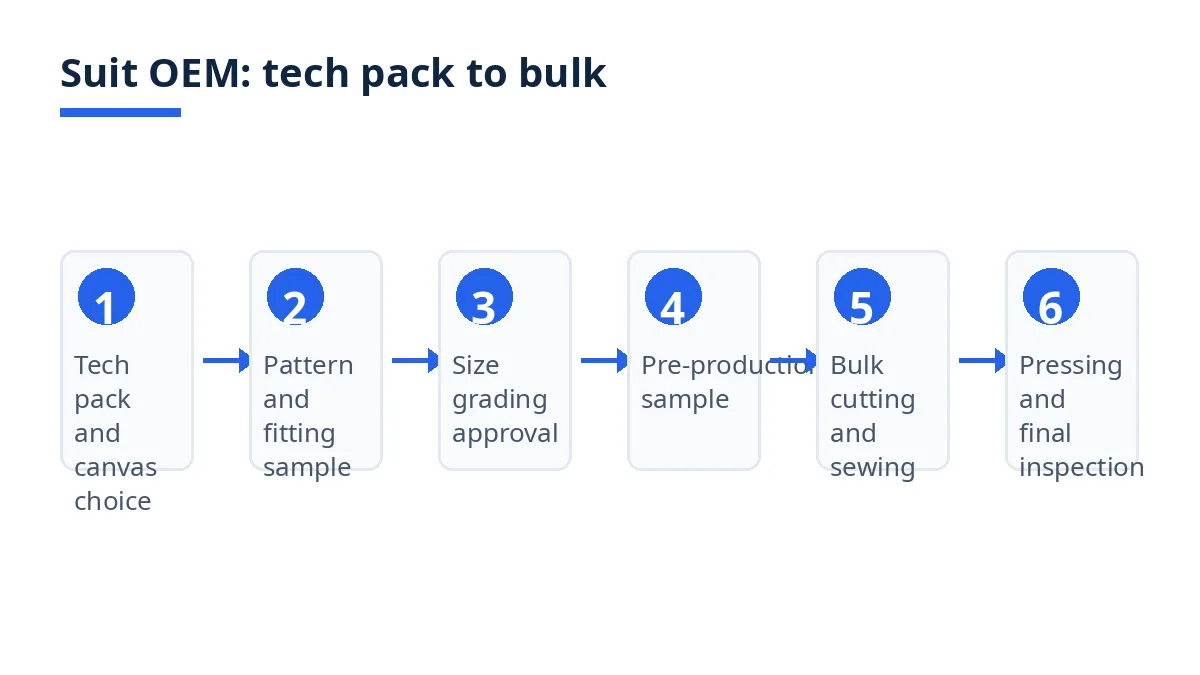
Set the jacket architecture on paper first. Fix the lapel style and width, the gorge position, the shoulder treatment and pad, the canvas method, the chest and pocket build, the lining coverage, the vent arrangement, the button positions and buttonhole finish, and the trouser rise and leg line, with the cloth weight, the size range and tolerances, and the form or fit model samples will be judged against.
Choose the canvas method per style and write it down. A fused front bonds interlining to the cloth, a half-canvas front carries a canvas chest piece with a fused lower front, and a full-canvas front carries canvas through the whole jacket front. Each choice changes how the chest drapes, how the lapel rolls, how the jacket responds to steam pressing, and how much handwork it needs. Record the method on the quotation and the purchase order.
Prove the pattern on a fitting sample. Cut the first sample in a cloth close to bulk in weight and behaviour, put it on the agreed form or model, and read the shoulder line, the lapel roll on both sides, the chest shape, the armhole ease, the jacket balance from front to back, and the trouser seat and rise. Return corrections as measurements and photographs tied to named pattern points.
Prove the size range on graded samples. Grading moves the approved base pattern out to the smallest and largest sizes, and that scaling is where proportion usually drifts: a lapel can look heavy on a small jacket, a shoulder slope can read differently at the top size, and a trouser rise can sit differently at the extremes. Measure graded samples at both ends of the range and judge them as worn shapes, not only as flat numbers.
Prove bulk materials and pressing on a pre-production sample. This sample must use the actual suit cloth, lining, buttons, thread and labels, pressed and packed exactly as bulk will be. Judge jacket and trouser side by side for shade agreement, lapel roll after pressing, buttonhole finish, lining behaviour at the vents and pockets, trouser crease retention, and jacket shape after packing and unpacking.
Cut and sew bulk against the approved sample. Before cutting, confirm the marker, the cloth lot allocation that keeps jacket and trouser pairs together, and the pressing sequence for the style. Keep one approved sample on the line as the visual reference, and put any cloth or trim substitution in writing before it is used, with a fresh shade and pressing check if the substitute lot differs from the approved lot.
Inspect finished suits as pairs. Check each set for shade agreement, pressing quality, left-right symmetry, buttonhole finish, lining behaviour and measurements, and check packed cartons for the correct size and shade mix inside each carton. Agree the inspection level and the acceptance quality limit values in the purchase order before production; ISO 2859-1 sets out a system of acceptance sampling plans for inspection by attributes, indexed by acceptance quality limit, for lot-by-lot inspection.1
Costs, timelines and documents
No guide can state a suit price or lead time as a fact, because price follows the specification: cloth, canvas method, lining coverage, buttonhole finish, pressing standard, packing per set, and delivery term together decide what a factory has to do. A full-canvas jacket needs more handwork than a fused jacket, and a wide size range needs more pattern and grading work than a narrow one. The delivery term changes the comparison as well, so every quotation should carry one Incoterm and one named place; the Incoterms 2020 rules set out 11 rules with a clear allocation of cost, risk and obligations.2
Time behaves the same way. Cloth availability, fitting correction rounds, canvas and lining supply, pressing capacity and the inspection plan each add their own span, and a single delivery week hides all of them. Ask for a separate date for each stage, from pattern to final inspection.
Example figures: an order of 480 two-piece suits in sizes 46 to 56, with one canvas method across the order, one cloth lot reserved for jacket and trouser pairs, and a pre-production sample approved after pressing. The example shows stage relationships only; it is not a typical price, a typical minimum, or a typical lead time, and changing the canvas method, the size split or the cloth lot rule would change the quotation.
Four paper items carry the order: the suit tech pack, an itemised quotation, a purchase order that records canvas method, tolerances and inspection, and written approvals after fitting, grading and pre-production. For shipment, confirm the current export document set with the exporter before freight is booked.3
Price or time driver | What it moves | Put in the enquiry |
|---|---|---|
Canvas method | Handwork, drape, pressing response | Fused, half-canvas or full-canvas, per style |
Cloth and lot rule | Shade agreement inside each pair | Composition, weight, one-lot rule for pairs |
Lining and buttonholes | Line time, finishing standard | Lining coverage, buttonhole finish and count |
Size range | Pattern work, extreme-size fit | Base size plus smallest and largest sizes |
Pressing and packing | Final jacket shape, carton condition | Pressing standard, packing per set |
Delivery term | Freight, insurance, risk point | One Incoterm and one named place |
Bangladesh-specific rules and tips
Bangladesh has a large woven base to draw on, but that is not the same as a deep pool of structured-jacket capacity, so suit evidence matters more than a general catalogue. The Bangladesh Garment Manufacturers and Exporters Association reports around 4,500 member factories, of which around 60 per cent are woven garment manufacturers.4 Ready-made garment exports reached $10.58 billion in July to September 2026, up 6.1 per cent year on year, with woven garment exports growing 5.11 per cent in the same period, according to Export Promotion Bureau data reported by The Business Standard.5 Ask for a recent jacket sample and structured-jacket pressing capacity.
Association claims are worth checking at the source: if a supplier states BGMEA membership, confirm it with the association, since membership describes a woven business in good standing rather than capacity for a particular jacket construction or delivery date.4 Keep one spelling of each company name across all papers. Imported inputs deserve an early question too, since suit cloth, canvas, lining and buttons may be bought in against the buyer's specification, and an imported cloth lot can set both the earliest cutting date and the smallest workable quantity. Settle the pair shade standard before cutting, including any second-lot replacement rule.
Fibre mix drives two decisions that belong before cloth is ordered: classification and labelling. Men's or boys' suits, ensembles, jackets, blazers, trousers and related articles, not knitted or crocheted, fall under heading 6203 of the Harmonized System.6 Where the suit will be sold in the European Union, Regulation (EU) No 1007/2011 requires the textile product to carry the name and percentage by weight of all constituent fibres, in descending order, on its label or marking.7
Mistakes and red flags
Signing off a jacket without its trouser. A suit is worn and sold as a pair, so shade, cloth hand and finish have to be approved on jacket and trouser together, at the pre-production sample and again at final inspection. A jacket approved alone leaves the pair unproven.
Leaving the canvas method off the quotation. A price that does not name fused, half-canvas or full-canvas construction cannot be set beside a price that does, and the lower figure may simply describe a lighter build. Put the method on the quotation and on the purchase order, per style.
Approving only the middle size. Grading drift shows at the ends of the range, where lapel proportion, shoulder slope and trouser rise move furthest from the base pattern. Measure graded samples at the smallest and largest sizes before bulk cutting.
Judging a sample before pressing. A suit that measures correctly flat can lose its lapel roll or its chest shape under steam, and a trouser can lose its crease in packing. Judge the pre-production sample after pressing, packed as bulk will be packed, and unpacked again before approval.
Pricing on mismatched delivery terms. Two prices mean nothing side by side when their terms differ, because one Incoterm bundles freight, insurance and risk differently from another: the Incoterms 2020 rules assign those items differently by rule.2 Keep the tech pack and the term identical across replies before ranking them.
Reading a profile as proof of jacket capacity. A profile or catalogue page is a starting point for enquiries. It does not show whether a factory can build a structured chest, set a sleeve into a shaped armhole, or press a jacket without flattening it.
Skipping the final check to recover time. Cutting inspection out leaves no control between bulk production and stock. An agreed acceptance quality limit check under ISO 2859-1 is that control, and removing it trades a visible saving for a hidden risk.1
Checklist
Use the list below as a sign-off sheet for the suit order: chase a written answer for every point, and hold the order until any gap is closed.
Suit tech pack sent, with lapel, shoulder, canvas method, lining, buttons, buttonholes, trouser rise, cloth, tolerances and packing.
One cloth lot rule recorded for jacket and trouser pairs, with a shade standard for pairs.
Canvas method named per style on the quotation and on the purchase order.
Fitting sample approved, with corrections listed by measurement and photograph.
Grading approved on the smallest and largest sizes, not only on the base size.
Pre-production sample in bulk cloth and trims approved after pressing, jacket and trouser together.
Cloth, canvas, lining and button supply confirmed, with any substitution rule in writing.
Inspection level and acceptance quality limit values in the purchase order.1
Quotations compared on the same tech pack, the same canvas method and the same Incoterm.2
Export document set agreed with the exporter before freight is booked.3
How Exportain helps
On Exportain, browse suppliers and post a request for quotation with the suit tech pack summary, the canvas method, the size range and the delivery term, so replies address the same construction. Ask each reply to state canvas method, grading and pressing in writing. A badge on Exportain reflects the document and photo checks described on the verification page, and it does not replace the buyer's own sample sign-off or final inspection.8
FAQs
What should I know first about formal suits?
A formal suit is a matched jacket and trouser set, and the match has to be specified rather than assumed: one cloth lot rule for pairs, a shared shade standard, and a fit standard with tolerances for shoulder, lapel, chest, rise and leg opening. Men's or boys' suits sit under HS heading 6203, which covers suits, ensembles, jackets, blazers and trousers, not knitted or crocheted.6 For EU sales, fibre names and percentages must appear in descending order on the label.7
What are the typical costs and timelines?
A buyer cannot rely on any typical figure here, because each factory prices the buyer's cloth, canvas method, lining, button work, pressing and delivery term for that specification.2 Sampling rounds, cloth delivery, canvas and lining supply, pressing capacity and inspection each add their own span, so ask for each stage as a separate dated line.
Which documents are needed?
Four sets of paper sit behind the order: the tech pack for the suit, an itemised quotation, a purchase order, and sign-offs written after fitting, after grading and after pre-production. Shipment papers are a separate matter: check the current export set with the exporter before any freight booking.3
What are the most common mistakes?
The most common mistakes are approving a jacket without its trouser, leaving the canvas method unstated, approving only the base size, judging a sample before pressing, and comparing quotations on different delivery terms.2 A badge does not guarantee capacity, quality or delivery, and inspection under an agreed acceptance quality limit is the last control before shipment.1
Next steps on Exportain
Start with the supplier directory, put the tech pack summary, canvas method and size range into a post on the RFQ board, and read how supplier verification works on Exportain before confirming.
Sources
- ISO 2859-1:2026 - Sampling procedures for inspection by attributes — Part 1: Sampling schemes indexed by acceptance quality limit (AQL) for lot-by-lot inspection. ISO (accessed )
- Incoterms® 2020. International Chamber of Commerce (ICC) (accessed )
- Customs Clearance Procedures for Export. Bangladesh Customs, National Board of Revenue (accessed )
- BGMEA at a glance. Bangladesh Garment Manufacturers and Exporters Association (BGMEA) (accessed )
- RMG exports grow 6.1% in Q1. The Business Standard, (accessed )
- Classification Detail — HS Code 6203. United Nations Statistics Division (accessed )
- Regulation (EU) No 1007/2011 on textile fibre names and related labelling and marking of the fibre composition of textile products. European Union, (accessed )
- Supplier verification: Earn trust badges buyers can see. Exportain (accessed )
About the author
Sourcing from Bangladesh?
Post a request for quotation and suppliers on Exportain can send you their quotes directly.
Post an RFQ