

Custom Denim Jackets Manufacturer in Bangladesh: OEM Process From Tech Pack to Bulk
A custom denim jacket order from Bangladesh turns on wash, shade, hardware and post-wash fit. This guide follows the OEM approvals from tech pack to bulk inspection.
Short answer
A custom denim jacket manufacturer in Bangladesh builds your jacket to your tech pack, with the wash recipe, shade reference, hardware set and post-wash fit approved before bulk cutting. Send the denim, wash, hardware, lining and size chart together, approve a washed fit sample and graded set, then a pre-production sample in bulk materials, and inspect bulk jackets after washing against the agreed shade and measurements.
On this page
Key takeaways
A custom denim jacket is approved in stages: wash trial, washed fit and grading, pre-production sample in bulk materials, then bulk inspection after washing.
The tech pack must state denim, wash recipe and shade reference, hardware finish and size, lining, size chart and packing, or quotations cannot be compared.
Shade is approved on a washed jacket, not a swatch, with tolerance agreed between panels, jackets and wash lots before bulk cutting.
Hardware is locked at the wash trial and re-tested on a washed jacket if it changes, since finish and function can change in the wash.
Exportain verification is a document and photo review, not a factory inspection, and a badge is not a guarantee of shade, fit or delivery.
A denim jacket order is settled in the laundry, not on the sample rail. A rigid swatch can look right, a button can close cleanly in the showroom, and a shoulder seam can sit neatly on a hanger, yet the finished jacket can still come back from its first wash a different shade, a different length, and with hardware that no longer matches the fabric. That is why a jacket tech pack has to carry decisions that a simpler woven garment does not: the wash recipe, the shade reference after washing, the hardware finish after washing, and the fit after shrinkage.
Bangladesh is a practical place to place that kind of order. The Bangladesh Garment Manufacturers and Exporters Association (BGMEA) reports around 4,500 member factories, with about 60 percent making woven garments, and states that its member factories account for 100 percent of the country's woven garment exports.1 Denim is a large part of that trade: Bangladesh exported $955.7 million in denim to the United States in 2025, up 34.06 percent from $713 million in 2024, according to data from the US Office of Textiles and Apparel reported by New Age.2 In the July to September 2026 quarter, Bangladesh's ready-made garment exports reached $10.58 billion, with woven garment exports growing 5.11 percent, according to Export Promotion Bureau (EPB) data reported by The Business Standard.3 This guide is written as approvals to require.
Classification matters from the first enquiry. Heading 6203 covers men's or boys' suits, ensembles, jackets, blazers, trousers, bib and brace overalls, breeches and shorts, not knitted or crocheted.4 Heading 6204 covers the corresponding women's or girls' garments, including jackets and blazers, not knitted or crocheted.5 State the wearer, the fibre content and the jacket construction in the enquiry, and confirm the heading for the finished jacket with the supplier before the quotation.
Why this matters for buyers and sellers
A jacket is worn as an outer layer, so faults that a shirt or trouser can hide stay visible. The front panels, collar, pocket flaps and cuffs are all on display, and the wash is part of the design rather than a finishing step added at the end. For the buyer, the risk is a bulk delivery that measures correctly before washing and drifts after it: sleeves shorten, the body narrows, a light wash turns patchy across panels, or a dark wash bleeds onto a light lining. For the seller, the risk is a wash lot and a hardware order that cannot be reused for another buyer once they are cut to your shade, finish and branding.
What should I know first about denim jackets?
A custom denim jacket is an OEM order built to your specification, and the specification has four parts that must be settled before bulk cutting. First, the denim itself: fibre content, weight, stretch content if any, and whether the fabric is supplied from local stock or bought in for the order. Second, the wash: the recipe name or description, the shade reference, and the tolerance you will accept between panels, between jackets in one lot, and between lots. Third, the hardware: buttons, rivets, zips, buckles and any branded plates, with finish, size, strength and wash resistance stated. Fourth, the fit after washing: the size chart measured on a washed jacket, with shrinkage allowances built into the pattern.
Step-by-step: how it works
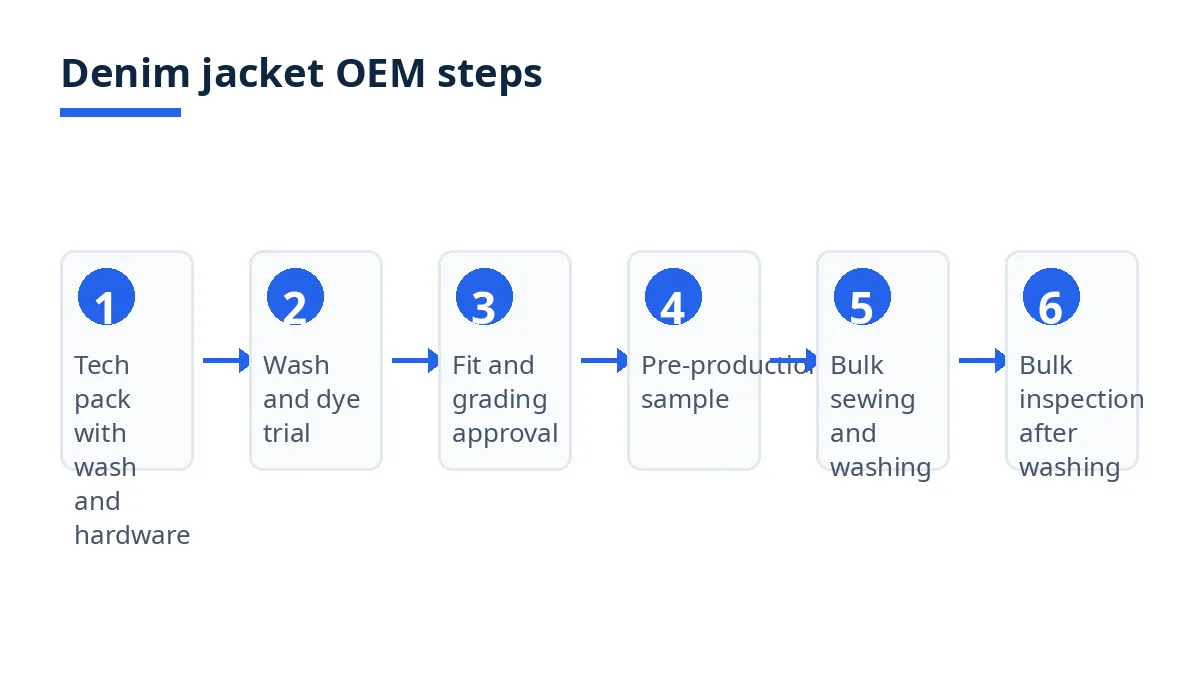
Write the jacket tech pack. State the denim fibre content, weight and stretch, the jacket style and length, collar and lapel shape, pocket type and placement, cuff and hem finish, lining if any, and every hardware item with its finish and size. Add the wash description, the shade reference, the label and tag artwork, the size chart, and the packing method. A tech pack that names the wash only as "light wash" or "dark wash" is not complete enough to quote or to approve against.
Ask for a wash and dye trial before a full sample. Require a trial on cut panels or a sample jacket in the bulk denim, run through the intended wash recipe, so shade, hand feel, shrinkage and hardware appearance can be judged together. Record the recipe, the shade reference, and the measurements before and after washing.
Approve the fit sample, then the grading. Measure the fit sample after washing, on the body and on the sleeve, shoulder and collar. Once the base size is approved, require a graded set across the full size range, measured after washing, before bulk cutting. A jacket that fits at a middle size can still fail at the smallest and largest sizes when the shoulder and armhole grade differently from the body.
Approve a pre-production sample in bulk materials. This sample must use the bulk denim, bulk wash, bulk hardware, bulk lining and bulk labels. Wash it, wear it, test the buttons and zips after washing, and check the shade against the approved reference under the same light each time. Approve it in writing, or list corrections in writing.
Run bulk cutting, sewing and washing as one controlled sequence. Confirm that bulk denim lots are grouped so jackets in one shade run together, that hardware lots are checked before sewing, and that wash lots are recorded against carton numbers. Ask how shade variation between wash lots will be handled, and what happens to a lot that falls outside the agreed tolerance.
Inspect bulk jackets after washing, not before. Check measurements on washed jackets, shade against the reference, hardware function and finish, stitching at pocket corners and button areas, collar and lapel shape, lining attachment, and label placement. Sampling under ISO 2859-1 uses acceptance quality limit (AQL) plans for lot-by-lot inspection by attributes.6 Write the inspection level and AQL values into the purchase order before production.
Costs, timelines and documents
What are the typical costs and timelines?
There are no typical costs or timelines a guide can state for a custom jacket, because each factory prices your denim, wash, hardware, lining, size range and order split, and each one schedules wash capacity, hardware delivery and line time separately. The Incoterms 2020 rules provide 11 rules with a clear allocation of cost, risk and obligations.7 Compare quotations only on the same Incoterm and named place.
The cost drivers specific to a jacket are the denim weight and stretch, the wash recipe and the number of wash steps, the hardware count and finish, any lining, the number of sizes, and the quantity per wash shade. Timelines follow the same logic: sampling depends on denim availability and wash trial rounds, and bulk production depends on wash capacity, hardware delivery and line time. Ask for sampling, wash approval, fabric ready, production, wash, inspection and shipment dates as separate lines, not as a single delivery week.
Driver | What it changes | State in your enquiry |
|---|---|---|
Denim | Weight, stretch, shade base | Fibre content, weight, stretch, local or bought-in fabric |
Wash | Shade, shrinkage, hand feel | Recipe, shade reference, tolerance between lots |
Hardware | Finish, strength, wash resistance | Item, size, finish, wash test required |
Lining | Cut, sewing, wash behaviour | Lining fabric, attachment, wash compatibility |
Size range | Grading, marker, cutting waste | Full size list and ratio per size |
Order split | Wash lot and hardware lot sizes | Quantity per style, shade and size |
Example figures: a buyer orders 900 jackets split across three wash shades at 300 per shade. The total clears the factory minimum, while each shade still has to clear its own wash lot and hardware lot. The same 900 jackets in one shade at 900 pieces clear one wash lot but give the buyer no shade range to sell. The example shows structure only, not a typical price, minimum or lead time.
Which documents are needed?
The order documents are the tech pack, the itemized quotation, and the purchase order, with the wash reference, hardware specification, size chart, inspection level and delivery term on each of them. Keep the legal name of the buyer and the supplier identical across the quotation, proforma invoice and payment documents, so the papers match the shipment. For export clearance, see the current Bangladesh Customs export procedure for the Bill of Export requirements that apply to the shipment.8
Bangladesh-specific rules and tips
Confirm association claims at the source. If a supplier claims BGMEA membership, confirm it with the association itself. BGMEA reports around 4,500 member factories, with about 60 percent making woven garments.1 Membership signals an active garment business, not a jacket wash capability, a hardware stock, or capacity for your shade and size range.
Ask where the denim comes from. Industry reporting cited by New Age states that local mills meet around 70 percent of denim fabric demand, with the remaining 30 percent imported.2 A locally stocked denim can shorten the fabric lead time and make a repeat shade easier to match, while a bought-in denim can set both the earliest production date and the minimum fabric lot.
Set the fibre label for the destination market. If you sell into the European Union, Regulation (EU) No 1007/2011 covers textile fibre names and related labelling and marking of fibre composition.9 State the fibre content on the label exactly as the bulk denim and lining require, and check that any lining, pocketing or trim fibre that must be declared is included.
Test hardware after washing. A button finish, rivet coating or zip tape that looks right before washing can dull, spot or stiffen after the wash recipe your jacket requires. Require the hardware test on the washed pre-production sample.
Mistakes and red flags
What are the most common mistakes?
Approving an unwashed sample. A jacket approved before washing has not yet shown its shade, shrinkage or hardware behaviour. Insist on approval after washing, on the bulk denim and with the bulk hardware.
Approving one size and assuming the range. Shoulder width, armhole depth and collar shape grade differently from body length. A single-size approval hides grading faults that appear only at the ends of the range. Require the graded set, measured after washing.
Approving shade on a swatch instead of a jacket. A flat swatch does not show how a wash falls across seams, pocket flaps, collar edges and cuffs, where abrasion and shading differ. Approve shade on a washed jacket, under consistent light, and keep that jacket as the reference.
Leaving hardware out of the wash trial. Hardware ordered after the wash trial, or changed after approval, can fail the wash or clash with the approved shade. Lock the hardware set at the wash trial stage, and re-test any substitute hardware on a washed jacket before bulk sewing.
Judging quotes that are not on the same jacket. A quote is comparable only when it answers the same tech pack, the same wash reference, the same hardware set and the same delivery term. A lower number attached to an easier wash, a standard hardware finish, no lining, or a different Incoterm is a different offer, not a saving.7
Treating a profile or a badge as a wash capability. A profile and a badge record document and photo checks, not a wash result. They do not test whether a factory can hold your shade across lots or your fit across sizes. The wash trial, the graded set and the bulk inspection are the tests that do.
Checklist
Before you confirm, every line should be answered in writing.
Jacket tech pack sent: denim, style, collar, pockets, cuffs, hem, lining, hardware, labels, sizes, packing.
Wash recipe and shade reference agreed, with tolerance between panels, jackets and lots.
Wash trial completed on bulk denim, with measurements before and after washing.
Hardware set locked: item, size, finish, and wash test passed on a washed sample.
Fit sample approved after washing; graded set across the full size range approved after washing.
Pre-production sample in bulk materials washed, worn, measured and approved in writing.
Order split stated per style, shade and size, with one size ratio per shade.
Inspection level and AQL values in the purchase order.6
Quotations compared on the same wash, hardware, lining and Incoterm.7
Export paperwork checked with the supplier before shipment, against the current Customs procedure.8
How Exportain helps
On Exportain, browse suppliers and post your jacket tech pack summary, wash reference and order split on the RFQ board, so suppliers quote against the same wash, hardware and size set. Ask each reply for its wash trial process, its hardware lot position, and its graded-sample step before bulk cutting. Read how supplier verification works on Exportain and MOQ guidance before you confirm. Verification on Exportain is a document and photo review, not a factory inspection, and a badge is not a guarantee of shade, fit or delivery.10 11
FAQs
What should I know first about denim jackets?
Know the four parts of the specification before bulk cutting: the denim, the wash and shade reference, the hardware set, and the fit after washing. A jacket order that settles only the fabric and the style leaves the wash, the hardware finish and the post-wash fit to be decided during production.
What are the typical costs and timelines?
There are no typical figures to rely on, because each factory prices your denim, wash steps, hardware, lining, size range and split, and schedules wash capacity and hardware delivery separately. Compare quotations only on the same Incoterm and named place,7 and ask for sampling, wash approval, production, wash, inspection and shipment dates as separate lines.
Which documents are needed?
The tech pack, the itemized quotation and the purchase order carry the order, with the wash reference, hardware specification, size chart, inspection level and delivery term on each. Keep buyer and supplier names identical across the papers, and check export paperwork with the supplier against the current Customs procedure before shipment.8
What are the most common mistakes?
The most common mistakes are approving an unwashed sample, approving one size instead of the graded range, approving shade on a swatch instead of a washed jacket, changing hardware after the wash trial, and comparing quotes on different washes, hardware or delivery terms.7 Each of these leaves a jacket decision to bulk production, where it is hardest to correct.
Next steps on Exportain
Raise your jacket tech pack summary, wash reference and order split as an RFQ after browsing suppliers. Read how to import denim jackets from Bangladesh before confirming, for the import-side steps this product needs.
Sources
- BGMEA at a glance. Bangladesh Garment Manufacturers and Exporters Association (BGMEA) (accessed )
- Bangladesh top denim exporter to US in 2025. New Age (accessed )
- RMG exports grow 6.1% in Q1. The Business Standard, (accessed )
- Classification Detail — HS Code 6203. United Nations Statistics Division (accessed )
- Classification Detail — HS Code 6204. United Nations Statistics Division (accessed )
- ISO 2859-1:2026 - Sampling procedures for inspection by attributes — Part 1: Sampling schemes indexed by acceptance quality limit (AQL) for lot-by-lot inspection. ISO (accessed )
- Incoterms® 2020. International Chamber of Commerce (ICC) (accessed )
- Customs Clearance Procedures for Export. Bangladesh Customs, National Board of Revenue (accessed )
- Regulation (EU) No 1007/2011 on textile fibre names and related labelling and marking of the fibre composition of textile products. European Union, (accessed )
- Trust & Safety Center. Exportain (accessed )
- Supplier verification: Earn trust badges buyers can see. Exportain (accessed )
About the author
Sourcing from Bangladesh?
Post a request for quotation and suppliers on Exportain can send you their quotes directly.
Post an RFQ


