

Custom Curtains Manufacturer in Bangladesh: OEM Process Timeline
A step-by-step OEM timeline for custom curtains from Bangladesh: what belongs in the tech pack, how sampling and pre-production approvals work, which bulk milestones to track, and how inspection and shipment close the order.
Short answer
A custom curtains OEM order in Bangladesh runs from a numbered tech pack through proto and sales samples, a pre-production approval in bulk fabric and trims, bulk production checked at cutting, mid-production and finishing, and a final inspection against an agreed sampling plan before shipment documents are checked and the goods are loaded.
On this page
Key takeaways
A custom curtains OEM order runs in sequence: tech pack, proto and sales samples, pre-production approval, bulk milestones, final inspection and shipment, with a written gate at each stage.
The tech pack must define fabric, heading and hardware, finished sizes and tolerances, lining, pattern match, labels and packing, with quantities per style, colour and size.
Keep proto, sales sample and pre-production approvals separate in writing, because each proves a different point and only the pre-production sample approves bulk production.
Check bulk at cutting, mid-production and finishing, not only at the end, and agree the inspection level, AQL values and curtain defect list at pre-production.
Exportain verification is a document and photo review, not a factory inspection, and a badge is not a substitute for sample approval, milestone checks or final inspection.
A custom curtains order from Bangladesh moves through a fixed sequence, and each stage has a gate that should close before the next stage starts. The tech pack defines the product, sampling proves the factory can make it, pre-production locks the bulk specification, bulk production is checked at set milestones, and inspection and shipment close the order. A skipped gate usually appears later, in bulk, where it costs more to correct.
Curtains fall under HS heading 6303, which covers curtains, including drapes, and interior blinds, and curtain or bed valances.1 That heading does not decide the design, fabric or finish. The tech pack does that, and sampling tests whether the factory has understood it.
What should I know first about curtains?
Start with the product definition, not with a price request. A curtain is defined by its fabric, construction, heading and hanging method, finished size, lining and packing. Change any one of those and the sampling, production plan and inspection points change with it.
State the fabric by fibre composition, construction, weight and colour reference, and whether each colour is stocked or dyed to order. State the heading type in plain terms, for example a pinch pleat, an eyelet heading or a rod pocket, and name the tape, rings, hooks or other hardware it needs. State the finished width and drop, how each is measured, and the tolerance you will accept. State the lining, if any, and whether it is attached, separate or interlined. State the hem, side seams and pattern repeat, where a printed or woven pattern must match across panels.
If you sell into the European Union, Regulation (EU) No 1007/2011 states that a textile product shall be labelled or marked with the name and percentage by weight of all constituent fibres in descending order.2 Put the fibre composition in the tech pack and label artwork from the start.
Two distinctions matter. A proto sample tests the idea, while a pre-production sample tests the bulk run, so approving a proto sample does not approve bulk production. A sample in a substitute fabric tests construction only, not colour, drape or finished look.
See the curtains manufacturers in Bangladesh guide and the HS code for curtains guide.1
The OEM timeline at a glance
The table below gives the sequence, gate and evidence at each stage. Agree the calendar for each stage in writing, with a date for each gate, rather than a single delivery week. The diagram below shows the six stages in order.
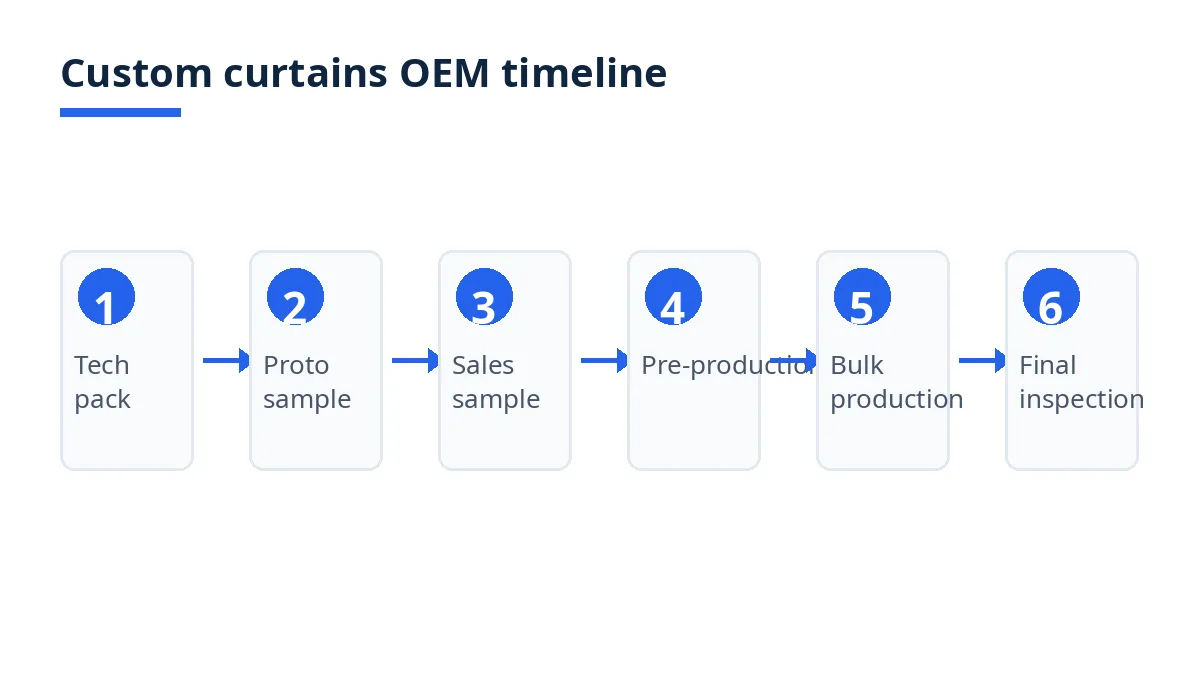
Stage | What happens | Gate that closes it | Written evidence |
|---|---|---|---|
1. Tech pack | Buyer defines fabric, construction, sizes, heading, lining, labels and packing | Factory confirms it can quote | Itemized quotation against the tech pack version |
2. Sampling | Proto sample, then sales sample in bulk fabric and colour | Buyer approves or lists corrections | Dated sample approval with measurements |
3. Pre-production | Pre-production sample in bulk fabric, trims and labels | Buyer approves bulk specification | Signed pre-production approval |
4. Bulk production | Cutting, sewing, heading, lining and finishing in agreed lots | Checks at cutting, mid-production and finishing | Milestone reports with photos and measurements |
5. Inspection | Final random inspection against the agreed standard | Lot accepted, corrected or rejected | Inspection report with defect list |
6. Shipment | Packing, carton marking, export documents and loading | Documents checked against the purchase order | Packing list, invoice and export set |
Step 1: Tech pack preparation
A tech pack is a set of instructions, not a mood board. It should be complete enough that two factories quoting on it quote on the same product. Send the same numbered version to every candidate factory, so a correction does not leave one factory working from an older file.
Include the following in the tech pack:
Fabric: fibre composition, construction, weight, colour reference, stocked or dyed to order.
Construction: panel construction, heading and hardware, hem and side seams, lining type and attachment.
Sizes: finished width and drop, how each is measured, and the tolerance for each.
Pattern: print or weave design, repeat size, and pattern match across panels and pairs.
Labels and packing: fibre composition, care and brand labels, hang tag, folding, polybag and carton specification.
Quantities: quantity per style, colour and size, with the size ratio for each colour.
Ask the factory to return an itemized quotation that follows the tech pack line by line, and to flag any point it cannot meet, any input it must buy in, and any measurement it reads differently. Record the tech pack version number on the quotation and on the purchase order, so the bulk run is tied to one document.
Step 2: Sampling rounds and approvals
Sampling usually runs in three rounds, and each round answers a different question. Do not collapse them into one sample unless you accept that the collapsed sample proves less.
Proto sample. The proto sample tests construction and proportions. It may be made in a substitute fabric, and it should be measured against the tech pack and checked for heading, drape shape, hem and finish. List corrections by measurement and construction point, not by general comment. A correction such as "increase the finished width by 4 cm and add one pleat per panel" can be measured; "make the heading fuller" cannot.
Sales sample. The sales sample is made in the bulk fabric and colour, with the bulk heading and lining, and it is the sample used to sell the product onward. Check colour under agreed lighting, the pattern match across panels, the finished size, and the label artwork. If the colour is dyed to order, the sales sample should come from the dye lot approach bulk will use, or the colour approval should be recorded as conditional on a later lab dip or bulk dye approval.
For every sample, record the date received, the tech pack version, measurements taken, and points approved and corrected. Photograph the sample hanging, not only laid flat, because a curtain is judged hanging. Keep one approved sample as the reference sample, and agree in writing that bulk will be judged against it and the measurement table, not a photograph alone.
Step 3: Pre-production
Pre-production is the last point where a change is cheap. Once bulk cutting starts, a change affects cut panels, not a single sample.
Before bulk starts, confirm in writing:
The pre-production sample, in bulk fabric, colour, trims and labels, measured and approved.
Bulk fabric and colour approvals, including any open lab dip or dye lot approval, and who signs each.
Trim and hardware supply: tape, rings, hooks, lining and labels in hand or on a dated plan, with a substitute only if approved.
The cutting plan: quantity per colour and size, the size ratio, and pattern matching across panels.
The packing plan: folding, polybag, carton size and quantity, and carton marking, checked against the sample packing.
The inspection plan: inspection level, defect classification and acceptance standard, agreed before production.
ISO 2859-1 defines a system of acceptance sampling plans for inspection by attributes, indexed by acceptance quality limit (AQL) for lot-by-lot inspection.3 AQL is the maximum average percentage of defective items considered acceptable during random sampling, and it determines sample sizes and acceptance or rejection thresholds.3 Put the inspection level and AQL values in the purchase order, and agree how major, minor and critical defects are classified for curtains, including heading, size, stitching, fabric and packing faults. A defect list written for garments will not cover a curtain heading or pattern match, so write the list for this product.
Agree separate dates for fabric ready, trims ready, cutting, mid-production check, finishing, inspection and shipment. A single delivery week hides which stage slipped, and whether inspection time was protected.
Step 4: Bulk production milestones
Bulk production moves through cutting, sewing and heading, lining, finishing and packing. Check it at milestones, not only at the end, because a fault found at cutting can be corrected before sewing, while the same fault found in finished cartons means rework across the lot.
Cutting check. Confirm the fabric, colour and quantity cut against the purchase order, the panel sizes against the measurement table, and the pattern match plan for printed or woven designs. Check that the first cut panels match the pre-production sample in heading construction and hem finish.
Mid-production check. Check a sample of sewn panels during production, not after all panels are sewn. Measure finished width and drop, check heading construction and hardware fitting, lining attachment, stitching and seam finish, and the pattern match across a pair. Record the measurements and defects, and agree the correction before the remaining panels are finished.
Finishing check. Check pressing or finishing, folding, labelling and polybagging on finished panels. Check that the fibre composition label matches the tech pack and the approved label artwork,2 that the care label is correct, and that the folding method matches the approved packing.
At each milestone, ask for dated photos, measurements and quantity completed, and keep the reports with the purchase order. If a check is missed, record that it was missed and why.
Step 5: Inspection and shipment
Final inspection is a decision, not a formality. It should be carried out on finished, packed goods, against the approved pre-production sample, the measurement table and the defect list agreed at pre-production.
The inspection report should record the lot size, the sample size drawn, the measurements taken, the defects found by classification, and the accept or reject decision. ISO 2859-1 sampling plans are designed for lot-by-lot inspection,3 so the sample size and acceptance number come from the agreed plan, not from a percentage guessed on the day. If the lot is rejected, record whether the correction is rework, reselection or a second inspection, and who pays for it.
After acceptance, check the shipment documents against the purchase order before loading. Goods may not be loaded unless an export declaration, the Bill of Export or Shipping Bill, is submitted to Customs and approved.4 Enclosed documents include the export contract or purchase order where there is no export letter of credit, the commercial invoice, the packing list, the EXP form certified by an authorized dealer, and a certificate of origin issued by the EPB or a Chamber of Commerce and Industry.4 Check that the description, quantity, HS heading and buyer name match across the invoice, packing list and Bill of Export.
State one delivery term for every quotation and for the purchase order. The Incoterms 2020 rules set out 11 rules with a clear allocation of cost, risk and obligations.5 Compare quotations only on the same term and named place, and record the term on the invoice and packing list.
What are the typical costs and timelines?
There are no typical costs or timelines that a guide can state as fact for a custom curtains order. Each factory prices your fabric, heading, lining, hardware, labels and packing, and schedules dyeing, cutting, sewing and finishing against its own line capacity. A price or lead time quoted for a different fabric, heading or size is a different offer.
For costs, ask for the quotation broken into fabric, heading hardware, lining, trims, labels, packing and the delivery term,5 so a change to one line can be priced without repricing the whole order. For timelines, ask for sampling, fabric ready, pre-production approval, bulk production, inspection and shipment as separate dates. A timeline with no inspection time, or with inspection on the loading day, should be revised before you confirm.
Example figures: sampling in three rounds, pre-production approval as a separate gate, and inspection booked before the loading date. The example shows timeline structure, not a typical duration, price or lead time.
Which documents are needed?
The order documents are the tech pack, itemized quotation, purchase order with the tech pack version, sample approvals, pre-production approval, milestone reports and final inspection report. Keep them in one file, in version order, so a dispute can be settled from the file rather than from messages.
The export set, as listed by Bangladesh Customs, is the Bill of Export, commercial invoice, packing list, EXP form certified by an authorized dealer, and certificate of origin issued by the EPB or a Chamber of Commerce and Industry, with the export contract or purchase order where there is no export letter of credit.4 Add the delivery term,5 HS heading 6303 detail1 and fibre composition label detail2 to your document check, so the shipment documents, labels and tech pack describe the same product.
What are the most common mistakes?
Approving a proto sample as if it were a bulk approval. A proto sample in a substitute fabric proves construction, not colour, drape or finished size. Keep the three approvals as separate written approvals.
Leaving the heading and size measurement undefined. A heading and finished size described only in words will be made differently by different factories. Define the heading construction, hardware, how width and drop are measured, and the tolerance for each.
Approving colour from a photograph. Colour on a screen is not a colour approval. Approve colour from a physical sample or lab dip in the bulk fabric, under agreed lighting, and record it against the dye lot approach bulk will use.
Starting bulk before trims are confirmed. Tape, rings, hooks, lining and labels each have their own supply date. A bulk start with one trim missing produces panels that wait, or panels finished with an unapproved substitute.
Writing the inspection plan at the end. An inspection level, AQL values and defect list agreed after production cannot be applied fairly to that production.3 Agree them at pre-production, and write the defect list for curtains, including heading, pattern match and packing faults.
Comparing quotations on different terms. Quotations on different delivery terms are not comparable, because the Incoterms 2020 rules allocate cost, risk and obligations differently for each rule.5 Compare only replies to the same tech pack on the same term and named place.
How Exportain helps
On Exportain, browse suppliers and post a request for quotation (RFQ) on the RFQ board with your tech pack summary, quantity per colour and size, and delivery term, so factories quote against the same specification. Ask each reply to confirm its sampling rounds, pre-production approval date, and milestone checks.
Read badges for what they record. Exportain verification is a document and photo review by staff, not a factory inspection.6 It is not a substitute for sample approval or final inspection. See how supplier verification works on Exportain.
Next steps on Exportain
Browse suppliers, then post your tech pack summary and quantity split on the RFQ board so factories quote on the same specification and timeline. Before you confirm, read how to import curtains from Bangladesh and the curtains quality control checklist.
Sources
- HS, 2012 - Code 6303: Curtains (including drapes) and interior blinds; curtain or bed valances. United Nations Statistics Division (accessed )
- Regulation (EU) No 1007/2011 on textile fibre names and related labelling and marking of the fibre composition of textile products. European Union, (accessed )
- ISO 2859-1:2026 - Sampling procedures for inspection by attributes — Part 1: Sampling schemes indexed by acceptance quality limit (AQL) for lot-by-lot inspection. International Organization for Standardization (accessed )
- Customs Clearance Procedures for Export. Bangladesh Customs, National Board of Revenue (accessed )
- Incoterms® 2020. International Chamber of Commerce (ICC) (accessed )
- Supplier verification: Earn trust badges buyers can see. Exportain (accessed )
About the author
Sourcing from Bangladesh?
Post a request for quotation and suppliers on Exportain can send you their quotes directly.
Post an RFQ


