Custom Chino Trousers Manufacturer in Bangladesh: OEM Process From Tech Pack to Bulk
A custom chino order from Bangladesh turns on waistband construction, pocket pattern, dye route, wash shade and size grading. This guide walks buyers through the tech pack, wash trial, fit approval and bulk inspection.
Short answer
A custom chino trousers order from Bangladesh is an OEM process that starts with a detailed tech pack and ends with a washed, pressed and inspected bulk shipment. The buyer must fix the waistband construction, pocket pattern, dye route and wash recipe, then approve a proto sample, a wash trial, fit grading across the size range and a pre-production sample in bulk materials before cutting begins.
On this page
Key takeaways
Fix the waistband, pockets, dye route and wash in the tech pack first, because those four decisions drive fit, shade and comparability across quotations.
Approve shade only on a washed physical sample kept sealed as the bulk reference, never from a photograph, and record shrinkage per measurement after the wash trial.
Approve fit and grading in the smallest, middle and largest sizes measured after washing, not in a single base size, before bulk cutting begins.
Hold bulk cutting until a pre-production sample in bulk materials, bulk colour and bulk trims passes, and inspect the finished, washed and pressed trousers against it.
Verification on Exportain is a document and photo review, not a factory inspection, so wash trials, fit approval and bulk inspection stay with the buyer.
A chino trouser order is won or lost at the waistband, the pocket and the leg. A buyer can approve a fabric swatch and a colour card and still receive trousers that twist at the leg, gap at the waist after washing, or vary in shade between the body and the pocketing. Those faults come from decisions made before bulk cutting: the waistband construction, the twill and stretch content, the pocket pattern, the wash recipe and the way sizes are graded from a single fit block.
Chino production belongs to Bangladesh's woven sector, and the sector numbers frame the search: BGMEA counts around 4,500 member factories, about 60 percent of them woven, and states that its members account for 100 percent of woven garment exports.1 EPB data puts July–September 2026 woven exports at $4,614.80 million, up 5.11 percent year on year, within ready-made garment exports of $10,578.56 million.2 Sector scale says nothing about a single factory, so each candidate still needs testing on chino work specifically — a curved waistband, a coin pocket and a garment wash that holds shade across a size range.
Why this matters for buyers and sellers
For the buyer, a chino is a fit garment before it is a fashion garment. The waist must sit where the customer expects it, the rise must allow sitting without pulling, and the leg opening must stay consistent from the smallest to the largest size. A trouser that measures correctly on a table but pulls at the thigh when worn, or whose waistband rolls after one wash, becomes a return rather than a repeat order, and that failure lands after shipment, when correction is no longer possible. For the seller, the same points decide whether the order runs cleanly, since washing shrinks and softens the twill, pressing sets the crease and waistband shape, and a pocket bag cut on the wrong grain can twist the front leg. Two controls keep quotations comparable: one delivery term on every quotation, since the Incoterms 2020 rules set out 11 rules with a clear allocation of cost, risk and obligations,3 and an inspection plan agreed before production, since ISO 2859-1 defines acceptance sampling plans indexed by acceptance quality limit (AQL) for lot-by-lot inspection.4
Step-by-step: how it works
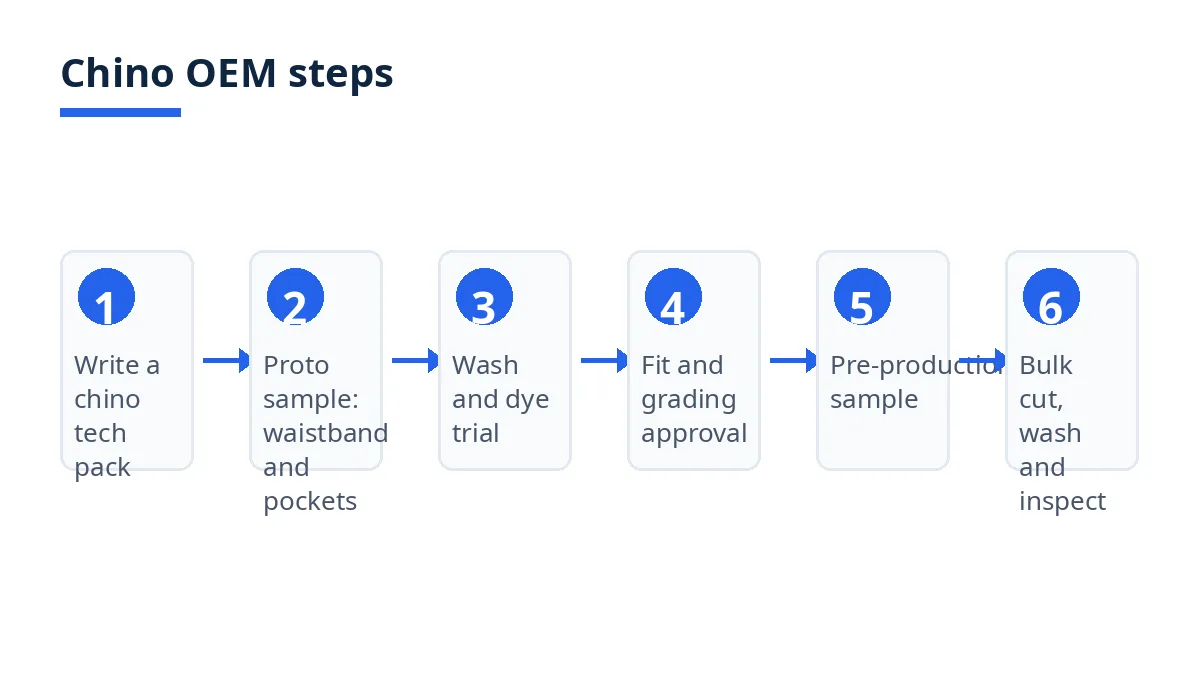
1. Write a chino tech pack, not a general trouser brief
State the fabric by composition, twill construction, weight and stretch content, and say whether the cloth is piece-dyed or garment-dyed. Piece-dyed cloth is coloured before cutting, so shade is set at the fabric stage. Garment-dyed chinos are sewn first and dyed as finished trousers, giving a softer, washed-down look but making shade matching across sizes and repeat orders harder to hold. Name the dye route in the tech pack, because it changes sampling, costing and inspection.
Then specify the waistband: its height, whether it is a separate curved band or a straight band, the closure type, button and buttonhole positions, belt loops and spacing, and the inner treatment. Give a drawing and a finished waist measurement for each size, taken with the waistband closed and laid flat. Add the pockets: front style, bag depth and fabric, coin pocket position if required, and back pocket style. Give the bag depth as a number, since a shallow bag is a common chino complaint. Finish with the leg: fit block, rise, thigh, knee and leg opening at each size, inseam lengths, hem finish and crease requirement.
2. Make a proto sample and check the waistband and pockets first
Order a proto sample in a cloth close to the intended twill, even if the exact colour is not yet available. Measure the waistband closed, the rise, the thigh and the leg opening against the tech pack, and check the waistband curve, pocket bag depth and pocket mouth position on a fit model or a form in your base size. A proto that fits on paper but gaps at the back waist or pulls at the pocket mouth needs a pattern correction now, not a note for bulk. Ask to see the inside as well as the outside, since waistband stitching, pocket bag seams and fly construction show how the trouser will survive washing and pressing.
3. Run the wash and dye trial as its own stage
Chino shade is set at the wash stage, and wash is where most chino orders drift. Ask for a wash trial on the proto or on trial trousers, using the exact recipe proposed for bulk: wash type, enzyme or softener treatment, drying method and pressing finish. Measure the trial trousers after washing and compare them with the pre-wash measurements, so shrinkage is recorded per measurement rather than assumed, since waist, inseam and leg opening shrink at different rates. Check shade under the same light you will use for bulk approval, and check pocketing and waistband lining against the body cloth. Approve the wash recipe, shrinkage allowances and shade standard in writing, and keep a sealed reference sample from the trial.
4. Approve fit and grading across the size range
Once the base size fits, require a fit and grading approval before bulk. Grading a trouser is not a uniform increase at every point: waist, hip, thigh, knee and leg opening grow at different rates, and the rise changes differently from the inseam. Ask for a size set in your smallest, middle and largest sizes, measured after washing, and check that the leg opening and knee stay in proportion at the extremes. A grade that works at the middle size can leave the largest size tight at the thigh or the smallest size wide at the leg opening. Do not approve bulk on a single size.
5. Approve a pre-production sample in bulk materials
The pre-production sample is the last gate before cutting. It must be made in the bulk twill, bulk colour, approved wash recipe and bulk trims: button, zip or button fly, thread, pocketing, labels and carton. Measure it after washing against the tech pack tolerances, check the shade against the sealed wash reference, and check the pocket bag depth, fly, belt loops and hem. Confirm label composition at this stage. In the European Union, a textile product shall be labelled or marked with the name and percentage by weight of all constituent fibres in descending order.5 For a cotton and elastane chino, the label must match the bulk cloth, including the elastane share, not the proto cloth. Approve in writing.
6. Cut, wash, press and inspect in bulk
Bulk production follows the approved sample: cutting, sewing, washing to the approved recipe, pressing and final inspection. Ask how the factory sequences washing and inspection, because the order matters. Trousers inspected before washing can pass measurements that fail after shrinkage, and shade checked before pressing can read differently once the crease is set. Require a final inspection after washing and pressing, on the finished garment, against the approved tolerances and the sealed shade reference. Agree the inspection level and AQL values in the purchase order before bulk starts, following ISO 2859-1, and state which defects are critical, major and minor for chinos.4 For classification, heading 6203 covers suits, ensembles, jackets, blazers, trousers, bib and brace overalls, breeches and shorts, other than swimwear, for men or boys, not knitted or crocheted.6
Costs, timelines and documents
What are the typical costs and timelines?
There are no typical costs or timelines a guide can state as fact. Each factory prices your twill, stretch content, dye route, waistband and pocket construction, wash recipe, trim set, label and carton runs, and the delivery term you choose.3 A garment-dyed chino carries dye and wash work after sewing, while a piece-dyed chino carries it at the fabric stage, so two quotes for the same-looking trouser can differ for a structural reason rather than a margin reason. For timelines, sampling depends on fabric availability, wash trial rounds and fit corrections, and bulk production depends on dyeing, wash capacity, trim delivery and line availability. Ask for sampling, fabric ready, wash approval, production and inspection dates as separate lines, not a single delivery week.
Example figures: a buyer orders 2,400 pairs in three colours at 800 pairs per colour. Dropping one colour leaves 2,400 pairs in two colours at 1,200 pairs per colour, raising the quantity per dye lot without changing the total. Separately, an example wash set-up of 600 currency units spread over 600 pairs adds 1.00 per pair, while the same set-up spread over 3,000 pairs adds 0.20 per pair (600 divided by 3,000). These are example figures only, showing how structure moves the unit price, not a typical chino price.
Which documents are needed?
The order documents are the tech pack with waistband, pocket, wash and grading rules, the itemized quotation, the purchase order with inspection level and AQL values, and the written sample approvals at each gate.4 For export clearance, see the Bangladesh Customs export procedure, which requires an approved Bill of Export before goods are loaded.7
Bangladesh-specific rules and tips
Treat association claims as leads, not proof. A supplier claiming BGMEA membership should be checked with the association itself. The association's figures — around 4,500 members, about 60 percent woven, 100 percent of woven exports1 — describe the sector, not a factory's wash capacity, shade control or chino fit skill.
Ask who washes, and where. Some woven factories wash in-house and some send trousers to a separate laundry. Either arrangement can work, but the wash trial, shade reference and bulk wash schedule all sit with the laundry rather than the sewing floor. Ask for the laundry's role in writing, and require the bulk wash to follow the approved recipe rather than a standard house wash.
One legal name, on every paper, without exception. The export declaration, trade licence, quotation, proforma invoice and payment account all name the exporter and the foreign buyer — if any one of them differs, clearance stalls while the file is reconciled.
Mistakes and red flags
What are the most common mistakes?
Approving shade from a photograph. A screen shifts twill shade, and lining can differ from the body in a way a photograph hides. Approve shade on a washed physical sample under agreed light, and keep it sealed as the bulk reference.
Approving fit in one size only. A grade can pass at the middle size and fail at the thigh or leg opening at the extremes. Require the smallest, middle and largest sizes, measured after washing.
Treating piece-dyed and garment-dyed as interchangeable. The two routes differ in shade control, shrinkage behaviour and repeat-order matching. A quote that does not name the dye route cannot be compared with one that does.
Skipping the wash trial. Wash moves waist, inseam and leg opening at different rates. Without a trial, shrinkage is guessed, and bulk tolerances are set against pre-wash measurements the finished trouser will never meet.
A quote for a straight band with patch pockets is not comparable with a quote for a curved band with welt pockets, and a quote on a different Incoterm is a different offer altogether. Compare replies only when they answer the same tech pack on the same term.
Checklist
Before you confirm, every line should be answered in writing.
Tech pack sent: twill, stretch, dye route, waistband, pockets, leg, hem, labels, packing.
Waistband fixed: curved or straight, height, closure, belt loops, inner treatment.
Pocket specification fixed: front style, bag depth as a number, coin pocket, back pocket style.
Wash trial approved: recipe, shrinkage per measurement, shade standard, sealed reference kept.
Fit and grading approved: smallest, middle and largest sizes measured after washing.
Pre-production sample approved in bulk materials, bulk colour and bulk trims.
Inspection level and AQL values in the purchase order, with chino defect classes named.4
Quotations compared on the same tech pack, dye route and Incoterm.3
Size ratio per colour agreed; wash provider and schedule confirmed in writing.
How Exportain helps
On Exportain, browse suppliers and post a request for quotation on the RFQ board with your chino tech pack summary, dye route, wash requirement and size range, so suppliers quote against the same waistband, pocket and wash specification. Read the MOQ guide before you set quantities, and read how supplier verification works on Exportain for what a badge records. Verification on Exportain is a document and photo review, not a factory inspection,8 so wash trials, fit approval and bulk inspection stay with you.
FAQs
What should I know first about chino trousers?
Know the waistband, the pockets, the dye route and the wash before you discuss price. A chino is a woven cotton twill trouser whose fit depends on the waistband curve, rise, pocket pattern and leg grading, and whose shade depends on whether the cloth is piece-dyed or the finished trouser is garment-dyed. Heading 6203 covers men's or boys' trousers, not knitted or crocheted, among other garments.6
What are the typical costs and timelines?
There are no typical figures a buyer can rely on, because each factory prices your twill, dye route, waistband and pocket construction, wash recipe, trim set and delivery term.3 Ask for each stage as a separate dated line.
Which documents are needed?
The order documents are the tech pack, itemized quotation, purchase order with inspection and AQL terms, and written approvals for the proto, wash trial, fit grading and pre-production sample.4
What are the most common mistakes?
The most common mistakes are approving shade from a photograph, approving fit in one size only, treating piece-dyed and garment-dyed chinos as interchangeable, skipping the wash trial, and comparing quotes on different waistbands, pockets or terms.3
Next steps on Exportain
Browse suppliers, then post your chino tech pack summary, dye route and size range on the RFQ board so suppliers state their wash route and grading approach against the same specification. Before you confirm, read the chino trousers quality control checklist and how to import chino trousers from Bangladesh.
Sources
- BGMEA at a glance. Bangladesh Garment Manufacturers and Exporters Association (BGMEA) (accessed )
- RMG exports rise 6.10% to $10.58b in July-Sept of FY27. tob.news, (accessed )
- Incoterms® 2020. International Chamber of Commerce (ICC) (accessed )
- ISO 2859-1:2026 - Sampling procedures for inspection by attributes — Part 1: Sampling schemes indexed by acceptance quality limit (AQL) for lot-by-lot inspection. ISO (accessed )
- Regulation (EU) No 1007/2011 on textile fibre names and related labelling and marking of the fibre composition of textile products. European Union, (accessed )
- Classification Detail — HS Code 6203. United Nations Statistics Division (accessed )
- Customs Clearance Procedures for Export. Bangladesh Customs, National Board of Revenue (accessed )
- Supplier verification: Earn trust badges buyers can see. Exportain (accessed )
About the author
Sourcing from Bangladesh?
Post a request for quotation and suppliers on Exportain can send you their quotes directly.
Post an RFQ