

Custom Cargo Pants Manufacturer in Bangladesh: OEM Process From Tech Pack to Bulk
Cargo pants OEM in Bangladesh, from tech pack to bulk: pocket and knee construction, wash and dye sampling, trouser fit grading, and the bulk checks that catch pocket and seam failures before shipment.
Short answer
A custom cargo pants order in Bangladesh runs from a pocket and knee tech pack through a proto sample, a wash and dye trial, fit and grading approval, a pre-production sample in bulk materials, and bulk inspection against that sample, with each stage approved in writing before the next begins.
On this page
Key takeaways
A cargo pant is defined by its pockets and its knee: fix every pocket type, position, dimension, gusset and closure, and the knee treatment, before asking for a price.
Approve shade, hand feel and leg twist on a washed sample in the actual fabric, because a garment wash or dye changes all three after sewing.
Approve fit and grading on the smallest, middle and largest sizes, with pocket positions checked on each, before bulk cutting.
Compare quotations only on the same pocket, knee and wash specification and the same Incoterm, or the comparison is meaningless.
Exportain verification is a document and photo review, not a factory inspection, and a badge is not a guarantee of capacity, quality or delivery.
A cargo pant earns its name from what it carries and where it carries it. Bellows pockets on the thigh, a knee panel that bends without pulling, a waistband that holds under the weight of loaded pockets, and a leg that keeps its shape after washing are the parts a buyer is actually ordering. When any of those parts is left vague in the specification, the factory fills the gap with its own habit, and the bulk delivery reflects that habit rather than the buyer's design. This guide follows a custom cargo pants order in Bangladesh from the tech pack to bulk shipment, with the pocket, knee, wash and fit decisions given the attention they deserve.
Cargo pants are woven trousers, so the supplier pool sits in Bangladesh's woven garment sector. The Bangladesh Garment Manufacturers and Exporters Association (BGMEA) represents the readymade garment industry, including woven garments, knitwear and sweaters, and reports around 4,500 member factories, about 60 percent of them woven garment manufacturers.1 In July to September 2026, woven garment exports reached $4.614 billion, up 5.11 percent year on year, within ready-made garment exports of $10.578 billion, according to Export Promotion Bureau (EPB) data.2 That scale tells a buyer where capacity sits. It says nothing about whether one factory can sew a bellows pocket cleanly, hold a knee dart through washing, or grade a relaxed trouser leg across a full size range, so the stages below are written as checks to run on each candidate.
In the Harmonized System, Chapter 62 covers articles of apparel and clothing accessories, not knitted or crocheted, and heading 6203 covers men's and boys' trousers, with subheading 6203.42 for trousers of cotton.3 Confirm the heading by wearer and fibre before quoting duty, because a cargo pant in a cotton blend, a synthetic fibre or a women's cut falls under a different line, and the label must follow the fibre mix actually used. For sales into the European Union, Regulation (EU) No 1007/2011 states that a textile product shall be labelled or marked with the name and percentage by weight of all constituent fibres in descending order.4
Why this matters for buyers and sellers
For the buyer, cargo risk concentrates in three places that a flat photograph cannot show. The first is pocket behaviour under load: a bellows pocket that gapes when empty, a flap that lifts, a snap or button that pulls through the fabric, or a pocket bag that shows through the leg. The second is knee behaviour in wear: a knee panel or dart that restricts sitting, a crease that sets in the wrong place, or reinforcement stitching that breaks at the flex point. The third is change after washing: a leg that twists, a waistband that rolls, or a pocket and body that drift apart in shade because they were washed in different batches.
For the seller, the same three points set the real cost of the order. Pockets add operations, hardware adds sourcing and setting time, knee work adds pattern pieces, and a garment wash adds a batch process with its own capacity and shade risk. A factory that prices a cargo pant as a plain trouser has either missed those operations or plans to simplify them. The buyer discovers the difference at the sample stage if the specification names each part, or at bulk inspection if it does not.
Step-by-step: how it works
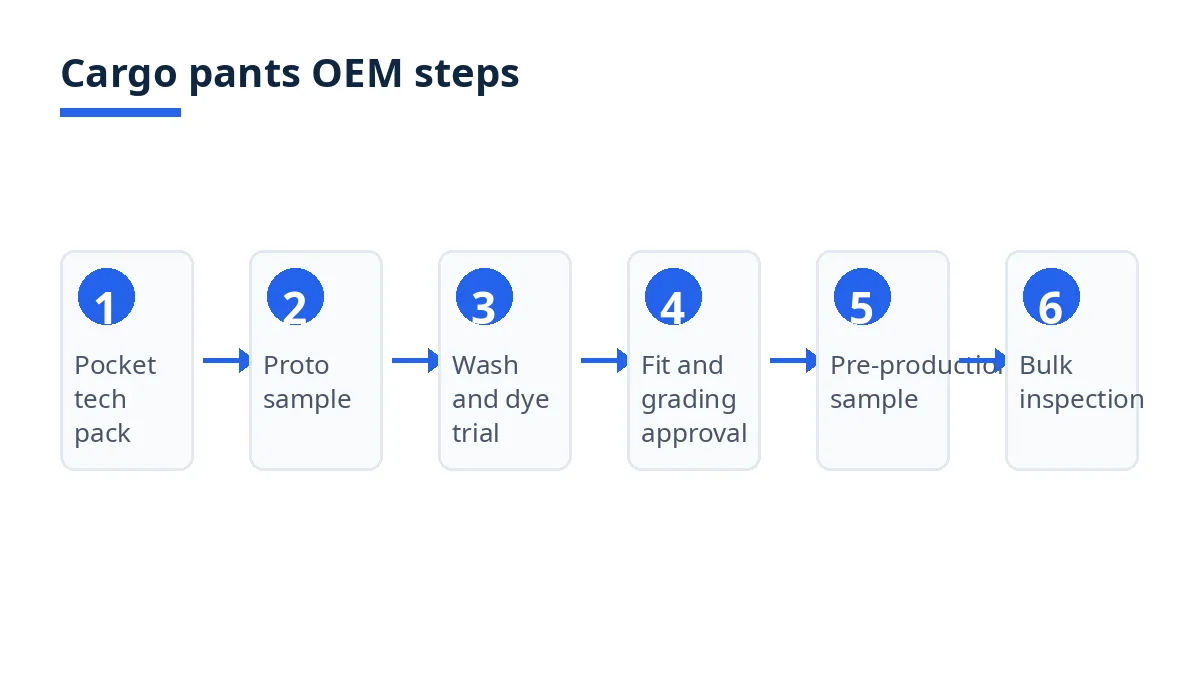
Write the cargo tech pack first, pockets before fabric. For every pocket, state its type (bellows, flap, welt, or zip), its position measured from the waistband and the side seam, its finished dimensions, its gusset depth, its closure type and position, and its stitching specification. State the knee treatment separately: plain leg, darted knee, articulated knee, or reinforced panel, with panel dimensions and stitch lines. Add waistband construction, fly type, hem finish, drawcord or belt loops, fabric composition and weight, colour, size chart, and label placements.
Send one tech pack to every candidate. A quotation that answers a different pocket or knee specification is not comparable with one that answers yours. Ask each factory to confirm, in writing, which pocket and knee operations it will run in-house and which it will subcontract, including washing and dyeing.
Approve a proto sample for pattern and construction. Check the pocket against the tech pack measurements, open and close every closure, sit in the sample, and bend the knee. Record corrections pocket by pocket and knee by knee, not as a general note about fit.
Run the wash and dye trial on the actual fabric. Cargo pants are commonly garment-washed or dyed after sewing, so approve the shade, hand feel, pocket-to-body shade match, and leg twist on a washed sample, not on unwashed cloth.
Approve fit and grading across the size range. Measure the waist, hip, thigh, knee, leg opening and inseam on the smallest, middle and largest sizes, and check the pocket position and size on each. Approve the grade in writing before bulk cutting.
Approve a pre-production sample in bulk fabric, bulk trims and the approved wash. This sample is the bulk standard: pocket dimensions, knee construction, hardware, labels, shade and measurements. Any change after this approval is a new approval, with its cost and time effect stated.
Inspect bulk against the pre-production sample, not against the tech pack alone. Check pocket dimensions and closures, knee stitching at the flex point, waistband behaviour, leg twist after the bulk wash, shade consistency between body and pockets, and measurements across sizes. Agree the inspection plan before production: ISO 2859-1 defines a system of acceptance sampling plans for inspection by attributes, indexed by acceptance quality limit (AQL) for lot-by-lot inspection.5
Costs, timelines and documents
What are the typical costs and timelines?
There are no typical costs or timelines a guide can state as fact, because each factory prices your fabric, pocket count and construction, hardware, knee work, wash or dye process, trim and label runs, and the delivery term you choose. The Incoterms 2020 rules set out 11 rules with a clear allocation of cost, risk and obligations.6 Compare quotations only on the same Incoterm and the same pocket, knee and wash specification, or the comparison is meaningless: a lower price on a simplified pocket or an unwashed leg is a different garment.
What drives cost and time on a cargo order is specific. Pocket count and type drive sewing minutes and hardware cost. Bellows construction drives pattern pieces and stitching time. Knee reinforcement drives fabric use and extra operations. A garment wash or dye drives batch scheduling, and a second wash trial after a shade rejection drives it again. Imported hardware can set both the minimum and the earliest production date, so ask which hardware is stocked and which is ordered for your specification.
For timelines, ask for sampling, fabric ready, wash trial, production and inspection dates as separate lines, not a single delivery week. Sampling depends on fabric availability and correction rounds, and bulk production depends on dyeing or washing capacity, hardware delivery and line time.
Example figures: a buyer orders 2,400 pieces in four colours at 600 pieces per colour. If one colour is cut to 150 pieces, that colour may fall below its dye or wash batch minimum even though the order total is unchanged, and the factory may surcharge it, merge it into another batch with a shade risk, or drop it. The arithmetic is 4 multiplied by 600 equals 2,400, and 150 is one quarter of 600. The example shows structure only, not a typical MOQ, price or lead time.
Which documents are needed?
The order documents are the tech pack, the itemized quotation, and the purchase order, with pocket and knee specifications, the wash or dye approval, the size grade, the inspection plan and the delivery term on all three. For export clearance, see the Bangladesh Customs export clearance procedure for the declaration and enclosed documents required.7
Bangladesh-specific rules and tips
Do not let a membership claim stand in for cargo evidence. Check any BGMEA claim with the association itself, and remember the sector figures — around 4,500 members, about 60 percent woven, 100 percent of woven exports1 — say nothing about pocket skill, wash capacity or grading accuracy for your cargo design.
Separate the wash from the sewing when you compare factories. Some woven factories sew well and wash elsewhere, and the wash house sets the shade, the leg twist and the schedule. Ask who washes, how pocket and body pieces are batched together, and what happens to shade matching when a wash batch is split across two loads.
Ask which inputs are imported for your order. Hardware, pocketing fabric and some woven fabrics may be bought in for your specification, and an imported snap or zip can set both the minimum and the earliest production date. Confirm that pocket bags and pocket flaps are cut from the same lot as the body where shade matching matters.
Set the fibre label from the bulk cloth. If the bulk fabric blend changes after sampling, the label and the customs heading may change with it. Regulation (EU) No 1007/2011 requires fibre names and percentages in descending order,4 so record the bulk composition in writing at the pre-production sample stage.
Mistakes and red flags
What are the most common mistakes?
Specifying pockets by photograph only. A photograph shows a pocket shape, not its gusset depth, closure position, stitch density or pocket bag depth. A factory copying a photograph will guess each of those, and the guesses will differ across sizes. State every pocket dimension and closure in the tech pack.
Approving fit on one size and one colour. A cargo leg that fits at the middle size can pull at the thigh on the largest size, and a pocket that sits well on a dark colour can show its bag through a light colour. Approve the smallest and largest sizes and the lightest colour before bulk cutting.
Approving shade on unwashed cloth. A garment wash or dye changes shade, hand feel and leg twist. A shade approved on a fabric swatch is not an approval of the washed trouser.
A cheaper quote is not a cheaper pant if the specification moved. Fewer pockets, a plain knee instead of a reinforced knee, or an unwashed leg each change the offer, so compare replies only when they answer the same tech pack on the same Incoterm.6
Do not leave a change to a pocket, wash or grade spoken-only. Write any agreed change onto the quotation and purchase order, with the pocket, colour and size it applies to — a verbal pocket simplification at bulk stage is difficult to reverse once cutting starts.
A profile does not prove cargo capability. It is a starting point for enquiries; it does not test whether a factory can sew a bellows pocket, hold a knee through washing, or grade a relaxed leg, and a badge guarantees nothing about capacity, quality or delivery.8
Checklist
Before you confirm, every line should be answered in writing.
Tech pack sent: pocket type, position, dimension, gusset and closure; knee treatment; waistband, fly, hem, drawcord or belt loops; fabric, colour, sizes, labels, packing.
Pocket and knee operations confirmed in-house or subcontracted, including washing and dyeing.
Proto sample approved pocket by pocket and knee by knee, with corrections recorded.
Wash or dye trial approved on the actual fabric, with pocket-to-body shade match checked.
Fit and grading approved on the smallest, middle and largest sizes, with pocket positions checked on each.
Pre-production sample in bulk fabric, bulk trims and the approved wash approved in writing.
Hardware status recorded: stocked or ordered for your specification.
Inspection level and AQL values in the purchase order.5
Quotations compared on the same pocket, knee and wash specification and the same Incoterm.6
Order documents agreed: tech pack, itemized quotation, purchase order, and the export set per the customs procedure.7
How Exportain helps
On Exportain, browse suppliers and post a request for quotation (RFQ) on the RFQ board with your cargo tech pack summary, pocket and knee specification, wash requirement, size range and delivery term, so suppliers quote against the same specification. Ask each reply for its pocket and knee operations, its wash arrangement, and its minimum per style and per colour. When you accept a quotation, Exportain creates one order and issues one proforma invoice from the accepted terms.8
Badges record checks, not inspections. Exportain Verified records identity, phone, email and business registration; Export Verified records the Export Registration Certificate (ERC);8 Factory Verified records a photo review of the manufacturer factory.8 Staff carry out these checks as a document and photo review, free of charge, and membership plans never buy them.9 Because it is not a factory inspection,8 9 pocket, wash, fit and bulk inspection remain yours. See how supplier verification works on Exportain and the MOQ guide.
FAQs
What should I know first about cargo pants?
A cargo pant is defined by its pockets and its knee, not by its fabric alone. Before you ask for a price, fix every pocket type, position, dimension, gusset and closure, fix the knee treatment, and decide whether the trouser will be garment-washed or dyed, because those three decisions set the sewing operations, the wash batch and the inspection points. Cotton cargo trousers for men and boys fall under subheading 6203.42 in the Harmonized System.3
What are the typical costs and timelines?
There are no typical figures a buyer can rely on, because each factory sets its price, MOQ and lead time for your specification. Pocket count and construction, knee work, hardware, the wash or dye process, the colour split and the delivery term drive the price,6 and fabric availability, hardware delivery, wash capacity and correction rounds drive the timeline. Ask for each stage as a separate dated line.
Which documents are needed?
The order documents are the tech pack, the itemized quotation and the purchase order, with pocket and knee specifications, the wash approval, the size grade, the inspection plan and the delivery term on all three. For export clearance, see the Bangladesh Customs export clearance procedure for the declaration and enclosed documents required.7
What are the most common mistakes?
The most common mistakes are specifying pockets by photograph only, approving fit on one size and one colour, approving shade on unwashed cloth, comparing quotes on different pocket, knee or wash specifications or terms,6 and reading a badge as a guarantee. A badge is not a guarantee of capacity, quality or delivery.8
Next steps on Exportain
Browse suppliers, post your cargo tech pack summary on the RFQ board, and read the cargo pants quality control checklist.
Sources
- Bangladesh Garment Manufacturers and Exporters Association (BGMEA). Devex (accessed )
- Exports up over 6% to $13.1bn in Q1 of FY27. Dhaka Tribune, (accessed )
- HS Nomenclature 2017, Chapter 62: Articles of apparel, not knitted or crocheted. World Customs Organization (accessed )
- Regulation (EU) No 1007/2011 on textile fibre names and related labelling and marking of the fibre composition of textile products. European Union, (accessed )
- ISO 2859-1:2026 - Sampling procedures for inspection by attributes — Part 1: Sampling schemes indexed by acceptance quality limit (AQL) for lot-by-lot inspection. ISO (accessed )
- Incoterms® 2020. International Chamber of Commerce (ICC) (accessed )
- Customs Clearance Procedures for Export. Bangladesh Customs, National Board of Revenue (accessed )
- Trust & Safety Center. Exportain (accessed )
- Supplier verification: Earn trust badges buyers can see. Exportain (accessed )
About the author
Sourcing from Bangladesh?
Post a request for quotation and suppliers on Exportain can send you their quotes directly.
Post an RFQ


