

Custom Bath Towels Manufacturer in Bangladesh: OEM Process From Tech Pack to Bulk
A custom bath towel order moves from tech pack to bulk through approvals, not a single sample: yarn and GSM, dye-lab shade, proto, wash performance, pre-production sample and bulk checks. This guide walks each gate for buyers in the USA, UK, EU and UAE.
Short answer
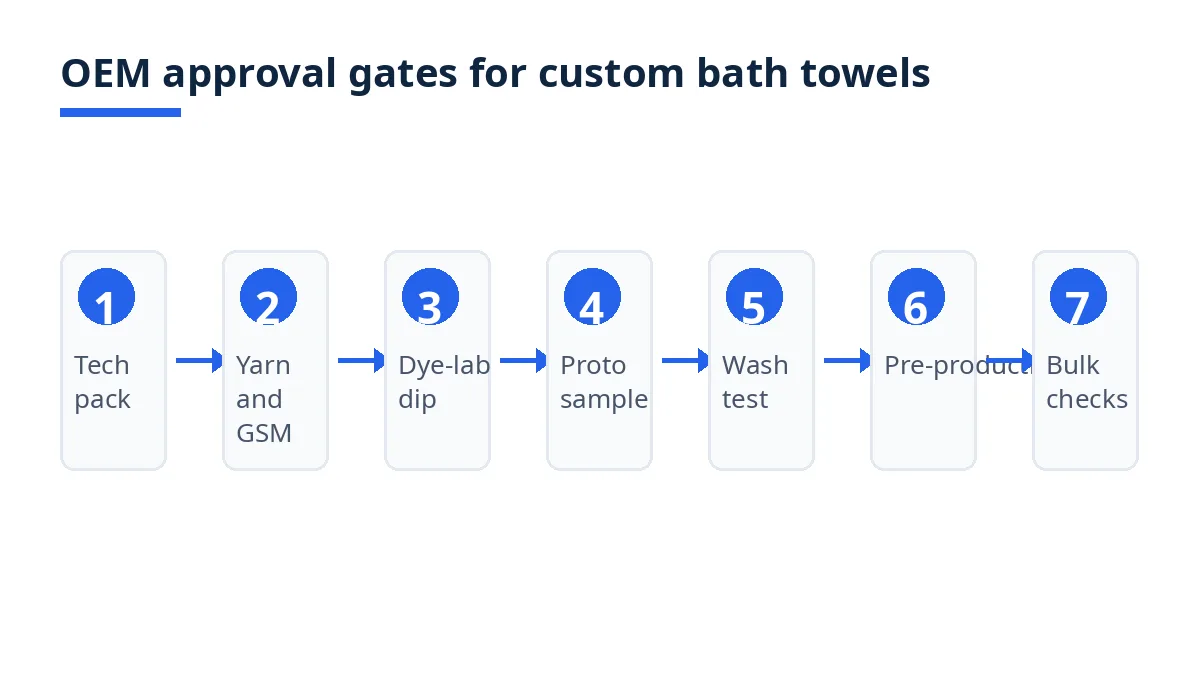
A custom bath towel OEM order in Bangladesh runs from tech pack to bulk through written approvals: yarn and GSM, dye-lab shade, proto construction, wash performance, a pre-production sample in production yarn and shade, then bulk with inline and final inspection. No gate should be skipped, because each one fixes a property bulk cannot correct later.
On this page
Key takeaways
A custom bath towel OEM order is a sequence of written approvals: tech pack, yarn and GSM, dye-lab shade, proto, wash performance, pre-production sample, then bulk checks.
Only the pre-production sample, made in production yarn, shade and finish, proves the towel bulk will deliver; a proto sample proves construction only.
Shade must be judged against a physical reference under an agreed light, never by photograph, and each colour needs its own lab-dip approval.
Bulk inspection needs an agreed plan before packing: inspection level, AQL values per defect class, an inline check and a final random check.
Exportain verification is a document and photo review, not a factory inspection, and a badge is not a guarantee.
A custom bath towel order is not a catalogue purchase with your logo added at the end. It is a manufacturing programme in which you set the specification and approve it gate by gate: yarn and weight, shade, construction, wash performance, pre-production sample, and bulk lot. This guide walks through that original equipment manufacturing (OEM) process for bath towels made in Bangladesh, from the tech pack to bulk, for buyers in the United States, the United Kingdom, the European Union and the United Arab Emirates. For the wider import journey, see the how to import bath towels from Bangladesh guide.
An OEM order means the factory makes a towel to your specification, rather than selling you a towel from its own range. When the towel is yours, each decision you leave open becomes a decision the factory makes for you. A complete tech pack, and written approval at each gate, is how you keep those decisions yours.
Why this matters for buyers and sellers
For the buyer, the OEM process is where product risk is created or removed. A towel that looks right on a table can still fail in use: it can shed pile, lose shade, shrink out of shape, or feel thin after washing. Those failures are set at the yarn, dyeing and finishing stages. Approving each stage in writing gives you a record when bulk differs from the sample, and the factory a fixed target.
For the seller, the same gates protect the production plan. Terry weaving, dyeing and finishing run in batches, and a late change to shade, weight or border design can mean re-dyeing yarn or re-setting looms. A buyer who approves the dye-lab dip, proto sample and pre-production sample in sequence gives the factory a stable brief, making bulk repeatable across colours and repeat orders.
Step-by-step: how it works
The process below is a sequence of approvals. Do not treat any gate as a formality, and do not let bulk start while an earlier gate is still open.
Write the tech pack. The tech pack is the single document every candidate factory quotes against and every sample is judged against. It states towel type and finished size with tolerances, fibre, yarn, target grams per square metre (GSM) with tolerance, pile construction, border design, hem and loop, colour list with a shade reference per colour, label artwork, packing, and towels per carton. Send the identical pack to every candidate, with replies in the same format, so quotes compare like for like.
Approve yarn and GSM. Before weaving starts, confirm the yarn and the target weight. Ask the factory to state the yarn count and fibre, the planned GSM, and the tolerance it will work to. A towel woven light for its agreed weight usually means thinner pile than the approved sample. Record the agreed GSM figure in writing, and judge every later sample against it.
Approve the dye-lab dip. For each colour, the factory dyes a small yarn or fabric sample, called a lab dip, against your shade reference. Judge it under the light you agreed in advance, and check the border yarn and hem thread against the same standard, since a body-to-border shade gap is a common bulk fault. Approve each colour separately, in writing, and keep the approved dip as the reference for bulk dyeing. A colour approved only as "close enough" will drift in bulk.
Approve the proto sample. The proto sample tests whether the factory can weave your construction: pile height and evenness, border design, hem width and stitching, squareness, and the placement of any logo or embroidery. Measure it flat without stretching, weigh it, and compare it with the tech pack line by line, listing every correction with the measurement that failed. A proto made in substitute yarn or an approximate shade proves construction only, not the finished towel.
Run the wash and performance sample. Wash the proto or a dedicated wash sample by the procedure you agreed, then re-measure length and width, re-weigh, and check absorbency, lint shedding, pile behaviour and shade after washing. Towels are used wet and laundered repeatedly, so a towel that passes dry and fails after washing is not approved. If your market needs care symbols, fix them now: ISO 3758 establishes a system of graphic symbols for care labelling, giving information on the most severe treatments that do not cause irreversible damage during textile care.1 Choose the symbols from test evidence, not from habit.
Approve the pre-production sample. The pre-production sample is the gate that matters most, because it must be made with the production yarn, dyed in the production shade, finished the production way, and carrying the production labels and packing. Check it exactly as bulk will be checked: dimensions and weight, shade against the approved lab dip, pile and hems, label wording and position, and carton packing. Approve it in writing, keep one sealed counter-sample of each type and colour, and state that bulk must match this sample.
Run bulk with inline and final checks. Once bulk weaving and dyeing start, agree an inspection plan before the goods are packed. ISO 2859-1 defines a system of acceptance sampling plans for inspection by attributes, indexed by acceptance quality limit (AQL) for lot-by-lot inspection, and AQL is the maximum average percentage of defective items considered acceptable during random sampling, used to set sample sizes and acceptance or rejection thresholds.2 Hold an inline check during weaving and dyeing, while drift can still be corrected, and a final random check on packed goods. For the detailed checks, use the bath towels quality control checklist.
Example figures: a buyer runs a programme in three colours. White and navy lab dips pass first round, while sage is returned twice for shade. Bulk for white and navy is released only after pre-production approval, while sage stays at the dye-lab gate. The example shows gate discipline only, not a typical timeline, price or order size.
Costs, timelines and documents
What are the typical costs and timelines?
There are no typical costs or timelines that can be stated as market facts for a custom towel programme, because each factory prices your yarn, construction, dyeing, finishing, label and carton specification, and the delivery term you choose. The Incoterms 2020 rules give a clear allocation of cost, risk and obligations across 11 rules, so compare every quotation on the same rule and named place.3 A quotation lower on a different term, or for a lighter towel at a lower GSM, is a different offer, not a saving.
Timelines follow the gates, not a calendar promise. Sampling time depends on yarn availability, dye-lab rounds and correction cycles, and bulk time on weaving, dyeing, finishing, inspection and packing for every colour. Ask for sampling, yarn ready, dyeing, production and inspection dates as separate lines. Where one colour is still at the dye-lab gate, that colour has no bulk date yet.
Which documents are needed?
The order documents are the tech pack, the itemised quotation, the purchase order carrying the approved GSM, shade references, tolerances and inspection values, and the written approvals at each gate. Keep the approved lab dips, sample reports and sealed counter-samples with the order file, because they are the evidence bulk is judged against.
For export clearance in Bangladesh, goods may not be loaded unless an export declaration, the Bill of Export or Shipping Bill, is submitted to Customs and approved.4 Documents enclosed with the Bill of Export include the export contract or purchase order where there is no export letter of credit, the commercial invoice, the packing list, the EXP form certified by an authorised dealer, and a certificate of origin issued by the EPB or a Chamber of Commerce and Industry.4 Check that the exporter name, buyer name and goods description match across the purchase order, invoice, packing list and declaration.
Bangladesh-specific rules and tips
Confirm what the factory actually does in-house. A towel programme needs terry weaving, dyeing and finishing capacity, not always under one roof. Ask which stages are done in-house and which are bought in, and for bought-in stages, who dyes the yarn and finishes the cloth.
Fix the shade reference in a form that survives the order. A colour name alone is not a reference. Use a physical swatch, a reference number, or a retained sample, and name the light for judging shade. Record border yarn, hem thread and embroidery thread against the same reference, since threads from a different lot can sit a shade apart.
Write the size ratio and carton plan into the tech pack. Towels ship by volume as much as by weight, so agree the carton plan at the tech pack stage. State towels per carton, carton dimensions and gross weight, and the size and colour ratio per carton.
Keep one legal name across every paper. The export declaration names the exporter and the foreign buyer,4 so the name on the trade licence, quotation, proforma invoice and payment account should match. A difference in spelling or entity name between the quotation and the invoice can hold a shipment.
Plan labels for each destination market at the sample stage. Fibre wording for the European Union follows Regulation (EU) No 1007/2011, under which a textile product shall be labelled or marked with the name and percentage by weight of all constituent fibres in descending order.5 Care symbols follow ISO 3758.1 Agree the full label set, including origin marking where required, before bulk labels are printed.
Mistakes and red flags
What are the most common mistakes?
Approving bulk from a proto sample. A proto proves construction. Only the pre-production sample, made in production yarn, shade and finish, proves the towel you will receive.
Approving shade by photograph. A phone photograph shifts shade with light, screen and compression. Judge lab dips and bulk shade against the physical reference under the agreed light.
Leaving GSM as a range without a tolerance rule. A target weight with no tolerance, and no statement of how weight is measured, cannot be passed or failed fairly. Fix the target, tolerance, measurement method, and whether weight is judged per towel or as a lot average, in the purchase order.
Accepting verbal approvals. Every gate approval, correction and shade decision should be written, dated and attached to the order file.
Treating a profile or a badge as production proof. A supplier profile is a starting point for enquiries. It does not test whether a factory can weave your towel to your GSM and shade tolerance. Exportain verification is a document and photo review by staff, not a factory inspection, and a badge is not a guarantee of production capacity, product quality or delivery.6
Skipping the wash sample to save a week. Wash performance is where towels fail most visibly: shrinkage, shade loss, shedding and pile change appear after laundering. Skipping the wash gate saves days at sampling and risks the whole bulk lot.
Red flags include a factory that will not state its yarn or GSM in writing, a lab dip judged only by photograph, a pre-production sample in substitute yarn, a refusal to agree inspection levels and AQL values before bulk, and a quotation that changes GSM or construction without flagging it. Any one of these is a reason to pause the gate.
Checklist
Before bulk starts, every line below should be answered in writing.
Tech pack issued to all candidates: size, fibre, yarn, GSM with tolerance, pile, border, hem, loop, colours with shade references, labels, packing.
Yarn and GSM confirmed in writing for each towel type.
Lab dip approved per colour, under the agreed light, including border and hem thread.
Proto sample measured, weighed and corrected in writing.
Wash sample tested per colour: size and weight after washing, absorbency, shedding, shade.
Pre-production sample approved in writing, in production yarn, shade, finish, labels and packing, with a sealed counter-sample.
Inspection level and AQL values agreed, with inline and final checks.2
Tariff line confirmed per towel type with your customs broker.7
Delivery term and named place fixed on every quotation.3
Export set agreed: invoice, packing list, EXP form, certificate of origin, Bill of Export.4
Carton plan confirmed: towels per carton, dimensions, gross weight, size and colour ratio.
How Exportain helps
On Exportain, browse suppliers and post your tech pack summary, colour list and delivery term on the RFQ board so suppliers quote against the same specification. Ask each reply to state its yarn, GSM, shade approval method and sample sequence, and compare replies gate by gate rather than on unit price alone. For order size, read the bath towels MOQ guide and the HS code for bath towels guide.
Read the badges for what they record. Exportain Verified means Exportain has checked identity, phone, email and business registration, and Export Verified means it has checked the Export Registration Certificate (ERC).6 Factory Verified means it has reviewed photos of the manufacturer factory, and Trading Company Verified means it has reviewed photos of the trading company office or warehouse.6 Verification is a document and photo review by staff, free, and never granted by membership plans.8 It is not a factory inspection,6 8 so sample approval and inspection stay with you.
FAQs
What should I know first about bath towels?
Know that a custom towel is a specification before it is a price. The tech pack fixes size, fibre, yarn, GSM, pile, border, hem, colours, labels and packing, and each gate then tests one part of it. A cotton towel of terry towelling sits under subheading 6302.60.00 in the United States schedule.7
What are the typical costs and timelines?
There are no typical figures a buyer can rely on, because each factory prices your yarn, construction, dyeing, finishing, label and carton specification, and the delivery term you choose.3 Timelines follow the approval gates.
Which documents are needed?
The order documents are the tech pack, itemised quotation and purchase order, with the approved GSM, shade references, tolerances and inspection values, plus the written approvals at each gate. The export set is the Bill of Export, commercial invoice, packing list, EXP form certified by an authorised dealer, and a certificate of origin issued by the EPB or a Chamber of Commerce and Industry.4
What are the most common mistakes?
The most common mistakes are starting bulk from a proto sample, approving shade by photograph, leaving GSM without a tolerance rule, accepting gate approvals verbally, and reading a badge as a guarantee. A badge is not a guarantee of capacity, quality or delivery,6 and verification is a document and photo review, not a factory inspection.8
Next steps on Exportain
Browse suppliers, then post your tech pack summary, colour list and delivery term on the RFQ board so suppliers state their yarn, GSM and sample sequence. Before bulk starts, read the bath towels quality control checklist.
Sources
- ISO 3758:2023 Textiles — Care labelling code using symbols. International Organization for Standardization (accessed )
- ISO 2859-1:2026 - Sampling procedures for inspection by attributes — Part 1: Sampling schemes indexed by acceptance quality limit (AQL) for lot-by-lot inspection. ISO (accessed )
- Incoterms® 2020. International Chamber of Commerce (ICC) (accessed )
- Customs Clearance Procedures for Export. Bangladesh Customs, National Board of Revenue (accessed )
- Regulation (EU) No 1007/2011 on textile fibre names and related labelling and marking of the fibre composition of textile products. European Union, (accessed )
- Trust & Safety Center. Exportain (accessed )
- Harmonized Tariff Schedule of the United States, Chapter 63. United States International Trade Commission (accessed )
- Supplier verification: Earn trust badges buyers can see. Exportain (accessed )
About the author
Sourcing from Bangladesh?
Post a request for quotation and suppliers on Exportain can send you their quotes directly.
Post an RFQ


