

Typical MOQ for Cushion Covers in Bangladesh (and How to Negotiate It Down)
Cushion cover MOQ in Bangladesh, from the buyer side: why factories set minimums per design, colour and size, how to find the binding line in a quotation, and the trades — fewer colourways, stock fabric, surcharge or phased commitment — that move it.
Short answer
There is no single typical MOQ for cushion covers from Bangladesh. Each factory sets its minimum per design, per colour and per size, and the binding line usually sits inside the order total. Negotiation works by changing cells, inputs or commitment: fewer colourways, a stock fabric, a shared dye lot, a standard trim, a surcharge, or a phased order. Put every agreed exception in writing, with the exact split it applies to, before production starts.
On this page
Key takeaways
There is no single typical cushion cover MOQ: factories set minimums per design, per colour and per size, and the binding line is usually inside the total.
The strongest moves change the specification or the commitment — fewer colourways, a stock fabric, a shared dye lot, a standard closure — rather than asking for the same order at a lower quantity.
A lower quantity at the same specification usually costs more per cover, through a small-lot surcharge or a higher unit price; compare the surcharge against the cost of holding unsold stock.
Every agreed exception belongs in writing on the quotation and purchase order, with the exact split it applies to, or it does not exist when production starts.
Ask several factories for the cushion covers MOQ in Bangladesh for the same cover and you will get different answers. There is no single typical MOQ, because each factory sets its minimum for your specification, usually per design, per colour and per size rather than for the order as a whole. A total that looks large can still fail, because one colour, size or trim line inside it falls below its own floor.
A cushion cover is a furnishing article, not a stuffed cushion. A U.S. Customs ruling on a finished cushion cover with a zipper closure held that cushion covers are classifiable in heading 6304, and that the explanatory notes exclude cushion covers from heading 9404, which covers stuffed or internally fitted cushions.1 When you buy cover-only, there is no fill lot in the minimum; add an insert and you add a second product with its own material and packing lines. Decide cover-only or cover-with-insert before you ask for a minimum.
This guide is about the mechanics of the minimum and how to move it, not the full import sequence, inspection checklist or wholesale tier structure in the companion guides. Its subject is narrower: which line inside a quotation is binding, and which trade you can offer for a lower one.
Why this matters for buyers and sellers
For the buyer, the MOQ decides how much cash sits in stock and whether a first order can test a design before a larger repeat. A range with six colours and four sizes multiplies quickly: every new colourway or size is a new production cell, and a cell below its floor drops out, carries a surcharge or blocks the order. For the seller, the minimum protects the run: fabric dyed or printed for your colour, a screen or embroidery file made for your design, and cartons printed with your artwork cannot be sold to another buyer, and a short run still uses the set-up, dye lot and cutting plan, so cost per piece rises as quantity per cell falls.
This negotiation is rarely won by repeating the request at a lower number. The factory's floor is a sum of its suppliers' floors and its own set-ups. Your leverage is what you can change: the number of cells, the inputs you accept, the timing you commit to, and the price for a smaller run.
Step-by-step: how it works
Work in this order: each step gives the factory what it needs to answer with a usable minimum instead of a headline total.
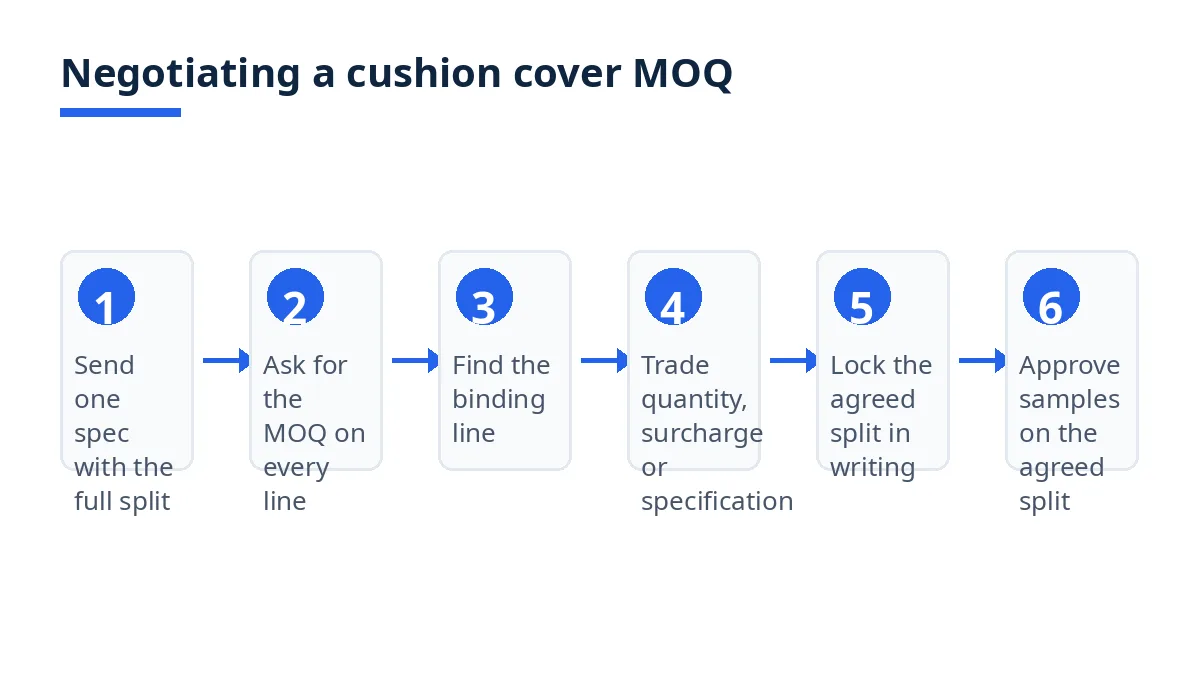
Send one specification with the full split. State cover sizes from your own insert chart, fibre and weave, design, closure type and position, piping or trim, colourway list, labelling and packing, with quantities per design, colour and size. A total without a split cannot be answered with a usable MOQ.
Ask for the MOQ on every line. Ask separately for the minimum per design, per colour and dye or print lot, per size, per closure and trim, per label and carton run, and for the insert if you are buying cover-with-insert — and which line is binding for your split.
Find the binding line. Compare your split against each line. The binding line is the one your smallest cell fails by the most, or the one whose fix costs you least. Most negotiations fail because buyer and factory argue about the total while the binding line sits untouched in one colour.
Trade quantity, surcharge or specification. Offer one lever — fewer colourways, a stock fabric, a shared ground colour, a standard zip, a surcharge, or a phased commitment — and ask for the revised minimum on the binding line only.
Lock the agreed split in writing. Record the revised minimum, any surcharge, the exact split it applies to, and what happens if one cell drops out, on the quotation and purchase order.
Approve samples on the agreed split. Order a development sample, then a pre-production sample in your actual fabric, colour, closure and labels. Work the closure repeatedly, fit the cover over its insert, and approve or list corrections.
Agree inspection and delivery term before you confirm. Write the inspection plan into the purchase order and state one delivery term and named place for every quotation. The Incoterms 2020 rules set out 11 rules with a clear allocation of cost, risk and obligations.2
Costs, timelines and documents
What sets the cost
There is no typical cushion cover cost: it follows your design, colourway count, size range, closure and packing, not the order total alone. Product costs cover fabric, dyeing or printing, embroidery, cutting and sewing, closures and trims, finishing and packing. Set-up costs sit apart: print screens, embroidery digitising, dye-lot work, label and carton print runs and artwork charges. A small-lot surcharge, where offered, is a third line: it prices the set-up your short run does not absorb. Keep the three groups separate on the quotation, so you can see whether a lower quantity is priced through the surcharge, a higher unit price, or both.
Example figures: one offer for the same cover at the same total quantity may look cheaper per cover but turn dearer once a per-colour surcharge on two slow colours is added, while the other carries no surcharge but a higher unit price across all colours. The example shows structure only, not a typical price, surcharge or MOQ. Compare offers only on the same specification, split and term.2
What sets the timeline
Timelines run in stages, not as a single delivery week. Ask for separate dates for fabric ready, dye or print ready, sample approval, production, inspection and shipment. Removing a colourway or switching to a stock fabric can shorten the fabric-ready date more than any later expediting request, because it removes a lot from the chain. Adding a surcharge while keeping six dyed-to-order colours shortens nothing.
Which documents sit in the order file
The order documents are the specification sheet with the agreed split, the itemised quotation showing the MOQ on every line, the purchase order carrying the revised minimum and any surcharge, the sample approval record, and the inspection plan. The export set is separate: goods may not be loaded for export unless an export declaration, the Bill of Export or Shipping Bill, is submitted to Customs and approved, and the enclosed documents include the export contract or purchase order where there is no export letter of credit, the commercial invoice, the packing list, the EXP form certified by an authorized dealer, and a certificate of origin issued by the EPB or a Chamber of Commerce and Industry.3 Keep the split identical across all of them.
Bangladesh-specific rules and tips
Confirm the fabric route before you argue the minimum. A factory that weaves or holds its own fabric controls the dye lot, while a factory that buys fabric in inherits its supplier's width and lot minimum. Ask which route applies, and whether a stocked width or colour would carry a lower floor.
Treat the insert as a separate negotiation. A cover-with-insert order adds fill, an insert casing and a second packing line, each with its own minimum. If the insert is the binding line, buy cover-only and inserts separately, or standardise one insert size across several cover sizes. Do not let an insert minimum quietly set the cover minimum.
Settle labelling at sampling stage for each market. In the EU, Regulation (EU) No 1007/2011 covers textile fibre names and related labelling and marking of the fibre composition of textile products.4 Agree the fibre wording at sampling stage and check that the percentages match the fabric you bought. In the UK, heading 6304 covers other furnishing articles excluding those of heading 9404, with cotton covers under subheading 6304 92 and separate lines for synthetic fibres and other textile materials.5 Keep the code per item in the order file. See the HS code for cushion covers guide for the classification detail.
Agree the inspection plan before production, not at the packing table. ISO 2859-1:2026 defines acceptance sampling plans for inspection by attributes, indexed by acceptance quality limit (AQL) for lot-by-lot inspection; AQL is the maximum average percentage of defective items considered acceptable during random sampling.6 Write the level and AQL values into the purchase order so a short, negotiated run is inspected to the same plan as a large one. A lower MOQ is not a lower quality bar.
Keep one legal name across every paper. The export declaration names the exporter and the foreign buyer,3 so a mismatch between the quotation, the proforma invoice and the payment account can hold up clearance after the goods are packed. The revised split on the purchase order must match the split on the invoice and packing list, cell by cell.
Mistakes and red flags
Which mistakes repeat most often
Asking for a total MOQ only. The binding minimum is usually per colour, per print or per size. An order can clear the total and still fall below the per-colour dye minimum for one colour, which then carries a surcharge or removal. Always ask for the lines underneath the total.
Comparing MOQs on different specifications. A lower minimum on a stock fabric, a hidden zip instead of an exposed one, stock labels or a different delivery term is a different offer. Compare only replies to the same specification, split and term.2
Accepting a verbal exception. A lower minimum agreed in conversation, without the split it applies to, is routinely lost when the order is entered. Record any agreed lower minimum, shared dye lot, waived set-up or surcharge on the quotation and purchase order, with its split.
Negotiating the quantity but not the cells. Cutting the total while keeping six colours and four sizes leaves the binding cells untouched and the factory's answer unchanged. Cut cells first: colours, sizes or designs. The total follows the cells, not the other way around.
Treating a profile or a badge as negotiation protection. A profile is a starting point for enquiries. Exportain verification is a document and photo review, not a factory inspection.7 Your protection is the specification, the written MOQ lines, the sample approval and the inspection plan in your own order file.
Red flags in a supplier reply. A reply that will not state its minimum per colour or per size, will not say which line is binding, will not put an exception in writing, or quotes a minimum without asking for your split is a reply to pause on. So is one that promises any quantity at the same unit price with no surcharge and no specification change: something in that offer is not what you specified.
Checklist
Before you confirm a cushion cover order at a negotiated MOQ, answer every line in writing.
Specification sent as one document: sizes, fibre, design, closure, trim, colourways, labels, packing.
Quantity stated per design, per colour and per size, not only as a total.
MOQ received on every line: design, colour, size, trim, labels, cartons, insert if included.
Binding line identified, and by how much your split fails it.
Lever chosen and priced, with the revised minimum on the binding line.
Agreed exception written on quotation and purchase order, with its exact split.
Samples approved in writing on the agreed split.4
Inspection plan written in: level and AQL values.6
Delivery term stated once, on every quotation.2
Export set agreed: invoice, packing list, EXP form, certificate of origin, Bill of Export.3
One legal name across quotation, invoice, payment account and declaration.3
How Exportain helps
On Exportain, browse suppliers and post a request for quotation (RFQ) on the RFQ board with your specification and full split — quantities per design, colour and size — so suppliers quote MOQ lines against the same cells instead of a bare total. Ask each reply for its binding line, stock-fabric options, and the surcharge or specification change that would move that line.
Read the badges for what they record. Exportain verification is a document and photo review, not a factory inspection, and membership plans never grant a trust badge.7 It is not a substitute for the specification, the written MOQ lines and the inspection plan in your order file.
FAQs
What should I know first about cushion covers?
Know first that a cushion cover is an unfilled furnishing article in heading 6304, not a stuffed cushion, and that its MOQ is set per design, per colour and per size rather than as one order total.1 Send the full split, ask for the minimum on every line, and find the binding line before you negotiate anything.
What are the typical costs and timelines?
There are no typical figures a buyer can rely on, because each factory prices your fabric, dye or print lot, embroidery, closures, labels, cartons and delivery term for your specification.2 Costs split into product, set-up and any small-lot surcharge lines; timelines split into fabric-ready, sample, production, inspection and shipment dates. Compare offers only on the same specification, split and term.
Which documents are needed?
The order documents are the specification sheet with the agreed split, the itemised quotation showing the MOQ on every line, the purchase order carrying the revised minimum and any surcharge, the sample approval record and the inspection plan. The export set is the Bill of Export, commercial invoice, packing list, EXP form certified by an authorized dealer, and a certificate of origin issued by the EPB or a Chamber of Commerce and Industry.3
What are the most common mistakes?
The most common mistakes are asking for a total MOQ only, comparing MOQs on different specifications, accepting a verbal exception, cutting the total while keeping every colour and size, letting an insert minimum quietly set the cover minimum, and reading a badge as protection: verification is a document and photo review, not a factory inspection.7
Next steps on Exportain
Browse suppliers, then post your specification with its full per-design, per-colour and per-size split on the RFQ board so suppliers state their MOQ lines and binding line. Before you confirm, read the MOQ guide.
Sources
- Customs Ruling HQ 953003 - Classification of a pillow shell and a cushion cover; pillow shell is classifiable in Heading 6307; cushion cover is classifiable in Heading 6304. U.S. Customs and Border Protection (accessed )
- Incoterms® 2020. International Chamber of Commerce (ICC) (accessed )
- Customs Clearance Procedures for Export. Bangladesh Customs, National Board of Revenue (accessed )
- Regulation (EU) No 1007/2011 on textile fibre names and related labelling and marking of the fibre composition of textile products. European Union, (accessed )
- Other furnishing articles, excluding those of heading 9404: UK Integrated Online Tariff, heading 6304. GOV.UK, HM Revenue and Customs (accessed )
- ISO 2859-1:2026 — Sampling procedures for inspection by attributes — Part 1: Sampling schemes indexed by acceptance quality limit (AQL) for lot-by-lot inspection. ISO (accessed )
- Supplier verification: Earn trust badges buyers can see. Exportain (accessed )
About the author
Sourcing from Bangladesh?
Post a request for quotation and suppliers on Exportain can send you their quotes directly.
Post an RFQ


