

Top Cushion Covers Manufacturers in Bangladesh: How to Find and Verify Them
Judge cushion covers manufacturers in Bangladesh by eight verification checks, not by ranking: fabric, print, closures, samples, certificate scope, capacity, packing and terms.
Short answer
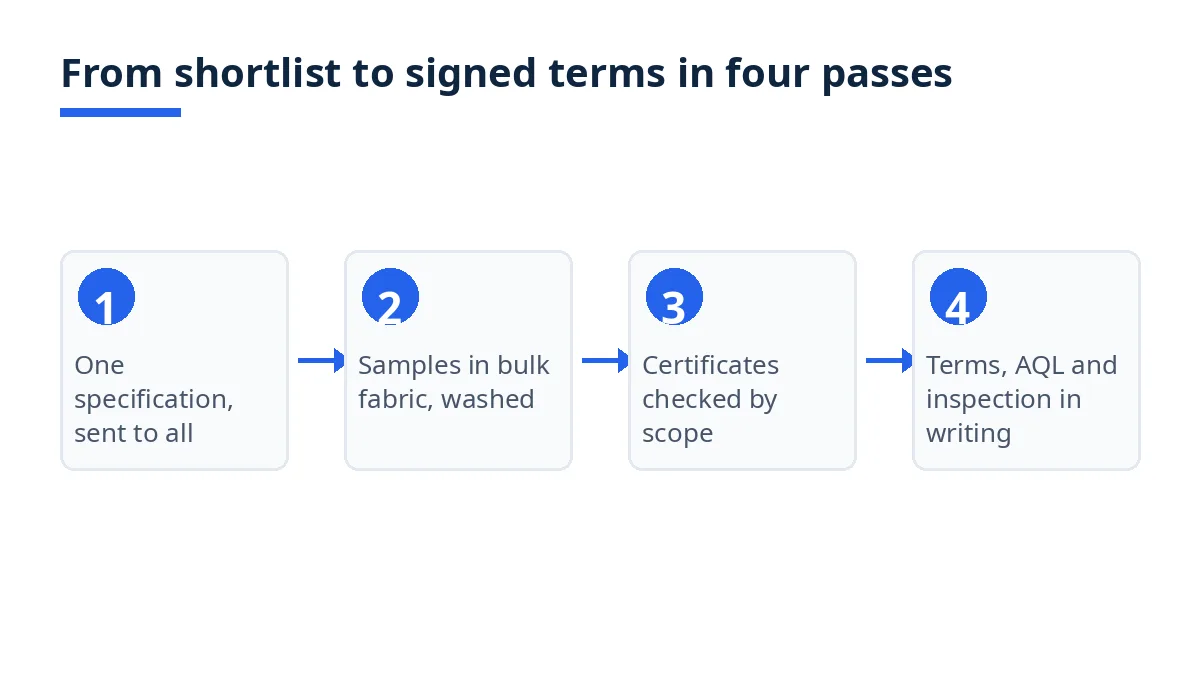
Cushion covers manufacturers in Bangladesh should be chosen by eight verification checks, not by ranking or price alone: fabric and construction evidence, print and embroidery durability, zip and closure function, sample discipline in the bulk fabric, certificate scope and dates, capacity and subcontracting transparency, packing and labelling readiness, and comparable written quotation terms. Run the checks in order, approve a washed pre-production sample, and put the producing site and inspection rule in the order terms before paying.

On this page
Key takeaways
Judge a cushion cover supplier by evidence for eight criteria: fabric and construction, print and embroidery, closures and trims, sample discipline, certificate scope, capacity and subcontracting, packing and labelling, and quotation terms.
A certificate, a sample and a low quote each prove only one thing: a tested article for a set period, one piece, and a price for a stated specification.
Send one written specification to every supplier you quote, approve a pre-production sample in the bulk fabric, and put the inspection rule and the producing site in the order terms.
Exportain badges record document and photo checks reviewed by the Exportain team; they are not factory inspections or quality guarantees.
A buyer looking for cushion covers manufacturers in Bangladesh faces a wide supply base, not a short shortlist. Bangladesh's garment exports reached US$10,578.56 million in the first quarter of fiscal 2026-27, and home textiles grew 11.94 per cent in the same quarter, according to Export Promotion Bureau (EPB) data.1 2 Many suppliers can show a cover photo, but fewer can show consistent fabric, print, closure and packing quality across a full order. This guide turns that selection problem into eight checks you can run on any supplier, in order, before you pay a deposit. It names no factories and ranks none, because the check, not the name, is what protects your order.
Key points to take away
Judge a cushion cover supplier by evidence for eight criteria: fabric and construction, print and embroidery, closures and trims, sample discipline, certificate scope, capacity and subcontracting, packing and labelling, and quotation terms.
A certificate, a sample and a low quote each prove only one thing. A certificate proves a tested article for a set period, a sample proves one piece, and a quote proves a price for a stated specification.
Send one written specification to every supplier you quote, approve a pre-production sample in the bulk fabric, and put the inspection rule and the producing site in the order terms.
Exportain badges record document and photo checks reviewed by the Exportain team. They are not factory inspections or quality guarantees.3
The list: eight checks for cushion covers manufacturers in Bangladesh
The eight checks below are the list. Work through them in order: the first four test the product, the next two test whether the supplier can repeat it, and the last two test whether the order arrives as agreed. A supplier that fails an early check does not earn a pass on a later one, however good its price looks.
1. Fabric and construction evidence
What to check. The fabric type, weave, weight and composition for the cover, the seam type and stitch density, the lining if one is specified, and the finished size after washing. Ask for the fabric specification in writing and a cutting of the bulk fabric, not only a finished sample from a different lot.
Why it matters. A cushion cover that looks right on a sample can still shrink, skew or fade once it is washed, because the sample fabric and the bulk fabric were never the same. Construction faults hide in plain sight: an uneven seam or a puckered seam only shows when the cover is turned, filled and measured against your size chart.
How to fix a gap. If the supplier cannot state the fabric specification or supplies a sample in a different fabric, stop and ask for a new sample in the bulk fabric before discussing price. Write the size, seam and shrinkage tolerances into the specification.
2. Print and embroidery durability
What to check. The print method and the embroidery stitch count and thread type, the artwork placement measured from fixed points on the cover, and the result after washing. Approve a strike-off on the production fabric, and wash it under the care conditions you will print on the label.
Why it matters. Print and embroidery fail after washing, not on the table. A print that cracks, an embroidery edge that frays or a motif that sits off-centre is a fault a buyer discovers too late, after shipment. Placement measured from a seam or a zip, rather than judged by eye, is what makes the check repeatable.
How to fix a gap. If the decorated sample has not been wash-tested, ask for a washed strike-off before approving bulk production. Agree who owns the screens and embroidery files if you change supplier later, and state that in the order terms so a repeat order does not start from scratch.
3. Zip, closure and trim function
What to check. The zip or closure type, its length and tape colour, the puller and stop strength, and the function of every trim on the cover: buttons, ties, piping and tassels where specified. Open and close each closure repeatedly on the sample, and check that the closure sits flat when the cover is filled.
Why it matters. Closures carry the daily use of a cushion cover, and a weak zip or a mismatched trim is the fault a customer meets first. A zip that snags or piping that twists after filling will generate returns even when the fabric and print are perfect.
How to fix a gap. If a closure fails repeated operation on the sample, change the closure specification rather than accepting a repair on the sample alone. Ask the supplier to state the closure supplier and type in the specification, and include a spare-trim quantity in the order where trims are detachable.
4. Sample discipline
What to check. A clear sample sequence: a proto sample for shape and construction, a pre-production sample in the bulk fabric with bulk trims, and a sealed reference sample kept by both sides. Each sample should arrive with a measurement sheet, and each approval should be written and tied to a sample reference number.
Why it matters. Sample discipline is the chain that links what you approved to what ships. Without a pre-production sample in the bulk fabric, the factory is effectively approving itself, and without a sealed reference sample, a dispute becomes one side's memory against the other's.
How to fix a gap. If the supplier sends only a sales sample and presses for a deposit, hold the deposit until the pre-production sample arrives in the bulk fabric and passes your measurement and wash checks. Refuse verbal approvals on both sides: a short written approval with the sample reference costs minutes and settles most later disputes.
5. Certificate scope, not certificate presence
What to check. The exact scope of any certificate the supplier claims: the certificate number, the holder name and site address, the article group and product class covered, and the expiry date. Check the number with the issuing body rather than accepting a scanned copy at face value. For OEKO-TEX STANDARD 100, the certificate is valid for 12 months and can be renewed annually, and the label is awarded only when all components of an item meet the criteria, not when a single component does.4
Why it matters. A certificate for yarn, for a different factory site or for a different product class does not cover your finished cushion cover. Cushion covers sit in the furnishing-materials class for OEKO-TEX purposes, so a certificate written for another class is a mismatch even when the document is genuine. A certificate that lapsed before production covers nothing in your shipment.
How to fix a gap. If the scope, site or dates do not match your order, ask the supplier to confirm in writing whether the existing certificate covers your order or whether new testing is required, and get that answer before production. Where a claim is central to your retail customer, make the certificate number and scope part of the order terms, not an email attachment.
6. Capacity and subcontracting transparency
What to check. Which stages the supplier runs itself and which it subcontracts: cutting, sewing, printing or embroidery, and packing. Ask for the producing site to be named for each stage, and for the order terms to name it too.
Why it matters. Quality control follows the site, not the sales office. A cover sewn in one place, printed in another and packed in a third has three chances for a handover fault. Subcontracting is not itself a fault, but hidden subcontracting is, because it removes the buyer's ability to check the work.
How to fix a gap. If the supplier will not name the producing site, treat that as a failed check, or make the named site a condition of the order. Do not accept a promise to confirm the site after the deposit is paid, when your leverage is gone.
7. Packing, labelling and barcode readiness
What to check. The retail pack and carton pack: the bag or box type, the pieces per carton, the carton markings, the care label wording and the barcode or label format your retailer requires. Pack one carton exactly as it will ship, and check that the label on the cover, the label on the pack and the carton marking all state the same size, colour and quantity.
Why it matters. Packing and labelling faults are expensive because they are discovered at the retailer's warehouse, after freight is paid. A wrong care label or a carton count that does not match the packing list can hold up a delivery, and relabelling at destination costs far more than a correct label at the factory.
How to fix a gap. If the supplier cannot produce a packed carton sample or a label proof, ask for both before bulk packing starts, and approve the label artwork in writing. State the pieces per carton and the marking format in the specification, and check the first packed cartons against it during inspection rather than at the port.
8. Quotation comparability and written terms
What to check. That every shortlisted supplier quotes the same specification, the same quantity and colour split, the same Incoterm and the same packing, so the prices can be compared line by line. Check that the quotation states unit price, minimum order quantity (MOQ), lead time, Incoterm, payment terms and validity, and that the order terms add the inspection rule. On Exportain, quotations are versioned with those fields, so two suppliers can be compared on the same fields rather than on email text.5
Why it matters. A cheap quote often leaves something out: a lighter fabric, fewer print placements, a different delivery term or no inspection provision. Example figures: two quotes for the same cover specification, one stating the bulk fabric weight and one omitting it, are not two prices for one product, and the gap between them is not a saving.
How to fix a gap. If a quote omits a field, ask for a revised versioned quote on the same basis before comparing. Set the inspection rule before production: ISO 2859-1 provides sampling schemes indexed by acceptance quality limit (AQL) for lot-by-lot inspection, so an inspector can accept or reject a shipment against a published rule instead of an opinion.6 Agree inspection and shipment conditions in writing before settling payment.5
Summary table
Check | What it proves | Fail it and you risk |
|---|---|---|
Fabric and construction | The bulk fabric and build match the specification | Shrinkage, skew and seam faults after washing |
Print and embroidery | Artwork survives washing and sits in place | Cracking, fraying and off-centre motifs |
Zip, closure and trims | The cover works through daily use | Snagging zips and detached trims |
Sample discipline | The approved sample is the shipped product | Silent substitution of fabric or trims |
Certificate scope | The claim covers your article, site and dates | A genuine certificate for the wrong product |
Capacity and subcontracting | The named site makes your covers | Unchecked work at an unknown site |
Packing and labelling | The delivery passes the retailer warehouse | Held deliveries and relabelling costs |
Quotation terms | Prices compare like with like, terms in writing | Paying later for what the quote omitted |
How Exportain helps
Exportain is a B2B marketplace for sourcing from Bangladesh. Buyers search published products by keyword and category, and can filter by Exportain Verified badge, sample availability and OEM or ODM capability, and sort by MOQ or lead time.5 Each supplier profile shows its verification level, location, main products and the certifications the supplier has declared.5 Buyers then post a request for quotation (RFQ) stating quantity, target price, destination, Incoterm, required certifications and deadline, and suppliers in that category quote against it.5
Use the badges as a starting filter, not a conclusion. Verification on Exportain is a document and photo review by the Exportain team, not a factory inspection, and membership never grants a badge.3 Run the eight checks above on your shortlist, and keep the exchange in the RFQ and message thread so the agreed terms are recorded. For the ordering steps that follow, read the guide to how to import cushion covers from Bangladesh, and for inspection detail, the cushion covers quality control checklist.
FAQs
What is the biggest mistake?
Choosing a supplier on a cover photo and a headline price before running the eight checks. A photo proves one cover looked good once, and a price without a specification proves nothing about the fabric, print, closure or packing you will receive.
How can I avoid it?
Send one written specification to every supplier, covering fabric, construction, print, closures, packing and labelling, and compare only quotes written against it. Approve a washed pre-production sample in the bulk fabric, check any certificate by scope, site and dates, and put the producing site, the inspection rule and the payment conditions in the order terms before you pay a deposit.
Who is responsible?
Both sides, at different points. The supplier is responsible for making covers to the agreed specification and the approved sample, at the named site. The buyer is responsible for making that specification complete, approving the right sample, and inspecting against it before shipment. When a dispute starts, the side with the written specification, the sealed sample and the inspection report is the side whose version counts.
Where can I get help?
Start with the records that exist: the certificate issuer for any claim, an inspection provider for the pre-shipment check under the AQL rule you agreed, and the Exportain guide to how supplier verification works on Exportain for what each badge does and does not cover.4 6 3 For the classification of the covers, the HS code guide for cushion covers explains how the heading is confirmed.
Next steps on Exportain
Browse Bangladeshi suppliers and filter cushion cover listings by badge, MOQ and OEM or ODM capability. Before you order, read how supplier verification works on Exportain so you know what each badge covers. Then post a free RFQ with your cover specification, quantity, destination and Incoterm, and compare the versioned quotations on the same basis.
Sources
- RMG exports rise 6.10pc to US$10.58b in July-Sept of FY27. The Financial Express, (accessed )
- Exports up over 6% to $13.1bn in Q1 of FY27. Dhaka Tribune, (accessed )
- Supplier verification: Earn trust badges buyers can see. Exportain (accessed )
- OEKO-TEX STANDARD 100 for textiles tested for harmful substances. Hohenstein (accessed )
- How to source and buy from Bangladesh. Exportain (accessed )
- ISO 2859-1:2026 — Sampling for Inspection by AQL. American National Standards Institute (ANSI) (accessed )
- supplier verification
- pre-shipment inspection
- quality control
- buyer guide
- Bangladesh sourcing
- home textiles
About the author
Sourcing from Bangladesh?
Post a request for quotation and suppliers on Exportain can send you their quotes directly.
Post an RFQ


