

Curtains Lead Time From Bangladesh: Production and Shipping Timeline
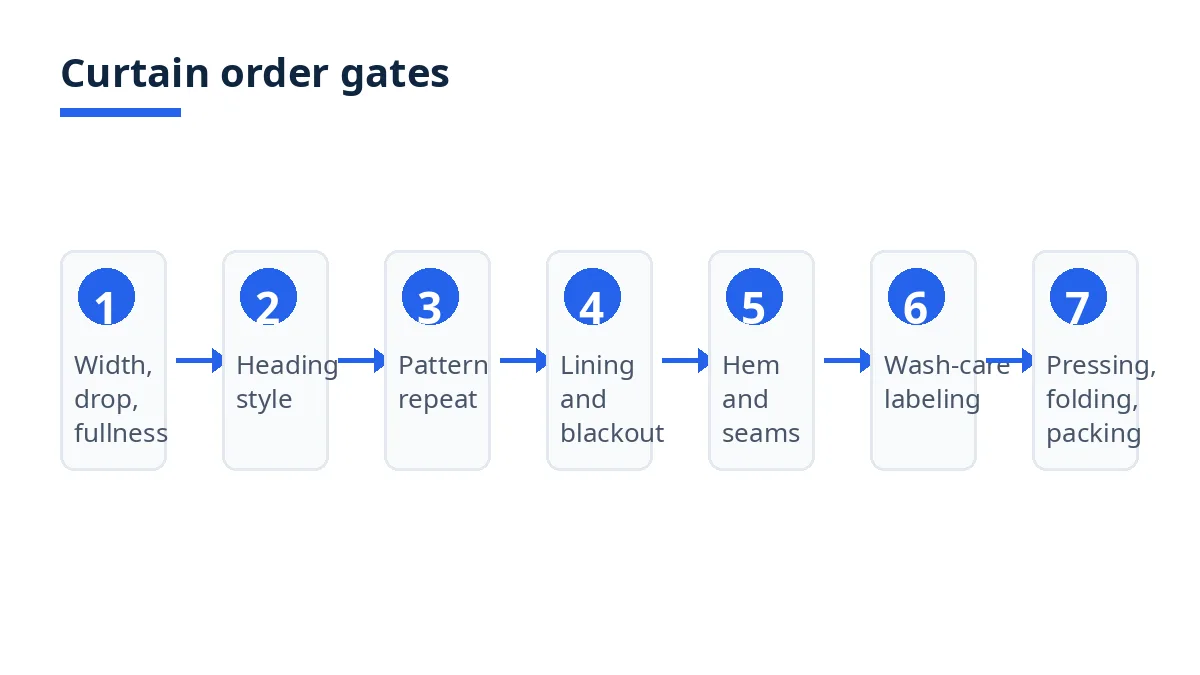
Plan a curtains lead time from Bangladesh by approval gates: width and drop, heading, pattern repeat, lining and blackout, hem and seams, wash-care labeling, then pressing, folding, inspection, documents, and loading.
Short answer
A curtain lead time from Bangladesh runs on approval gates, not a single production run: width, drop, and fullness, heading style, pattern repeat matching, lining and blackout layer, hem and side-seam finishing, wash-care labeling, then pressing, folding, inspection, export documents, and loading. Every duration is an illustrative planning example only. Replace it with the dated figures in the written quote and the dated forwarder estimate before setting a selling date.

On this page
Key takeaways
A curtain order runs on approval gates in a fixed order: width, drop, and fullness before heading approval, heading before pattern repeat approval, repeat before lining approval, lining before hem and labeling approval, and hem and labeling before pressing, folding, inspection, and packing.
State the heading with its hardware in writing: grommet panels suit poles only, pinch pleat panels suit poles and tracks, and rod pocket panels suit poles only, with ring or hook size and rod or track diameter named, and test the heading on a hanging sample drawn open and closed.
Approve pattern repeat as a hanging pair, not as one drop: round the cut drop up to a complete vertical repeat, start every panel at the same point in the design, and check motif alignment across each join side by side.
Approve blackout as a lined hanging panel with each edge gap measured, approve hems only after pressing with a hanging check on both panels, approve labels for face fabric and lining together on a finished folded panel, and read every duration as an illustrative planning example to replace with the dated written quote and forwarder estimate.
A curtain order from Bangladesh is decided at the heading, at the drop, at the pattern repeat, at the lining, at the hem, and at the fold. A pair that measures correctly on paper can still fail when the heading does not fit the rod or track, when one panel hangs longer than the other, when a motif staggers across the center join, or when a label states a method the curtain cannot survive. This guide reads a curtain order through gates in a fixed order, so a buyer can see which decision is holding the order. Every duration here is an illustrative planning example only, or an item to confirm in the written quote and the dated forwarder estimate.
Why this matters for buyers
A curtain is judged hanging, in a pair, and in motion, not flat on a table and not alone. Width, drop, and fullness fix fabric quantity. The heading fixes hang and movement. The pattern repeat fixes whether the pair reads as one design. The lining fixes light blocking and rod load. The hem fixes straight hang after pressing. The label fixes safe care. Pressing, folding, and packing fix what arrives in the carton.
The hardware is part of the product decision. Grommet curtains use metal rings, or eyelets, punched into the top header, and those rings let the panels slide easily on the rod, creating soft, even folds.1 Pinch pleat curtains gather fabric into pleats at regular intervals, secured with pins or hooks, and hang in structured, vertical pleats suited to formal settings.1 Rod pocket curtains carry a sleeve of fabric at the top that hides the rod and gives a gathered, casual look, but they move less freely when drawn.1 A heading approved without its rod or track diameter, ring size, and hook type is not approved at all.
Step-by-step: how it works
Read a curtain order against seven gates, in this order.
Gate 0: Width, drop, and fullness
Gate 0 fixes the window math before cutting: usable pole or track width excluding finials, finished drop, fullness, usable fabric width, and panel count. The essential measurements are the pole or track width, finished curtain drop, fabric width, fullness, making allowance, and vertical pattern repeat.2 Double fullness means using approximately twice the pole or track width before the heading is formed.2 Gate 0 closes when the width count is rounded up to a whole width, never down. A planning example is 2 to 4 days for confirmation and a written calculation.
Gate 1: Heading style
Gate 1 approves the heading as a working fitting, not as a style name. Grommet panels suit poles only, and the eyelet size limits which rod diameters fit.1 Pinch pleat panels suit both poles and tracks, but need precise installation to hold their structured look.1 Rod pocket panels suit poles only and work best where panels stay largely in place, since the gathered fabric moves less freely.1 Gate 1 closes on a hanging sample drawn open and closed, with heading, ring or hook size, and rod or track diameter named in writing. A planning example is 3 to 6 days for that sample.
Gate 2: Pattern repeat matching across panels
Gate 2 approves the pattern as a pair, not as a single drop. For patterned fabric, the cut drop usually needs to be rounded up to a complete pattern repeat so adjacent widths can be matched, and this is why two fabrics for the same window can require different meterage.2 A worked example makes the cost visible: pole width 240 cm, fullness 2 times, usable width 137 cm, finished drop 220 cm, making allowance 30 cm, and vertical repeat 64 cm give a raw cut drop of 250 cm, a matched cut drop of 256 cm, and 10.24 meters across four widths, against 10 meters without matching.2 Gate 2 closes when every panel starts at the same point in the design and the pair is checked hanging side by side. A planning example is 4 to 7 days for a matched pair sample.
Gate 3: Lining and blackout layer
Gate 3 approves the lining as a separate layer with its own calculation, weight, and care rule. Face fabric, lining, and interlining are normally calculated separately because their widths, construction, and allowances may differ, and a plain lining will not usually need the same pattern-matching allowance as the face fabric.2 A blackout lining is designed to significantly reduce incoming light, while the final result still depends on installation details such as track position, overlap and returns, and light gaps around edges.3 Gate 3 closes when lining type, weight, attachment method, and light test are written, and a lined panel is checked hanging with each edge gap measured. A planning example is 4 to 7 days for a lined hanging sample.
Gate 4: Hem and side-seam finishing
Gate 4 approves the bottom and the sides after pressing, not before. The cut drop already includes heading and hem allowances, and the correct allowance depends on the heading and construction method, so one standard allowance must not be carried from another project.2 Gate 4 therefore has two checks: a pre-press check of hem depth, side-seam straightness, and weight placement, and a post-press check of the same panel hanging. Gate 4 closes when hem depth, hem method, side-seam finish, and weights are written and the post-press hanging check passes on both panels. A planning example is 3 to 5 days for the two checks in bulk.
Gate 5: Wash-care labeling
Gate 5 fixes the label wording, position, and care method as a buyer-spec item. Labels for garments exported from Bangladesh carry required information such as size, material composition, care instructions, and country of origin.4 For curtains, the same four items apply, but the face fabric and the lining may need different care, so the label must state the method safe for both layers together. A listed blackout lining example states care of 30 degrees wash, no bleach, no tumble dry, and cool iron at 110 degrees on the non-coated side only.3 Gate 5 closes when label wording, fiber content, size marking, country-of-origin marking, and care symbols are approved in writing and checked on a finished, folded panel. A planning example is 2 to 4 days for that approval.
Gate 6: Pressing, folding, and packing as a stage
Gate 6 runs bulk production only after Gates 0 to 5 have closed, and it ends with pressing, folding, inspection, and packing treated as one stage. Pressing sets the hang, folding sets the crease pattern on opening, and packing sets carton volume and the freight basis, because a folded pair and a rolled pair do not fill a carton the same way. The buyer states the fold method, pairs per polybag and per carton, assortment per carton, and carton marking, and checks a packed carton against that standard. Final inspection measures packed panels against the approved samples, and panels that fail stay out of the packed cartons. A planning example is 5 to 10 days for bulk pressing, folding, inspection, and packing.
Costs, timelines and documents
The table below is a stage framework only. Every figure in the middle column is an illustrative planning example, not a promised date or price. Replace each figure with the dated figure in the written quote and the dated forwarder estimate before setting a selling date.
Stage | Illustrative planning example only | Gate that closes the stage |
|---|---|---|
Window math and width calculation | 2 to 4 days | Gate 0 |
Hanging heading sample | 3 to 6 days | Gate 1 |
Matched pair sample | 4 to 7 days | Gate 2 |
Lined hanging sample | 4 to 7 days | Gate 3 |
Pre-press and post-press hem checks | 3 to 5 days | Gate 4 |
Label approval on a finished panel | 2 to 4 days | Gate 5 |
Bulk pressing, folding, inspection, and packing | 5 to 10 days | Gate 6 |
Export documents and loading approval | Confirm in the dated forwarder estimate | Gates 0 to 6 and document set below |
Cost moves with the same gates that move time. Fabric cost moves with width count and repeat waste, because a matched drop uses more fabric than a plain drop of the same finished size.2 Hardware cost moves with heading choice, because grommets, rings, hooks, and track fittings are not interchangeable. Lining cost moves with the layer chosen and its separate calculation.2 Packing cost moves with fold method and carton volume, because the freight basis follows the packed carton, not the flat panel.5
The export document set starts with the commercial invoice, packing list, bill of lading or air waybill, export declaration form, and certificate of origin.4 For customs clearance in Bangladesh, goods must not be loaded or stuffed in containers for export unless an export declaration, known as a Bill of Export or Shipping Bill, is submitted to Customs in the prescribed format and approved by the Customs authority.6 The enclosed set for all export consignments includes the export letter of credit or approved contract, purchase order, or guarantee, the commercial invoice, the packing list, the EXP form certified by authorized dealers, the certificate of origin, the VAT registration certificate, and the taxpayer identification number.6 Keep one owner and one gate date for each document.
Bangladesh-specific rules and tips
Three Bangladesh rules shape a curtain timeline more than any other single factor. First, the loading rule: approval of the Bill of Export comes before loading, not after, so document preparation must run in parallel with Gate 6, not after it.6 Second, the labeling rule: size, material composition, care instructions, and country of origin must be correct on the label and on the waybill information, because clear and legible labeling helps customs officials and recipients identify and handle the goods correctly.4 Third, the delivery-term rule: for container cargo handed over at a terminal in Bangladesh, the any-mode terms often match the real handover better than the sea-only terms.5 Confirm the rod or track standard at Gate 1 and packed carton dimensions at Gate 6, because the forwarder prices the packed carton.
Mistakes and red flags
The most common mistakes are approving a heading without hardware size, a drop without a hanging pair check, a pattern without a matched pair check, blackout without an edge-gap check, a hem before pressing, a label from face fabric alone, and a fold without a packed carton check. Each mistake reopens its gate and moves the stages after it.
A heading sample shown flat, and never drawn on its rod or track, is not a heading approval. A pattern sample shown as one panel, and never as a hanging pair, is not a repeat approval. A blackout claim shown as a swatch, and never as a lined panel with its edges checked, is not a light-blocking approval. A hem approved before pressing, and never rechecked hanging after pressing, is not a finishing approval. A label or packing plan approved without a finished panel or a packed carton check is not an approval either.
Checklist
Use this checklist at the end of each gate.
Gate 0: pole or track width, finished drop, fullness, usable width, panel split, and whole-width count are written.
Gate 1: heading, ring or hook size, rod or track diameter, and stack-back space are written, and a hanging sample has been drawn.
Gate 2: matched cut drop, repeat start point, and motif alignment are written, and a hanging pair has been checked.
Gate 3: lining type, weight, attachment method, and edge-gap check are written, and a lined panel has been checked.
Gate 4: hem depth, hem method, side-seam finish, and weights are written, and a post-press check has passed on both panels.
Gate 5: label wording, fiber content, size marking, origin marking, and care symbols are written, and a label has been checked on a finished panel.
Gate 6: fold method, pairs per polybag and per carton, carton assortment, and marking are written, and a packed carton has been checked.
Documents: invoice, packing list, EXP form, certificate of origin, and Bill of Export each have an owner and a gate date, and loading waits for approval.6
How Exportain helps
Exportain helps a curtain buyer hold the gate order in one place. A buyer can list the seven gates as written requirements, ask each seller to reply gate by gate, and compare replies on heading, repeat, lining, hem, labeling, and packing, rather than on a single headline date. The suppliers page, the Incoterms guide, and the RFQs page give a starting list, delivery-term wording, and a place to post the gate table.
FAQs
What should I know first about curtains?
Know the window math first, the heading second, and the pair third. Width, drop, and fullness fix fabric quantity. Heading fixes hardware and movement. The pair fixes pattern, lining, hem, and fold as a matched set.
What are the typical costs and timelines?
Costs move with width count, repeat waste, heading hardware, lining layer, and packed carton volume, as set out in the table above, and no figure there is a quoted price. Timelines move gate by gate, with the document and loading stage confirmed only in the dated forwarder estimate. Replace every example range with the dated figure in the written quote and the dated forwarder estimate before setting a selling date.
Which documents are needed?
The core set is the commercial invoice, packing list, bill of lading or air waybill, export declaration form, and certificate of origin.4 For Bangladesh customs clearance, add the Bill of Export or Shipping Bill with the enclosed set listed in the costs section, with loading only after Customs approval.6 Confirm the owner and gate date for each document early, and confirm the delivery term with its named place and edition in the same written quote.5
What are the most common mistakes?
The most common mistakes are approving a heading without hardware sizes, approving a pattern on one panel without a hanging pair check, approving blackout from a swatch without an edge-gap check, approving a hem before pressing, approving a label from the face fabric alone, and approving packing without a packed carton check. Each mistake reopens its gate. Return to the gate, name the missing item in writing, and close it on the sample or carton that gate requires.
Next steps on Exportain
Browse the Exportain suppliers page and compare replies gate by gate.
Read the Incoterms guide for shipments from Bangladesh before agreeing a delivery term.
Post the gate table as a requirement on the Exportain RFQs page and ask each seller to reply against each gate in writing.
Sources
- Choosing Curtains: Grommet, Pinch Pleated, Ring Top, Back Tab, Rod Pocket. Dolcewe (accessed )
- Curtain Fabric Calculator: Cut Drop and Metres Guide. The Millshop Online (accessed )
- Flame Retardant Blackout Lining 274cm Supersoft. Direct Fabrics (accessed )
- How to export garments overseas from Bangladesh. DHL (accessed )
- Incoterms for Shipments From Bangladesh. Exportain (accessed )
- Customs Clearance Procedures for Export. Bangladesh Customs, National Board of Revenue (accessed )
About the author
Sourcing from Bangladesh?
Post a request for quotation and suppliers on Exportain can send you their quotes directly.
Post an RFQ


